Humanoid Robots in 2026: Production Boom and Deployment Myths
More than half of 2026 has passed, and the humanoid robot industry has delivered a seemingly impressive performance report card.
Gan Xiaobin, Vice Director of the Department of Science and Technology of the Ministry of Industry and Information Technology, revealed at the press conference of the World Artificial Intelligence Conference in July that the annual output of complete humanoid robots is expected to exceed 100,000 units this year. The five-fold surge from about 20,000 units in 2025 to 100,000 units in just one year is enough to draw widespread attention from all industrial tracks. Ke Jixin, Vice Minister of the Ministry of Industry and Information Technology, also pointed out that the surge in output sends a clear industrial signal: humanoid robots are accelerating from technical exploration to standardized and large-scale development.
However, behind the carnival of production figures, the real picture of the industry is far more complex than it appears. In the nearly 100,000-square-meter exhibition hall of WAIC 2026, more than 200 complete machine enterprises compete on the same stage, ranging from biped to wheeled, from industrial to consumer, from million-yuan level to ten-thousand-yuan level. This competition has just begun, and the outcome is far from clear.
Dual oligarchs take the lead, but mass production does not equal actual implementation
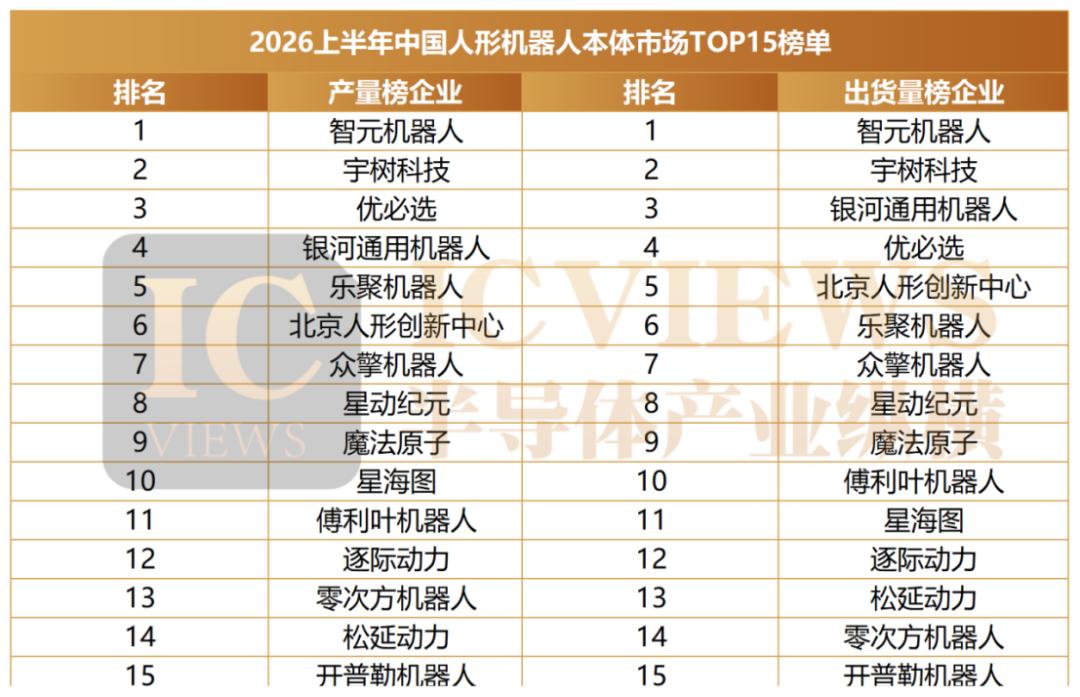
The humanoid robot production ranking list in the first half of the year is clear at a glance. Data from MIR DATABANK shows that Agibot and Unitree have formed a "dual oligarchy" pattern in the track. Agibot announced the offline production of 15,000 robots in early June, while Unitree completed the mass production of about 11,000 units in March.
Source: Sina Weibo screenshot
Agibot's mass production trajectory is at the textbook level. There were only 6 prototypes in 2023, large-scale mass production was launched in August 2024, the number of units exceeded 1,000 in January 2025 and reached 5,000 by the end of 2025, crossed the 10,000-unit mark in March 2026, and exceeded 15,000 units in June. Yao Maoqing, partner of Agibot, pointed out: "Mass production is the core foundation for embodied intelligence to move out of the laboratory and be implemented in the industry." At present, Agibot has formed deployment solutions for seven real scenarios, covering loading and unloading of production lines, industrial handling, logistics sorting, tour guide and shopping guide, service retail, security inspection, and industrial and commercial cleaning.
Unitree is also accelerating its pace. Owen Chen, Asia-Pacific Director of the company, revealed that the total shipment volume this year is expected to at least double compared with more than 6,500 units in 2025, and may even nearly triple. To meet the demand, Unitree plans to expand its annual production capacity to 30,000 units. Until the first three quarters of 2025, more than 70% of Unitree's humanoid robot revenue came from the scientific research and education field, and industrial applications accounted for only 9%, which means that a large number of shipped robots have not really "entered the factory to work" but stayed in laboratories and classrooms. This data reveals a subtle reality: the growth of production figures is not directly equivalent to the in-depth advancement of industrialization.
The MIR list also points out another noteworthy phenomenon: UBTech, which ranks third in production, has slipped to fourth in the shipment ranking. "High production but declining shipment ranking usually means inventory backlog or delayed delivery rhythm." Not all the produced robots have been delivered to customers. UBTech released the world's first mass-producible full-size super-realistic humanoid robot U1 on June 30, with cumulative orders exceeding 13,361 units, and the U1 Pro is priced at 169,800 yuan. However, as a ToC consumer product, this batch of orders is not included in the industry production statistics. The boom on the consumer side and the calm on the industrial side form a sharp contrast.
The temperature difference between production volume and shipment volume essentially reflects the most core contradiction in the current humanoid robot industry: manufacturing capacity has been initially established, but real user demand and a sustainable business closed loop are still under construction.
Differentiation: five enterprises, five survival states
Going deep into the industrial chain, this differentiation can be seen more clearly. At WAIC 2026, the author visited five humanoid robot enterprises with different backgrounds, and their situations almost outline the ecological map of the entire industry.
The State-Local Co-constructed Humanoid Robot Innovation Center is the representative of the pragmatic school. Its humanoid robots have achieved stable commercial implementation in three scenarios: public tour guide, safety inspection, industrial sorting and bin handling, with customers covering automation industries such as electric power and automobiles. The total planned production capacity in 2026 is 5,000 units, the wheeled product is priced at more than 400,000 yuan, and the biped product is priced at more than 600,000 yuan. It is worth noting that the State-Local Center frankly stated that in industrial scenarios, wheeled robots have lower cost, higher stability and better battery life, so the shipment volume of wheeled products will be much higher than that of biped products. This clear understanding of its own product form is not common in the current industry. Public information shows that the State-Local Center, in cooperation with Huawei, has built the country's first demonstration site of embodied intelligence training field, and the pilot test service platform built in cooperation with Shanghai Electric has been fully put into operation, opening the whole chain services of trial production, testing and scenario verification to the whole industry, and has also signed a special contract for the trial production of 1,000 sets of humanoid robots with Zhuoyide. From the perspective of industrial ecology, the State-Local Center's development strategy is more inclined to the construction of platform-based infrastructure, rather than the logic of a pure product company.
Matrix Intelligent Manufacturing takes the high-end biped route. It adopts full-size biped design and dual dexterous hands, and uses linear joints instead of rotary joints, with higher precision and stability. The third-generation general-purpose humanoid robot MATRIX-3 released during WAIC is 1.70 meters tall, weighs 65 kilograms, is equipped with a 27-degree-of-freedom cable-driven dexterous hand, and has a single operation duration of 4 hours. It is priced from 580,000 yuan, with a planned production capacity of 5,000 units in 2026 and cumulative orders of about 1,000 units. However, the product functions are still in the adaptation and debugging stage — high price, small batch, and scenarios not fully finalized. The core logic of Matrix Intelligent Manufacturing is "scenario generalization", which believes that the biped structure can cover most of the spaces that humans can enter without any modification to the environment. This logic is theoretically valid, but the commercial time window and cost curve are still huge unknowns. The company is currently in the rhythm of "determining production according to orders", and there is still a considerable distance from large-scale mass production.
Banxing Embodied Intelligence has taken a different approach, taking the ODM customization route and providing skeleton-style delivery of humanoid robots, with customers customizing the shell and brand by themselves. It is priced at 208,000 yuan, all core components are self-developed, and it has recently completed a new round of financing of tens of millions of yuan, with a monthly production capacity of dozens of units, and the annual revenue is expected to exceed 100 million yuan. This model reflects a certain awkwardness in the industry: customers who really know what they want and have secondary development capabilities do not need to buy complete machines; while customers who want to buy complete machines are often not sure what they can do after buying them back. The practice of Banxing Embodied Intelligence is equivalent to leaving the "last mile" to the customers themselves, but this also means that its business ceiling depends on how many buyers with secondary development capabilities there are in the market. From the on-site communication, the company has a pragmatic attitude towards scenario adaptation, and frankly will not promise customers that "you can use it as soon as you buy it", but truthfully inform the actual capabilities and limitations of the products.
Zhongjian Technology is still lingering in the concept stage. During WAIC, its subsidiary Huazhijian exhibited the conceptual humanoid robot ZERO, and the R&D expenses in the first quarter increased by 291.23% year-on-year. However, according to on-site understanding, ZERO is still in the prototype R&D stage, and specific application scenarios have not yet been clarified. Although the R&D investment is large, the foothold of commercialization is still unknown. It is worth noting that Zhongjian Technology's previous judgment on the industry boom was relatively cautious. In its view, there are still many practical obstacles to the implementation of humanoid robots, and the actual progress of the industry may not be as optimistic as the market expects. This conservative attitude reflects from one side that the attitude towards the "mass production carnival" within the industry is not unified.
Magic Atom has chosen to cut into the market from vertical scenarios. Its traffic duty robot "Xiaomai" has been on duty with official permits to perform traffic diversion tasks at the Wuxi Marathon in April this year. During WAIC, it also released new products such as the flagship full-size humanoid robot MagicBot X1 and the industrial wheeled humanoid robot MagicBot D1. Magic Atom is the one with the most focused scenarios and the clearest customers among the five enterprises. Although the vertical scenario of traffic duty has a limited market size, it has the advantages of real demand, clear willingness to pay, and clear implementation path. In addition, the company is also expanding to industrial and service scenarios beyond the traffic scenarios, trying to replicate the engineering capabilities accumulated in vertical scenarios to a wider range of application fields.
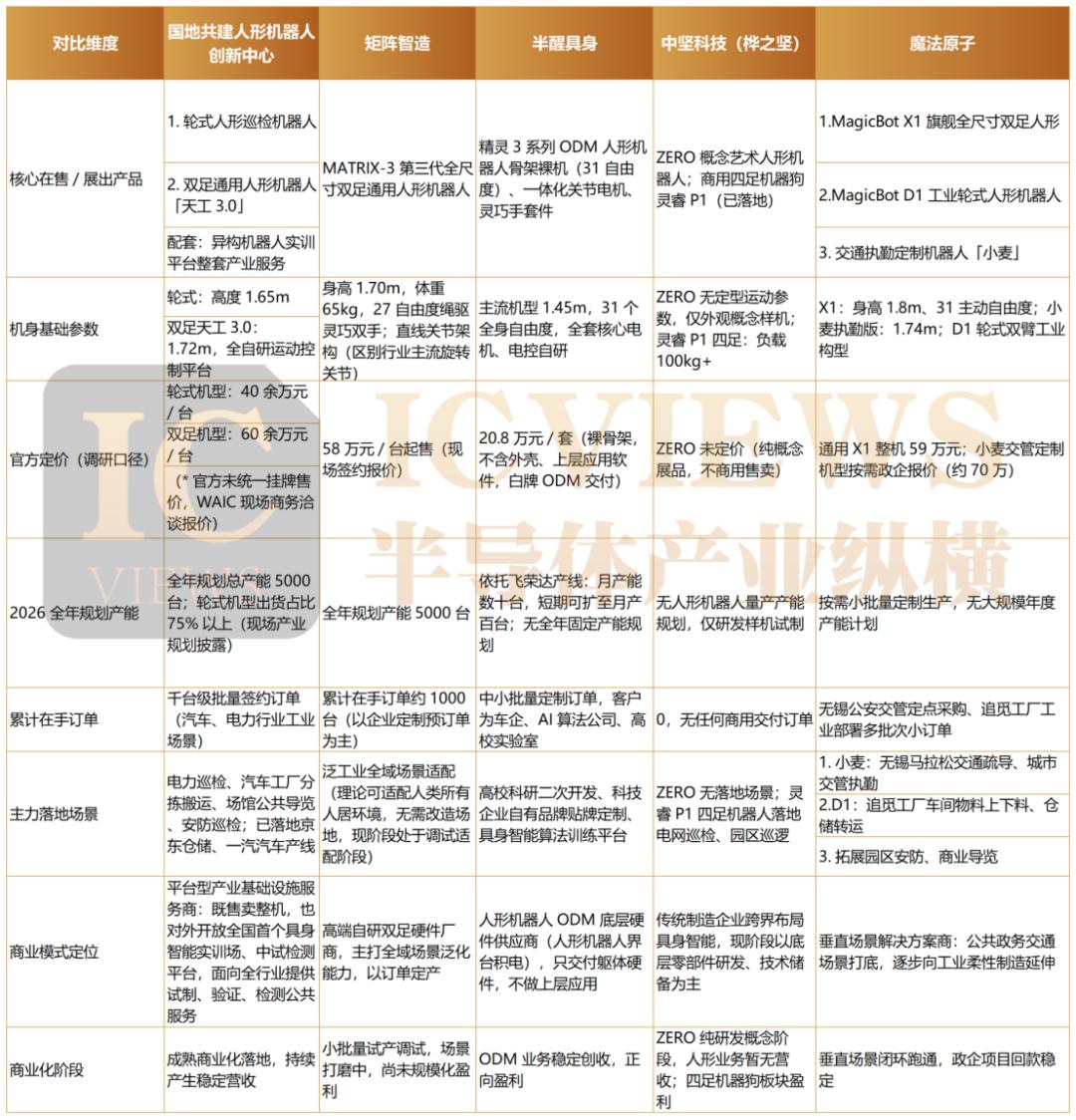
From implemented and revenue-generating to prototype stage, and then to ODM customization, the five enterprises with five situations outline an industry landscape far more complex than "all is well".
Form myth: biped, wheeled or quadruped robot?
Is "humanoid" necessary? This is probably the most basic and most divisive question in the current industry.
The core logic of the biped school is "environmental compatibility". Matrix Intelligent Manufacturing believes that the current human living environment is designed on the human scale. The height of stairs, the width of corridors, the plane position of the operating table, all infrastructure is planned according to the size of the human body. The biped structure can seamlessly access this existing world without any modification to the environment. In contrast, the wheeled solution has higher efficiency on flat ground, but it will be limited when encountering stairs, thresholds and uneven roads; the quadruped solution has advantages in adaptability to complex terrain, but in the daily human environment, two legs are already the "optimal solution" verified by thousands of years of evolution.
However, the pragmatic school has a completely different perspective. The structural stability of quadruped robots is obviously better than that of biped robots, with a lower center of gravity, lower probability of falling, and stronger anti-interference ability. Under the current engineering level, these characteristics mean lower failure rate and higher availability. The shipment data of the State-Local Co-constructed Center also confirms this point: wheeled robots are more widely used in industrial scenarios, and the shipment volume of wheeled products this year is much higher than that of biped products. A more straightforward statement is that the core value of humanoid robots in commercial scenarios lies in meeting emotional needs — such as tour guide, reception, and performance, while in industrial scenarios, the solution of AGV chassis plus robotic arm is already mature and efficient enough. The shipment volume of quadruped robots exceeded 44,000 units in 2025, and the first large-scale "on-the-job" products in the first half of this year were indeed quadruped robots and wheeled dual-arm robots.
These two logics are not necessarily opposite, but they point to completely different time dimensions. Biped is a long-term vision, on the premise that the motion control algorithm is mature enough, the hardware cost is low enough, and the battery energy density is high enough. Wheeled and quadruped are currently available solutions with higher technical maturity, lower cost, and greater possibility of customers being willing to pay. The question is, how many enterprises can survive to the "long term"? If the cash flow cannot last for the next two or three years, no matter how perfect the long-term vision is, it will be meaningless.
From a global perspective, the competition between different technical routes is still ongoing. After Boston Dynamics' Atlas switched to electric drive, it has demonstrated amazing motion capabilities, but its cost structure is still a mystery. Tesla Optimus's mass production target has been delayed again and again, which also to some extent shows that the engineering difficulty of biped humanoid robots far exceeds expectations. In China, Unitree and Agibot have achieved large-scale shipment on the consumer and scientific research sides, but their penetration on the industrial side is still limited. A practitioner's judgment is relatively direct: if biped humanoid robots want to gain a firm foothold in industrial scenarios, at least two core problems need to be solved: battery life and reliability, and there are no satisfactory answers to both at present.
Capital is still pouring in, but money has changed direction
In the first half of 2026, the total financing amount of the embodied intelligence track reached 104.1 billion yuan, nearly double that of the whole year of 2025. Unitree's IPO registration on the Sci-Tech Innovation Board has been approved, ExRobotics has completed nearly 200 million US dollars of Pre-IPO round financing, and the listing applications of Leju Intelligent and Deep Robotics have been accepted one after another, and a wave of listings is accelerating.
However, structural changes have taken place in the capital flow. More than half of the funds have gone to "brain-oriented" companies, and robot body manufacturers have received less than 20% of the funds. Capital no longer pursues the bodies that "can walk and jump", but bets on the brains that "can think and make decisions". The VLA model has taken 42% of the funds, the world model accounts for 27%, and the data infrastructure accounts for 20%. This capital flow itself is a barometer of the industry's bottlenecks. What is really restricting the development of the industry is not the hardware manufacturing capacity, but the intelligence level that enables robots to understand the world and make independent decisions.
This shift points to the most fundamental bottleneck of the industry. VLA (Vision-Language-Action model) is widely regarded as the standard component of the embodied intelligence brain, but to achieve general autonomous capabilities, at least ten million hours of high-quality real interaction data are required. The reality is that as of the beginning of 2026, the total amount of compliant and available robot data in the world is only 500,000 hours, with a gap of more than 99%. At present, most humanoid robots are far from realizing autonomous consciousness, and essentially still rely on manual remote control or preset programs in actual operation. It can be said that the current humanoid robot industry is facing the awkward situation of "having a body but no mind". The motion control (cerebellum) is quite mature, but the perception and decision-making (brain) is still in a relatively primitive stage.
Battery is another physical hard injury. The limited space of the fuselage makes it difficult to carry large-capacity batteries, and the battery life of existing products is generally between 1 and 3 hours. A practitioner calculated an account: a 70-kilogram humanoid robot, just to maintain a standing posture without falling, the hip and knee joints need to continuously output torque to fight gravity, consuming 200 to 300 watts of power. It can run for four or five hours in the laboratory fine-tuning state, but it can only last for one or two hours in the real scene. The improvement rhythm of battery energy density basically follows the laws of physics, and there can be no breakthrough in the short term, which means that the battery life problem will be a hard constraint for biped humanoid robots in the next few years.
The knockout round has already begun
In February 2026, China's first "Humanoid Robot and Embodied Intelligence Standard System (2026 Edition)" covering the entire humanoid robot industry chain was officially released. In June, the Ministry of Industry and Information Technology and the State-owned Assets Supervision and Administration Commission of the State Council jointly launched the annual real-scene