OpenAI officially announced its next-generation model Astra, achieving breakthroughs in 10 major unsolved problems, with a 249-page research paper attached.
All related problems have been open for at least 10 years, with no progress on core conclusions for a long period.
August 2, Zhidx reports, in the early hours of today, OpenAI unveiled the next-generation model Astra, and announced that its internal version has achieved 10 new breakthroughs in mathematics and theoretical computer science, covering fields including high-dimensional geometry, coding theory, group theory, arithmetic circuit complexity, quantum complexity, lattice cryptography, and extremal combinatorics.
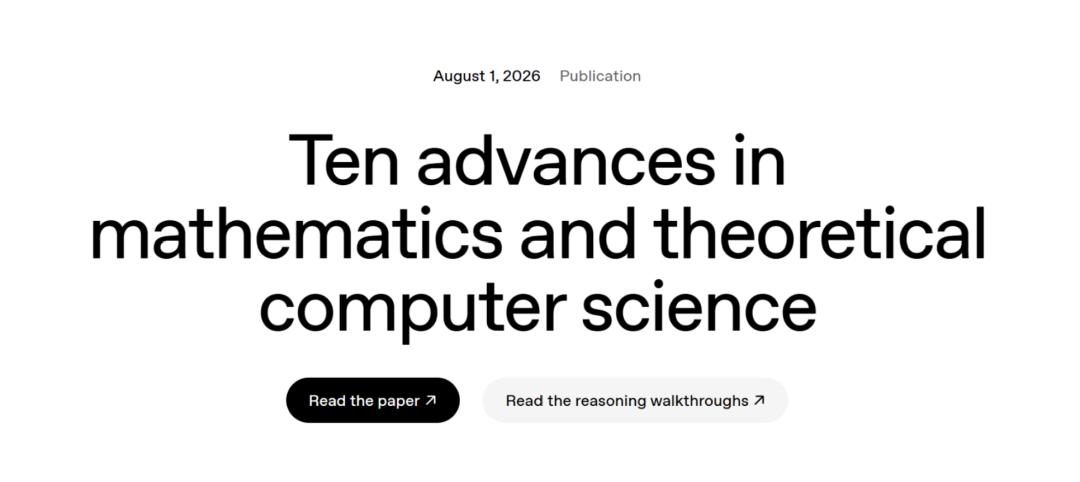
The newly announced results fully demonstrate Astra's capability to explore cutting-edge scientific research problems. All relevant problems have been open for at least 10 years with no progress on core conclusions for a long time, and most of the problems have a much longer research history. Using the same model, OpenAI compiled the proofs into a 249-page paper, accompanied by a separate 62-page document explaining the problem-solving ideas. Calculated at the Sol API rate, the total Token cost for the model to find these solutions is approximately 2,000 US dollars (equivalent to about 13,500 RMB).
Before OpenAI officially announced these results, Astra had already caught the attention of U.S. policymakers. Yesterday, according to a report from The Information, Sam Altman, CEO of OpenAI, previewed Astra this week in Washington, D.C., U.S. for policymakers including White House officials, cabinet members, and members of Congress.
It is worth noting that this is not the first time OpenAI has announced AI-assisted solutions to difficult mathematical problems. In May this year, OpenAI publicly disclosed a counterexample to the Erdős distinct distances conjecture discovered by AI. This result was found by an unreleased model during the evaluation period, and has promoted a number of follow-up studies in the fields of mathematics and theoretical computer science.

Paper link:
https://cdn.openai.com/pdf/ten-proofs-oai.pdf
Lean formal proof certificate link:
https://github.com/openai/ten-proofs
Model problem-solving walkthrough:
https://cdn.openai.com/pdf/reasoning-walkthroughs.pdf
01. The model has achieved 10 new breakthroughs, marking the first improvement to the sphere packing exponent in 48 years
The 10 results announced by OpenAI this time are as follows:
1. High-dimensional sphere packing: A new upper bound for the sphere packing density is given, pushing the result to the Cohn–Elkies threshold. This is the first improvement to the general sphere packing exponent since 1978.
2. Binary codes and spherical codes: An exponential improvement on the upper bound of the maximum size of binary codes under any given minimum distance is achieved, and similar results are obtained for high-dimensional spherical codes.
3. Non-sofic groups: An explicit non-sofic group is constructed, disproving the conjecture that "all countable groups are sofic groups". This problem has been one of the core open problems in group theory since it was formally proposed around 2000.
4. Connes rigidity conjecture: A long-standing conjecture is disproved. The conjecture holds that certain groups can be uniquely determined by their corresponding von Neumann algebras; the new result proves that different groups may correspond to the same von Neumann algebra.
5. Arithmetic circuit complexity: New lower bounds are given for calculating the permanent using arithmetic circuits and formulas, where the lower bound of the arithmetic formula reaches the order of n⁴/log n.
6. Quantum parallel repetition: An exponential parallel repetition theorem applicable to general two-player quantum games is proved, expanding the fundamental principles of classical complexity theory.
7. Closest vector problem: The closest vector problem is proved to have approximation hardness with a polynomial factor. This is a fundamental problem in lattice theory, which is related to post-quantum cryptography.
8. Ehrhart volume conjecture: The maximum volume that a convex body with exactly one lattice point inside and the lattice point located exactly at the center of gravity can reach in any dimension is determined.
9. Multicolor Ramsey number: A super-exponential lower bound for the multicolor triangle Ramsey number is given, solving Erdős's 183rd problem.
10. Extremal number conjecture: Results are obtained on the compactness conjecture and degeneracy conjecture in extremal graph theory, solving Erdős's 146th and 180th problems.
These results are achieved by the internal version of Astra, OpenAI's next-generation key model. The total number of Tokens consumed to find all the solutions is about 2,000 US dollars (equivalent to about 13,500 RMB) calculated at the Sol API rate. Subsequently, human researchers used the same model to compile the arguments into a paper, and then the model converted each argument into a Lean formalized proof certificate. In addition, OpenAI also released the model's explanation of the problem-solving ideas.
02. Mathematical arguments are generated by the model, and the company is responsible for the correctness
OpenAI believes that the participation of AI systems in mathematical research is bringing up a series of questions that no technology company can answer alone. There are different views in the academic community on what role AI should play in mathematical research, and some mathematicians are also cautious about its impact.
In terms of authorship of achievements, OpenAI believes that if a proof is completely generated by an AI system but signed as a human author, it will distort both the contribution of the AI system and the nature of original human work.
OpenAI stated that the company participated in paper compilation and Lean formal verification, and is responsible for the correctness of the results, but the mathematical arguments in them are generated by the AI system. OpenAI hopes the mathematical community will further test these results, place them in the context of existing research, and carry out new research on this basis.
03. Conclusion: The 10 breakthroughs highlight the scientific research capability of the next-generation model
The 10 newly announced results fully demonstrate the scientific research capability of Astra, OpenAI's next-generation key model. It can not only process existing knowledge, but also begin to participate in core scientific research links such as exploring solutions, generating mathematical arguments, and formal verification.
Compared with a single breakthrough in a difficult problem, Astra has obtained new results on multiple long-standing open problems at the same time this time, demonstrating the potential to solve cutting-edge problems across different research directions. However, these results still need further testing and evaluation by the mathematical community. Whether Astra can stably extend this capability to the field of science will be a major highlight before its official release.
This article is from the WeChat Official Account "Zhidx" (ID: zhidxc), author: Yang Jingli, editor: Li Shuiqing, published with authorization from 36Kr.