The reshuffle of new EV automakers in July: Leapmotor alone exceeded the 100,000-unit sales mark, while the "NIO, XPeng, Li Auto, Xiaomi" camp is trapped in the 30,000-unit sales tier.
On August 1, new EV startups released their July sales results as usual.
July is the traditional off-season for the domestic auto market. The China Passenger Car Association estimates that the retail sales of narrow-segment passenger vehicles in China reached about 1.52 million units that month, down 16.8% year-on-year. While the overall market is shrinking, the differentiation in the rankings of new EV startups has become more pronounced.
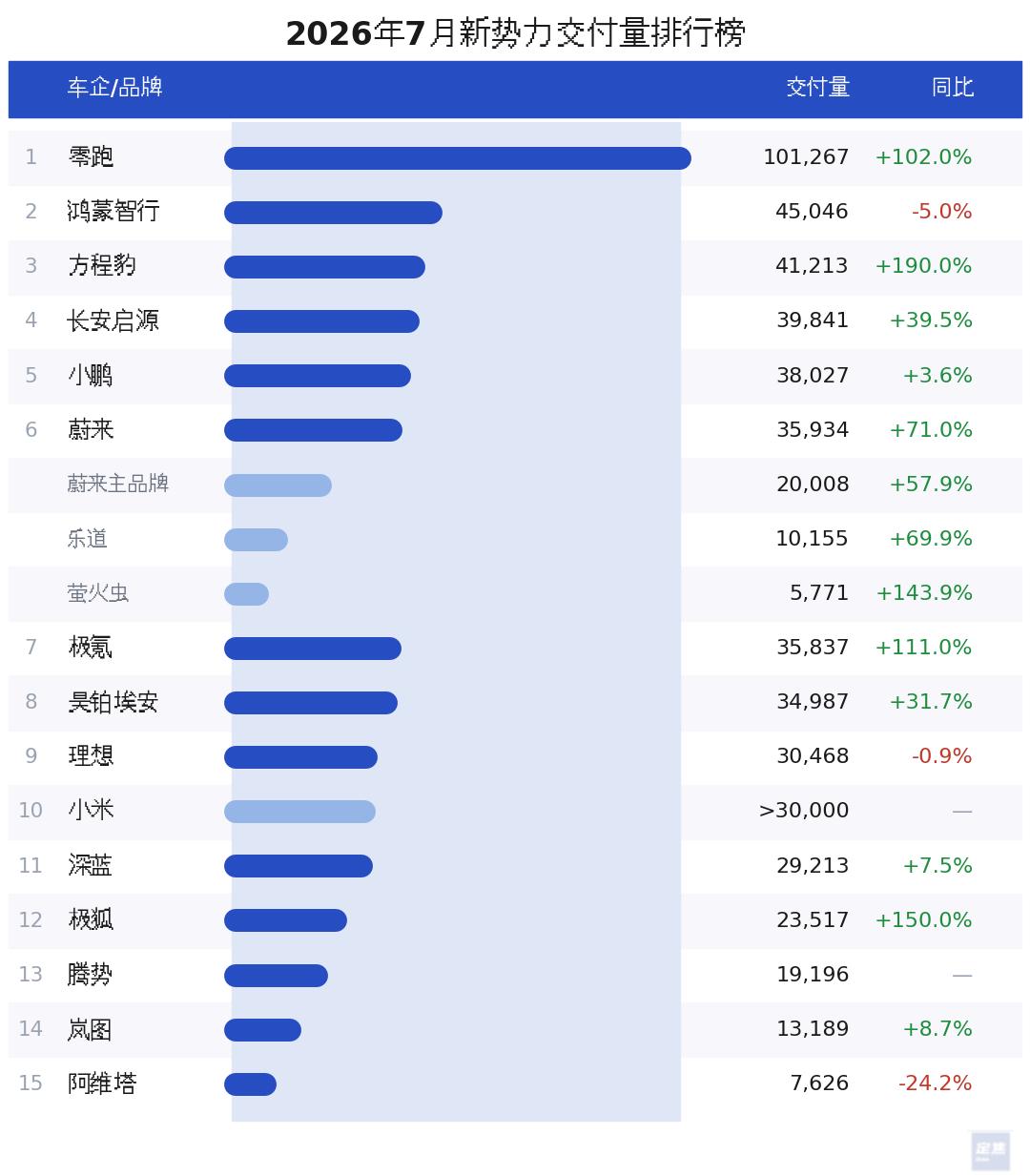
Leapmotor delivered 101,000 units, up 102% year-on-year, becoming the first domestic new EV startup to exceed 100,000 units in monthly deliveries, standing alone in the first tier. HarmonyOS Intelligent Mobility delivered 45,000 units, ranking second, but it has posted year-on-year declines for two consecutive months. The third tier includes four brands: XPeng delivered 38,000 units, NIO delivered 36,000 units, Li Auto delivered just over 30,000 units, and Xiaomi delivered more than 30,000 units.
Among traditional automakers, the gap between leading players is also widening.
BYD's total sales in July reached nearly 420,000 units, up 22% year-on-year, with exports of nearly 180,000 units, up 124.3% year-on-year. Its sub-brand Fangchengbao delivered 41,000 units, with a year-on-year increase of 190%, a volume that is close to that of HarmonyOS Intelligent Mobility. Denza's monthly deliveries were close to 20,000 units.
Chery Group sold 277,000 units in July, up 23% year-on-year, of which exports reached 203,000 units, up 70.1% year-on-year, refreshing China's monthly auto export record for five consecutive months.
Geely sold just over 250,000 units in July, with overseas exports exceeding 100,000 units for two consecutive months, up 202% year-on-year, hitting a new monthly export high. Its sub-brand Zeekr delivered 36,000 units, up 111% year-on-year, reaching an all-time high.
In addition, the three brands under Changan showed differentiated performance: Qiyuan delivered nearly 40,000 units (up 39.5% year-on-year), Deepal delivered 29,000 units (up 7.5% year-on-year), and Avatr delivered 7,626 units (down 24.2% year-on-year); GAC Aion Hyper delivered 35,000 units (up 31.7% year-on-year), BAIC Arcfox delivered 23,500 units (up 150% year-on-year), and Dongfeng Voyah delivered 13,000 units (up 8.7% year-on-year).
The trend since the beginning of this year is that brands incubated by traditional automakers are squeezing into the middle of the ranking list, and the sales gap between new EV startups will only widen. Competition is intensifying. On July 16, six brands including Li Auto, XPeng and Leapmotor launched 7 new models in two and a half hours, with prices ranging from 120,000 yuan to 350,000 yuan. These new models will be delivered one after another starting in August, and the rankings on the list will change again.
01. The top two, one rising and one falling
In the July delivery ranking, the positions of the top two did not change, but the trends of the two are opposite: Leapmotor exceeded 100,000 units, while HarmonyOS Intelligent Mobility posted year-on-year declines for two consecutive months.
Leapmotor: First time exceeding 100,000 units, but still facing sales pressure
Leapmotor delivered 101,267 units in July. How did it sell more than 100,000 units in the traditional off-season? Domestic sales were boosted by new models and promotions, while overseas markets contributed new increments.
Leapmotor launched new models intensively since June, and the sales volume was concentrated in July: three models in the C series were upgraded with cockpit chips and 800V platforms, and B01 and B10 entered the 100,000-yuan market. The simultaneously launched "Summer Price Promotion" benefits and four lifetime warranty policies further lowered the consumer's decision-making threshold for car purchases.
In terms of sales structure, Leapmotor specially emphasized that its high-end model D19 delivered 10,043 units that month. Exceeding 10,000 units in a single month indeed proves that the brand has made progress in moving upward, but its proportion in total deliveries is less than 10%.
What really supports the scale is still the product matrix for the mass market: The A10, which was launched at the end of March, delivered 28,593 units in July, accounting for nearly 30% of total deliveries; the B and C series are tasked with expanding coverage in the mid-market, bringing 800V fast charging, zero-gravity seats and AR-HUD down to the 100,000-yuan market, essentially using the "low price with high configuration" strategy to attract consumers.

Image source / Leapmotor official website
The overseas market further expanded Leapmotor's scale. The company disclosed that it sold nearly 100,000 units overseas in the first half of the year, exceeding the total volume of last year; according to industry estimates, the figure is about 96,300 units, of which exports in the second quarter accounted for more than 20%. Against the background of the shrinking overall market, among the six new EV startups, only Leapmotor can achieve such a volume in overseas markets.
However, Leapmotor is still facing considerable sales pressure, and the first bottleneck is production capacity. The cumulative deliveries in the first 7 months reached about 457,000 units, with the completion rate of the annual target (1.05 million units) at about 44%. In the remaining 5 months, it needs to deliver an average of 118,000 units per month, about 17,000 units higher than that in July. Cao Li, Senior Vice President of Leapmotor, mentioned at the launch of B01 and B10 that he is more worried about the continuous delivery demand from factories, as the monthly production capacity of one factory is only more than 30,000 units. To continue to deliver more than 100,000 units per month, Leapmotor not only needs to stabilize the sales of existing models, but also ensure that new models continue to bring increments, while avoiding errors in the supply chain and quality control.
HarmonyOS Intelligent Mobility: Two consecutive months of year-on-year decline, performance in August depends on M9
Ranking second is HarmonyOS Intelligent Mobility, which delivered 45,046 units in July, marking the second consecutive month of year-on-year decline. Different from the statistical caliber of a single automaker such as Leapmotor and XPeng, HarmonyOS Intelligent Mobility is a combined statistical caliber of cross-partner ecosystem, covering multiple brands including AITO, Luxeed and Stelato.
Last month, the sales volume of AITO, Luxeed by brand and the sales of the single model of Zhijie were announced, but as of now, the brand-specific sales data for July has not been released, only mentioning that the delivery of Luxeed V9 exceeded 10,000 units; Seres also did not issue an announcement.
Data shows that HarmonyOS Intelligent Mobility was indeed under pressure in July, with a 11% month-on-month decline and a 5% year-on-year decline. The reason for the decline is not complicated. June is the closing month of the first half of the year, and HarmonyOS Intelligent Mobility followed the industry to rush sales, with deliveries reaching an annual high of more than 50,000 units, which overdrafted part of the demand. There were no new models or promotions in July, and it was also the traditional off-season, so deliveries declined accordingly. More critically, in terms of model rhythm, the biggest increment in the first half of the year was the AITO M6, which delivered more than 30,000 units 54 days after its launch, but by July, these orders were basically digested, and the increment naturally declined; the monthly sales of AITO M9 are limited, and new high-volume models have not yet taken over.
There are also considerations for not launching promotions. Data from Huachuang Securities shows that the industry discount rate in late July was flat month-on-month. After half a year of price war, the market entered a stalemate stage. All actions of HarmonyOS Intelligent Mobility in July were on the software side: the summer OTA was pushed at the end of the month, with 34 new functions added for ADS 5 and HarmonyOS Cockpit; Stelato G9 also obtained the Beijing L3 road test license. However, Ryan, a channel professional focusing on new EV startups, said that from the industry rhythm, after obtaining the L3 road test license, it usually takes several months to complete the verification and access process, so the probability of G9 being delivered in August is low.
In addition, HarmonyOS Intelligent Mobility's first FUV (positioned as a "crossover multi-purpose vehicle") Luxeed RX announced at the end of July that it will open pre-orders in August. According to revelations from automotive bloggers, Luxeed RX has already been tested on roads. It usually takes a certain period of time from road test to official delivery, so the possibility of official delivery in August is also relatively low.
Ryan judges that whether HarmonyOS Intelligent Mobility can resume growth in August still depends on whether AITO M9 can achieve high sales volume.
02. XPeng and NIO, only 2,000 units apart
Ranking third and fourth are XPeng and NIO respectively, with a gap of just over 2,000 units between the two. The former only increased by 3.6% year-on-year, while the latter rose by 71% year-on-year.
XPeng: Hot orders, delayed deliveries
XPeng delivered 38,027 units in July, down 5.2% from June, with a slight year-on-year increase of 3.6%. To sum up XPeng's performance in this month: During the transition period between old and new products, new models are highly popular, but deliveries cannot keep up synchronously.
In mid-July, XPeng launched the MONA L03, with an official price of 123,800 yuan, 20,000 yuan lower than the pre-sale price. Orders were hot in the early stage of launch, but it contributed almost no deliveries in July, and production capacity ramp-up became the bottleneck. A new group of users who planned to buy the current models began to wait and see. Citi's survey mentioned that some customers turned to compare competing products.
XPeng officially stated that it will accelerate the large-scale national delivery of L03 in August. Citi expects L03 to deliver 8,000 to 10,000 units in August and about 15,000 units in September.
Therefore, XPeng's deliveries in July mainly relied on old models, and its high-end line encountered some troubles.
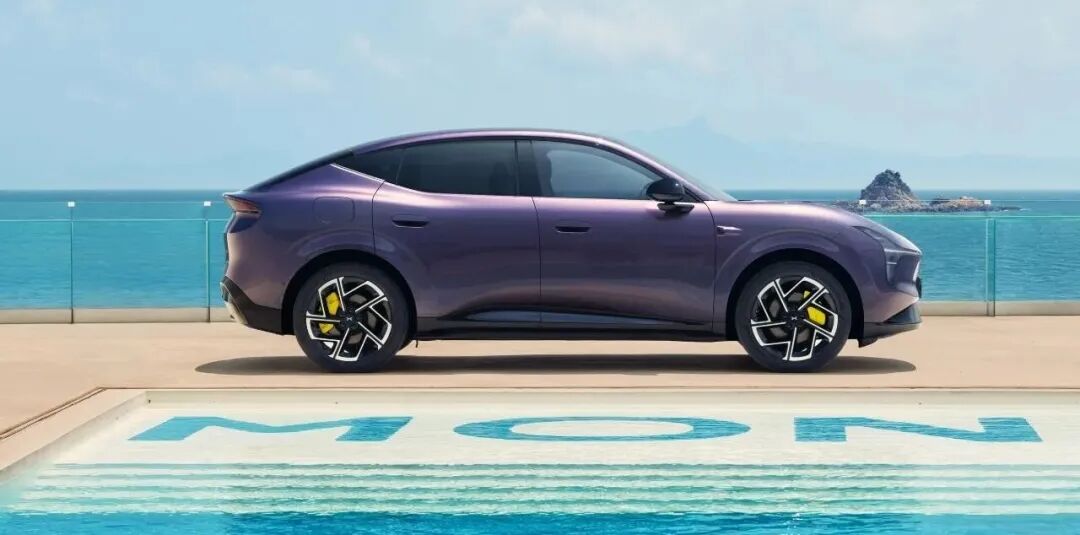
Image source / XPeng official website
The main delivery volume still comes from MONA M03, P7+, G6 and G7. According to Ryan's analysis, affected by the launch of L03, the monthly sales of MONA M03 declined to some extent. As the SUV version of the MONA series, L03 and M03 have similar price ranges, and the two models compete with each other.
The contribution of high-end models GX and X9 is limited: the production capacity of GX has increased, but the delivery rhythm is still restricted; X9 encountered a high-temperature air suspension failure in July, and XPeng announced the recall of 33,473 units.
In the first 7 months of this year, XPeng delivered 204,000 units. To achieve the annual target of 550,000 to 600,000 units, it needs to deliver an average of 70,000 to 80,000 units per month in the remaining 5 months, which is about twice the delivery volume in July. Almost all expectations are placed on L03. To keep orders hot, production capacity must keep up.
NIO: Sales growth slows down, raising prices to maintain gross profit
NIO, ranking fourth, is in a different situation. It delivered 35,934 units in July, up 71.0% year-on-year, with the highest year-on-year growth rate among the six new EV startups. In the first seven months, NIO's cumulative deliveries reached 227,057 units, up 68.0% year-on-year. In terms of total volume, NIO has come out of the trough of last year and returned to the track of rapid growth. The completion rate of its annual target (456,000 to 489,000 units) is 46.4% to 49.8%.
However, NIO's overall deliveries decreased by 11.5% month-on-month, which is the first obvious decline since February this year.
By brand, all segments posted month-on-month declines. The main NIO brand delivered 20,008 units (down 8.7% month-on-year), LeDao delivered 10,155 units (down 13.5% month-on-month), and Firefly delivered 5,771 units (down 16.9% month-on-month).
LeDao and Firefly, positioned in the 150,000 to 300,000 yuan market, jointly contributed 44% of deliveries in July, which indeed helped NIO expand its overall scale. But this month, the three brands failed to complement each other to offset the decline.
NIO actually took actions in July. On July 9, the large five-seat version of ES8 with a starting price of 382,800 yuan was launched, and deliveries started the next day. Logically, the launch of the new model should have driven up sales to some extent. But the results show that the main brand not only did not rise, but fell by 8.7%. The large five-seat version only had a delivery period of about 20 days in July, and its production capacity has not been fully released; at the same time, the BaaS scheme lowered the entry threshold to 274,800 yuan, which can attract new customers, but it will also inevitably make some users who originally planned to buy the ES6 or the six-seat version of ES8 turn to the large five-seat version, forming a "transfer of sales within the brand".
It is worth mentioning NIO's pricing strategy. When competitors such as Leapmotor launched limited-time benefits of tens of thousands of yuan to grab orders in July, NIO not only did not follow up, but also raised the price of some main models by 5,000 to 10,000 yuan. Li Bin said at the mid-July communication meeting: The prices of aluminum, copper and lithium carbonate are all rising, and the cost of a single ES