Jinjiang "accuses" Fanqie: Trying to use public opinion as a public relations tactic?
Online rights protection is becoming increasingly common, and has even become a habitual routine.
However, after the routine has been used too many times, the public has gradually developed the ability to identify it.
Therefore, accompanying online rights protection, there is also a common phenomenon: "Sorry for occupying public resources."
Recently, Jinjiang has accidentally trapped itself in the "routine" of online rights protection.
The incident originated from Jinjiang's accusation on Weibo that Fanqie infringed its copyright, but unexpectedly, the incident experienced multiple reversals.
Subsequently, this "accusation" turned into a public opinion storm unrelated to infringement, which eventually backfired on Jinjiang itself.
Reversal of the Infringement Narrative: Jinjiang's Double Standards
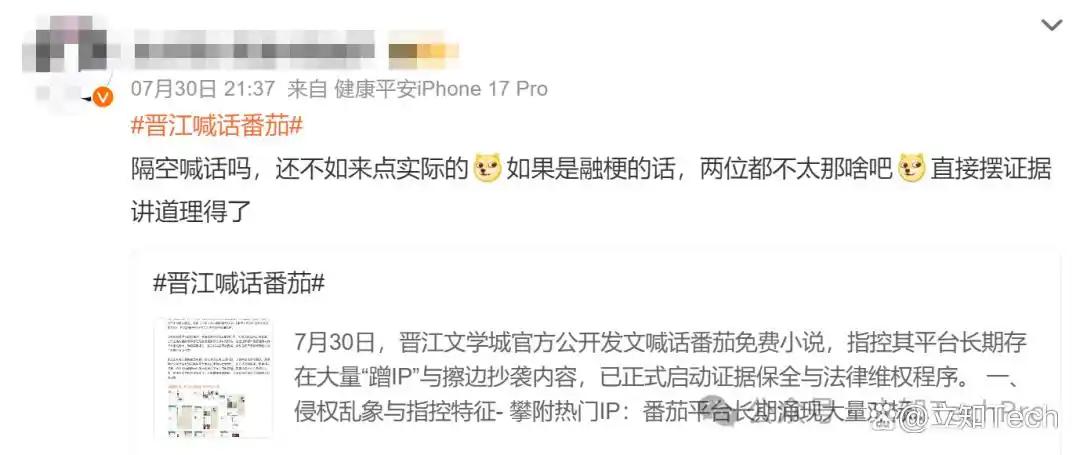
On July 30, the official Weibo account of Jinjiang publicly released a rights protection notice.
In the notice, Jinjiang pointed out that many novels on Fanqie infringed the copyright of Jinjiang's novels, which is a typical act of free-riding on IP, riding on popularity and unfair competition, trying to prove that the Fanqie platform infringes its rights.
But the truth is not the case.
Taking the naming infringement of *Chasing Jade* as an example, the naming time of the work *Chasing Jade* by the Jinjiang author and the work *Chasing Jade* by the Fanqie author has not yet been clarified, and the two sides still hold their own opinions.
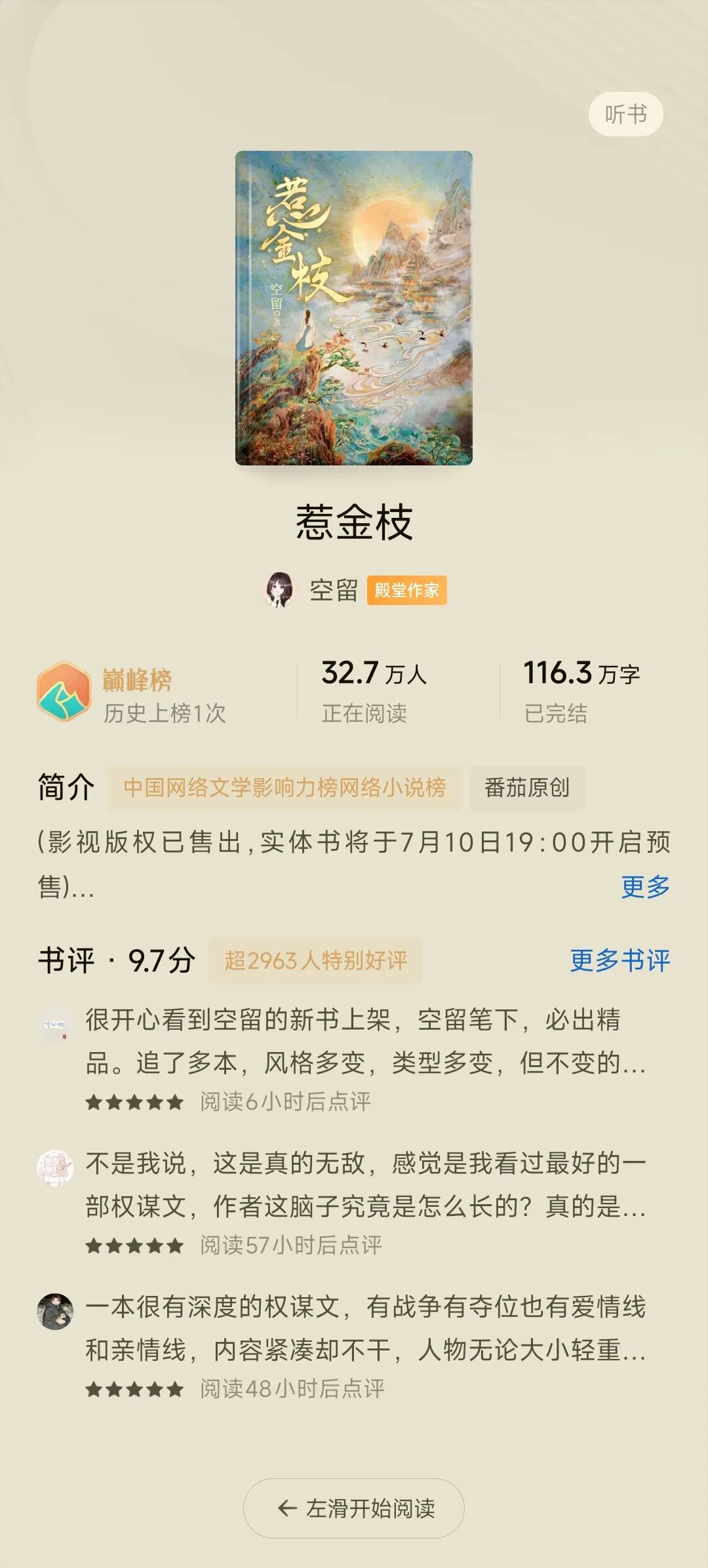
Furthermore, if using the same name is taken as the infringement standard, there are quite a few novels on Jinjiang that infringe the copyright of works from other platforms. For example:
In July 2023, *The Golden Branch* was launched on Fanqie; in September 2023, a signed work with the same name appeared on the Jinjiang platform.
In April 2022, *I'm Engaged in Involution in the Cultivation World* was launched on Fanqie; in July 2025, a work with the same name appeared on the Jinjiang platform.
In September 2024, *The Farming and Reading Family* was launched on Fanqie; in September 2025, the work *The Farming and Reading Family (Imperial Examination)* appeared on the Jinjiang platform.
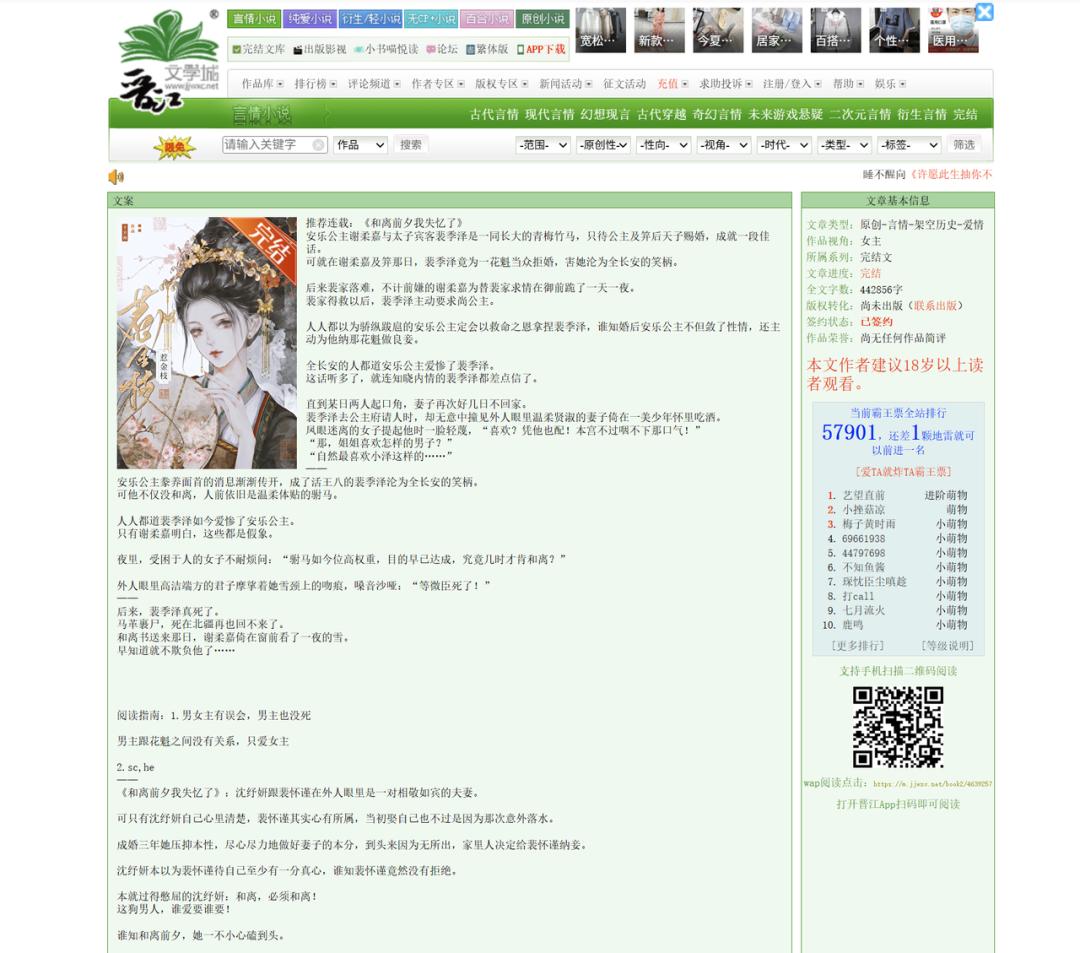
Apart from this kind of same-name infringement, there are many fan works on the Jinjiang platform adapted from works on Fanqie. For example:
In December 2022, *The Apocalypse of Ten Days* was launched on Fanqie; in January 2025, the fan work *The Apocalypse of Ten Days Qiao Jiajin BG* appeared on the Jinjiang platform.
There are many other examples like this.
Jinjiang holds high the banner of rights protection, but in fact, it fails to protect the original works of authors on its own platform, and implicitly allows its authors to infringe works from other platforms.
The most criticized issue is the "melting of tropes" incident.
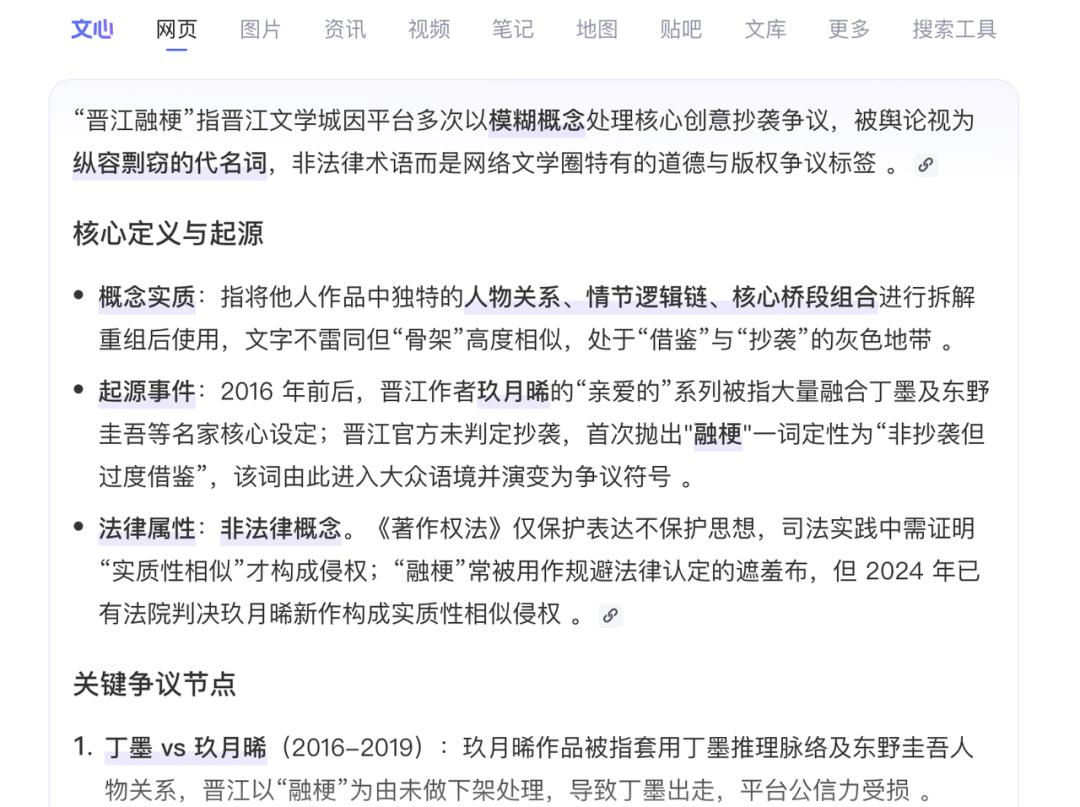
As early as 2016, the plagiarism of Jinjiang author Jiuyue Xi caused controversy.
The original novel author "Zuzhan" and readers spontaneously sorted out comparison charts to prove that multiple works of Jiuyue Xi highly overlapped with many original authors in core character settings, narrative frameworks and key plots, and a large number of complaints were submitted to the platform background.
However, Jinjiang did not make a clear plagiarism judgment, but instead divided a gray area of "melting tropes" — distinguishing the legally protected textual expressions from the unprotected creative "tropes", implicitly weakening the infringement attribute of highly referential behaviors, and thus rejecting the complaints from readers and original authors.
Jinjiang's double standards for internal and external parties were brought up again by the majority of readers in this "accusation" incident.
This is the first reason for the reversal of public opinion trend.
Behind the Reversal: Jinjiang's Platform Trust Crisis
The deeper reason lies in the long-term accumulated governance disorder and reputation collapse of the Jinjiang platform itself.
The infringement complaint is just the trigger for this public opinion storm.
Compared with the long-standing controversy over melting tropes, the invoice protest incident of *The Female Lead Is Tired of This* that broke out in March this year more intuitively exposed the arbitrariness and double standards in the implementation of platform rules, and also deepened the dissatisfaction of ordinary readers with Jinjiang.
The incident originated from Jinjiang's lock-up review of the popular female-oriented work *The Female Lead Is Tired of This*. The platform determined that the commonly used online term "Laotian Nai" used in the book was a "coined word not certified by authoritative Chinese institutions", which was suspected of creating confrontation and using non-compliant words, requiring the author to forcibly modify the content, otherwise the work would not be unblocked.
The incident quickly fermented, and netizens also pointed out the double standard loophole of Jinjiang: on the one hand, it explicitly prohibits ordinary authors from using words such as "Laotian Nai", on the other hand, the official Weibo account of Jinjiang has publicly used this word.
After noticing that public opinion was out of control, the platform not only failed to sincerely apologize and rectify, but also secretly modified the wording of the announcement, slightly adjusting the original "It is strictly prohibited to use coined words" to "It is strictly prohibited to force others to use coined words", trying to blur the fault and perfunctorily end the incident.
This kind of "rectification" completely enraged users, and finally readers used 260,000 invoices to express their protest against the platform.
What further escalated the incident was the public statement of Liu Xudong, Vice President of Jinjiang.
The statement of senior executives is in itself a public relations act representing the position of the platform and the enterprise.
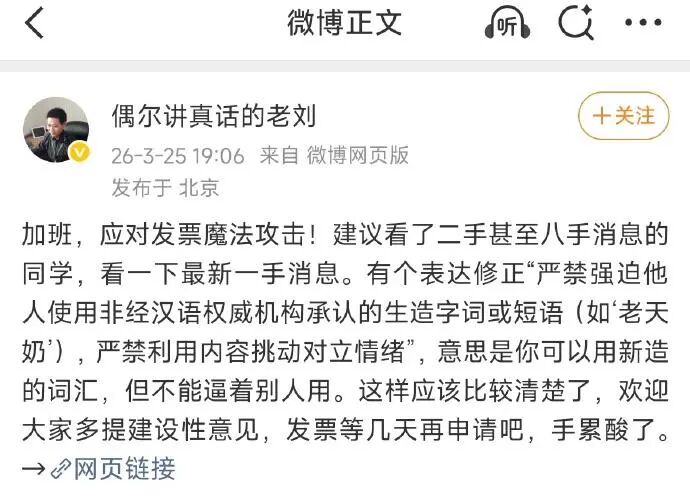
Liu Xudong's statement not only failed to face up to the problem, but also put on a victim posture first, claiming that the platform was under "magic attack".
The platform rules reflect the attitude towards readers and users, while crisis public relations reflect the attitude towards public opinion.
Sincere apology followed by response measures is already the most basic "routine" of crisis public relations response.
If we say that Jinjiang in the past neither paid attention to the internal construction of the platform nor understood the basic norms of public relations.
This time Jinjiang seems to have learned a little smarter.
Reversal of Effect: Public Opinion as a Public Relations Tool
During the last time he was ridiculed by the public, Liu Xudong probably realized that public opinion is a powerful public relations tool.
But he is not smart enough, he did not realize that the public relations effect of public opinion depends on the public, not the speaker.
This is just like another version of the story of "The Boy Who Cried Wolf".
After experiencing all kinds of previous crises, Jinjiang has been labeled as "failing to protect authors" and "disregarding readers". When it puts on the high hat of "striving for the survival of original works" again, the public will not always act as it wishes.
The public opinion out of focus, the deeper reason is that there is another event that is more noteworthy and more controversial than the self-created public opinion event.
This is not uncommon in the business world.
For example, Jia Guolong of Xibei, who was at the center of the public opinion storm last year.
When facing the questioning of pre-made dishes, Jia Guolong's tough attitude made the majority of netizens resist: it was another crisis public relations that failed to face up to the problem. The public had already sown the seeds of distrust at that time.
When Jia Guolong realized that public opinion has such a strong public relations effect, and then tried to sue Luo Yonghao as a "victim", he was instead backfired by public opinion.
This also reflects the arrogance of these enterprises and their bosses. The "routine" of online rights protection and the "routine" of public opinion public relations will not proceed according to the will of the "rights protector".
Just like Jinjiang, the "routine" is finally backfired by the "routine". An active public opinion rights protection "accusation" eventually "lost focus" and became its own platform crisis.
This is actually paying off the long-accumulated "public opinion debt" and "public relations debt".
This article is from the WeChat Official Account "Internet Compass" (ID: hlwzhibei), the author is: Fighting for the People's Interests?, released with authorization from 36Kr.