Coinbase: After the cryptocurrency price "ebb" retests the new low, can we still wait for the favorable policy tailwind?
Coinbase releases its Q2 earnings report, further deepening the downturn shown in the Q1 report. The details are as follows:
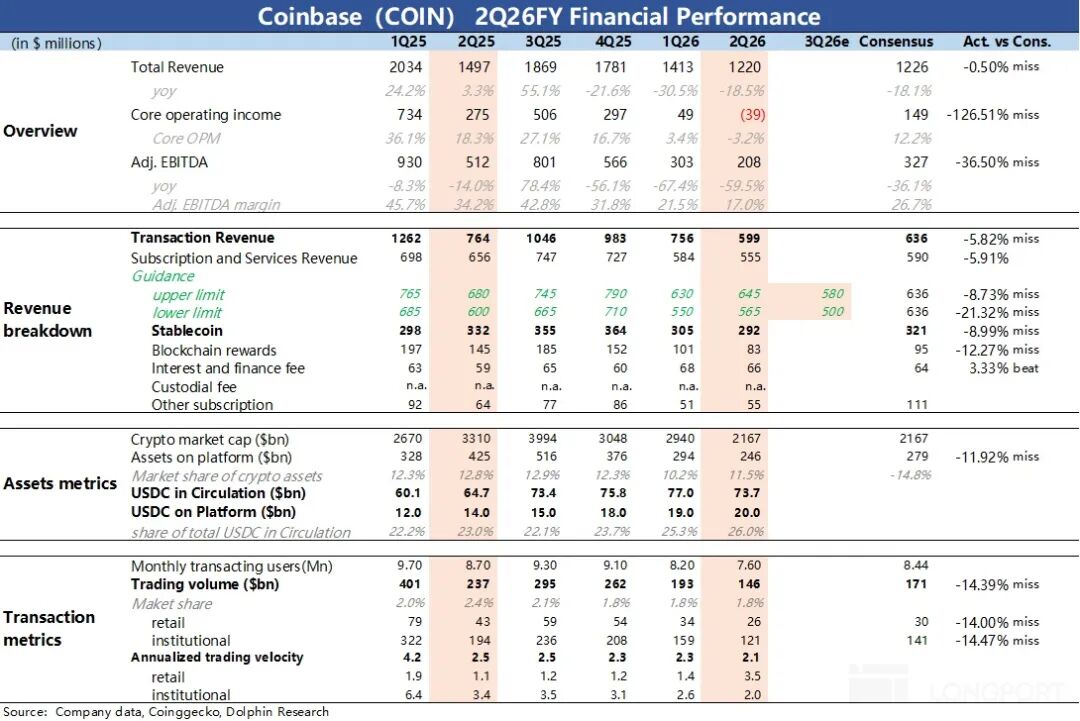
1. Trading continues to slump sharply: Trading revenue fell 19% year-on-year. The company did not disclose the trading volume data under the original statistical caliber this quarter, but Coinbase's spot trading volume dropped significantly both year-on-year and quarter-on-quarter.
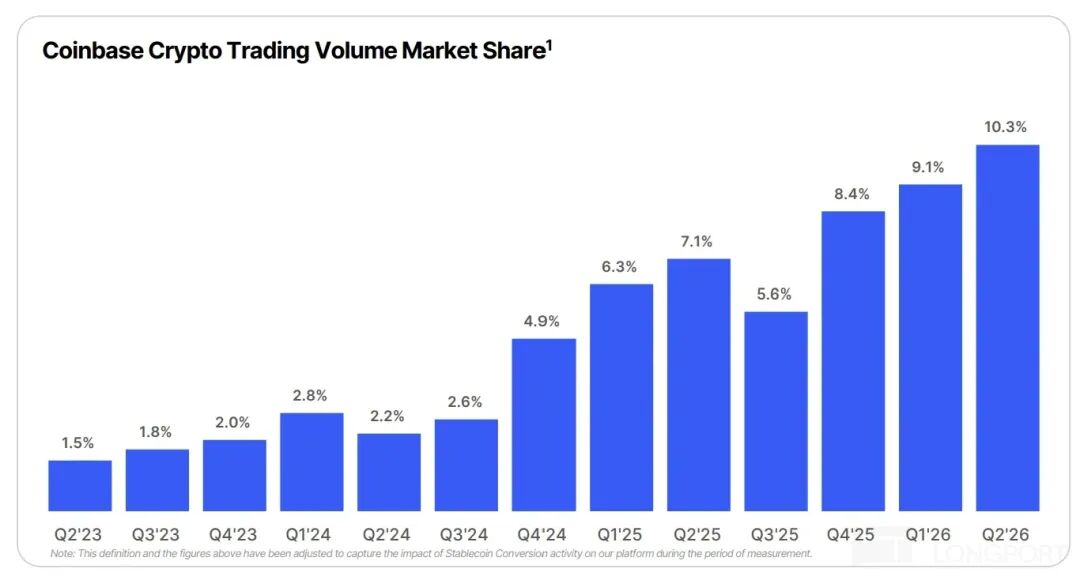
The same trend applies to the whole industry. According to Coingecko's statistics, the total spot trading volume of crypto assets across the industry in Q2 decreased by 27% quarter-on-quarter, and the total market value shrank by 11% quarter-on-quarter. In the financial report, the market share (limited to the centralized exchange spot trading market) disclosed by Coinbase itself has steadily increased to 10%.
2. Subscription performance is also poor with weak guidance: Subscription revenue outside of trading is mainly composed of stablecoin revenue, staking revenue, Base chain revenue and interest income. It reached 560 million in Q2, down 12% year-on-year and 5% quarter-on-quarter, showing a more stable trend than trading revenue.
Looking at the segments in detail, stablecoin revenue basically fluctuates with the market value; staking revenue was hit by the double drop of underlying token market value and yield, leading to a sharp decline; only custody fee and Base chain revenue remained relatively stable, rising 4% quarter-on-quarter and falling 5% year-on-year.
The company's guidance for Q3 subscription revenue is flat quarter-on-quarter but lower than market expectations, which means the recovery and expansion of stablecoin USDC, the rebound of ETH/SOL asset prices and staking yields will not be smooth in the short term.
3. Continue to increase the share of stablecoin holdings: The stablecoin market also shrank in Q2, suffering from the dual impact of the sluggish crypto market and the shelving of the CLARITY Act. The overall market value of USDC fell to 73.5 billion, down 5% quarter-on-quarter, with a significantly larger fluctuation range than USDT.
The main reason may be that USDT has a wider range of application scenarios, such as commodity payment, and a large proportion of users are from non-US regions, so it is less sensitive to interest rate changes and the implementation progress of the CLARITY Act.
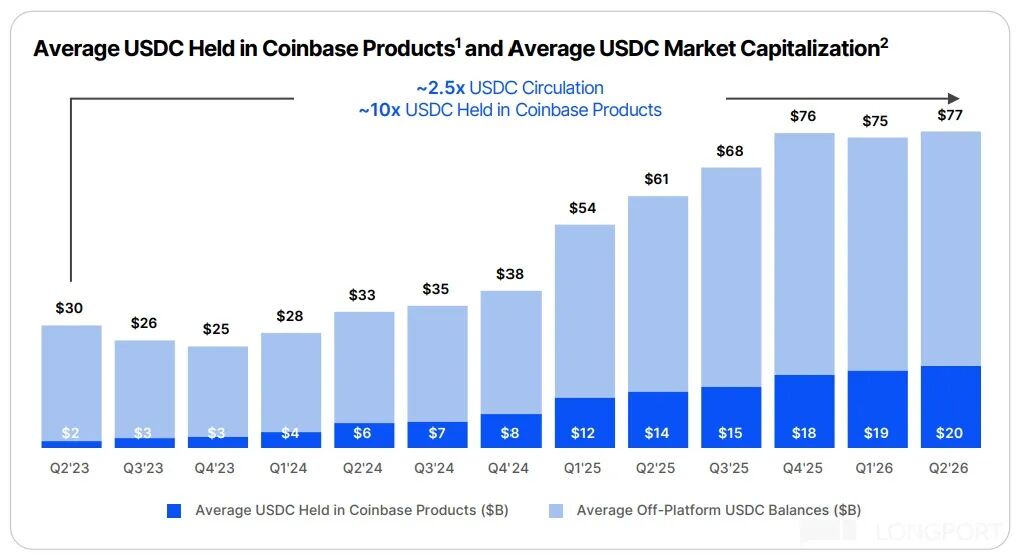
However, Coinbase is still actively increasing its holdings of USDC. In Q2, the average amount of USDC held and custodied by the platform reached 20 billion, accounting for 26% of the circulating volume, continuing to rise from 25% in the previous quarter. At present, the cooperation agreement with Circle has been renewed, and the two sides will continue to be closely bound ecological partners.
4. Core profit turns negative: Under the high revenue pressure and relatively rigid expenses (although Q2 expenses have been reduced through layoffs and other measures, R&D expenses still increased by 22% due to layoff compensation, consolidation of Deribit and new product investment), the profit is squeezed from both sides. The core profit calculated by gross profit minus three types of expenses directly turned negative this quarter.
5. Share repurchase slows down: Only 120 million US dollars of shares were repurchased in Q2 (810,000 shares at an average price of 149 US dollars, and the repurchases basically took place during the sharp correction period in June), while the repurchase amount in the previous quarter was as high as 1.1 billion US dollars. Up to now, half of the 4 billion repurchase plan has been used, and 2 billion is left for future repurchases, but no clear deadline has been specified.
6. Overview of key performance indicators
Dolphin Research View
The performance in Q2 is an enhanced version of the downturn in Q1. There was almost no major rally for crypto assets in Q2. On the one hand, geopolitical frictions kept emerging and interest rate expectations were unstable. On the other hand, global capital was attracted by the AI sector, and trading volume has shrunk sharply to the level of 2023.
Therefore, in the view of Dolphin Research, the performance in Q2 is even worse. However, the market value of Coinbase has changed a lot between the two earnings seasons, so the market reaction to the more pressured Q2 performance is not as strong as that in Q1.
At this point in time, crypto assets are still facing selling disturbances brought by interest rate hike expectations and geopolitical frictions from time to time. Therefore, the catalyst of whether the CLARITY Act can be advanced is particularly important. Especially for the originally promising time window at the end of July, if the opportunity is missed, it is very likely that the act will not be implemented this year.
At present, Coinbase's CEO said he is very confident, revealing that many relevant people have begun to urge the government to push forward the process. As the August recess is approaching, it will force the Senate to promote the CLARITY Act to a full vote in the Senate as soon as possible.
As the price of crypto assets continues to be under pressure and trading volume shrinks, Coinbase's profit expectations are also being revised down. Although its market value has now fallen to 45 billion US dollars, down nearly 20% since the release of the last quarter's earnings report, the valuation has not yet reached our conservative bottom range. Given that the current time window for the act is relatively small and there are still variables, Dolphin Research still suggests continuing to observe and wait for the implementation of the act's commitments.
Detailed Analysis as Follows
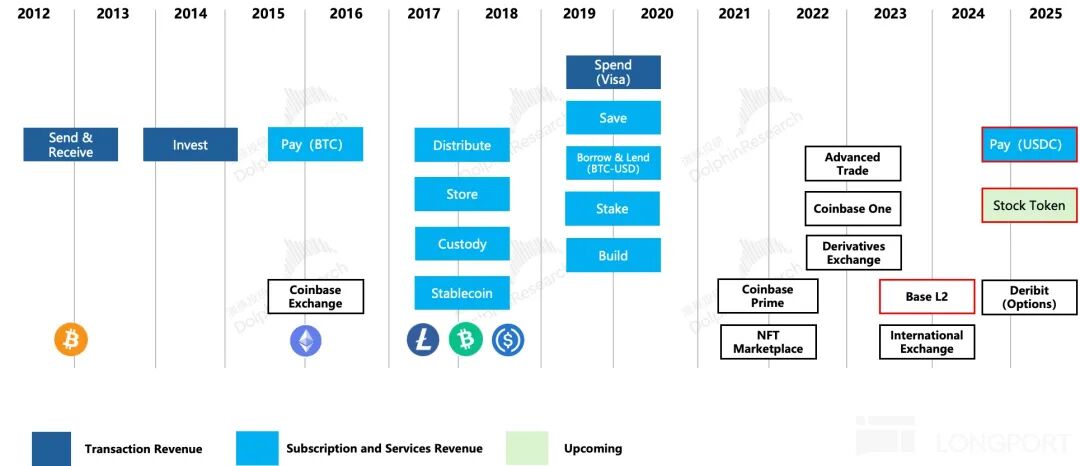
I. Introduction to Coinbase's Main Business
Coinbase is a platform that started as a crypto exchange and is committed to building a comprehensive on-chain financial scenario around virtual assets. Compared with its peers, its biggest advantage is regulation-friendly, which is expected to take the lead when regulators actively recognize and promote the virtual asset market.
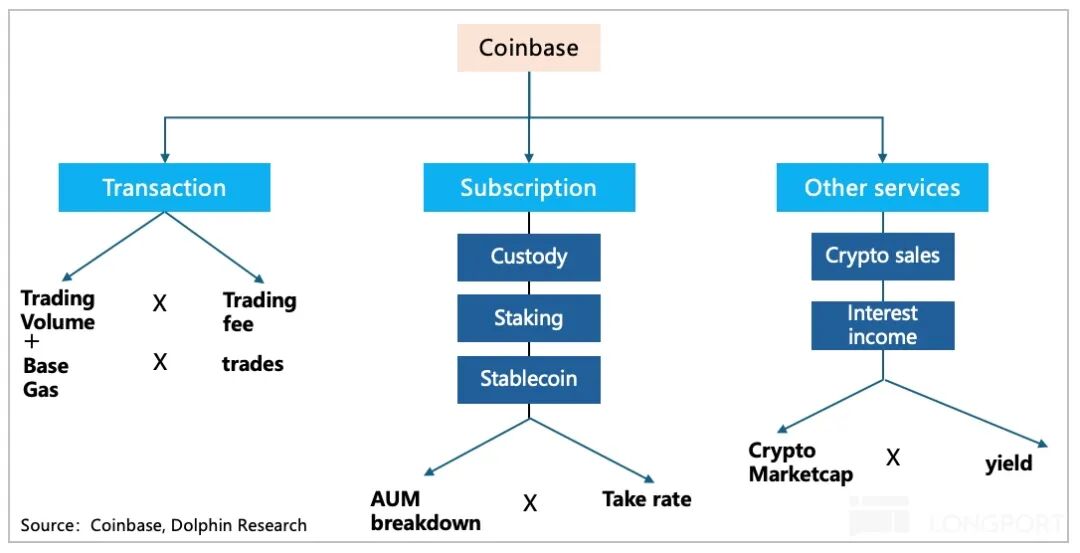
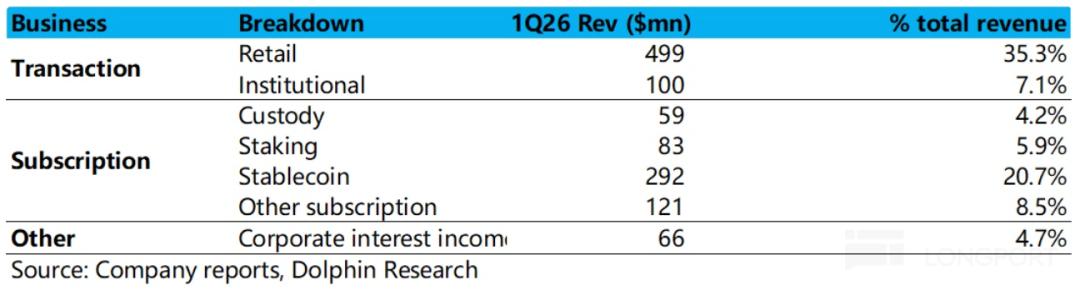
In terms of major revenue contribution categories, Coinbase has three main revenue sources: trading revenue, subscription revenue, and other revenue.
Among them, trading revenue is extremely vulnerable to the impact of market trading conditions, but it is still the largest revenue source of Coinbase at present, accounting for more than 50%. Subscription revenue and other revenue (including custody and settlement, staking, stablecoin, data/cloud and the company's investment income, etc.) act as a lubricant. Due to its relatively stable growth, it can slightly smooth the fluctuation of trading revenue.
However, an obvious trend is that with the expansion of application scenarios, intensifying competition, and structural changes in incremental capital sources, Coinbase will become less and less dependent on trading revenue in the future.
Attracting users with low fees and then expanding added value through comprehensive financial services is the business model that Coinbase wants to achieve. At present, it mainly relies on its own compliance advantages to offer fee discounts for institutional users.
With the penetration of stablecoins in scenarios such as cross-border B2B transactions and RWA on-chain, Coinbase is expected to become a "water seller" in the gold rush boom by taking advantage of the expansion of virtual asset scale.
II. Bottom Market Leads to Extreme Trading Shrinkage
First, let's look at the changes in Coinbase's user ecosystem.
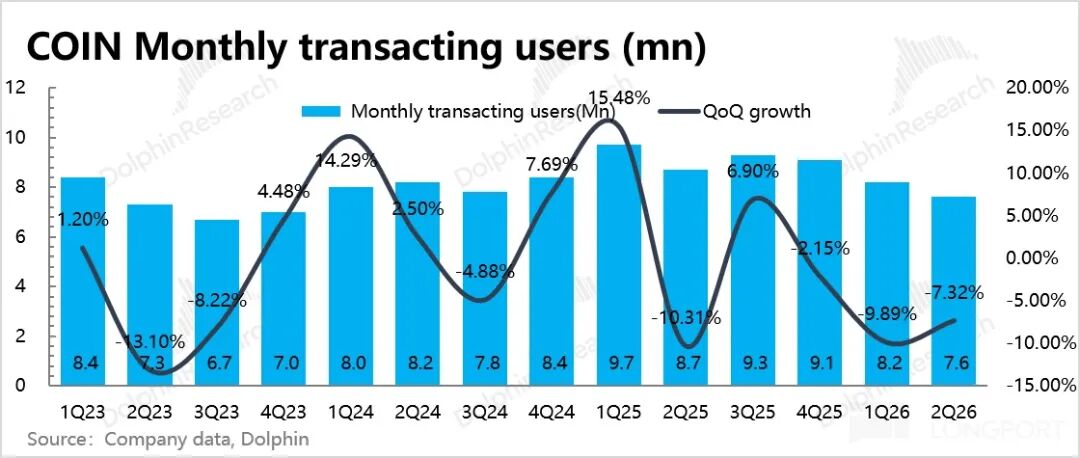
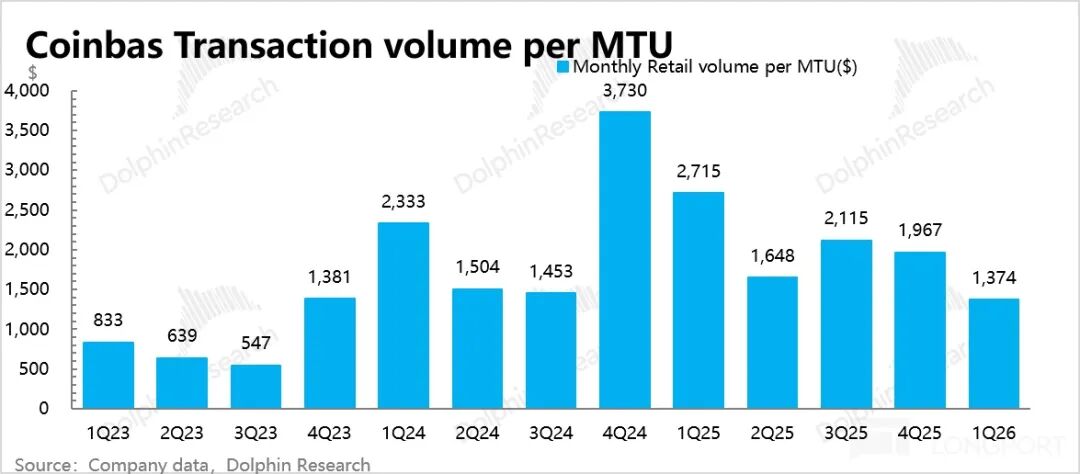
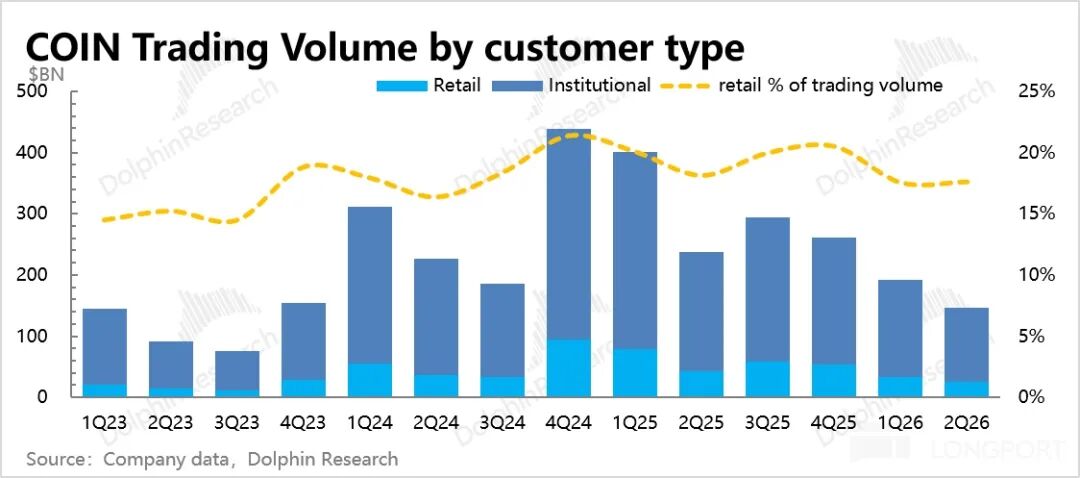
Due to higher macro environment uncertainty in Q2, the number of active trading users continued to drop by 600,000 net quarter-on-quarter to 87.6 million. Rough calculation shows that the per capita transaction volume decreased by 30% quarter-on-quarter, further hitting the freezing point of market sentiment.
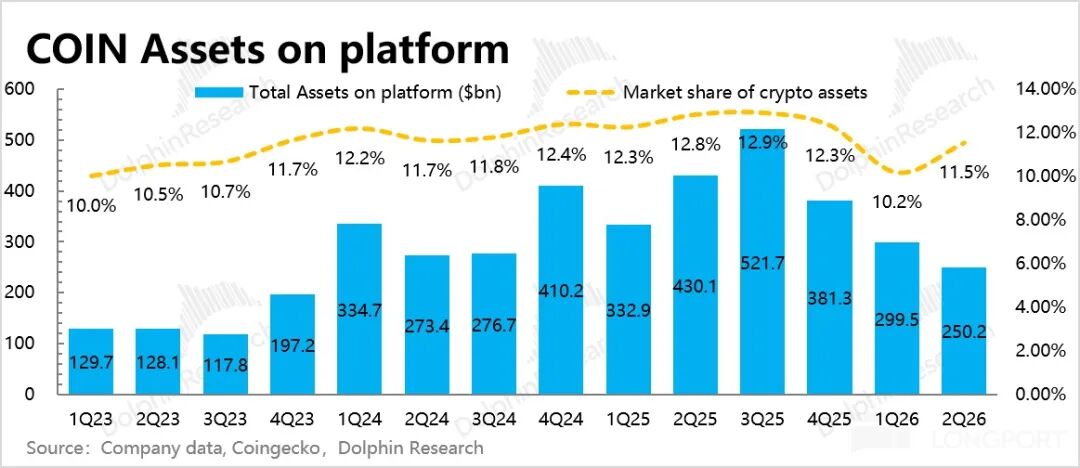
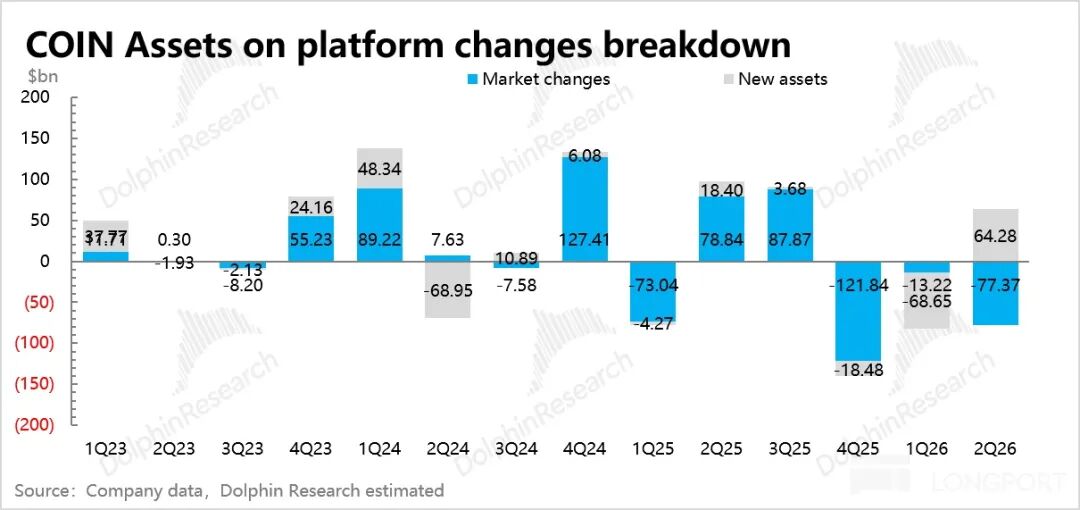
The scale of platform assets also continues to shrink, the total of customer assets and segregated custodian funds at the end of the quarter reached 25 billion (including fiat currency scale), down 16% quarter-on-quarter. However, the AUM decline this quarter is mainly caused by market value fluctuations, and there are also some capital bottom-fishing behaviors in the market.
III. Trading: Spot Market Drops Sharply, Derivatives + Prediction Market Partially Hedge the Decline
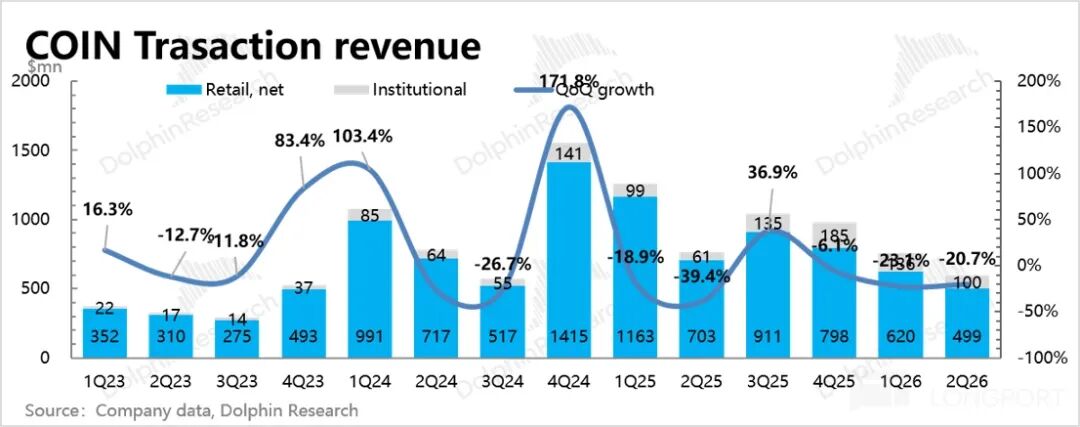
Coinbase's short-term fundamentals still rely heavily on trading revenue (accounting for 53%). Trading revenue fell 22% year-on-year in Q2, and the quarter-on-quarter slowdown is mainly due to base effect. Among them, trading volume shrank by 24%, but derivatives revenue and the fully consolidated revenue from the acquired Deribit are complete incremental contributions, which partially offset the decline.
From the industry perspective, the total market value of cryptocurrencies at the end of the period fell back to just over 2 trillion, and the average daily trading volume of spot centralized exchanges fell by nearly 20% year-on-year (according to Coingecko). Coinbase disclosed that its trading share in the spot market continued to pick up slightly, which may be related to the launch of new trading varieties to promote user activity and stickiness.
Finally, trading revenue is mainly driven by scale and market trading volatility. Trading revenue in Q2 reached 600 million US dollars, down 22% year-on-year and 21% quarter-on-quarter.
III. Subscription: Stablecoin and Staking Revenue Stagnate, Only Base Chain Expands Steadily
Subscription revenue in Q2 was 555 million, down 5% quarter-on-quarter, and the median guidance for the next quarter is 540 million, which will continue to decline quarter-on-quarter.
Looking at the segments in detail:
(1) Stablecoin revenue fell 4% quarter-on-quarter. Although the proportion of USDC held by Coinbase's platform continued to rise to 26%, the overall circulating value of USDC shrank, which was affected by multiple factors:
USDC has a higher proportion of institutional holders in its market, so when institutions choose to avoid crypto assets due to excessive macro environment fluctuations, USDC will face a larger redemption range than USDT which has more commercial payment scenarios. At the same time, the cooling of DeFi leverage will also lead to short-term selling of USDC.
In Q2, Coinbase reduced the incentive share for users holding USDC (from 61% to 51%). On the one hand, it may be in response to the banking industry's protest against the behavior of giving out returns in the name of incentives, and on the other hand, it can maintain profit margins when interest rates decline year-on-year.