Maximum 20 papers per person? ICLR's new policy has drawn a sarcastic petition from DeepMind researchers.
How many papers should an author properly participate in for a top-tier AI conference?
The answer given by ICLR is 20.
Recently, ICLR 2027 released new submission rules, explicitly stipulating that any author can only appear in the author list of a maximum of 20 submissions. Papers exceeding the quota will receive a reminder at the abstract submission stage. If no adjustment is made by the full paper deadline, the conference will randomly reject some papers until every author is within the quota...
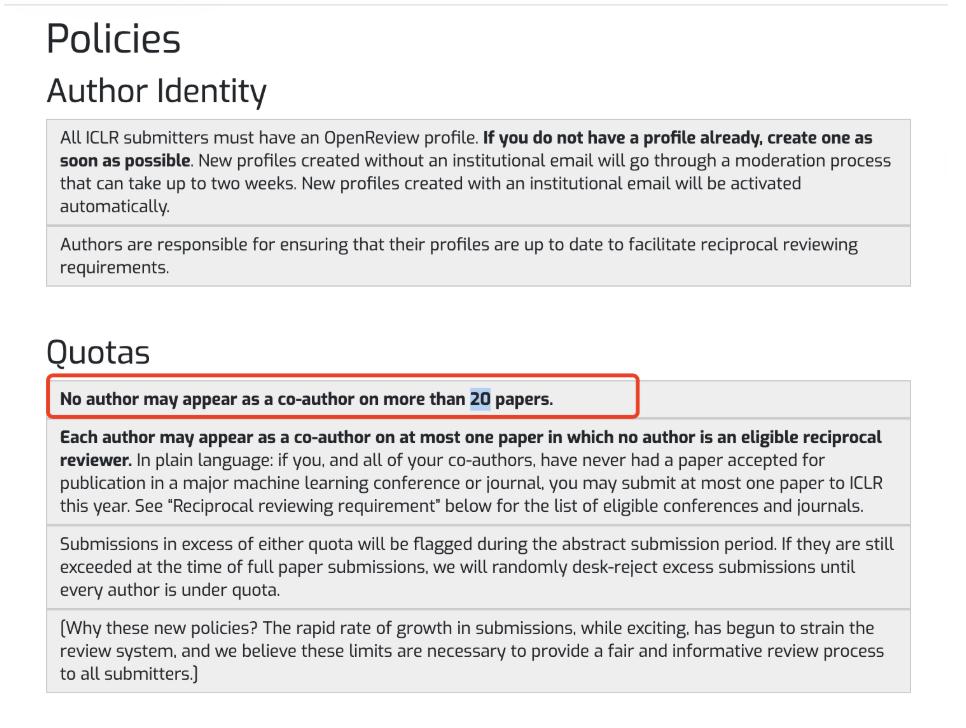
The explanation given by ICLR is very simple: The number of submissions is growing too fast, and the review system is under huge pressure. Quotas are needed to maintain fair and informative reviews.
Behind this is the "crisis" of submissions and reviews experienced by ICLR 2026.
Statistics show that ICLR 2026 received a total of 19,525 valid submissions, and finally 13,763 papers obtained formal acceptance or rejection decisions, involving 76,139 review comments provided by 18,054 reviewers.
Compared with about 11,603 submissions of ICLR 2025, the number of submissions in 2026 increased by about 68%. This means that within one year, the conference needs to process nearly 8,000 additional papers and tens of thousands of review tasks...
Once the news was announced, it sparked heated discussions among netizens. Dan Roy, visiting researcher at Google DeepMind and professor at the University of Toronto, Canada, also noticed this change and launched a "petition" against this rule: Petition to cancel the 20-paper submission limit for ICLR conferences.
He posted on X:
"ICLR limits the number of submissions per author to 20, which is ridiculous! It will also slow down the development of artificial intelligence.
Why 20? This is a completely arbitrary number. Nowadays, AI Agents can already complete some interesting but incremental AI research work with almost little guidance. We should encourage everyone to complete and submit as many papers as possible, especially now that all review work has been handed over to large language models... Admit it!
Click the link to sign my petition!"
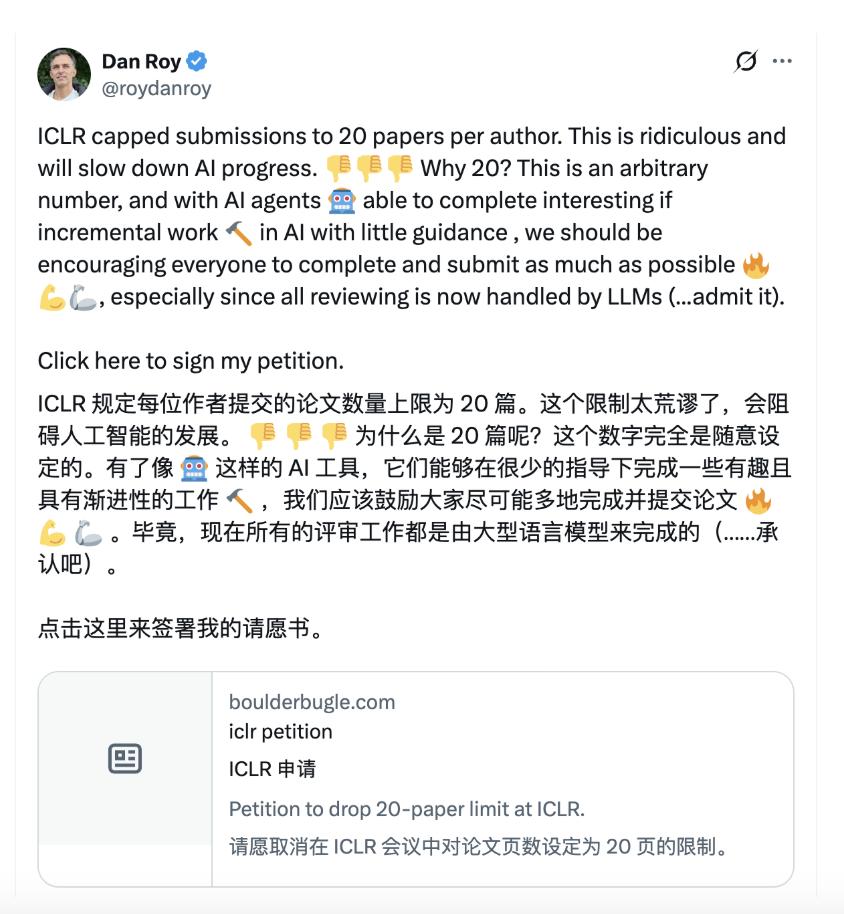
Obviously, Dan Roy is clearly dissatisfied with the 20-paper limit, but he is also secretly teasing the current impact of AI on the academic environment. The whole post is ironic.

For example, ICLR reminds researchers that current AI Agents still cannot independently complete a paper that meets the standards of top conferences. After code assistants and research infrastructure improve efficiency, researchers should challenge more ambitious problems, submit more complete and mature results, and reduce the influx of a large number of incremental papers into the conference.
Dan Roy completely reversed this set of statements.
ICLR wants to see a more complete "slow science", so Dan Roy pretends to advocate "let Agents produce as many incremental results as possible"; ICLR tries to limit the "flood" of papers, and he pretends to worry that "this will slow down the development of artificial intelligence".
In particular, the phrase "now all review work has been handed over to large language models... Admit it" is also satirizing that large models have not only entered the paper writing process, but also AI is present in the peer review process.
Dan Roy did not exaggerate this point.
At the end of 2025, during the peak review period of ICLR 2026, Graham Neubig, a famous AI researcher at Carnegie Mellon University, noticed anomalies after receiving several review comments and suspected that there was AI "moisture". So he used EditLens, an AI text detection tool developed by Pangram Labs, to scan and analyze the review comments made public by the conference.
The results show that after testing 75,800 review comments, about 21% of the review comments are highly suspected to be "completely generated by AI".
Once the news spread, the industry was in an uproar, which further aroused the academic community's concerns about the decline in review quality and "AI abuse".
Perhaps in this "petition", the real question Dan Roy wants to raise is that when the situation of "Agents generating papers in batches, researchers submitting papers in batches, and reviewers using large models to complete reviews in batches" is becoming more and more normal, directly imposing a "one-size-fits-all" restriction only by limiting the number of paper submissions may not be a good strategy...
What about you? What do you think of ICLR's approach and Dan Roy's "petition"? Welcome to leave a message and communicate in the comment area!
Reference links:
https://iclr.cc/Conferences/2027/AuthorGuidelines
https://x.com/roydanroy/status/2083202134414102594
This article is from the WeChat official account "Synced" (ID: almosthuman2014), the author is an AI follower, and it is released with authorization from 36Kr.