New Shovels Amid the AI Power Crunch
AI data centers are reshaping the demand structure for electricity in the United States.
The power consumption of an ultra-large-scale AI training cluster is equivalent to that of a medium-sized city. This means the load that the power grid needs to support at a single node has jumped from the magnitude of "several buildings" to the magnitude of "an entire city".
However, it takes 3 to 5 years for a new power grid substation to go from planning to operation, and orders for gas turbines are already scheduled 5 years in advance.
The demand side is growing rapidly, while the expansion on the supply side is highly rigid. This speed gap is exactly the structural opportunity faced by SOFC.
The Power Shortage
The expansion speed of the traditional power system cannot keep up with the commissioning speed of AI data centers. There is an order-of-magnitude gap in power consumption between AI data centers and traditional data centers.
The peak power of an AI training cluster is 3 to 5 times that of a traditional data center of the same scale. This means the power distribution architecture needs to be redesigned. Transformer capacity, line current-carrying capacity, and backup power configuration all require comprehensive upgrades.
Investment in power distribution architecture upgrades can reach tens of millions to hundreds of millions of dollars for a single project. This is one of the driving factors behind the continuous rise in capital expenditure of the five major tech companies.
These investments ultimately flow into the construction of computing power infrastructure, and the operation of computing power is highly dependent on electricity. The huge investment scale will eventually translate into massive power demand, which is highly concentrated in a few regions such as Northern Virginia and Silicon Valley. Taking Northern Virginia as an example, the power consumption of the local data center cluster has exceeded that of the largest single industrial user in the state.
The planning logic of the power grid is based on stable load and linear growth. A substation takes 3 to 5 years from project approval to commissioning, and operates stably for 20 years after being put into use.
The demand logic of AI data centers is completely the opposite: they need to be put into operation in 12 to 18 months, with power consumption equivalent to that of a medium-sized city. The gap between these two rhythms is the root cause of the contradiction.
There are three paths to fill this gap.
The power grid path is the most stable but the slowest. The 3-5 year approval cycle and serial processes simply cannot keep up with the construction rhythm of data centers. The gas turbine path attempts to respond quickly with mature technology, but the supply chain expansion also takes 3 to 4 years, and orders have been scheduled to 2030. The common problem of these two paths is that they are all queuing in the same overloaded traditional system, and the queue is getting longer and longer.
This is exactly where the opportunity for SOFC lies, as it provides three levels of alternative value.
The first level is time value. Under the premise that the construction cycle of power infrastructure in the United States is measured in years, the 90-120 day delivery capability itself is a scarce resource.
The second level is structural value. The modular design means that technology companies do not need to make all power investment decisions at one time, but can gradually expand capacity in units of 200kW according to the cabinet deployment rate and actual load. Neither the power grid expansion nor the gas turbine solution has this flexibility.
The third level is cost value. According to Lazard's 2025 calculation, after accounting for the hidden costs of power grid expansion (approval waiting, line renovation, land coordination), SOFC already has cost competitiveness in some scenarios.
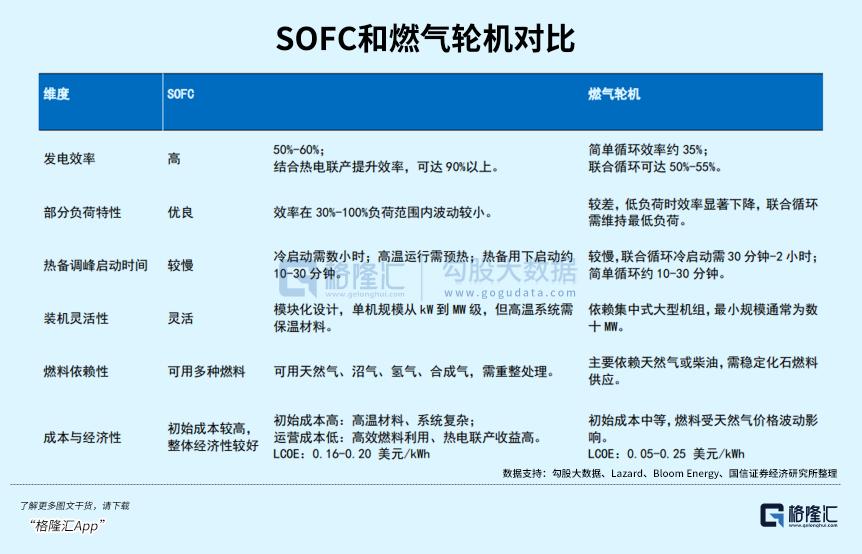
Moreover, bottlenecks will be transmitted step by step. The approval cycle of the power grid pushes up the order pressure of gas turbines, and the scheduling bottleneck of gas turbines pushes the remaining demand to the third path. Friction in each path will be converted into a demand thrust for the next path.
However, SOFC also has thresholds to cross. Its core bottleneck lies in the speed of capacity expansion. Whether the capacity ramp-up can be fulfilled as scheduled directly determines the maximum market space this path can support in the next five years.
Supply Chain
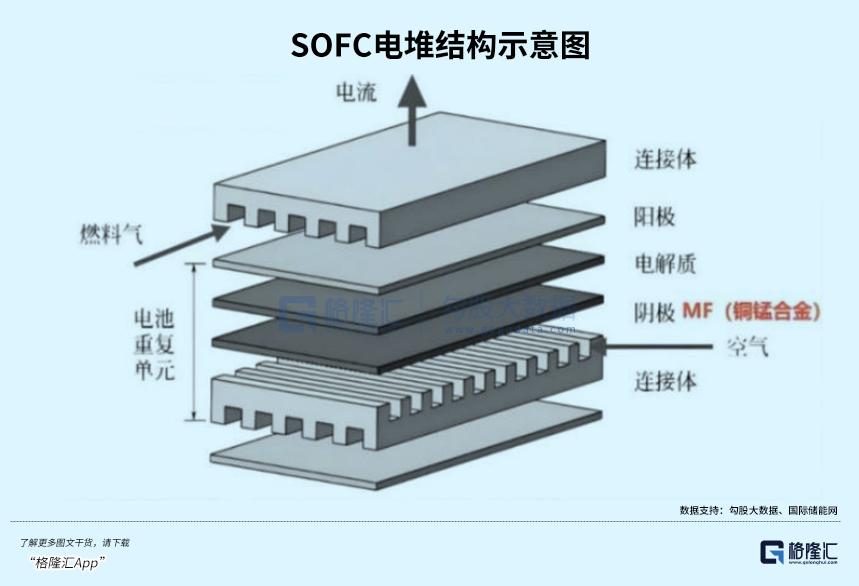
In the value distribution of the SOFC industrial chain, electrolytes and stacks together account for 35% to 45% of the BOM cost.
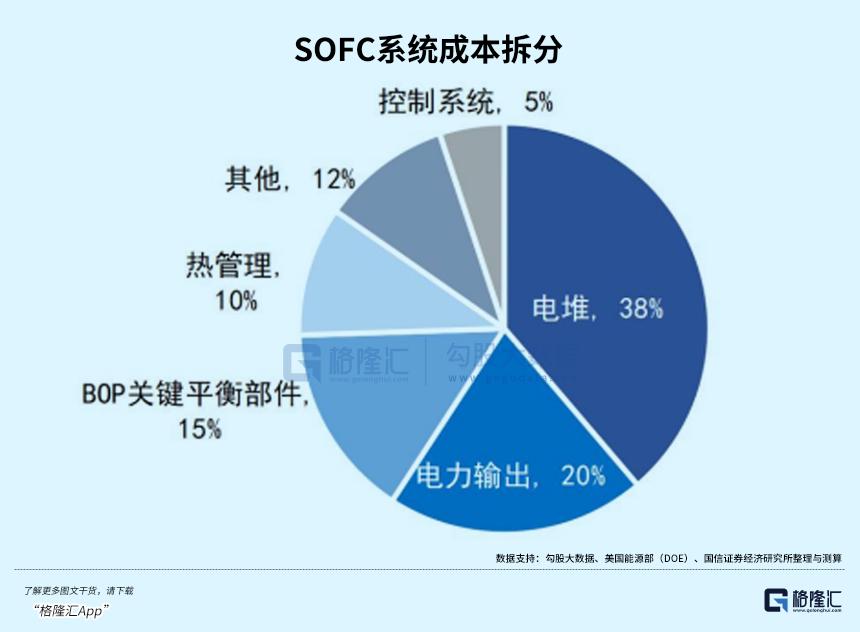
The electrolyte formula (especially the ScSZ route adopted by BE) and stack manufacturing process (screen printing + co-sintering) are the most difficult parts to replicate in the entire SOFC system.
The core of the industrial chain — BE Energy (hereinafter referred to as BE) was founded in 2001. Over the past 25 years, it has developed SOFC from a laboratory technology into a commercially scalable product, with a global market share of over 65%.
In addition to BE, Mitsubishi, Doosan and Ceres in Japan and South Korea have their own technical reserves, but their commercial scale is not at the same level as BE. This means that BE's capacity expansion rhythm directly determines the flexibility release space of the entire industrial chain.
BE's expansion is supported by order flow. The total backlog reached 20 billion US dollars in 2025, and the product backlog increased by 140% year-on-year. The largest orders are as follows:
Oracle — signed a master service agreement with a maximum capacity of 2.8GW in April 2026, and the initial 1.2GW is already under deployment. Among them, a 2.45GW park in New Mexico is completely powered by BE's SOFC, operating independently from the power grid, replacing the gas turbines and diesel generators in the original plan.
AEP — a 20-year long-term agreement of 900MW worth 2.65 billion US dollars, converted from an option to a firm contract in January 2026, to power a data center park in Cheyenne, Wyoming. Another unnamed large cloud service provider — with a maximum capacity of 2.45GW, BE is designated as the exclusive on-site power supplier.
Coupled with Brookfield's 5 billion US dollar capacity investment and CoreWeave's AI data center project that has been put into operation in Q3 2025, BE's order spectrum covers the complete chain from power companies to AI cloud service providers to infrastructure capital.
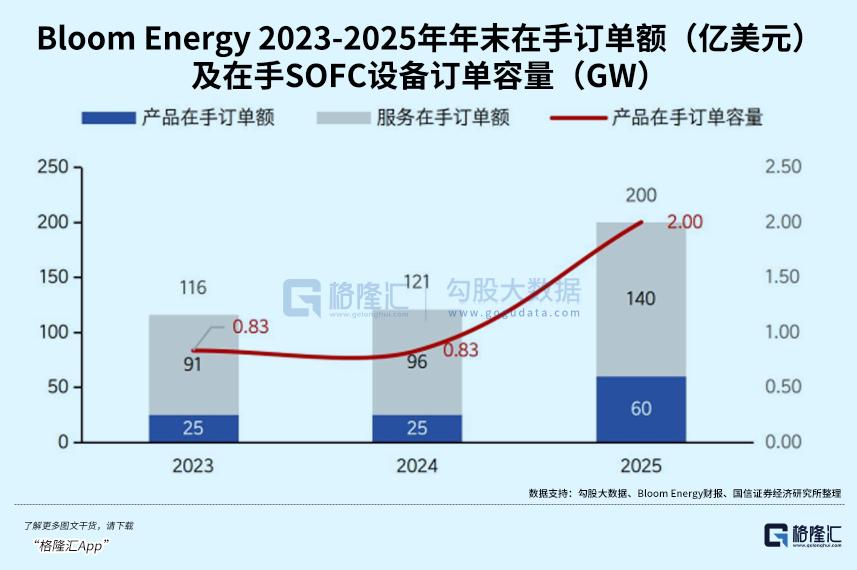
However, the capacity ramp-up faces considerable thresholds.
The first threshold is scandium.
BE's ScSZ route outperforms the industry's general YSZ, at the cost of high dependence on scandium. About 45 tons of scandium are consumed per GW, and 5GW corresponds to more than 220 tons. The global annual output of scandium is about 240 tons, while the annual demand has exceeded 310 tons. The scandium market itself is in a state of supply shortage. If BE reaches its 5GW production target as scheduled, it will almost need to lock in more than 90% of the global scandium supply.
What's more complicated is that global scandium resources are dominated by China. The company's CEO has publicly claimed many times that "there is no dependence on the Chinese supply chain", but according to an independent investigation by HunterbrookMedia in July 2026, it has tracked at least four supply paths that indirectly enter the company's Delaware plant from China.
The second threshold is the engineering difficulty of manufacturing ramp-up.
SOFC manufacturing involves precision ceramic processes. Tape casting of electrolyte sheets, screen printing of electrode layers, and high-temperature co-sintering all have yield windows at each step.
Scaling from 2GW to 5GW, the scarcity of production line engineers, quality consistency during process transfer, and the arrival cycle of key equipment are all time costs that cannot be skipped in precision manufacturing.
How deeply are Chinese companies embedded in this chain?
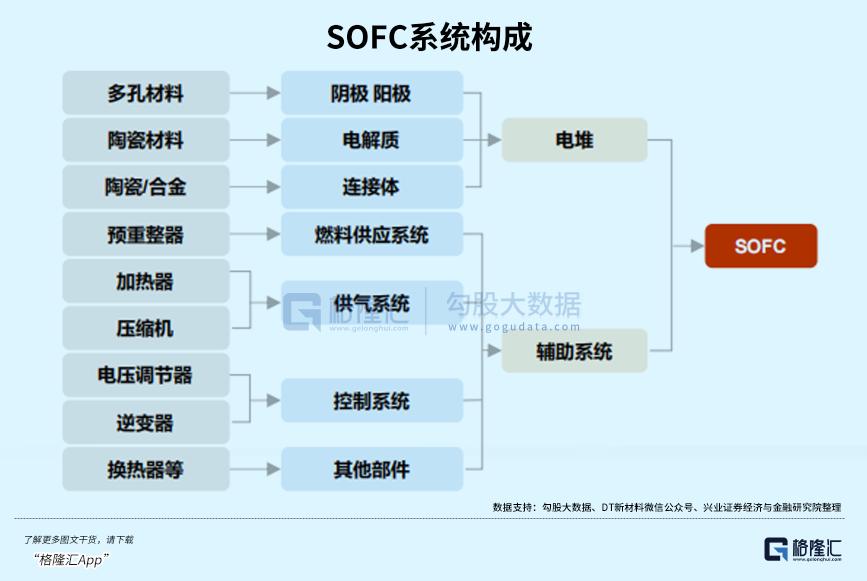
The Secretary of the Board of Directors of Sanhuan Group directly replied in September 2025: "We have established a long-term cooperative relationship with BE and are its main supplier." BE provides the ScSZ formula, and Sanhuan undertakes precision ceramic OEM. Sanhuan will directly benefit from BE's capacity expansion.
The microchannel heat exchanger of Kaizhong Precision has passed BE's certification and entered mass production and supply. The metallic chromium products of Zhenhua New Materials have also entered the interconnector supply chain of BE.
There is currently insufficient confirmation basis for both Johnson Electric and JingquanHua. Johnson Electric stated in public channels that it "supports mainstream SOFC manufacturers", but did not specifically refer to BE. JingquanHua was mentioned in industry reports as "indirectly supporting BE", without official confirmation from the company.
Beneficiary Directions in China
Attaching to BE's supply chain is a path for Chinese enterprises to enter the SOFC field. At the industrial level, there are two other independent investment logics: the YSZ material price increase chain triggered by rare earth regulation, and the long-term layout of China's independent SOFC route.
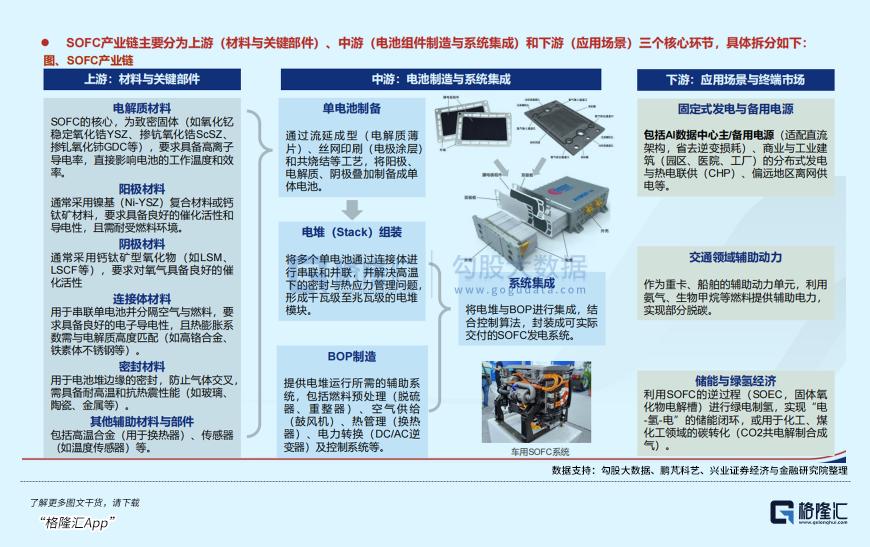
YSZ is not only the basic material for SOFC electrolytes, but also widely used in downstream industries such as dentistry, semiconductors and sensors. After China launched the rare earth export control to Japan, China's yttrium oxide exports to Japan plummeted by 93.8%. Japan's TOSOH accounts for 44% of the global high-end YSZ production capacity, and directly stopped production due to raw material supply interruption.
The supply gap is quickly reflected in prices. The domestic price of yttrium oxide rose from 41,000 yuan per ton to 57,500 yuan, an increase of about 40%. The overseas market is more drastic, with the unit price soaring from 10 US dollars per kilogram to 500 to 700 US dollars, an increase of more than 5000%. The price difference between domestic and overseas expanded to 50 to 85 times, forming a structural premium.
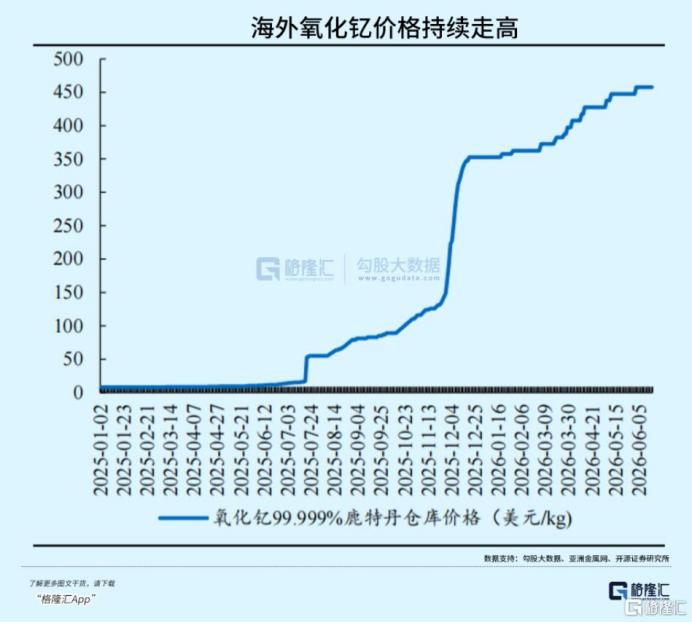
The capital market has already priced in the supply gap.
Sinocera Materials announced on July 20 that it will raise the price of zirconia powder by 10% to 40%, with high-end YSZ powder leading the increase. The company's stock price started at 51.6 yuan in early June, and hit a maximum of 112.88 yuan intraday on June 29, doubling.
Orient Zirconium Industry is a leading domestic zirconium product manufacturer. After Japan's TOSOH stopped production due to raw material supply interruption, the remaining global high-end YSZ capacity gap directly points to its export substitution. Its stock price started at 13.01 yuan in early June, and hit a maximum of 26.85 yuan intraday on July 2, also doubling.
The other logic is China's independent SOFC route, where domestic enterprises independently develop stacks and systems, targeting distributed power generation and industrial by-product hydrogen scenarios.
Shenzhen Sanhuan's 300kW project is the first commercial demonstration in China and has been put into operation. The T100/T200 series test systems of Proton Power have been delivered to central enterprises. The demonstration project cooperated by Shaanxi Gas and Weichai Power has also been put into operation. The 8kW system of Yishitong is in trial operation, and the 30kW prototype of Zhongzi Technology has completed R&D.
Epilogue
All in all, Against the backdrop of the power bottleneck of North American AI data centers, the release of demand for SOFC on-site power supplies is opening up opportunities for the entire industrial chain. According to institutional estimates, under the neutral scenario, the demand for SOFC systems in North American data center scenarios is expected to reach 761.6 billion yuan in 2030, with AI data centers being the largest incremental engine.
Overseas, BE has taken the lead in completing GW-level order verification, and its integrated capabilities from product delivery to operation and maintenance financing have built a clear first-mover barrier.
Whether BE's GW-level orders can be fulfilled as scheduled into MW-level deliveries, whether the capacity ramp from 2GW to 5GW can proceed smoothly, and whether the system cost can continue to drop to a level comparable to traditional solutions, these factors will determine the fulfillment rhythm on the supply side.
The two domestic paths have completely different time scales. The complete machine system is still waiting for the first whistle of commercialization, while the components have already gone through the closed loop from certification to mass production.
However, the stock prices of the targets are highly volatile. Between the correct direction and reasonable valuation, there is a whole industrial chain's performance to be fulfilled.
What has not been fully priced in is the quarterly MW delivery, the changing trend of upstream materials, and each yield improvement. The marginal changes in these physical volume data are the variables that will drive the valuation center to move up and down in the future.
Gelonghui Statement: The views in the article all come from the original author and do not represent the views and positions of Gelonghui. Special reminder: Investment decisions need to be based on independent thinking. The content of this article is for reference only, and does not serve as any practical operation suggestion. Transaction risks are borne by the investors themselves.