It is quite a surprise that none of the profit-making companies rely on hydrogen energy business, while all those that have placed big bets on hydrogen energy are running at a loss, and the semi-annual reports of 10 hydrogen-related companies have been released.
Hydrogen energy is still in the cultivation stage, and the traditional core business determines whether an enterprise can survive.
Energy Foresight noted that in July 2026, ten listed hydrogen-related enterprises successively released their first-half performance reports. Huachang Chemical posted a net profit of 123 million yuan, surging more than 10 times year on year; Donghua Energy expected a profit of nearly 200 million yuan, with the maximum growth rate reaching 266%. On the other side, Meijin Energy expected a maximum loss of 650 million yuan, Lanshi Heavy Industry expected a maximum loss of 180 million yuan, Jingcheng Co., Ltd.'s loss expanded to the 70 million yuan level, and Petrochemical Machinery turned from profit to loss.
Hydrogen energy is the future story shared by all these companies — hydrogen production, hydrogen storage, hydrogen refueling, fuel cells, hydrogen heavy-duty trucks, hydrogen bicycles, with different narratives for each. However, the half-year reports reveal a more realistic proposition: hydrogen energy businesses are almost all in the early stage of cultivation, far from the stage of contributing profits. What really determines who can survive in this long run is still the old question — whether the traditional core business can hold up.
Overview of the first-half performance of ten enterprises
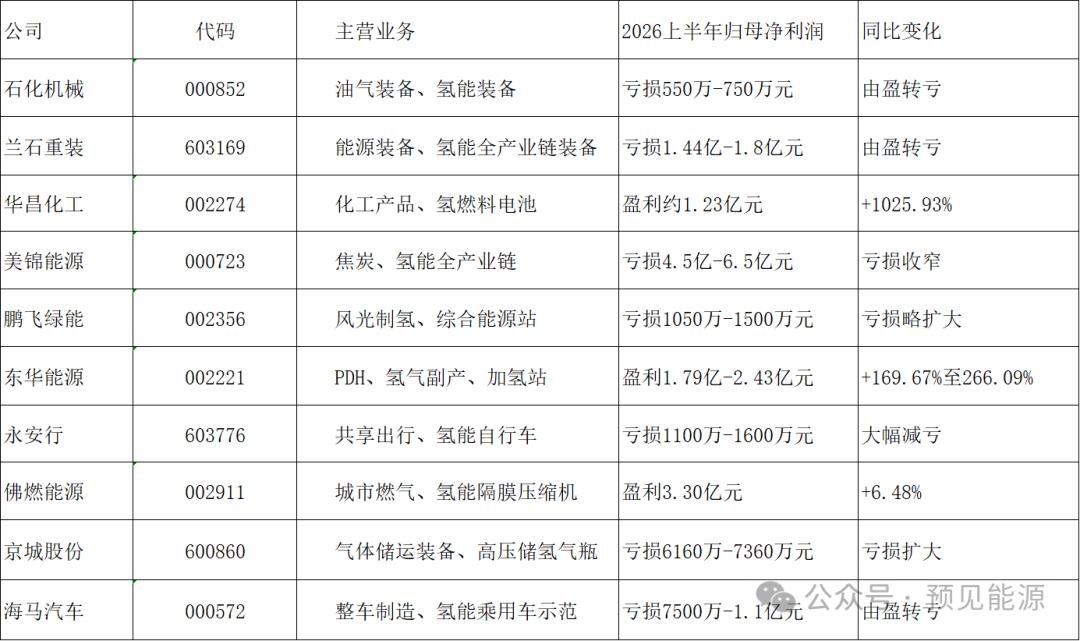
Data source: 2026 semi-annual performance forecast/express of each company
Among the ten enterprises, five made losses and five made profits. But none of the profitable enterprises made money from hydrogen energy.
The same story, different hidden cards
The common feature of these ten enterprises is that: all have laid out hydrogen energy businesses, but their hydrogen energy operations are still in the investment period, and none of them can generate large-scale profits from hydrogen energy.
Huachang Chemical's hydrogen energy business fully relies on its subsidiary Huachang Energy, focusing on the layout of hydrogen fuel cell stacks, engines and testing systems, and has built a hydrogen refueling station with a daily hydrogen refueling capacity of 500kg and a hydrogen filling station with a daily output of 4 tons of hydrogen.
In 2022, the first batch of 10 120kW hydrogen heavy-duty trucks were delivered for demonstration operation, and 25 hydrogen fuel cell buses were delivered in early 2025. However, the company admitted that there has been no major breakthrough in market business expansion, and hydrogen energy is still positioned as a "future industry under cultivation".
Meijin Energy has a very complete hydrogen energy layout, covering all links of hydrogen production, storage and transportation, hydrogen refueling and complete vehicle manufacturing, and has built a complete chain of "hydrogen production - stack - complete vehicle" by holding and participating in many industrial chain enterprises. The company produces hydrogen nearby in Shanxi, Hebei, Guizhou and other regions and supports hydrogen refueling stations, claiming that it has the ability to control the terminal hydrogen price within 25 yuan/kg in the surrounding areas of the hydrogen production base. However, these layouts are far from the stage of generating large-scale profits at present.
Donghua Energy's four sets of PDH units can produce about 100,000 tons of high-purity hydrogen as by-product per year, and the Zhangjiagang Gangcheng Hydrogen Refueling Station was put into operation at the end of 2020. However, the proportion of hydrogen revenue in the overall profit is still limited, and the company's first-half profit came from the spread expansion brought by the rise of international energy prices caused by geopolitical conflicts.
Foran Energy has a gross profit margin of about 29% for its new energy business, and the gross profit margin of SOFC fuel cells, hydrogen energy diaphragm compressors and other businesses exceeds 33%. However, the volume of these high-margin businesses is still small, and the company's overall profit still depends on its core urban gas business.
Yonganxing recorded a hydrogen energy business revenue of 65.0858 million yuan in 2025, with a gross profit margin of 30.30%, but this volume cannot cover the depreciation and operation and maintenance costs of its core shared mobility business.
Jingcheng Co., Ltd. explained the reason for its loss more directly: emerging businesses such as hydrogen energy are still in the initial stage of industry cultivation, and the overall market size has not met expectations.
The common point is very clear: everyone is laying out hydrogen energy, but no one makes money from hydrogen energy. Hydrogen energy is the future, not the present.
The traditional core business is the real watershed
Why do some enterprises make profits while others suffer losses even though they all lay out hydrogen energy? The answer does not lie in hydrogen energy, but in the traditional core business.
Huachang Chemical turned losses into profits in the first half of the year, due to the rise in product sales prices and the increase in sales volume brought by the commissioning of the polyol project. It has nothing to do with hydrogen energy.
Donghua Energy expected a profit of nearly 200 million yuan in the first half of the year, because geopolitical conflicts pushed up international energy prices and the price spread of main products expanded. It also has nothing to do with hydrogen energy.
Foran Energy's revenue decreased but its profit increased, because it actively cut off low-margin businesses. It still has nothing to do with hydrogen energy.
Looking at the loss-making enterprises on the contrary.
Lanshi Heavy Industry lost 180 million yuan, because the competition in the traditional energy equipment industry intensified, product selling prices went down, the revenue scale did not reach the break-even line, and the development of new metal materials business fell short of expectations. Hydrogen energy cannot help.
Meijin Energy lost 650 million yuan, because the coke business was affected by the fluctuation of upstream coal supply and downstream steel market demand. Hydrogen energy cannot help either.
Petrochemical Machinery turned from profit to loss, because the investment in upstream oil and gas exploration slowed down, and the demand for oil and gas equipment market was released slowly. Hydrogen energy cannot help as well.
Jingcheng Co., Ltd.'s loss expanded, because emerging businesses such as hydrogen energy are still in the initial stage of cultivation, coupled with the increase in R&D investment. Hydrogen energy not only failed to help, but is still burning money.
Enterprises with profitable traditional core businesses take hydrogen energy as a welcome addition; enterprises with loss-making traditional core businesses cannot be saved by hydrogen energy. This is the most direct message conveyed by the half-year reports of these companies.
The gap between policy support escalation and commercialization bottlenecks
While these companies released their half-year reports, the policy side of the hydrogen energy industry is heating up rapidly.
In March 2026, the *Government Work Report* positioned hydrogen energy as a "new growth point" for the first time, and set up a national low-carbon transformation fund to support its cultivation. The outline of the 15th Five-Year Plan clearly lists hydrogen energy, quantum technology, biomanufacturing and nuclear fusion energy as the key cultivation directions for future industries.
In June, three government departments issued the *Notice on Launching Comprehensive Hydrogen Energy Application Pilot Work*, selecting 5 urban agglomerations through the "open competition for selected projects" mechanism, with a pilot period of 4 years, and a single urban agglomeration can obtain a maximum of 1.6 billion yuan of reward subsidies instead of financial allocation. The goals are clear: the average terminal hydrogen price will drop to below 25 yuan/kg by 2030, and the ownership of fuel cell vehicles will strive to reach 100,000 units.
Data from the National Energy Administration shows that the year-on-year growth rate of investment in the hydrogen energy sector in the first half of 2026 exceeded 160%.
The policy side is hot, the investment side is hot, but the profit statements of enterprises are cold.
According to data from the China Association of Automobile Manufacturers, in June 2026, the output of hydrogen fuel cell vehicles was 100 units, down 46.8% year on year; the sales volume was 50 units, down 78.9% year on year. The average terminal hydrogen refueling price in non-subsidized areas exceeds 40 yuan/kg, and the fuel cost per kilometer is higher than that of pure electric vehicles.
This is the gap. Policies are promoting, investment is pouring in, but the terminal market has not yet taken off. While enjoying policy dividends and capital attention, enterprises are under financial pressure brought by R&D investment and production capacity construction. Jingcheng Co., Ltd. stated clearly in its announcement — "Emerging businesses such as hydrogen energy are still in the initial stage of industry cultivation, and the overall market size has not met expectations".
Policies have opened up the track, but the market has not yet brought returns.
The spring of the hydrogen energy industry will come sooner or later. The question is who can survive until that day. Judging from these ten half-year reports, the answer does not depend on how well the hydrogen energy story is told, but on how long the traditional core business can hold on. Enterprises with resilient core businesses that can continuously generate cash flow are qualified to wait for the day when hydrogen energy truly becomes a source of profit. For enterprises whose core business is already losing blood, hydrogen energy will only make them lose blood faster.