Daily spending exceeds 20 million US dollars, and short drama, tool and game manufacturers are collectively venturing into the overseas AI sector.
Industry data shows that the current total daily consumption of the overseas micro-short drama market exceeds 20 million US dollars, among which AI-generated dramas account for about 70% of the total. Against this backdrop, DataEye Research Institute finds that recently, a number of overseas short drama and AI drama apps have been newly launched for user acquisition campaigns, including many enterprises that used to produce domestic short dramas, such as Guyan Network, Qinjiu Network, Yueyou Technology, etc.
Moreover, even some manufacturers that previously focused on game and tool products have increased their investment in overseas short drama businesses. As AI technology greatly reduces production costs, players from different tracks are pouring into the same battlefield.
01 Under AI equalization, are AI dramas and comic dramas ushering in a period of full competition?
Data from ADX Overseas Short Drama Edition shows that since June this year, many enterprises that have long been engaged in domestic short drama business have begun to deploy overseas short drama apps. DataEye Research Institute has briefly sorted out the relevant information as follows:
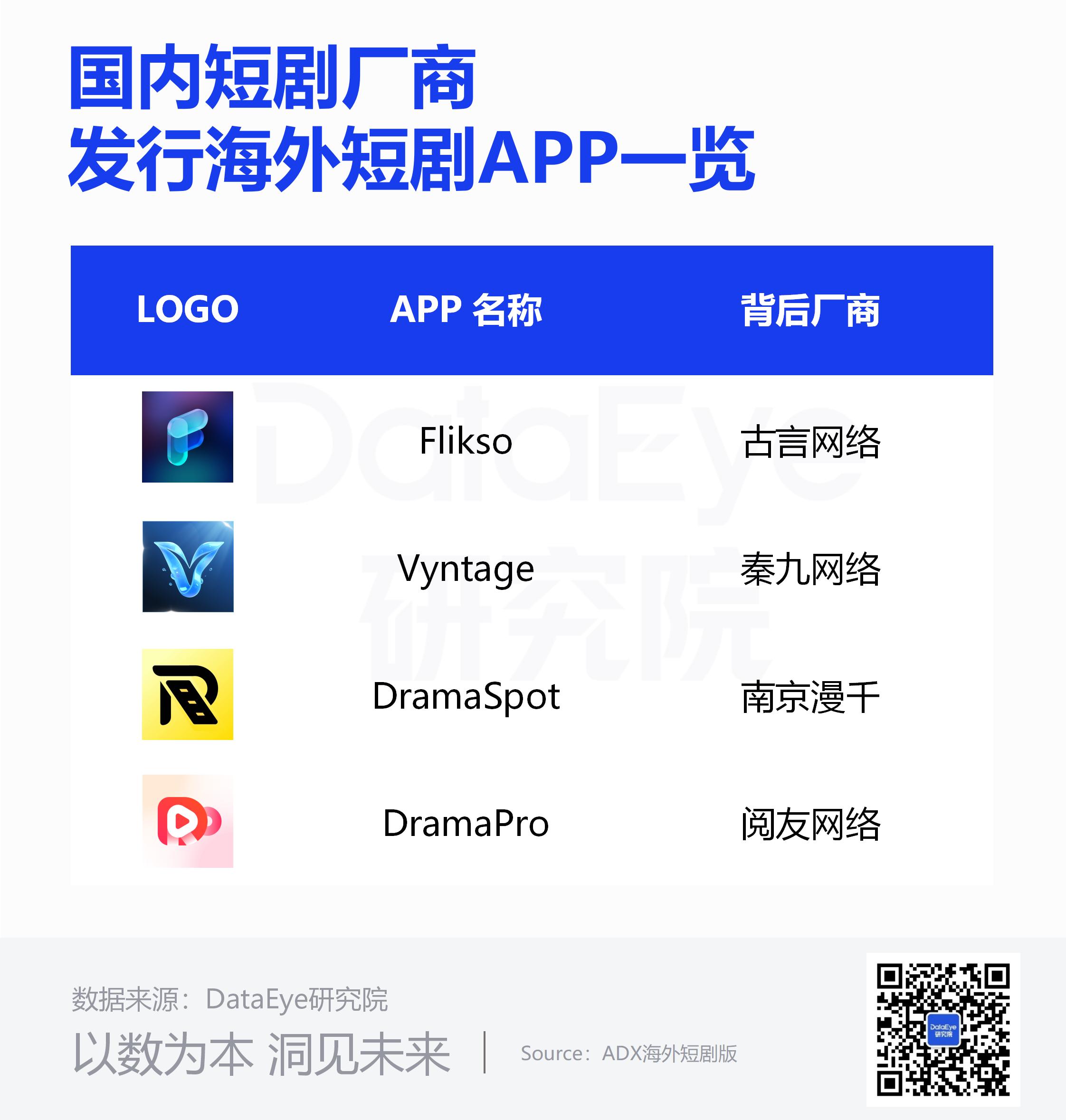
The above manufacturers have accumulated experience in the domestic micro-short drama track to varying degrees. Among them, Flikso and Vyntage, as new products, have also invested considerable efforts in ad delivery:
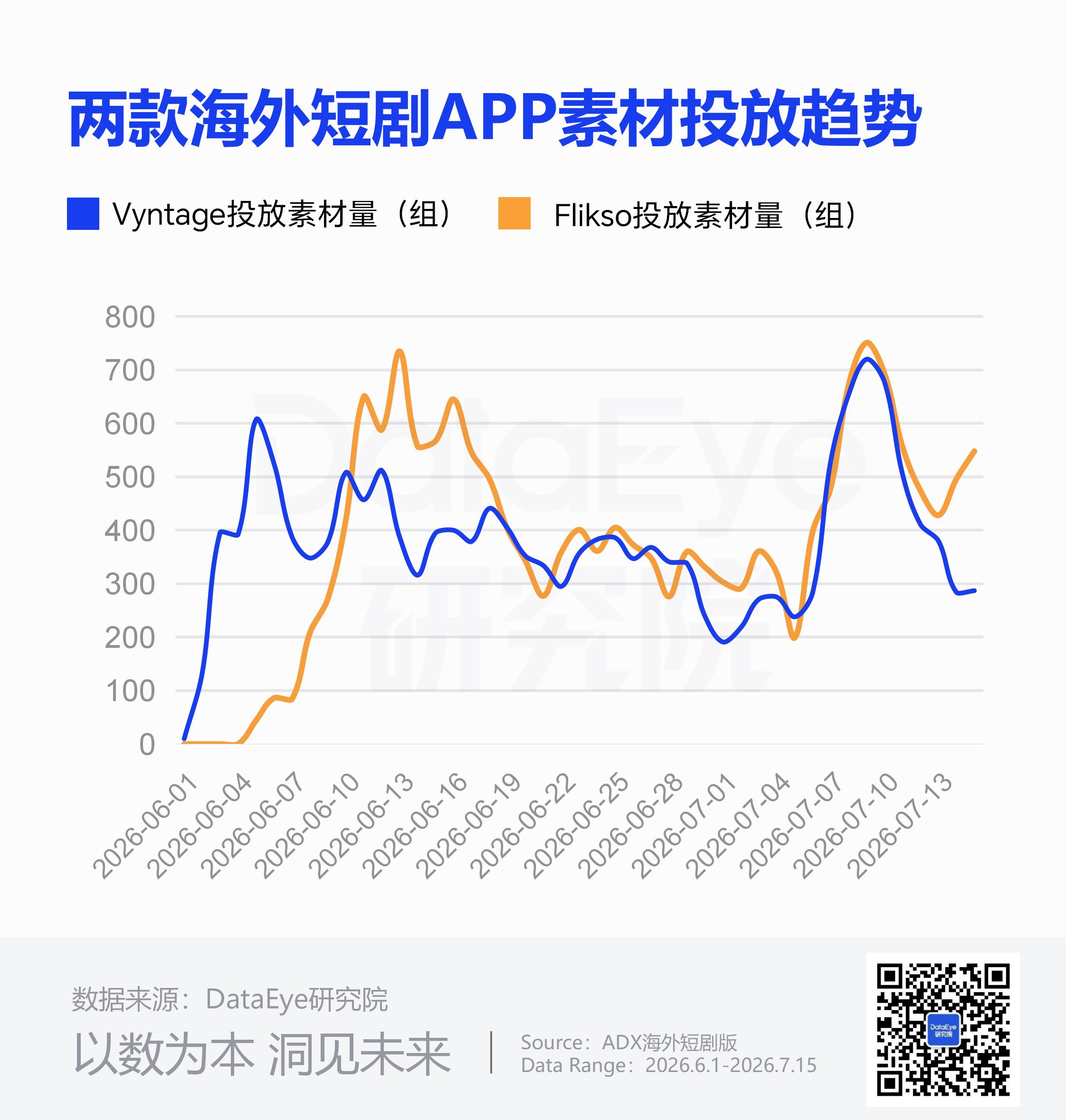
Data from ADX Overseas Short Drama Edition shows that Flikso launched its ad delivery on June 5, with the maximum number of daily delivery materials approaching 800 groups, and the number stabilized at around 400 groups in late June. Vyntage started ad delivery on June 1, and the number of daily delivery materials has remained at about 400 groups so far.
It is worth noting that most of the short dramas promoted by these two products are AI-generated dramas. Why do they all turn their attention to overseas markets at this moment?
AI technology is the key variable behind this trend.
In the past, entering the overseas local drama market required a lot of manpower and material resources, including a series of work such as shooting teams, venues, and actor coordination. The cost of a single overseas drama was as high as 100,000 to 200,000 US dollars.
Now, with the maturity of AI technology, the production cost of a single AI short drama has been drastically reduced, with the cost of one drama only ranging from 50,000 to 100,000 RMB, and the team only needs 3 to 5 people. As the threshold for "testing the overseas market" drops, some small and medium-sized manufacturers also have the qualification to enter the market.
In addition, AI has largely solved the cultural adaptation problem that plagues the overseas expansion of traditional short dramas. In the past, when live-action short dramas entered the overseas market, they often faced the dilemma of "acclimatization" due to multiple factors such as scenarios, actors, languages, cultural customs and other aspects. However, AI dramas can directly generate overseas scenes and character images, and it is easier to produce corresponding short dramas adapted to overseas cultural customs. The cost is almost no significant difference from that of domestic-themed dramas, which further lowers the threshold for going overseas.
Against this background of AI equalization, the era of "all competitors flocking to the track" for overseas short dramas has arrived. But it is worth noting that in this wave of overseas expansion, the participants are far more than the old players in the domestic micro-short drama track.
02 Three types of manufacturers: short drama producers, game developers and tool developers are collectively crossing boundaries
Further observation shows that the players entering the overseas short drama market in this round mainly fall into three categories: domestic short drama manufacturers, game manufacturers, and tool manufacturers.
In terms of game manufacturers, companies including GOOD GAMES, 17 Funs Game, Mee Game and H2 gaming have also entered the market one after another.
17 Funs Game is worth special attention. According to TapTap, 17 Funs Game once planned RPG products such as *The Return of the Great Sage M* and *The Record of a Mortal's Journey to Immortality*. In 2022, as a distributor, it was still looking for MMO, card and other types of products that can be released overseas.
In terms of tool manufacturers, Zixing Network, Fire Technologies, PixelPort Technology, Hangover Studios, Ka Chuang Technology, Huidin Technology and other enterprises have also entered the market one after another.
DataEye Research Institute sorts out the relevant information as follows:
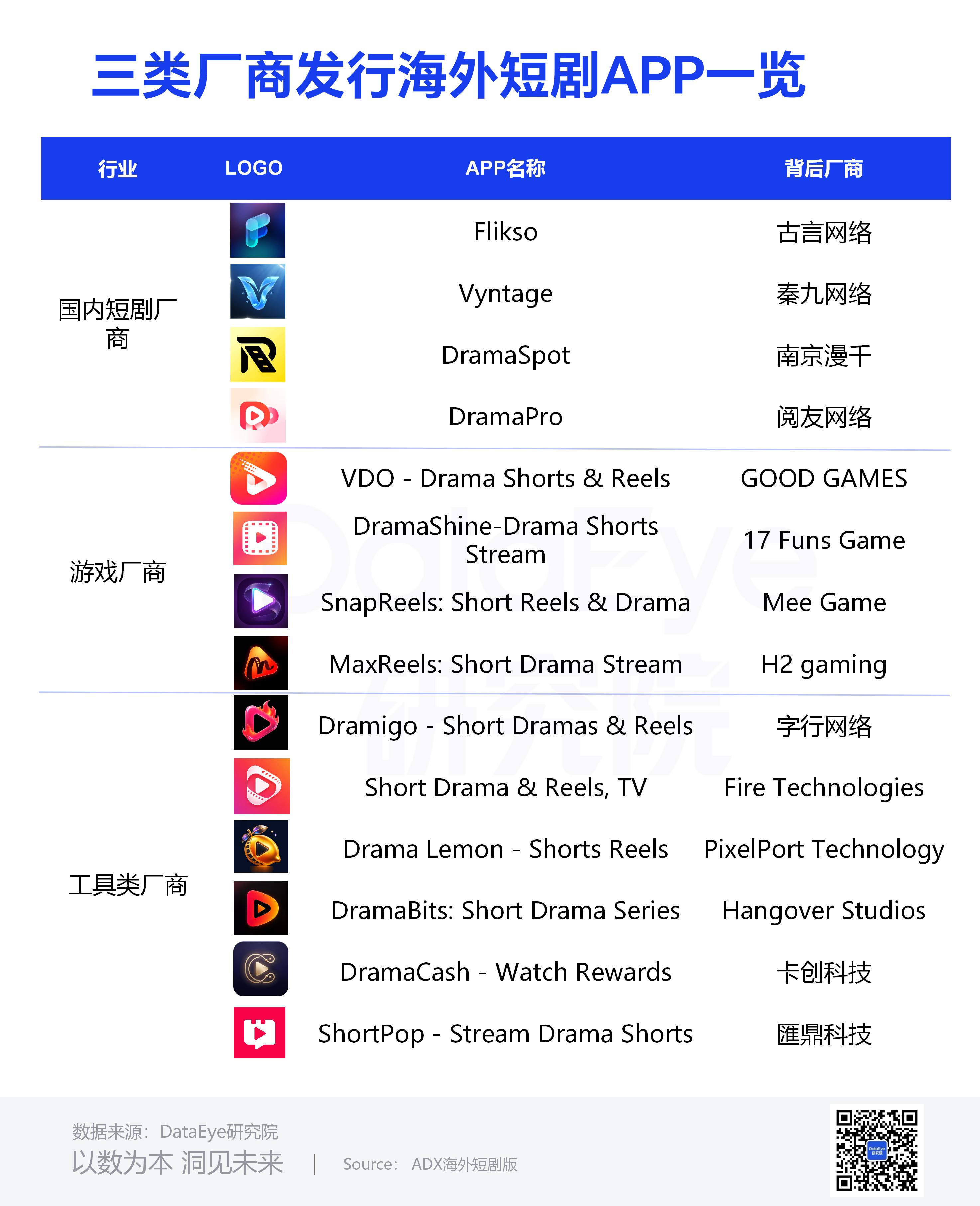
It is worth noting that although the backgrounds of these three types of manufacturers are significantly different, they show a high degree of concentration in the time dimension: their launch times are all concentrated in the past two months or so. The underlying logic behind this is as mentioned above: the maturity of AI technology has greatly reduced production costs, attracting different manufacturers to cross the border collectively.
In addition, overseas AI dramas are also at the critical point of explosive growth, with sufficient short-term market dividends and broad long-term incremental space.
However, although AI technology has reduced production costs, whether the capital threshold for overseas short drama apps has been significantly lowered is also a key issue that new entrants need to consider.
The core reason is that the core competition logic of the overseas short drama industry is not simply content generation, but also the ability to acquire traffic and recycle cash flow.
As a typical user acquisition-driven industry, overseas short dramas require continuous and rolling capital investment for ad delivery, and the cash flow is under long-term pressure. At the same time, as the market gets hotter and more players enter, the cost of user acquisition keeps rising, which eventually puts forward higher requirements for the enterprise's capital reserve and sustainable profitability.
Therefore, small and medium-sized teams with insufficient capital reserves that blindly enter the track are very likely to be forced to exit the market due to cash flow pressure. In this case, where are the opportunities for small and medium-sized manufacturers?
03 Deep cultivation of segmented and niche tracks may be the opportunity for small and medium-sized manufacturers
At present, most traditional overseas short drama apps follow a relatively broad path: covering multiple markets, multiple languages and multiple themes to cover as many user groups as possible, but this also means higher operating costs and content costs.
However, the overseas market is different from the unified domestic market, and there are huge differences in user preferences and population characteristics in different regions. Therefore, DataEye Research Institute believes that for small and medium-sized manufacturers with shallow capital reserves, abandoning the "large and comprehensive" model and focusing on vertical, segmented and niche tracks may be a way to break through the current situation.
Specifically, the following directions are worth paying attention to:
① Language/region segmentation
Taking the US market as an example, as the region with the highest willingness to pay in the world, the US market is also the market with the highest competition intensity for overseas short dramas. But it is worth noting that in addition to English, Spanish, as the second largest language in the United States, also has a huge user group.
According to the 1-year estimate data of the 2024 U.S. Community Survey released by the U.S. Census Bureau, among the U.S. population aged 5 and above, about 44.9 million people speak Spanish at home. Focusing on this segmented market will lead to more concentrated bidding areas for ad delivery, more accurate user portraits, and significantly reduced capital pressure. At the same time, focusing on a single region is also more conducive for teams to deeply understand local cultural preferences and consumption habits, so as to create truly adapted content.
② Crowd segmentation
In terms of crowds, manufacturers can also try to make in-depth layout for specific groups, such as the LGBTQ+ group, African American group in the US, or a certain ethnic/immigrant group, etc. The more vertical the crowd is, the clearer the content style will be, and the stronger the sense of belonging of users will be.
③ Theme segmentation
Segmentation in themes is the most noteworthy. In the AI era, manufacturers can focus on one or two advantageous themes to develop thoroughly, highly bind the app with the theme itself, and form a brand effect, such as focusing on AI fantasy dramas, AI sad-romance dramas, etc.
For example, My Drama, the leading platform for overseas short dramas, focuses on the "special emotion" theme. Most of the hit dramas on this platform focus on LGBTQ+ relationships, ethical romances, forbidden romances, dark romance and other contents, forming a unique style.
In general, the core advantages of this vertical strategy lie in clear positioning and focused user groups, which avoids head-on competition with large manufacturers in the mainstream direction, and is expected to build vertical barriers in the segmented market.
However, the vertical strategy also has certain limitations: the user scale of the segmented market is naturally limited, the ceiling is relatively low, and it requires continuous deep cultivation in the selected direction.
It is worth noting that overseas AI short dramas are not a short-term arbitrage track. Enterprises need to abandon short-term speculative thinking and make long-term business plans. In the era of "all competitors flocking to the market", instead of "wanting to do everything but not doing anything thoroughly", finding a suitable ecological niche and developing vertically may be the best choice for small and medium-sized manufacturers.
This article is from the WeChat official account "DataEye" (ID: DataEye), written by DataEye, and authorized for release by 36Kr.