Kering's Turning Point: Being an AI Optimist in China
Author | Xie Yunzi, Huang Yida
Editor | Zhang Fan
Kering's transformation has delivered initial positive results.
On July 28, French luxury group Kering released its 2026 first-half financial report, posting revenue of 7.22 billion euros, representing a 1% year-on-year increase on a like-for-like basis.
A more critical signal lies in the second quarter: the single-quarter revenue reached 3.652 billion euros, up 2% year-on-year. Against the backdrop of lingering uncertainty in the Middle East and a global consumption downturn, Kering achieved its first positive single-quarter revenue growth in three years.
Among its portfolio, core brand Gucci recorded second-quarter revenue of 1.41 billion euros, with its year-on-year decline narrowing to 2% from 8% in the first quarter, marking a 7 percentage point quarter-on-quarter improvement, whose performance recovery exceeded market expectations. Over the first half of the year, Gucci's revenue hit 2.757 billion euros, with a recurring operating margin of 17%, up 1 percentage point year-on-year.
For other brands, Yves Saint Laurent (YSL) returned to growth in the first half of the year with solid performance in North America and Western Europe; Bottega Veneta outperformed expectations with accelerated growth across all regions quarter on quarter; Balenciaga is still in its creative transition phase.
In terms of channels, as of June 30, the group operated a total of 1,635 directly-operated stores, with a net reduction of 84 stores in the first half of the year, down 5% from the end of 2025. In the second quarter, the directly-operated retail network recorded a 2% year-on-year sales growth, representing a 4 percentage point quarter-on-quarter improvement. Wholesale and other revenues grew by 5%.
Boosted by the financial report, Kering's Paris-listed shares surged at the opening the next day, closing 17% higher on the day.
The seeds of this confidence were sown back in April this year. At the Capital Day held in Florence, Italy, newly appointed Kering CEO Luca de Meo officially unveiled the "ReconKering" strategy.
The strategy focuses on reigniting brand appeal, strengthening operational excellence to lead the next era of the luxury industry, and pooling all strengths of its portfolio brands and the Kering platform.
The core targets are to more than double the group's recurring operating margin in the medium term compared with the 2025 level, cut around 1 billion euros of inventory within 12 months, and close about 250 stores in the next four years to boost store productivity, including at least 100 store closures in 2026.
This revival plan has set the tone for Kering's future. Meanwhile, the Chinese market is placed at the core of its strategic transformation.
"For Kering, China has never been just a market. It is the origin driving innovation across the entire group — from cutting-edge technologies to business models, and the evolution of consumer trends."
A week before the financial report was released, Luca de Meo led the group's senior management team to Shanghai for the "Kering China Innovation Day". In his view, the luxury industry boasts huge space for technological innovation, but technology has never been the core topic. "Just as the left and right hemispheres of the human brain need to work in synergy, we hope to achieve deep integration of art and science."
This "tech-savvy" CEO, who previously worked at Volkswagen and came from the automotive industry, always regards AI as an enabling tool. He also believes that the Chinese market, with strong accumulated data resources, will become a leader in AI innovation.
The following is an excerpt from the dialogue hosted by 36Kr.
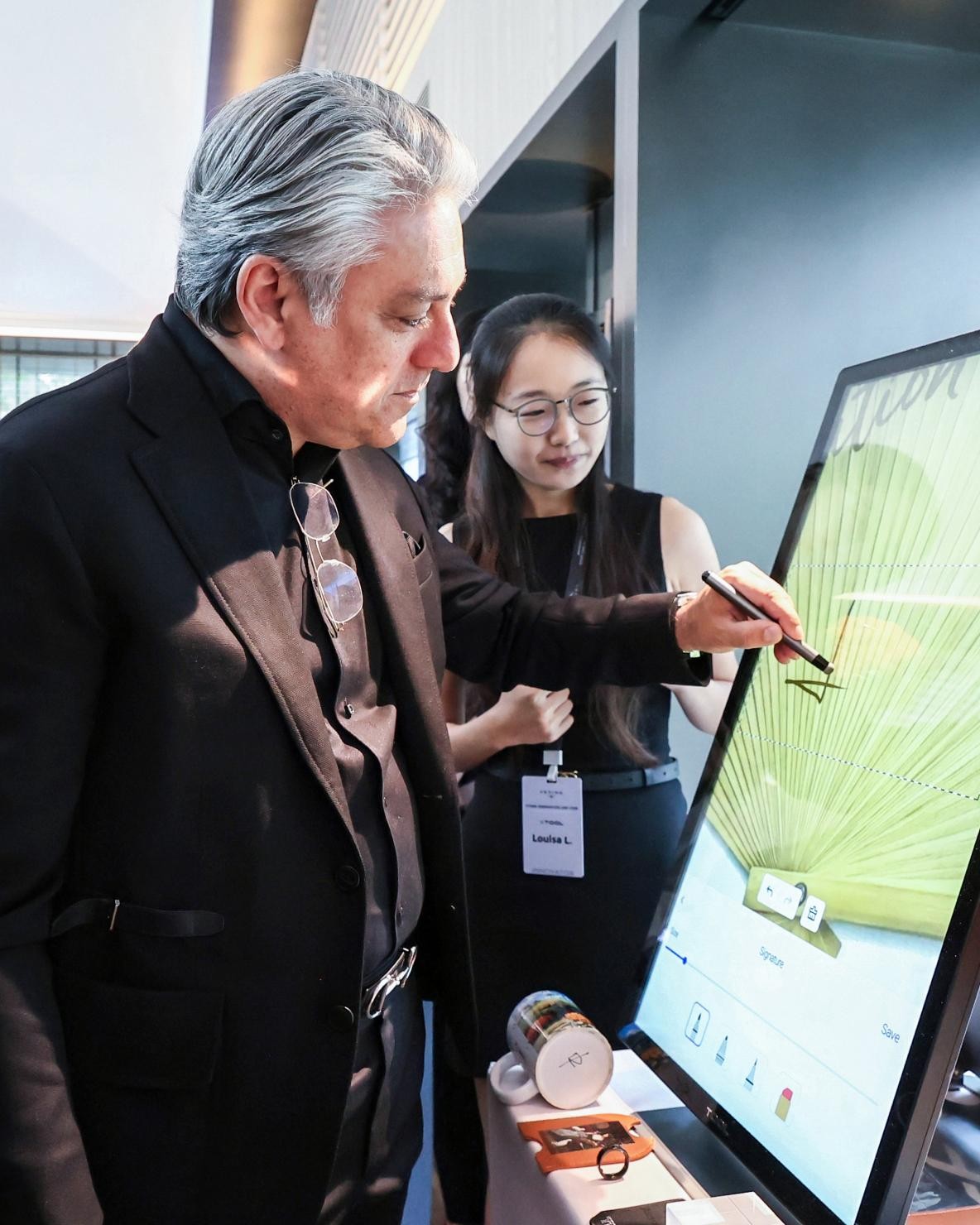
Luca de Meo at Kering China Innovation Day; Image courtesy of Kering Group
About China: From a Market to an Innovation Origin
Q: This is your second visit to China as Kering's CEO.
Luca de Meo: Actually, I have deep ties with the Chinese market, having visited here more than 20 years ago.
Before joining Kering, I worked extensively in the automotive industry at Volkswagen. Volkswagen has maintained close ties with China since the 1980s. Later, I joined a French automotive company where I led a key and highly valuable strategy — to set up localized R&D centers in China.
We were the first to roll out our R&D system in China. Even with considerable trial-and-error risks, we achieved disruptive results: we drastically shortened the product R&D cycle through a brand new path underpinned by digital technologies. That was only two or three years ago, and I know it is a feasible approach.
Q: This time you led the Kering team to China, what goals do you hope to achieve?
Luca de Meo: ReconKering is not only focused on data indicators, implementation and performance, but also on reshaping the mindset of all employees and the organizational culture. That is also the core goal of this trip: to humbly listen to the insights of every colleague, and refine the localized Chinese version of the ReconKering strategy based on feedback from all parties.
Q: What is the strategic position of the Chinese market in this round of the group's transformation?
Luca de Meo: We firmly believe that the Chinese market will remain the core hub for global high-end categories. Based on this confidence, we will continue to elevate the strategic weight of the Chinese market.
At the same time, we have observed that the Chinese market is undergoing transformation: the consumer ecosystem is maturing, and consumers are raising higher requirements for brands. They have independent judgment and a very thorough understanding of brands. We know that the industry's growth dividends may shift to new categories. In this context, China is exactly the perfect testing ground for the group's transformation.
Q: Kering launched the "China Innovation Day" back in 2019. How do you understand the innovation ecosystem of the Chinese market?
Luca de Meo: We position the Chinese market as a crucial innovation center for the group. China is the "global manufacturing platform" across all markets. In the manufacturing sector, mature industrial infrastructure, abundant data resources and a vibrant market atmosphere have created unique development advantages.
I have also noticed that local digital ecosystem platforms such as Xiaohongshu and Tencent are extremely widely adopted. The core of artificial intelligence is data. Markets with richer data and faster iteration will naturally achieve greater development, and China will definitely become one of the global leaders in AI innovation.
Q: Kering's China Digital Innovation Center is based in Shanghai. What technological achievements has it made in the past two years?
Luca de Meo: Many industry leaders have not yet realized that the high-end or luxury industry has full room for technological innovation. But technology has never been the core topic.
For example, what our industry calls "creativity" is referred to as "innovation" in other industries. The wording itself reflects the difference in mindset. I have been conveying a proposition to my team: what we most need to implement is the deep integration of art and science, and we cannot rely on only one of them. Just as the left and right hemispheres of the human brain need to work in synergy, we combine perceptual creativity with rational logic.
This is the core focus of the ReconKering strategy, and also a key layout of the group. This line of thinking may not conform to the inherent perception of the industry. I personally believe that the reasonable implementation of cutting-edge technologies can help us optimize products, understand consumer demands, improve service experiences, and upgrade retail models and logistics chains, among other aspects.
Back to your question, Kering has currently launched technology pilots in some business segments.
Take the jewelry category as an example. For high-end jewelry to deliver superior texture, precious materials such as gold are still the core carrier. If we use AI to complete pre-production digital simulation, we can drastically reduce all kinds of resource consumption. It may be hard to imagine that we spend millions of euros on physical samples every year, and we have to go through countless rounds of physical prototyping and repeated trial and error before each new collection is launched.
Our current challenge is still to elevate technology issues to the core of our strategic agenda. Of course, to promote sustainable development, we are also committed to reducing resource waste across the entire value chain, which is another topic.
About AI: Enabling, Not Replacing
Q: The fashion industry emphasizes human warmth. Is it difficult to strike a balance between brand tonality, artistic design and science and technology?
Luca de Meo: It cannot be generalized. For the logistics department, without standardized methodologies, infrastructure, data support and scientific logic, it is impossible to ensure that goods are delivered to the right place on time. While creative workshops focus more on artistic inspiration.
Looking at all the group's businesses, they are two sides of the same coin. On the one hand, we need standardized scientific methods and implementable execution systems; on the other hand, we cannot do without the unique creative thinking of human beings, which is crucial. The group gathers a large number of exceptionally talented people with outstanding creativity, who often come up with new ideas that directly resonate with consumers.
If someone can develop a set of replicable creative generation algorithms, it will surely generate huge commercial value. But to this day, the unique creative inspiration of human beings cannot be replicated by any algorithm.
Q: What AI products is Kering currently using?
Luca de Meo: The adoption of new technologies often encounters widespread psychological resistance. When the iPhone was launched in 2007, Steve Jobs put forward a disruptive idea: the device would no longer come with a printed user manual. His logic was that the product itself should be simple and easy to use enough for ordinary people to get started easily.
Using that as a reference, I believe the most effective way to promote AI adoption within the group is to lower the usage threshold for all employees. The group is currently carrying out large-scale digital training, handing AI tools to every employee and encouraging them to explore applicable implementation scenarios based on their own job responsibilities.
We have independently developed a mobile AI tool, which builds a middle layer between the group's existing IT systems and databases, and can automatically capture multi-channel data and integrate it into mobile terminals. With this tool, data required for various reports can be generated into presentation slides with one click, greatly releasing human resources.
Objectively speaking, most of the analysis and judgments provided by AI are in line with basic business logic, but it also has clear limitations: AI can only complete status diagnosis, and cannot translate analysis conclusions into actionable solutions. The organization of manpower and the promotion of project implementation still rely on real human teams.
Q: Can innovative technologies truly improve profitability?
Luca de Meo: This is a hotly debated topic across the globe. The luxury industry has traditionally been rooted in craftsmanship heritage and human warmth, so it naturally holds a conservative attitude towards AI. I have witnessed the transformative power of AI in other industries, and I am optimistic about the deep value of AI for the luxury industry at this stage.
As I have mentioned on multiple occasions, the core value of AI lies in accelerating the operation of all businesses. I just saw a company at Kering China Innovation Day that has a database of around 200 million consumer profiles, and can automatically complete customer research using AI.
However, the group needs to complete a large number of systematic tasks to further improve its overall competitiveness, operational efficiency and creative output. I still cannot draw a conclusion on whether AI can truly empower creativity in the high-end industry, and we cannot pin all our hopes on a single technology.
Embracing AI is definitely a major trend.
Luca de Meo: I will always regard AI as an enabling tool. As the helmsman of Kering, my core responsibility is to push the entire organization to remain flexible and open, so as to build the group's unique competitive advantage and allow us to smoothly navigate this wave of technological change. Leading companies like us must never resist the future or close the door to innovation. If I ignore the general trend of global technological transformation, I will fail to fulfill my management responsibilities.
All industries follow similar development patterns: in the initial stage of new technology implementation, productivity will rise sharply; in the middle stage, it will enter a plateau period, and productivity growth will fall to single digits. Whenever a round of disruptive technological transformation comes, productivity will be re-energized.
From the labor force perspective, some practitioners will be affected in the short term, but people will always explore new work patterns and ultimately achieve better development.
I believe that the collective wisdom of human beings will eventually guide technologies to serve and empower people. Maybe I am a little idealistic, but this is the objective law. Looking back at history, the popularization of internal combustion engines, electricity and the Internet all followed this path, and we should view artificial intelligence from the same perspective.
*Disclaimer:
The content of this article only represents the views of the authors.
Market risks exist, and investment requires caution. Under no circumstances shall the information or opinions expressed in this article constitute investment advice to any person. Before making any investment decision, investors must consult professional advisors and make prudent decisions if necessary. We have no intention of providing underwriting services or any services that require specific qualifications or licenses to engage in for any trading parties.

Follow us for more updates
This article is from the WeChat official account "36Kr Finance", written by Xie Yunzi and Huang Yida, and authorized for release by 36Kr.