Half-year assessment of the water purifier market six months after the withdrawal of national subsidies: the retail market size has decreased by 14%, and leading brands have entered the stock competition stage.
The water purifier track is entering a "weightless" phase.
In the past two years, the water purification track has witnessed a phased boom driven by household appliance consumption subsidy policies. As key categories on the policy list, water purifiers and water dispensers leveraged replacement subsidies to unlock massive new demand, with channels showing strong enthusiasm for stocking goods and the market size continuing to rise. Many brands and distributors fully pinned the industry's growth on policy dividends, seizing the opportunity to expand production capacity and open offline stores.
In January 2025, water purifiers were included in the national trade-in subsidy program for the first time, with a subsidy ratio ranging from 15% to 20% and a cap of 2,000 yuan. Benefiting from the policy dividend, the retail scale of the end-point water home appliance market achieved growth.
National Subsidy Fades Away and Dividends Disappear
On December 30, 2025, the National Development and Reform Commission and the Ministry of Finance issued a notice, reducing the number of national household appliance subsidy categories from 12 to 6 in 2026, and water purifiers were officially removed from the subsidy list. The subsidy ratio was uniformly adjusted to 15%, the cap was lowered to 1,500 yuan, and only products with level 1 energy efficiency are eligible.
This is undoubtedly a huge "negative factor" for the water purifier track.
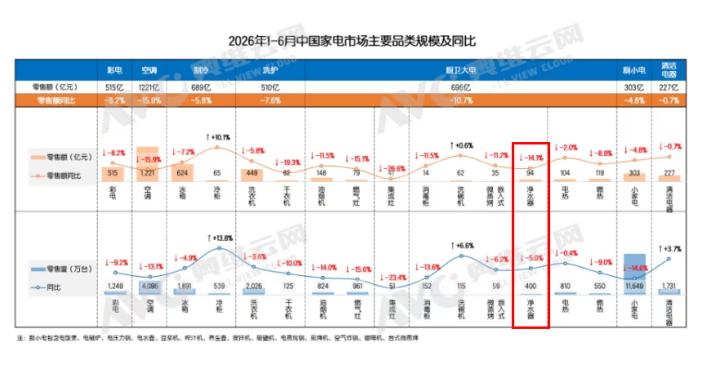
Image source: AVC
Reflected in the market, data from AVC shows that in the first half of 2026, the retail size of the water purifier market reached 9.4 billion yuan, down 14.1% year on year, with retail volume hitting 4 million units, down 5% year on year; during the "618" shopping festival, the total online sales of water home appliances stood at 2.24 billion yuan, down 16.7% year on year, and sales volume dropped 17.3% year on year. Among sub-categories, water purifier sales reached 1.2 billion yuan, down 22% year on year; water dispenser sales hit 300 million yuan, with a year-on-year decline of 25.3%.
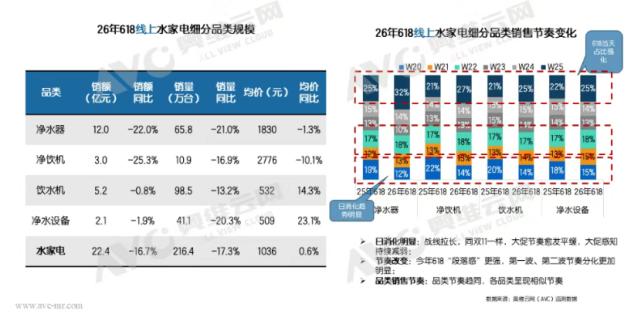
Image source: AVC
In other words, after the end of the policy-oriented cycle, to compete for limited market share, price competition among brands has intensified, directly driving down the average product price. During this year's "618" period, the average price of water purifiers fell slightly by 1.3% year on year, and the average price of water dispensers plummeted by 10.1% year on year. The entire market is falling into a vicious involution where products are sold cheaper and cheaper, yet harder to sell at lower prices. Low-price competition will further compress enterprises' R&D investment, leading to convergence in product filtration solutions and structural design, making it difficult to form differentiated experiences.
An analyst in the household appliance industry pointed out: "When price becomes the only means of competition, enterprises will have no incentive to invest in R&D, and the technological progress of the entire industry will stagnate."
Facing such a situation, how exactly should water purifier enterprises get rid of their dependence on policy dividends and find a sustainable growth path? What kind of self-rescue paths will leading brands with different advantages take?
Leading Water Purifier Brands Are Under Respective Pressure
Angel
In the past few years, Angel has been deeply engaged in the high-end development path. After introducing positioning theory in 2014, Angel cut hundreds of redundant SKUs, reduced its product line from more than 500 to 30, and launched the high-end water purifier A6 priced at 3499 yuan, directly targeting foreign brands such as A.O. Smith. This strategy achieved phased results in 2025, with Angel's Space Master series accounting for 66.52% of the offline retail volume of whole-house water purification products.
However, the aggressive expansion during the 2025 national subsidy period laid the groundwork for the predicament in 2026. Data shows that Angel added 233 new offline stores from January to April 2025. Analysts believe that after the national subsidy was withdrawn in 2026, these new stores are faced with not incremental demand, but a sharply shrinking market.
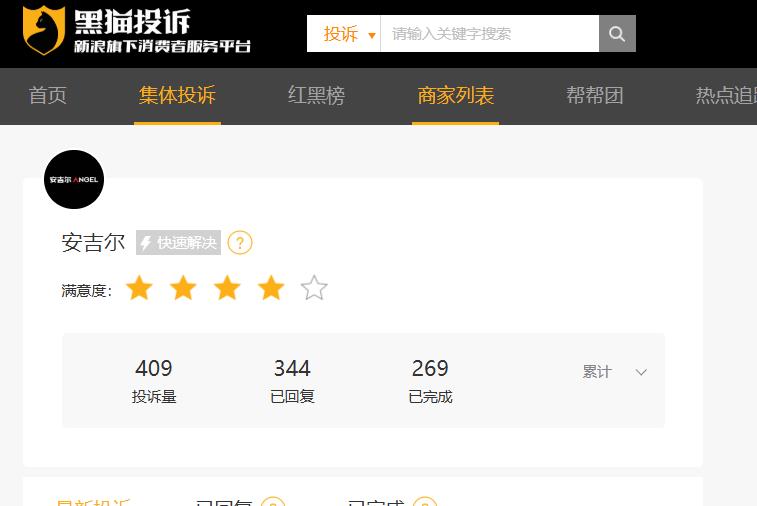
Image source: Black Cat Complaint
At the same time, Angel is also facing consumer complaints such as high filter replacement costs and slow after-sales response. Angel claims to have a "seven-star after-sales service system", but previous reports show that there have been more than 400 accumulated complaints against Angel on the Black Cat Complaint platform, covering problems such as abnormal filters, evasive after-sales support, and water quality issues.
Qinyuan
Qinyuan is one of the local brands that have long been engaged in the water purification track in China. It once launched the *National Water Quality Map* covering six major geographical regions and more than 2,900 cities across China, and developed differentiated filtration technologies for different water quality regions: using "high-pressure resistant super surface reverse osmosis membrane" for northern hard water areas, and adopting "0.5-nanometer uniform pore high-precision membrane" technology for southern soft water areas. This "differentiated water purification" concept does have certain differentiated value in the industry.
Meanwhile, Qinyuan relies on its offline dealer network covering cities at all levels, and has a solid user base in the third- and fourth-tier markets. During the policy dividend period, Qinyuan achieved continuous product shipments with its huge offline channels. However, after the market environment changed, the cost of the traditional offline dealer model kept rising, terminal passenger flow declined, many small and medium-sized dealers faced rising inventory pressure, and their willingness to restock decreased.
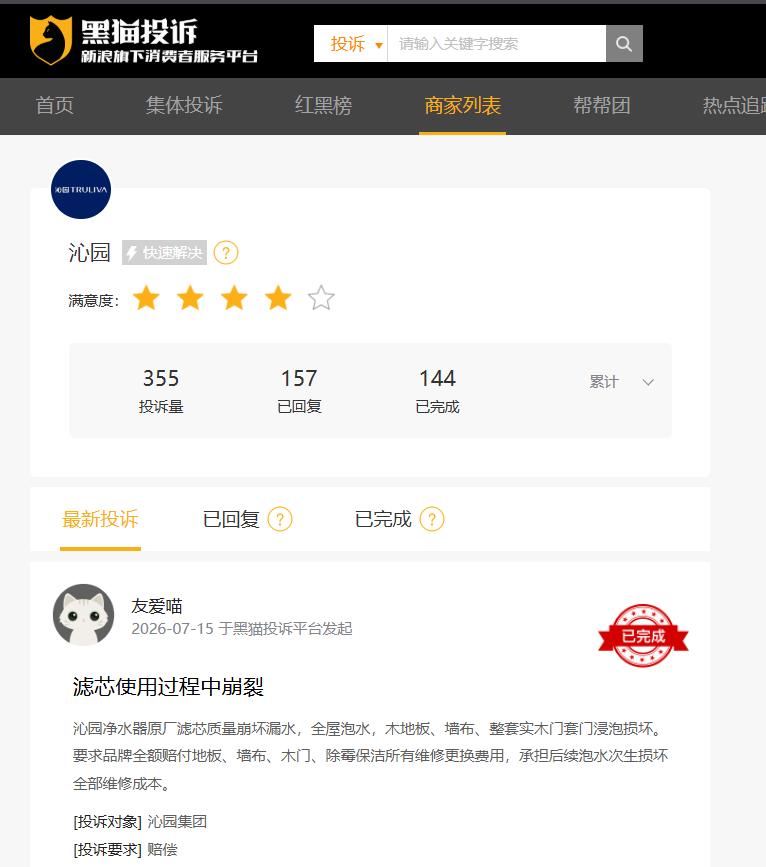
Image source: Black Cat Complaint
In terms of user reputation, complaints about Qinyuan on platforms such as Black Cat Complaint focus on several aspects: mandatory binding of original filters, false marking of filter service life, and evasive after-sales service. For example, some users reported that the Qinyuan water purifier purchased in 2024 will automatically lock after one year of use, "no water will come out without replacing the filter, and only original Qinyuan filters can unlock the device". Some other users pointed out that the product claims the RO filter can be used for 5 years, but the system prompts for replacement after about two years of actual use.
In response to multiple pressures, Qinyuan has started to optimize its channel structure, eliminate inefficient offline dealers, increase investment in online channels, build exclusive online product lines to avoid online and offline price conflicts. On the product side, it slows down the iteration of low-end water dispenser models, focuses on high-end desktop water dispensers and whole-house water purification systems, and improves the filter consumables subscription service, trying to transform one-time hardware sales into continuous service revenue.
However, some industry insiders believe that this profit model of "selling hardware at low prices and making profits from filters" may be tolerated by consumers during the industry's upward period. But in the stock competition period, this model is accelerating the consumption of brand trust. If Qinyuan cannot solve the pain points of users in filter cost and after-sales service, its technical advantages can hardly be transformed into market advantages.
Midea
Against the background of the overall industry downturn, Midea is one of the few brands that have achieved counter-trend growth in market share.
According to data from AVC, from January to May 2026, Midea's cumulative sales share of water purifier categories across all channels reached 18.34%, up 2.16 percentage points year on year. In the online market, Midea ranks among the top in the industry with a market share of 17.51%.
Midea's advantage lies in the channel synergy brought by full-category coverage. The trend that consumers choose water purifiers of the same brand when buying refrigerators and washing machines is becoming more and more obvious. Compared with professional water purification brands, Midea can realize bundled package sales through joint display in offline stores of refrigerators, kitchen appliances and water heaters, and also divert traffic relying on full-category traffic online.
Midea's water purifier product lines are too scattered, covering products from low-end to high-end, leading to dispersed resources and difficulty in forming core competitiveness. More importantly, Midea's brand recognition in the water purifier field is relatively weak, and there is a gap compared with professional water purifier brands.
In addition, it is worth noting that in the "price war" during the "618" period, Midea's main products were inevitably involved in the price reduction wave. Some evaluations pointed out that the promotional price of Midea Xinghe 1200G Pro has been lower than 1999 yuan. Against the background of rising raw material costs, price reduction means continuous compression of gross profit margin. Although Midea has achieved expansion in market share, it remains to be seen whether it can hold its ground in terms of profit.
Conclusion
After the withdrawal of national subsidies, the short-term pressure on the water purifier industry has become a foregone conclusion.
In the long run, leading brands will turn to the R&D of new high value-added products, focus on upgrading core functions such as health orientation, long-lasting filter elements and functional integration, to fight a long-lasting "value war". The living space of small and medium-sized brands and white-label manufacturers that lack core technologies and only rely on low prices as their competitiveness will be further squeezed, and they will even face the dilemma of zero profit or even losses. The K-shaped differentiation pattern of the water purification industry will continue. This is not only a challenge for the water purifier track, but also a common problem faced by the entire household appliance industry at present.
From another perspective, this track also breeds new opportunities. Xu Dongsheng, Vice Chairman of China Household Electrical Appliances Association, pointed out at the industry work conference that the foundation for the long-term growth of the industry is still solid, consumers' attention to drinking water health continues to rise, and demand is upgrading from basic purification to health orientation, intelligence and whole-house coverage. But the premise is that enterprises must get rid of their dependence on policy dividends and truly return to the competition of product strength and user value.
In other words, only enterprises that can adapt to changes, adhere to innovation and focus on value can stand out in the wave after this policy change, and lead the industry into a new stage of development.
This article is from the WeChat official account "Chief Consumer Officer", author: Hasove, published with authorization from 36Kr.