Cook's "last report card"
As Cook is about to pass the baton, Apple has released its last full fiscal quarter earnings report during his tenure as CEO.
On July 30 local time in the United States, Apple released its Q3 2026 fiscal earnings report after US stock market hours, covering the period ending June 27.
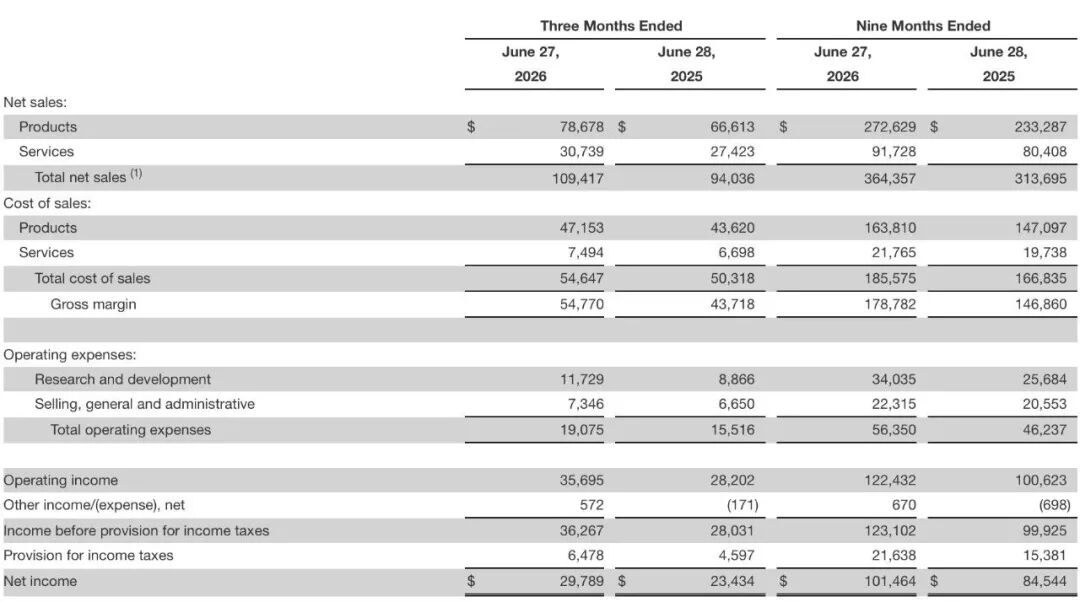
Key Financial Data of Apple
According to the earnings report, Apple's total revenue for the quarter reached 109.417 billion US dollars, a year-on-year increase of about 16.4% compared with 94.036 billion US dollars in the same period last year, hitting a record high for the same period in history.
Net profit reached 29.789 billion US dollars, an increase of about 27% compared with 23.434 billion US dollars in the same period last year; diluted earnings per share were 2.02 US dollars, a year-on-year increase of 29% compared with 1.57 US dollars in the same period last year. Among them, the profit includes a positive contribution of 0.11 US dollars per share brought by the US government's tariff tax refund. Excluding the tariff tax refund, the actual earnings per share stood at 1.91 US dollars, still higher than Wall Street's estimate of 1.89 US dollars.
After the release of Apple's earnings report, market sentiment cooled rapidly. As the revenue growth guidance for the fourth fiscal quarter ending September was only 9% to 11%, lower than Wall Street's expectation of 12%, coupled with the underperformance of the service business, Apple's stock price once fell by more than 6% in after-hours trading. Before the earnings report was released, Apple's stock price had risen by more than 22% so far this year, and it had retaken the title of the world's most valuable company by market capitalization.
01 Strong Hardware Support, Service Business Underperforms Expectations

Key Business Data of Apple
In terms of specific businesses, Apple showed clear differentiation in this fiscal quarter: core hardware products grew faster than expected, the growth rate of the service business slowed down, and iPad revenue declined year-on-year.
The iPhone business, as the core source of the group's revenue, delivered a strong performance. iPhone sales in the third fiscal quarter reached 54.252 billion US dollars (44.582 billion US dollars in the same period last year), a year-on-year increase of 21.7%, higher than analysts' estimate of 53.86 billion US dollars, marking the best performance Apple has ever recorded for the third fiscal quarter.
Usually, mobile phone sales in this fiscal quarter slow down as customers look forward to new models launched in autumn, but this year, driven by the continued hot sales of the iPhone 17 series, strong consumer demand pushed this business beyond market expectations; at the same time, against the backdrop of tight memory chips and rising expectations of price hikes for electronic products, the market is also paying attention to whether part of the demand has been released in advance, but Cook said that no clear evidence of this has been seen in the data so far.
Mac sales performed extremely strongly, with quarterly revenue surging to 10.352 billion US dollars (8.046 billion US dollars in the same period last year), a year-on-year increase of 28.7%, far exceeding analysts' estimate of 8.74 billion US dollars and hitting a new all-time high for the third fiscal quarter.
Apple stated that Mac growth was mainly driven by the entry-level MacBook Neo and high-end MacBook Pro, and the number of users upgrading their Macs in this fiscal quarter set a record; at the same time, on-device AI applications are also driving some enterprise and professional users to adopt Mac devices.
Sales of wearables, home devices and accessories increased by 6.5% to 7.883 billion US dollars (7.404 billion US dollars in the same period last year), maintaining a steady year-on-year growth trend, slightly higher than market expectations.
iPad sales, however, dropped by 5.9% to 6.191 billion US dollars (6.581 billion US dollars in the same period last year), lower than analysts' expectation of 6.92 billion US dollars. Cook attributed the decline in iPad sales mainly to the high base formed by the launch of the A16-version iPad in the same period last year. At the same time, Apple also faced certain supply constraints and component cost pressures in this fiscal quarter, but the company did not directly list them as the main reason for the decline in iPad revenue.
The service business (including App Store, iCloud, Apple Music, Apple TV, Apple Pay, content advertising and other segments) grew by 12.1% to 30.739 billion US dollars (27.423 billion US dollars in the same period last year), missing analysts' estimate of 31.22 billion US dollars. The influencing factors include the slowdown of mobile games, the adjustment of the App Store business model in some countries, and the US court ruling on external payment links.
Although the revenue of this segment was slightly lower than Wall Street's expectations, becoming one of the few underperforming indicators in this quarter's earnings report, the App Store still set a revenue record for the June quarter, and the number of paid subscriptions on Apple's platforms has exceeded 1.5 billion.
02 Full Recovery Across All Global Regions, Greater China Rebounds

Key Financial Data of Apple by Region
In terms of geographical regions, all of Apple's major markets achieved year-on-year growth in the third quarter, and the active installed base of devices hit all-time highs across all major product categories and geographical segments. Cook specially emphasized in the earnings report that Apple's iPhone, Mac and service businesses all recorded double-digit percentage growth, and the company's overall revenue in every geographical region also achieved double-digit percentage growth.
Revenue in the Americas market reached 45.781 billion US dollars (41.198 billion US dollars in the same period last year), a year-on-year increase of about 11.1%, continuing to rank first among all regions and contributing the largest share of total revenue, showing that the demand resilience of the core North American market remains prominent.
The European market performed particularly strongly, with revenue of 29.395 billion US dollars (24.014 billion US dollars in the same period last year), a year-on-year increase of 22.4%, the same growth rate as Greater China, maintaining strong double-digit growth and becoming one of the fastest-growing regions this quarter.
Greater China saw a notable rebound, with revenue growing 22.4% to 18.816 billion US dollars (15.369 billion US dollars in the same period last year). This growth rate reversed part of the pressure previously faced by the region, and was regarded by multiple reports as a key highlight of this quarter.
However, this figure still did not reach the previously forecast target of about 19.67 billion US dollars from some analysts and institutions, indicating that although the rebound is significant, it has not fully matched higher market expectations.
Revenue in the Japan market reached 6.554 billion US dollars (5.782 billion US dollars in the same period last year), a year-on-year increase of about 13.4%; revenue in other Asia-Pacific regions reached 8.871 billion US dollars (7.673 billion US dollars in the same period last year), a year-on-year increase of about 15.6%. Both regions maintained steady growth, further confirming Apple's full recovery in both emerging and mature Asia-Pacific markets.
Overall, the core feature of regional performance this quarter is "comprehensive growth + China rebound": Europe and Greater China simultaneously recorded a high growth rate of 22.4%, the Americas as the fundamental market delivered stable contributions, and the all-time high installed base provided a broader user base for subsequent hardware upgrades and service monetization. The market focus is concentrated on whether Greater China can sustain this rebound momentum in the next quarter, and whether supply constraints will have varying degrees of impact across different regions.
03 Supply Constraints Become the Biggest Bottleneck, R&D Expenditure and Component Costs Both Rise
Breaking down this quarter's performance shows that the core constraint behind the growth comes from supply chain and cost pressure, and the increase in expenditure mainly stems from two main lines: the substantial expansion of R&D investment, and the increasingly severe chip and memory cost pressure on the supply chain side.
In terms of R&D and administrative expenses, Apple's R&D expenditure in this quarter increased sharply by about 32.3% to 11.729 billion US dollars (8.866 billion US dollars in the same period last year), reflecting the company's solid investment in accelerating the development of next-generation software, AI innovation and core technology R&D.
In addition, sales, general and administrative expenses (SG&A) stood at 7.346 billion US dollars (6.650 billion US dollars in the same period last year).
In terms of supply chain and component cost crisis, Apple's Chief Financial Officer Kevan Parekh stated that the company continues to see "high levels of demand", but supply constraints have affected operational flexibility. Cook clearly pointed out in the earnings call and interviews that the main supply limitation is the industry-wide shortage of advanced chip manufacturing technology used to produce Apple Silicon chips, which has a particularly obvious impact on the Mac product line. "We have seen extraordinary demand in this cycle. The supply chain simply does not have enough flexibility to meet such a high level of demand," Cook said.
In addition, Apple is also facing severe shortages of memory and storage chips. Due to fierce competition for upstream logic chip capacity from TSMC and other manufacturers, coupled with industry-wide supply chain tensions brought about by AI data center construction, the costs of components such as RAM and storage chips have continued to rise in the past few quarters.
Cook said Apple is "evaluating all options" to find alternative component suppliers. The company has previously raised prices for products such as Mac and iPad due to rising component costs, and Wall Street analysts expect that the iPhone may also see price hikes at the autumn launch event in September this year. Cook also mentioned that looking beyond September, memory market prices may continue to rise, and the impact on the business may further increase.
In terms of gross margin and tariff tax refund, Apple reported a gross margin of 50.1% (gross profit of 54.770 billion US dollars) for this quarter, which includes the favorable impact of the US government's tariff tax refund. The tariff tax refund brought a positive impact of 0.11 US dollars per share and contributed about 2 percentage points to the gross margin. After excluding one-off favorable factors such as the tariff tax refund, the actual gross margin was 48.1%, higher than the midpoint of guidance and analysts' estimates, but the actual profit structure still faces long-term tests brought about by rising component costs.
04 Tariff Tax Refund Boosts Profits, New Siri Runs Parallel with Hardware Cycle
Profit in this quarter was supported by the tariff tax refund, with net income reaching 29.789 billion US dollars, a year-on-year increase of about 27%.
At the same time, Apple is accelerating its AI-related layout. The company launched the brand-new Siri AI at WWDC26, and plans to release it together with the new iPhone hardware this autumn.
Some analysts believe that this may be a key step for Apple to realize a commercial closed loop in the on-device AI competition, although the market still remains cautious about its technological leadership. Mac products are popular for supporting on-device AI tasks, partially offsetting the competition from cloud service monthly subscription models.
This quarter's earnings call also has a special historical significance, as it is Cook's last full fiscal quarter conference as Chief Executive Officer. Cook will officially step down as CEO on September 1 and take up the post of Executive Chairman, and will be succeeded by John Ternus, the current Senior Vice President of Hardware Engineering who has 25 years of working experience at Apple.
05 Revenue Guidance Falls Short of Expectations, Market Focuses on Supply and Pricing
In terms of future performance outlook, Apple's financial guidance is relatively cautious, which also constitutes the main reason for the pressure on its after-hours stock price.
For the current fourth fiscal quarter of 2026 ending September, the company expects total revenue to achieve a year-on-year growth of 9% to 11%, lower than Wall Street's target of 12%. Among them, iPhone revenue is expected to grow at a mid-teens percentage rate, lower than Wall Street's expectation of 17.6%; gross margin guidance is 47% to 48%. Exchange rate headwinds are expected to sequentially drag down the year-on-year revenue growth rate by about 2.5 percentage points. Parekh said that high demand remains, but supply constraints and foreign exchange movements will affect iPhone performance.
Apple's Board of Directors also announced that it will pay a cash dividend of 0.27 US dollars per common share to shareholders registered as of the close of trading on August 10, 2026, with the payment date set as August 13.
Overall, Apple's third fiscal quarter earnings report reflects the reality the company faces at the stage when tight supply and the AI hardware cycle run in parallel: the fundamental iPhone and Mac businesses remain strong enough to support the overall revenue to hit new highs; but on the other hand, shortages of advanced chips and memory limit delivery flexibility, and slowing service growth coupled with cautious guidance have raised market concerns about the sustainability of growth.
For capital markets and investors, the key points to observe for Apple in the future lie in whether supply constraints can be eased, how the pricing strategy of the new iPhone in September will be implemented, and whether the brand-new Siri AI can drive the next round of coordinated growth of hardware and services, to resolve multiple pressures brought by the supply chain and costs.
Cook emphasized during the earnings call that despite supply constraints, the product cycle has far exceeded expectations, and the company is evaluating alternative solutions. He said that AI has begun to accelerate the core business, and he is optimistic about its future potential. In response to market concerns about the supply chain and costs, Apple continues to emphasize that it will promote product and service innovation under strong demand, while actively responding to industry-wide component shortages.
After the earnings report was released, Apple's CEO Cook, CFO Parekh, and incoming CEO John Ternus attended the earnings call to interpret the earnings report and answer questions from analysts.
The abbreviated version of the earnings call is as follows:
Q: The Q4 guidance is only 9%–11%, a significant slowdown from 16% in Q3. How much of this slowdown is contributed by supply constraints and foreign exchange respectively? What exactly are the constraints, and will they further expand?
Parekh: From the third fiscal quarter to the fourth fiscal quarter, we expect foreign exchange to sequentially drag down the company's total year-on-year growth rate by about 2.5 percentage points. At the same time, the impact of supply constraints will increase significantly, spreading to iPhone, Mac and iPad. The combination of these two factors basically explains the main reason for the growth rate falling back from 16% to 9%–11%. We have fully taken these factors into account in our guidance.
Cook: In the third quarter, we did encounter supply constraints, mainly concentrated on Mac, with a certain degree of impact on iPhone and iPad as well. The root cause of these constraints is not the conventional capacity problem of suppliers, but the fact that iPhone grew 22% year-on-year and Mac grew 29% year-on-year, and the demand far exceeded our previous expectations, leaving the supply chain without enough flexibility. The availability of advanced process nodes is the core bottleneck.
We have been pulling supply in advance, but there is a limit at a certain point. Entering the fourth quarter, high levels of demand remain, but the impact of supply constraints will increase significantly, fully affecting iPhone, Mac and iPad. We