Elon Musk said "Money may be worthless in 10 years", but wage earners will not live to see that day.
Recently, Elon Musk made another bold prediction in an interview with *The Economist*.
He believes that in the next 5 years, the intelligence of AI may surpass that of all human beings; in the next 10 years, AI and robots will create a large number of goods and services, leading humanity into an era of "extreme abundance". Around 2036, work may become a choice, and money will no longer be that important.

It sounds like a world where people do not have to go to work and never need to worry about money.
But the current reality is that the number of college graduates of the 2026 cohort is expected to reach 12.7 million, an increase of 480,000 year on year. On social platforms, posts with content like "can't find a job", "sent hundreds of resumes with no response" and "entry-level positions also require three years of experience" can be seen everywhere.
On one side, Elon Musk is envisioning a future where "work is no longer needed", on the other side, ordinary people are sparing no effort to secure a job.
These two seemingly contradictory facts actually point to the same change:
Money has not become invalid yet, but the market value of some jobs has already started to disappear.
Jobs are not disappearing all at once, but being re-priced
When talking about AI, people can not help thinking: "Which occupations will be replaced?"
Judging from the current job market, AI has not reduced all positions simultaneously, and some positions are showing more obvious talent gaps.
The *2026 Insight on Talent Supply and Demand Trends in the Artificial Intelligence Industry* released by the Liepin Big Data Research Institute shows that in the first half of 2026, the number of new positions for AI architects increased by 76.74% year on year, far exceeding the 12.84% growth rate of algorithm engineers; the median annual salary of AI talents with more than 10 years of working experience reaches 552,000 RMB.
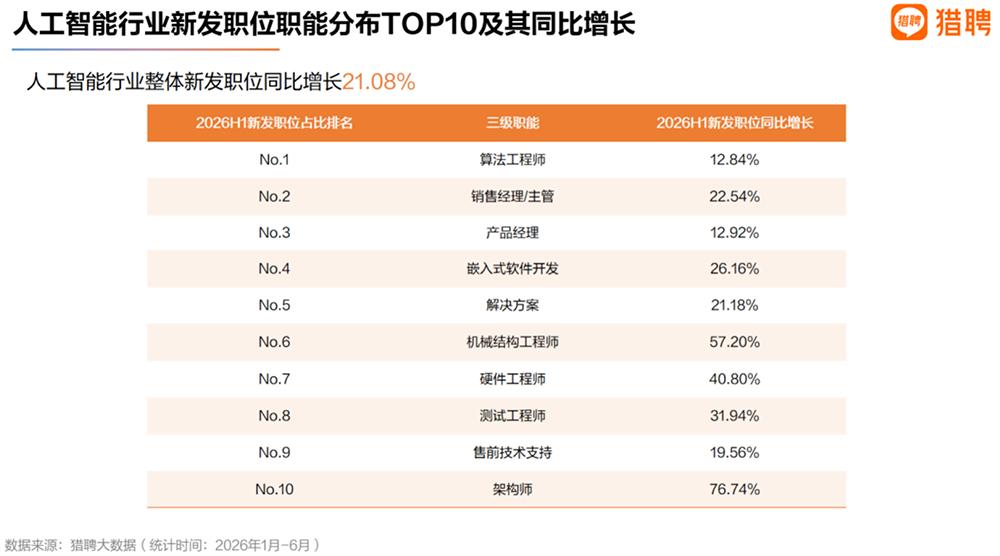
The job market is shifting from "recruiting people for existing positions" to "recruiting people to solve specific problems".
Under the same job title, the market value of people who can only complete assigned tasks and those who can solve practical problems is completely different.
AI makes things harder for fresh graduates
In the past, if a person wanted to become a senior employee, they usually had to finish a large amount of basic work first.
Junior copywriters develop their judgment by revising drafts over and over again; junior programmers understand the complete system starting from fixing small issues; new employees gradually build their understanding of the industry by sorting out materials and analyzing data.
These tasks are not high-level, and even somewhat boring, but they are the only necessary path for ordinary people to accumulate work experience.
AI is exactly best at taking over these tasks. The work of material sorting, basic analysis and initial version of solutions that used to be completed by several junior employees can now be done by only one senior employee with the help of Agent.
For enterprises, this means efficiency improvement; but for job seekers, especially fresh graduates, it means the first step on the career ladder is disappearing.

Enterprises expect job seekers to "be competent for the job immediately after onboarding", but if enterprises are no longer willing to provide entry-level positions, how can new employees improve their capabilities?
As a result, an increasingly obvious "experience paradox" has emerged in the job market:
Enterprises need experienced people, but are increasingly unwilling to pay the cost of cultivating experience; job seekers need their first job to accumulate experience, but find that no experience equals no opportunity.
The first groups to be affected are often not senior employees who have already mastered resources and judgment, but recent graduates, career changers, and people who want to restart their careers after a career gap.
Will money become unimportant after jobs lose their value?
Elon Musk believes that "when AI and robots make the supply of goods and services nearly infinite, the importance of money will decline."
What he describes is the end point after the technology is highly mature, but before reaching that perfect world, what we are most likely to experience first is a long and arduous period of career transformation.
In the past six months, AI has truly begun to be introduced into large tech companies. With the dual effects of cost reduction and efficiency improvement and AI transformation, the organizational structure is adjusted at any time, and many employees of large companies failed to survive the 630 deadline. Personnel changes are not the original intention of enterprises, but the realistic result is that money is still very important, while the value of some jobs has already depreciated.
As for whether money will lose its meaning in 2036, no one can give a definite answer now.
The most dangerous thing in the future workplace may not be being unable to find a job temporarily, but working for many years and still only repeating tasks defined by others, without accumulating clients, judgment, personal achievements and bargaining power.
Money has not lost its value yet, so we should find a job that can help us keep increasing our personal value as early as possible.
This article is from the WeChat Official Account "Liepin" (ID: liepinwang), written by Haoduoyu, authorized for release by 36Kr.