Feishu "ties the knot" with Doubao, Tencent launches the "Human-AI Co-writing" feature: Major tech giants finally decide to charge for their AI office services.
On July 30, two hidden cards were turned over simultaneously at the AI gaming table of China's internet industry, behind which lies the same anxiety — after burning so much money on AI, how on earth can the returns be realized?
In the morning, an internal email from ByteDance announced the restructuring of Feishu, which the company has operated for a decade: the product team was merged into Doubao, while the sales and service teams were integrated into Volcano Engine. Xie Xin, CEO of Feishu, now reports to Zhao Qi, the head of Doubao, marking the official end of Feishu's era as an independent business unit.

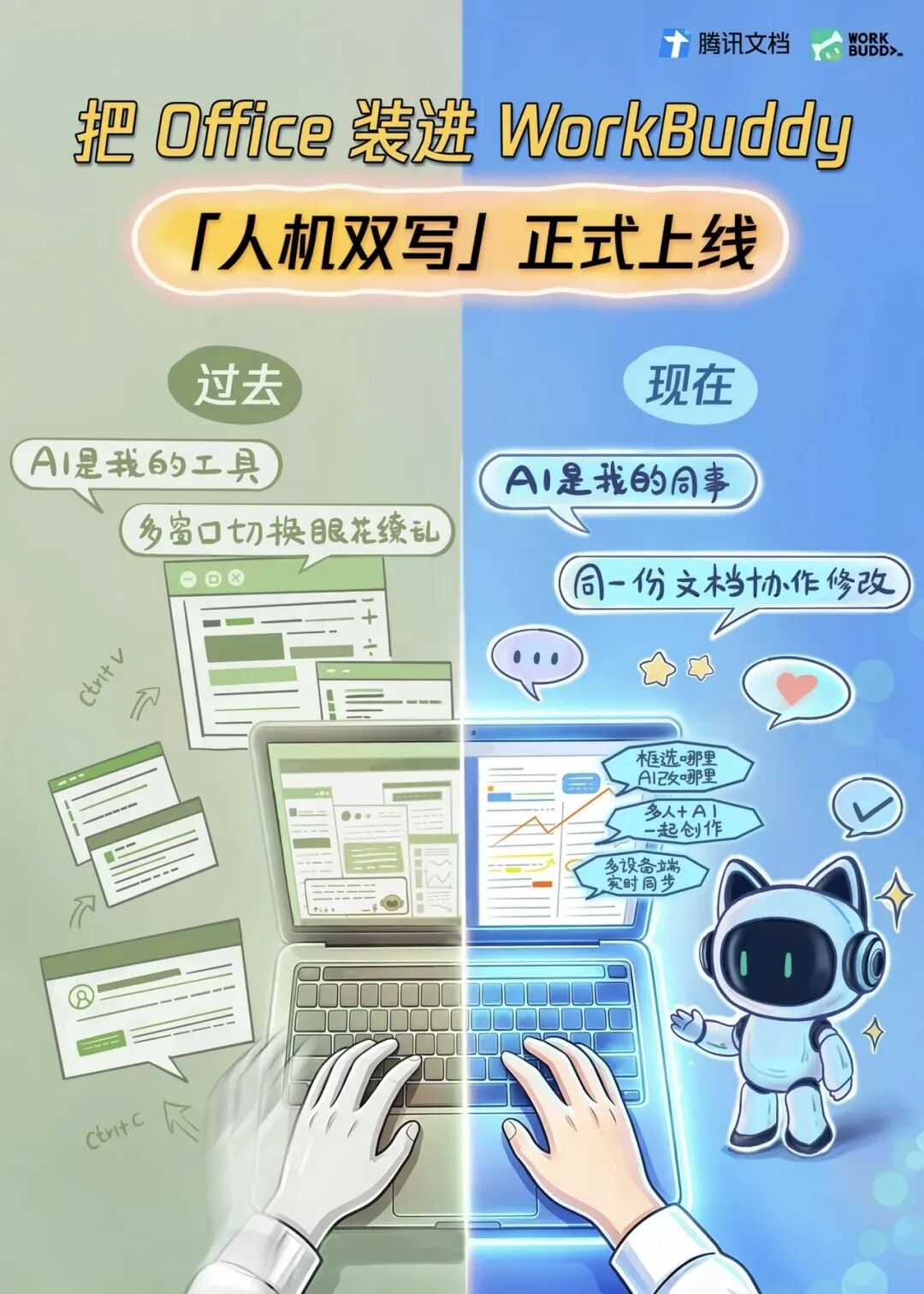
On the same day, Tencent WorkBuddy released the major V5.3.5 version update, launching the "Human-AI Dual Writing" collaborative editing feature in partnership with Tencent Docs: when opening Word, Excel or PowerPoint files, human users and AI can collaborate and co-create in real time in the same document. You can select a paragraph of text to let AI optimize it, circle a table to let AI generate charts, or mark blank areas to let AI supplement relevant chapters.
One side is dismantling the office entry, while the other is upgrading the office entry. It is by no means a coincidence that the two events fell on the same day.
Behind this lies the same judgment: As an independent category, collaborative office is disappearing, and leading internet companies can no longer afford to delay the monetization of AI services.
Ten Years of Feishu: From a Tool for "Advanced Teams" to the "Dowry" of Doubao
Feishu was not shut down abruptly.
When Liang Rubo promoted the BU (Business Unit) restructuring in 2021, Feishu was an independent business group parallel to Douyin and Volcano Engine, and Xie Xin reported directly to the CEO. Four years later, Feishu's annual recurring revenue (ARR) exceeded 3 billion yuan, and the monthly active users of its multidimensional spreadsheet feature surpassed 10 million. However, ByteDance's algorithm recommendation engine already handles 180 trillion Token calls per day, and the annualized revenue of its large model business has hit 4 billion US dollars.
"A business with an annual ARR of several billion yuan that cannot evolve into a core entry point can only achieve greater value by merging with Doubao and Volcano Engine."
This is ByteDance's choice, as well as the fate of Feishu. Feishu has a team of about 4,000 employees, with an annual labor cost of 3.2 to 4 billion yuan, and Xie Xin once extended the profit target of Feishu to 2030. However, under the harsh reality that Doubao's daily active users (DAU) has reached 200 million but its daily revenue is less than 1 million yuan with tens of millions of application consumption per day, and against the background that ByteDance's capital expenditure in 2026 will exceed 200 billion yuan, the "independent development narrative" of Feishu seems too extravagant.
The deeper reason is: AI is redefining the core demands of "advanced enterprises".
Feishu was originally developed internally by ByteDance, aiming to solve the problem of "how information can flow more fully within organizations in the digital era". With the concept of "Context not Control", it integrated documents, meetings, instant messaging and OKR into a set of organizational operating system, and exported this capability to a group of "advanced teams" including Li Auto, Xiaomi and NIO.
But in the AI era, the most urgent pain point of enterprises is no longer "how information flows", but "whether AI can read enterprise knowledge, understand organizational permissions, call business tools, and finally complete actual work".
A truly functional Agent that can work in enterprises requires five layers of capabilities: model, computing power, data, tools and entry point, none of which is dispensable. Volcano Engine has models and computing power, Feishu has scenarios and permission systems, and Doubao has the interactive entry. Only by integrating the three can ByteDance put the "brain, infrastructure, working environment and interactive entry" into the same system.

The advancement of ByteDance's AI business is essentially a natural extension of its successful genes. Long before generative AI became mainstream, the company had established its business territory relying on an AI-driven recommendation engine; now it is spilling over this capability to foundational models, intelligent agents and AI products. Given time, ByteDance will look less and less like a social media company, and more like an AI platform company with massive consumer distribution capabilities.
The integration of Feishu into Doubao does not mean the failure of Feishu, but that the "collaborative office" category itself is evolving from a "destination" to a "called tool".
WorkBuddy's "Human-AI Dual Writing": Tencent is "Planting" Agents in Documents
Different from ByteDance's "top-down" integration approach, Tencent has chosen a more "quiet and pervasive" path.
On July 30, the "Human-AI Dual Writing" feature of WorkBuddy V5.3.5 directly embeds AI into the editing environment of Tencent Docs. It is not a sidebar Q&A function, nor a workflow that requires copying and pasting after generation, but real-time collaboration between AI and human users in the same Word, Excel or PowerPoint file.
This solves a real pain point: in the past, when using AI to write reports, you had to manually copy the generated long text into the document to adjust the format, modify the tone and verify the data; now AI edits directly on the original content, and AI optimizes exactly the area you select.
Data from Analysys shows that in June 2026, the monthly access volume of WorkBuddy reached 20.97 million, ranking first among 17 mainstream desktop AI office agents in China, exceeding the sum of ByteDance's TRAE IDE (the second place) and Alibaba's QoderWork (the third place). Tencent internally defines this business as a "super project", with Ma Huateng (Pony Ma) personally overseeing its progress.
Tencent's logic is very straightforward: WeChat, QQ, Tencent Docs and Tencent Meeting are natural entry points, and Agents can be directly built on this ecosystem to call tools, connect systems, and complete work end-to-end. Tencent will not build a new separate entry point, but "plant" AI capabilities into the soil of existing paid products, and realize monetization through application integration.
BAT Reaching the Same Goal via Different Paths: Agent Becomes the New Gaming Table, and Monetization Is the Absolute Hard Rule
While ByteDance and Tencent are taking actions, Alibaba is also not idle.
On July 27, Alibaba's "Qianwen Office" launched the internal test, integrating three Agent products including QoderWork, Wukong and MuleRun, with Chen Yusen, the new CEO of DingTalk, taking overall charge of the business. Its strategy is a "dual-brand" layout: DingTalk acts as a heavily armed tank focusing on "+AI" transformation, while Qianwen Office acts as a light cavalry focusing on "AI+" expansion.
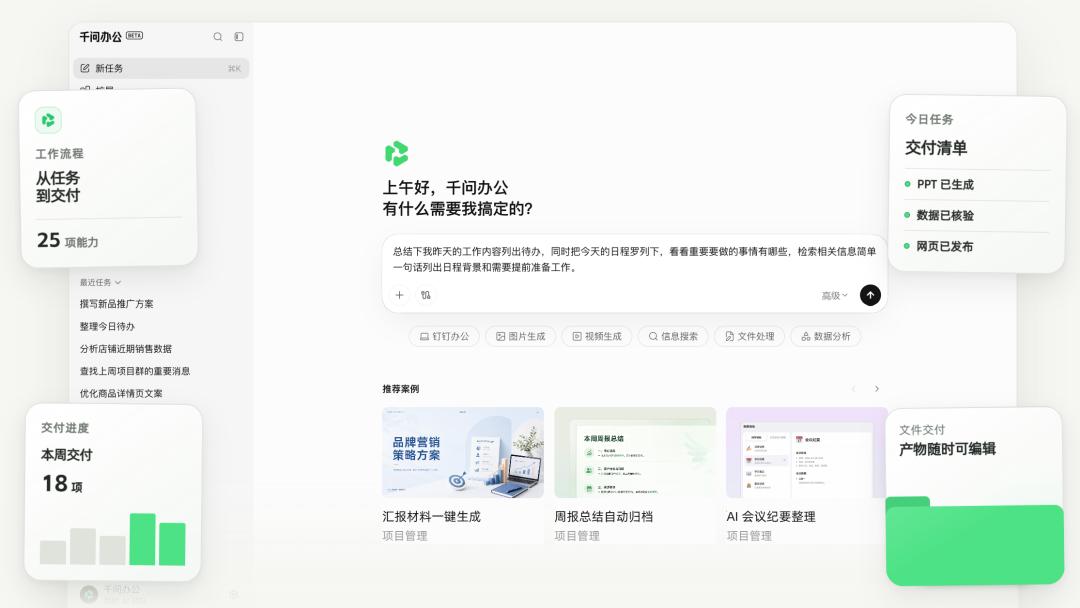
In less than ten days, the three BAT companies have completed the reorganization of their AI office business lines.
What is the underlying logic behind this?
Models are becoming as ubiquitous as water and electricity. Doubao's daily Token calls have exceeded 180 trillion, DeepSeek has pushed the inference price to the floor level, and open-source models are everywhere. When models are no longer a scarce resource, "who can truly apply the models to actual work" has become a real problem. For models to complete work, they must first know which company you are in, where your data is stored, who has the permission to view what content, and where the work process should go next — all these information are stored in office software.
Industry insiders call this the "organizational context". Whoever controls the working environment will seize the last mile of AI landing in enterprises.
But what is more urgent than "who can apply AI" is "who can collect revenue from AI business".
ByteDance's Doubao adopts the "subscription + advertisement" model. In June this year, Doubao launched a paid professional version amid controversy: the standard package is 68 yuan per month, the enhanced package is 200 yuan per month, and the advanced package is 500 yuan per month. After Feishu is merged, the enterprise version of Doubao can call Feishu's documents, spreadsheets, meetings and permission systems, and sell packaged subscriptions of "Agent + office scenarios" to enterprise customers. The fact that Feishu's sales team with over 3 billion yuan ARR is merged into Volcano Engine is essentially to find a revenue-bearing outlet for Doubao's B-end commercialization.
Alibaba adopts the "ecosystem model". Alibaba Cloud's revenue in FY26 Q4 reached 41.6 billion yuan (up 38% year on year), its ARR exceeded 35.8 billion yuan for the first time, the AI revenue maintained three-digit growth for 11 consecutive quarters, and the proportion of AI in external revenue exceeded 30% for the first time. Qianwen Office does not sell Agents separately, but bundles models, computing power, DingTalk organizational relations and industry solutions into a set of "Cloud + AI" ecosystem, and locks in enterprise customers through cloud service contracts.
Tencent's path is "application integration". WorkBuddy, CodeBuddy, Miaojing, LearnBuddy — Tencent will not build separate paid entry points, but embed AI capabilities into existing paid or to-be-paid applications such as Tencent Docs, Tencent Meeting and WeCom, making Agents a "value-added module" of the existing subscription system.
In China's AI cloud market, leading players including Alibaba Cloud, Tencent Cloud, Volcano Engine, Huawei Cloud, Baidu Intelligent Cloud, JD Cloud and China Telecom Cloud are competing around integrated cloud platforms, Agent-based AI technology stacks, sovereign compliance and industry solutions; price pressure continues to rise, and the focus of differentiation is shifting to Token cost-effectiveness, governance capabilities and ecosystem depth.
The competition has shifted from "who has larger model parameters" to "who can let AI truly help enterprises complete work" — and who can make enterprises pay continuously for this value.
ByteDance's AI Ambition: Evolving from a TikTok-focused Company to an AI Platform Company
To understand why ByteDance must "absorb" Feishu, we must first look at what it wants to become.
The core of ByteDance's AI strategy is a vertically integrated, product-driven approach — leveraging data, distribution and rapid iteration as leverage. It deeply couples foundational models such as Doubao and Seed with content, e-commerce and hardware, prioritizing the growth of user duration and commercialization, while selectively building enterprise capabilities to diversify its revenue structure.
This is not a transformation, but a "return" — ByteDance originally started its business with an AI recommendation engine, and now it is only extending this capability from "recommending short videos" to "recommending everything".
The Seed team focuses on cutting-edge models and application intelligence. Its advantages lie in a strong data flywheel, tight integration between products and models, and extremely fast experiment speed; its shortcomings are insufficient B-end presence and underdeveloped ecosystem. Its strategy is shifting from internal empowerment to external API and commercialization, which is more closely aligned with product and revenue goals.
ByteDance amplifies its B2B AI business through Volcano Engine, exporting models, fine-tuning capabilities and industry solutions on an integrated cloud platform. It will first target digital native industries, and then expand outward gradually. This step will intensify price wars, accelerate product commoditization, and force competitors to seek differentiation in governance, ecosystem depth and vertical specialization.
ByteDance has a credible path to success, because it holds capital, computing power infrastructure and massive user data at the same time. But its real challenge lies elsewhere: building sales, service and ecosystem capabilities for enterprise AI, while coping with the restrictions on the global expansion of its AI platform brought by digital sovereignty requirements. Whether it can overcome these barriers will determine whether it can expand from the consumer internet to the broader AI leadership space.
ByteDance will play the role of a product-led AI innovator, building advantages in applied AI and experience design. It will shape user interaction modes and monetization paths, while selectively expanding its B-end territory.
The enterprise customers, organizational relations and permission systems accumulated by Feishu over the past ten years are the "context" for Agents to enter enterprises. Now, all these contexts are uniformly handed over to Doubao for scheduling — ByteDance is betting that in the AI era, the office entry point will not be Feishu, but Doubao.
"The Primary User of Software is Changing from Human to Agent"
On the day when Feishu was merged into Doubao, DingTalk released "DingTalk CLI 2.0", fully opening 7 core capabilities including intelligent messaging, schedule management and document collaboration, covering more than 200 selected commands and 19 structured AI Agent skills.
Since late March, DingTalk, Feishu and WeCom have successively open-sourced their CLI, and Google Workspace and Obsidian have also launched CLI functions. The logic behind this is very clear: Office software has admitted that it is evolving from a "destination" to a "called tool".
"The primary user of software is changing from human to Agent."
In the past, you opened Feishu to write documents, opened DingTalk to send messages, and opened Tencent Meeting to hold video conferences — you were the user of the software. In the future, Agents will directly call document APIs, send messages and schedule meetings, and human users will only check the final results. The independent interface of collaborative office may become less and less important.
Feishu has undergone two rounds of restructuring, but these two moves have raised a more cruel question: When AI can directly operate documents, spreadsheets, meetings and workflows, do we still need the intermediate layer of "office software"?
July 30 May Be the Most Important Day in the History of China's Collaborative Office Industry
In the ten years of development, Feishu has evolved from an internal efficiency tool of ByteDance, to an independent business unit, and then to a component of Doubao. The path it has gone through may be the complete life cycle of the last "independent collaborative office product".
Tencent WorkBuddy's "Human-AI Dual Writing" and Alibaba Qianwen Office's "dual-brand" layout are essentially answering the same question: In the Agent era, who on earth should organize the work of knowledge workers?
Among the three BAT companies, one integrates office business into AI to bet on the "subscription + advertisement" model, one embeds AI into office scenarios to realize application integration, and one locks in enterprise