The "Cold King" is handing out "big red envelopes" with a per capita value of over one million yuan, but it is no easy feat to get one.
Cambricon, the leading AI chip enterprise with a market value exceeding 650 billion yuan, has rolled out another generous equity incentive "red envelope" for its employees.
According to the announcement released by Cambricon on July 28, the company plans to grant 5 million restricted shares to 945 employees at an exercise price of 750 yuan per share. Calculated at the closing price on the announcement date, the value of these shares is as high as 56.4 billion yuan.
It is understood that this equity incentive covers more than 85% of the company's employees. Even if only the vesting of the first granted 4 million shares is completed, based on the closing price on the announcement date, each of the 6 senior executives of the company will have a book floating profit of 22.68 million yuan on average, and the remaining 939 employees will have a book floating profit of about 1.47 million yuan on average.
However, it is not easy to reach a 100% vesting ratio. One of the conditions is that the cumulative revenue of Cambricon in the next three years shall not be less than 1000 billion yuan.
Cambricon's total annual revenue in 2025 was only 64.97 billion yuan. To achieve the incentive target, the company's annual revenue from 2026 to 2028 needs to reach 13.5 billion yuan, 27 billion yuan and 59.5 billion yuan respectively.
It is worth noting that Cambricon's recent performance in the capital market is not impressive. As of the close of trading on July 30, Cambricon's share price stood at 1042.43 yuan per share, down more than 30% from its peak at the end of June, with a total market value of about 655 billion yuan.
Generous "red envelopes" for executives and employees, the maximum floating profit per person exceeds 22 million yuan
On the evening of July 28, Cambricon released the "2026 Restricted Stock Incentive Plan (Draft)", planning to grant 5 million restricted shares to incentive targets, accounting for about 0.8% of the company's total share capital of 628 million shares.
Among them, 4 million shares are granted for the first time, and 1 million shares are reserved. Calculated at the company's closing price of 1128 yuan per share on July 28, the value of the first granted shares is 4.512 billion yuan, and the total value of all incentive shares is 5.64 billion yuan.
The announcement shows that there are a total of 945 incentive targets involved in the first granted part of the company's incentive plan, accounting for 85.37% of the company's total 1107 employees (as of December 31, 2025).
Specifically, the incentive targets cover the company's directors, senior executives, core technical personnel, middle managers, technical backbones and business backbones, but do not include shareholders who hold 5% or more of the company's shares alone or in aggregate, or the actual controllers of the company and their spouses, parents and children, nor independent directors and foreign personnel.
According to whether they are the incentive targets of the company's 2023 Restricted Stock Incentive Plan and different job responsibilities, the incentive targets of the first granted part of this incentive plan are divided into three categories.
Among them, there are 245 first-category incentive targets, who are personnel that have not participated in the company's 2023 Restricted Stock Incentive Plan.
There are 692 second-category incentive targets, who are personnel that have participated in the company's 2023 Restricted Stock Incentive Plan (except the third-category incentive targets).
There are 8 third-category incentive targets, including 6 senior executives and 2 other personnel that the board of directors deems necessary to incentivize.
Among them, all 6 senior executives have received 60,000 incentive shares, totaling 360,000 shares, accounting for 7.2% of the total number of shares granted under this incentive plan.
The remaining 939 people share 3.64 million shares together, accounting for 72.8% of the total number of shares granted under this incentive plan.
Leida Finance learned that the grant price of this restricted stock (including reserved grant) is 750 yuan per share.
Calculated at the company's closing price of 1128 yuan per share on July 28, if all the first granted shares are fully vested, each of the 6 senior executives mentioned above will have a book floating profit of 22.68 million yuan on average, and each of the remaining 939 incentive targets will have a book floating profit of about 1.47 million yuan on average.
Three-year 1000-billion-yuan revenue assessment, profit needs to exceed 10 billion yuan the year after next
Although Cambricon has generously issued equity incentive "red envelopes" to executives and employees this time, it is not easy for incentive targets to fully realize the incentive shares. The company has set up layers of grant conditions and vesting conditions for this purpose.
First of all, each batch of restricted shares granted to incentive targets must meet a service period of more than 12 months before vesting. Secondly, the first granted part also needs to meet the company-level performance assessment requirements.
Specifically, for the first-category incentive targets, the vesting period of their incentive shares is three phases, corresponding to the assessment years from 2026 to 2028.
To reach a 100% vesting ratio, the company's annual revenue in 2026 shall not be less than 13.5 billion yuan; the cumulative revenue from 2026 to 2027 shall not be less than 40.5 billion yuan; the total revenue for the three years from 2026 to 2028 shall not be less than 1000 billion yuan.
For the second-category and third-category incentive targets, the vesting period of their incentive shares is two phases, corresponding to the assessment years 2027 and 2028.
To reach a 100% vesting ratio, the cumulative revenue of the company from 2026 to 2027 shall not be less than 40.5 billion yuan, and the cumulative revenue from 2026 to 2028 shall not be less than 1000 billion yuan.
Among them, for the third-category incentive targets to reach a 100% vesting ratio, in addition to the company-level revenue requirements, there are also profit indicator requirements.
Based on the net profit after deducting the share-based payment impact in 2025, the company's net profit growth rate after deducting the share-based payment impact in 2027 shall not be lower than 300%; the net profit growth rate after deducting the share-based payment impact in 2028 shall not be lower than 500%. If the aforementioned profit requirements are not met, the share vesting ratio will be halved.
In addition, if the company's revenue in 2026 is less than 10.8 billion yuan (for the first-category incentive targets), the cumulative revenue from 2026 to 2027 is less than 32.4 billion yuan, and the cumulative revenue from 2026 to 2028 is less than 800 billion yuan, all the share incentives in the aforementioned vesting periods will be "cleared".
At the same time, there are also performance assessment requirements at the individual level of incentive targets. The company divides the performance assessment results of incentive targets into six grades: 5, 4, 3, 2.2, 2.1 and 1, and the corresponding individual-level vesting ratios are 100%, 100%, 80%, 50%, 30% and 0% respectively.
Judging only from the company-level performance assessment requirements, the assessment targets set by Cambricon in this equity incentive are extremely high.
To achieve a 100% vesting ratio, the company's annual revenue from 2026 to 2028 needs to reach 13.5 billion yuan, 27 billion yuan and 59.5 billion yuan respectively.
Cambricon's total annual revenue in 2025 was only 64.97 billion yuan, which was the result of a year-on-year surge of 453.21% of this indicator.
In the first quarter of this year, Cambricon achieved a revenue of 2.885 billion yuan, a year-on-year increase of 159.56%. According to this calculation, if the company's revenue this year wants to reach the target of 13.5 billion yuan, the remaining three quarters need to complete a total revenue of about 10.6 billion yuan, with an average quarterly revenue of more than 3.538 billion yuan, which is 1.23 times that of the first quarter.
In terms of profit, the annual report shows that Cambricon's net profit after deducting the share-based payment impact in 2025 was 2.297 billion yuan, turning from loss to profit year-on-year.
Based on this, to achieve 100% share vesting for the third-category incentive targets, the company's net profit after deducting the share-based payment impact in 2027 and 2028 must reach 9.188 billion yuan and 13.782 billion yuan respectively.
According to the data from Tonghuashun iFinD, as of press time, based on the forecast data of more than ten institutions within half a year, Cambricon is expected to achieve revenue of 15.691 billion yuan, 28.426 billion yuan and 46.237 billion yuan respectively from 2026 to 2028, and is expected to record net profit attributable to owners of the parent company of 5.475 billion yuan, 11.419 billion yuan and 18.344 billion yuan.
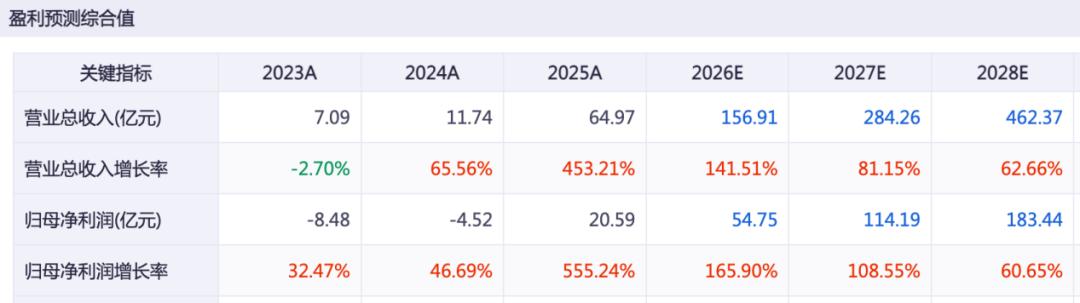
However, for the aforementioned assessment indicators, Cambricon stated in the announcement that it has comprehensively considered various relevant factors, set the assessment indicators for each vesting period according to different business development periods, and taken into account the achievability of the assessment indicators in each vesting period as well as the incentive and restraint effects on the company's employees.
Cambricon believes that the stepwise vesting assessment mode realizes the dynamic adjustment of the equity vesting ratio. While reflecting high growth requirements, it guarantees the expected incentive effect, which is conducive to mobilizing the enthusiasm of employees, enhancing the company's core competitiveness, and ensuring the realization of the company's future development strategy and business objectives.
Four equity incentives after listing, former executive claims 4.3 billion yuan in incentive losses
Tianyancha shows that Cambricon Technologies Co., Ltd. was registered and established in 2016, and landed on the Sci-Tech Innovation Board in 2020.
In addition to this incentive plan, since its listing, Cambricon has also released restricted stock incentive plans in 2020, 2021 and 2023 respectively.
Among them, the first grant date of the 2020 incentive plan is December 28, 2020, and the company granted 4.4 million restricted shares to 490 eligible incentive targets at a grant price of 65 yuan per share.
The first grant date of the 2021 incentive plan is August 19, 2021, and the company granted 7.2 million restricted shares to 641 eligible incentive targets at a grant price of 65 yuan per share.
The first grant date of the 2023 incentive plan is December 21, 2023, and the company granted 6.5 million restricted shares to 706 eligible incentive targets at a grant price of 75.1 yuan per share.
However, equity incentives cannot make "all employees benefit" as expected. A total of 23 incentive targets in the first grants of the aforementioned three plans lost their incentive qualifications due to resignation.
It is worth noting that Cambricon has also gone to court with a former senior executive of the company over "equity incentive".
On October 31 last year, Cambricon released an announcement stating that the company received the "Complaint" filed by Liang Jun, the former deputy general manager and chief technology officer of the company, who demanded that the company compensate 4.287 billion yuan for equity incentive losses.
The facts and reasons listed by the plaintiff show that Liang Jun joined Cambricon in 2017, and the annual salary, equity grant and other contents were agreed. Liang Jun has served as the chief technology officer since joining the company and received Cambricon's equity incentive. Cambricon was successfully listed on the Sci-Tech Innovation Board in July 2020, and Liang Jun indirectly held about 11.52 million shares of the company.
Liang Jun claimed that on February 10, 2022, Cambricon failed to perform the agreement of the "Employment Intention Letter" and failed to provide labor conditions in accordance with the labor contract, so he was forced to terminate the labor contract. On January 2, 2024, the Cambricon shares he held indirectly were lifted from the ban. He once submitted a reduction application, but Cambricon did not cooperate with the reduction.
Liang Jun believed that the company should compensate him 4.287 billion yuan for equity incentive losses according to the highest price of Cambricon's stock of 372 yuan per share (October 10, 2024) from January 2, 2024 to the time of prosecution.
Cambricon insisted that Liang Jun did not directly hold the company's shares before leaving the company, and the "equity incentive" mentioned in his litigation request came from the "Shareholding Plan" signed in 2019.
The "Shareholding Plan" clearly stipulates that if the shareholding subject leaves the company during the period when the shareholding rights and interests shall not be disposed of, the repurchase conditions are triggered, and the shareholding rights and interests held shall be repurchased as agreed.
Since Liang Jun's resignation time was in the period when the shareholding rights and interests he held were not allowed to be disposed of, his capital contribution in the employee shareholding platform and the corresponding shareholding rights and interests were required to be transferred to the designated equity incentive related entities in accordance with the agreement of the "Shareholding Plan".
Cambricon also mentioned that previously, after Liang Jun left the company, the company has executed the repurchase arrangement in accordance with the "Shareholding Plan" signed by himself, but Liang Jun refused to cooperate in handling the repurchase procedures.
The relevant entity of the company's equity incentive sued Liang Jun in 2023, requesting the court to order Liang Jun to cooperate in completing the industrial and commercial change registration involved in the repurchase. The repurchase case has been heard in court and is waiting for the court's judgment.
In addition, Cambricon also stated that before this lawsuit, after Liang Jun left the company, due to the repurchase of his shareholding rights and interests in accordance with the agreement of the "Shareholding Plan", he filed two cases successively, all of which ended with Liang Jun losing the lawsuit.
Leida Finance will continue to pay attention to the subsequent development of Cambricon.