For the first time, Azure's annual revenue has exceeded the 100-billion mark, and Microsoft has temporarily sorted out the accounts of its AI business.
On July 29 local time in the United States, Microsoft released its financial report for the fourth fiscal quarter of fiscal 2026 (the second quarter of the calendar year) ending June 30, as well as the full-year financial results.
According to the financial report, Microsoft's revenue in the fourth fiscal quarter reached 90 billion U.S. dollars, up 18% from 76.4 billion U.S. dollars in the same period last year, and 17% growth in constant currency, which exceeded the general expectation of 87.62 billion U.S. dollars from analysts surveyed by the London Stock Exchange Group (LSEG).
Operating profit was 40.6 billion U.S. dollars, up 18% from 34.4 billion U.S. dollars in the same period last year, keeping pace with the revenue growth rate, indicating no dilution of the profitability of core businesses.
Net profit was 35.8 billion U.S. dollars, compared with 27.2 billion U.S. dollars in the same period last year, representing a year-on-year increase of 31%. Diluted earnings per share stood at 4.81 U.S. dollars, up 32% from 3.65 U.S. dollars in the same period last year. LSEG analysts generally expected 4.24 U.S. dollars in diluted EPS and 31.5 billion U.S. dollars in net profit, meaning the actual performance fully beat market expectations.
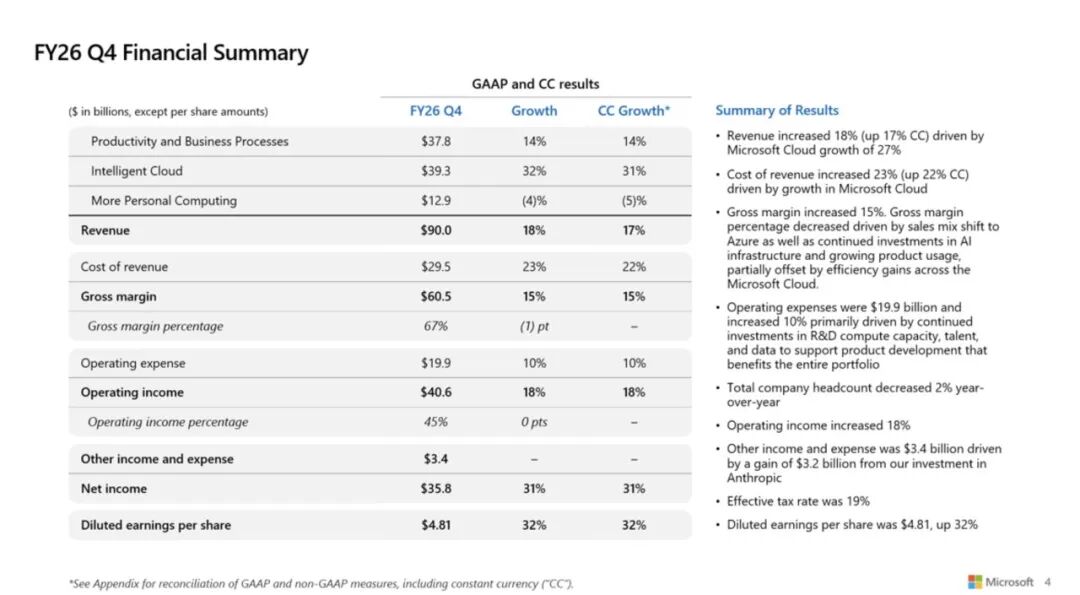
Summary of Microsoft's financial results for the fourth quarter of fiscal 2026
In the fourth fiscal quarter, Microsoft's net profit was affected by several special items.
The company recorded a 3.2 billion U.S. dollar gain from its investment in Anthropic, and expenses related to the voluntary separation program were lower than the forward guidance previously provided by the company on April 29, 2026, which was partially offset by severance pay and impairment charges in the Xbox division. The above items combined had a net positive impact of 0.27 U.S. dollars on diluted earnings per share.
The impairment charges and severance expenses of the Xbox division reflect Microsoft's cost reduction for non-core loss-making businesses, while the gain from the Anthropic investment indicates that its layout in the AI field has generated financial returns.
Excluding the impact of the OpenAI investment, on a Non-GAAP basis, Microsoft's net profit was 35.3 billion U.S. dollars, up 22% from 28.8 billion U.S. dollars in the same period last year; diluted earnings per share was 4.74 U.S. dollars, up 23% year-on-year.
The difference between GAAP and Non-GAAP in the fourth fiscal quarter was a net loss of 480 million U.S. dollars caused by the OpenAI investment, while the investment generated a net gain of 1.575 billion U.S. dollars in the same period last year, with a net impact change of 2.055 billion U.S. dollars. This reversal is mainly due to the change in the accounting treatment of Microsoft's investment in OpenAI after the latter transformed into a for-profit entity at the end of 2025.
For the full fiscal year 2026, Microsoft's total revenue reached 331.8 billion U.S. dollars, up 18% year-on-year, and 16% growth in constant currency; operating profit was 155.2 billion U.S. dollars, up 21% year-on-year, and 19% growth in constant currency; net profit was 133.7 billion U.S. dollars, up 31% year-on-year; diluted earnings per share was 17.95 U.S. dollars, up 32% year-on-year.
In the fourth fiscal quarter, Microsoft returned 10.2 billion U.S. dollars to shareholders through dividends and share repurchases. After the release of the financial report, Microsoft's stock price rose by about 7% in after-hours trading. Microsoft's stock price has fallen by about 19% cumulatively in 2026, while the S&P 500 index has risen by about 7% in the same period.
The decline in stock price during the year is related to investors' continuous concerns about the return prospects of AI investments, and the core data of this financial report directly addresses market doubts.
01 Azure's annual revenue exceeds 100 billion U.S. dollars for the first time
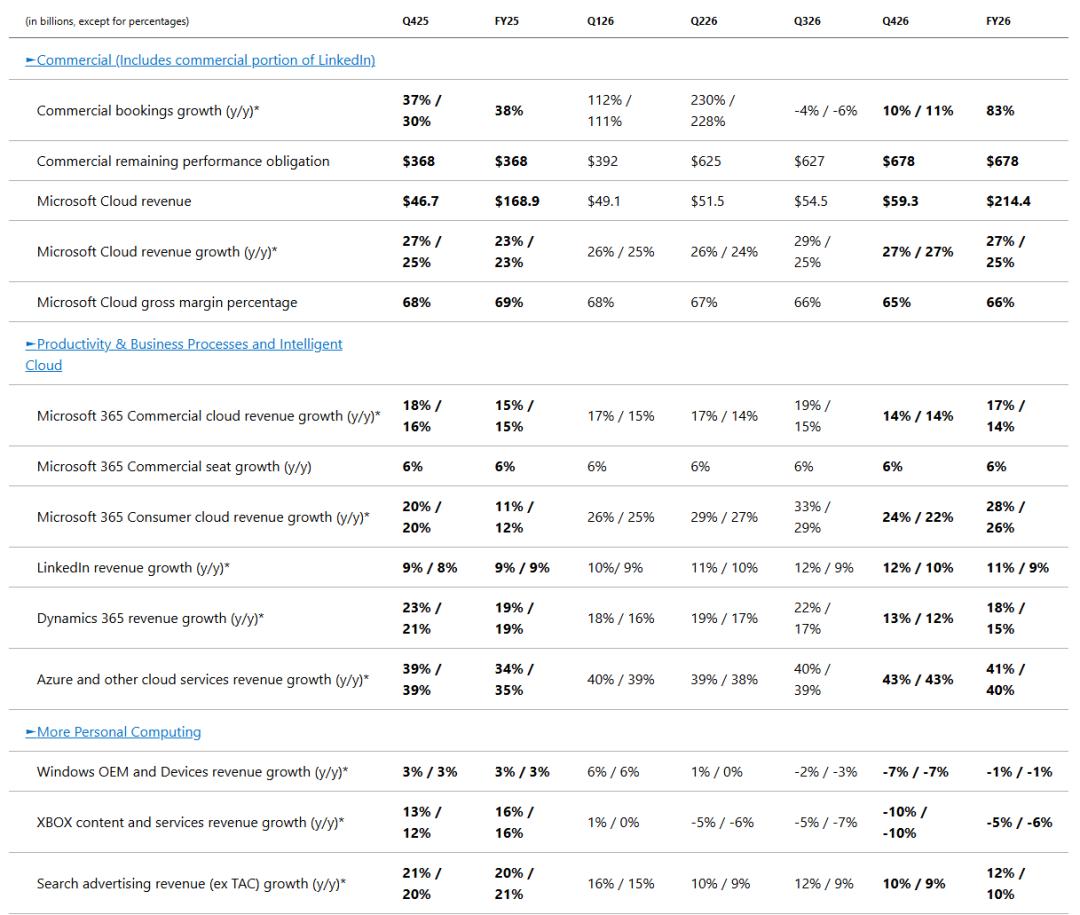
Financial performance of Microsoft's three major business segments
Microsoft's Intelligent Cloud division generated revenue of 39.3 billion U.S. dollars in the fourth fiscal quarter, compared with about 29.9 billion U.S. dollars in the same period last year, representing a year-on-year increase of 32% and 31% growth in constant currency, exceeding the general expectation of 38.16 billion U.S. dollars from analysts surveyed by StreetAccount.
This division is the fastest-growing part among Microsoft's three major business segments and has the most significant pulling effect on total revenue.
Revenue from Azure and other cloud services increased by 43% this quarter, compared with a 40% growth rate in the previous quarter, accelerating by 3 percentage points, marking the fastest quarterly growth rate since the beginning of 2022. This performance significantly exceeded Microsoft's previous guidance range of 39% to 40% in constant currency, and was also higher than the 39.6% expected by analysts surveyed by CNBC and StreetAccount.
Bank of America analysts pointed out before the earnings release that an Azure growth rate reaching or exceeding the guidance range may be necessary to support the stock price, and a weaker result may trigger concerns about AI investment returns. The actual 43% growth rate directly eliminated this risk.
Satya Nadella, Chief Executive Officer of Microsoft, disclosed in the financial report that Azure's full-year revenue for fiscal 2026 exceeded 100 billion U.S. dollars for the first time. Microsoft has never separately announced the annual revenue scale of Azure before, and this disclosure allows the market to directly compare it with competitors.
In terms of scale, Azure is larger than Alphabet's Google Cloud, but still lags behind Amazon's AWS. Azure's 43% growth rate at its current volume means an annual increment of more than 40 billion U.S. dollars, and its absolute growth value is equivalent to the total revenue of some mid-sized cloud vendors.
Microsoft's remaining commercial performance obligations reached 6.78 trillion U.S. dollars at the end of the fourth fiscal quarter, up 84% year-on-year and 8% quarter-on-quarter. This indicator measures the amount of revenue that has been contracted but not yet recognized, and its growth rate far outpaces the current-period revenue growth rate, which means the visibility of future revenue continues to improve.
Microsoft stated in the financial report that the quarter-on-quarter growth was mainly driven by customer commitments other than AI model developers. This statement directly addresses the market's concern that Microsoft is overly dependent on OpenAI. Microsoft disclosed in January 2026 that about 45% of its then 6.25 trillion U.S. dollars of remaining commercial performance obligations were related to OpenAI, and the growth of commitments from non-OpenAI customers this quarter is diluting this concentration.
Deutsche Bank analysts previously pointed out in a report that Microsoft's relationship with OpenAI faces "certain concentration risks", especially against the backdrop of the rise of open-source models, but maintained a "buy" rating.
The overall revenue of Microsoft's cloud business in the fourth fiscal quarter was 59.3 billion U.S. dollars, up 27% year-on-year, covering Azure, Microsoft 365 commercial cloud, Dynamics 365, LinkedIn and other commercial cloud services. Amy Hood, Executive Vice President and Chief Financial Officer of Microsoft, said in the financial report: "We closed the fiscal year with strong performance, highlighted by Microsoft Cloud revenue of 59.3 billion U.S. dollars, up 27% year-on-year."
02 Paid Copilot seats exceed 30 million
Microsoft's Productivity and Business Processes division recorded revenue of 37.8 billion U.S. dollars in the fourth fiscal quarter, up 14% year-on-year, exceeding the general expectation of 37.19 billion U.S. dollars from analysts surveyed by StreetAccount. This division includes Office, Dynamics and LinkedIn, and is the most stable profit-contributing segment of Microsoft.
The number of paid seats for Microsoft 365 Copilot exceeded 30 million. Three months ago, Microsoft disclosed that this figure was about 20 million, representing a quarter-on-quarter increase of about 50%.
Brad Reback, an analyst at Stifel, previously predicted that this number would be 26 million, and the actual figure far exceeded expectations. Reback commented: "Microsoft's investments in AI infrastructure and first-party applications are paying off for them."
Mandeep Singh, an analyst at Bloomberg Intelligence, believes this growth is a positive outcome, noting that "Microsoft's bundling strategy continues to work", which means Microsoft leverages the large user base of the Office suite to drive Copilot penetration and reduce the cost of acquiring customers separately. Against the backdrop of fierce competition for enterprise AI budgets from competitors such as Google, Anthropic and OpenAI, Microsoft is converting its existing user base into high-value AI subscription revenue by virtue of its market dominance in office software.
Revenue from Microsoft 365 commercial cloud increased by 14% on a reported basis, and 16% after adjustment. The 2 percentage point difference between the two figures is due to the early recognition of a revenue item in the same period last year, which raised the base figure at that time. Excluding this factor, the data can better reflect the actual business growth in the current period. Revenue from Microsoft 365 consumer cloud increased by 24%, and 22% in constant currency, showing that cloud service subscriptions on the individual user side also maintain robust growth.
Revenue from LinkedIn increased by 12%, and 10% in constant currency. Revenue from Dynamics 365 increased by 13%, and 12% in constant currency, with stable demand for enterprise resource planning and customer relationship management software.
Nadella summarized in the financial report: "We are advancing the frontier of the cost-output curve, ensuring that every customer can convert Tokens into business outcomes. This year, Azure's revenue exceeded 100 billion U.S. dollars for the first time, and the number of paid Microsoft 365 Copilot seats surpassed 30 million, which reflects customers' trust in our ability to help them with AI transformation."
03 Revenue of the More Personal Computing division declines
The More Personal Computing division generated revenue of 12.9 billion U.S. dollars in the fourth fiscal quarter, down 4% year-on-year, making it the only segment that recorded a decline among the three major divisions, but still higher than analysts' expectation of 12.17 billion U.S. dollars.
Revenue from Windows OEM and devices decreased by 7%, which was larger than the 4.2% decline in PC shipments estimated by Gartner in the same period, indicating that Microsoft is also facing pressure on the selling price or shipment structure of device-side licenses. Revenue from Xbox content and services decreased by 10%, the largest decline within the division. Microsoft announced in early July that it would lay off 3,200 employees in the Xbox division and close several game studios. The simultaneous occurrence of layoffs and impairment indicates that this business is undergoing structural contraction rather than cyclical adjustment.
Search advertising revenue (excluding traffic acquisition costs) increased by 10%, making it the only growth pillar within the division, but the growth rate has fallen from the early 21% to a plateau.
04 Capital expenditure continues to rise
Microsoft's capital expenditure in the fourth fiscal quarter was 41 billion U.S. dollars, up about 70% year-on-year. Analysts previously expected 42 billion U.S. dollars, and the actual expenditure was slightly lower than expected.
For the full fiscal year 2026, Microsoft's total capital expenditure reached 145.3 billion U.S. dollars. Microsoft stated in April that it expects capital expenditure for the 2026 calendar year to be about 190 billion U.S. dollars, a 61% increase from 2025. The company explained that due to industry-wide chip shortages, rising memory and component costs pushed the expenditure figure up by about 25 billion U.S. dollars. This cost driver is not unique to Microsoft, and the entire group of hyperscale cloud vendors is facing the same supply chain price pressure.
While making huge expenditures, Microsoft maintained positive cash flow. In the same period, Alphabet's Google reported negative cash flow, and this difference gives Microsoft a comparative advantage in financing costs and financial flexibility. Some investors are cautious about whether AI investments can generate sufficient returns, but Microsoft's positive cash flow status provides a wider buffer space.
The core basis supporting Microsoft's capital expenditure is the 6.78 trillion U.S. dollars of remaining commercial performance obligations. This indicator increased by 8% quarter-on-quarter, meaning the growth rate of locked-in future revenue far exceeds the current capital expenditure growth rate. Microsoft explained that the demand for its cloud services has exceeded the capacity of existing data centers, and the current capital expenditure is essentially expanding delivery capacity for already signed contracts, rather than speculative investment based on forecasts.
Before the release of Microsoft's financial report, UBS raised its capital expenditure estimate for fiscal 2027 from 234 billion U.S. dollars to 261 billion U.S. dollars, stating that the continuous demand for model training workloads and memory cost inflation are the reasons for the upward adjustment.
UBS also believes that investors' expectations for Microsoft's capital expenditure in fiscal 2027 are already in the range of 255 billion to 260 billion U.S. dollars. This level of expectation actually "reduces downside risks, even if AI capital expenditure rises and the Azure guidance for the second half of the year is confirmed rather than raised". This judgment means that the market has priced in the high expenditure expectation in advance, and as long as the actual expenditure does not significantly exceed this range, the negative impact on the stock price will be limited.
Bank of America analysts previously pointed out that Azure growth, AI infrastructure spending and Copilot adoption will become the dominant topics of discussion. The combination of Azure's 43% growth rate this quarter, 30 million paid Copilot users, and capital expenditure slightly lower than expected gives positive or neutral responses to all three concerns.
This article is from the WeChat public account "Tencent Tech", written by Tencent Tech, and published with authorization from 36Kr.