AI short films, targeting film festivals
AI film and television remains one of the most widely discussed topics this summer vacation.
On July 16, Douyin creator Feifeifei uploaded a collection of AI short films titled *The Laid-off Girl*, which has received more than 3 million likes so far;
On July 21, Tencent News' *I Have an Idea* launched the "Literature Super Interface: AIGC Image Experiment" screening event, encouraging AI creators to adapt serious literature for film and television.
On July 23, iQiyi launched its first AI online film *Strange Tales: Paper Blade Crossing the Wasteland*, with a duration of more than one hour;
On the Douyin platform, the number of fans of AI actors is also growing. Some people sigh that AI actors have more traffic than real entertainers, while others marvel at the evolution speed of AI film and television.
A number of practitioners are committed to refining AI content, striving to win more honors at more film festivals and screenings, waiting for explosive traffic push from platforms to obtain more commercialization opportunities.
Everyone knows that the model of simply producing a large volume of content can never last long.
The person who has won the most awards in the AI short film industry
Speaking of Kong Defei, people in the circle describe him as: "The person who has won the most awards in the AI short film industry."
In the past two years, relying on the creation of AI short videos, Kong Defei has won as many as hundreds of awards, which can almost fill two walls of his studio, including awards from the AI unit of Hainan Island International Film Festival, as well as international grand prizes such as the main competition unit of Cannes World AI Film Festival WAIFF. This year, he also joined the "Literature Super Interface: AIGC Image Experiment" to adapt the serious literary work *Bit Circle* with AI.
In the second half of 2024, when domestic AI large models were just starting out, Kong Defei, who had worked in the advertising industry for 11 years, participated in an AI advertising competition initiated by a brand. At that time, he did not expect AI to be valued so much as it is now, nor did he expect that he would finally win the national championship of this competition.
At the same time, AI large models are also iterating at a very fast speed. In just two or three months, AI has evolved to the efficiency of helping a person produce a demo film. Kong Defei finds it incredible, and wants to use AI to present all the bizarre ideas in his mind one by one.
In the past advertising industry, Kong Defei was mainly responsible for advertising creativity, while the execution side was controlled by the director team. This means that if the director can implement the creative ideas efficiently, the shooting of the advertising film will go smoothly; but if the director and the entire execution side fail to grasp the creative ideas, the final output will be greatly reduced. "Every time information goes through a layer of transshipment processing, it will be lost."
After the emergence of AI, Kong Defei can not only fully control his own content, present his creativity completely from the source, but even eliminate the situation of mutual buck-passing at work.
However, unlike many practitioners who decided to seize the opportunity of AI manhua, Kong Defei designed two paths for the business development of his studio: the first is to use his old expertise to carry out advertising creativity production business; the second is to create more high-quality AI story works, so as to be noticed by the mainstream film and television circle by winning awards at home and abroad, and make his creative ability recognized by more people.
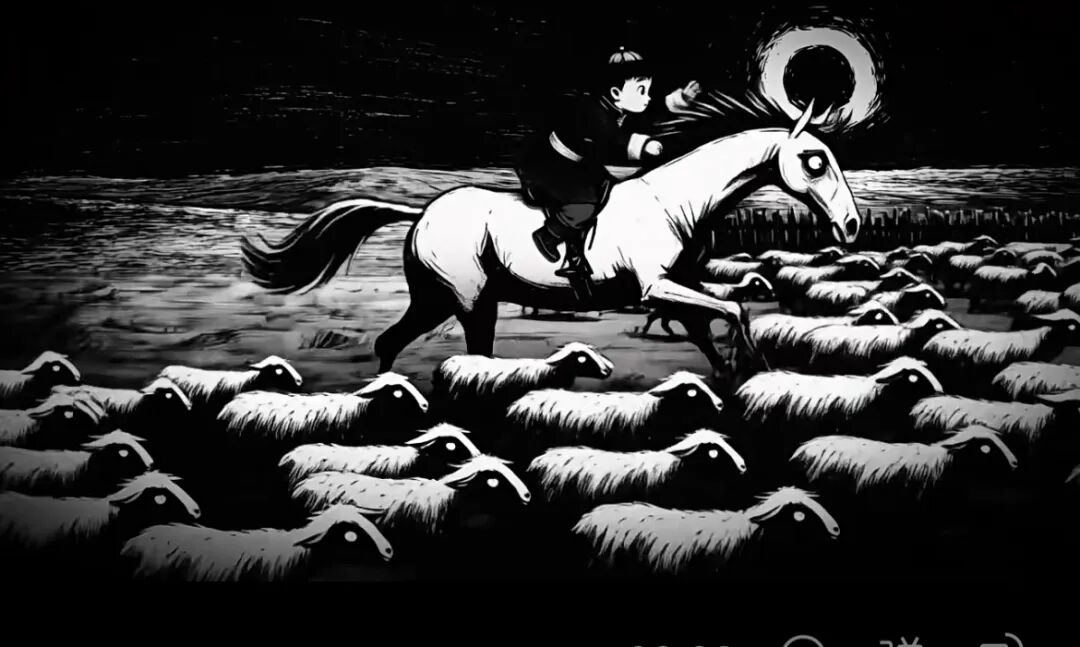
"Advertising is just a kind of commercial art, which ultimately serves commercial purposes, and is completely separated from personal expression, but our desire for narrative expression is still very strong, and we hope to make films."
Kong Defei's decision is also very wise. He did not follow the trend to make some realistic human short films that cause the uncanny valley effect, but chose to make fable-style content in the form of animation. For example, *Pumpkin* tells a slightly terrifying story in a textured fable style. This short film was entirely produced by Kong Defei alone, with a story outline of only 1,000 words, and finally won the Best Thriller Award at the 2026 AAFF International Ark AI Film Festival.
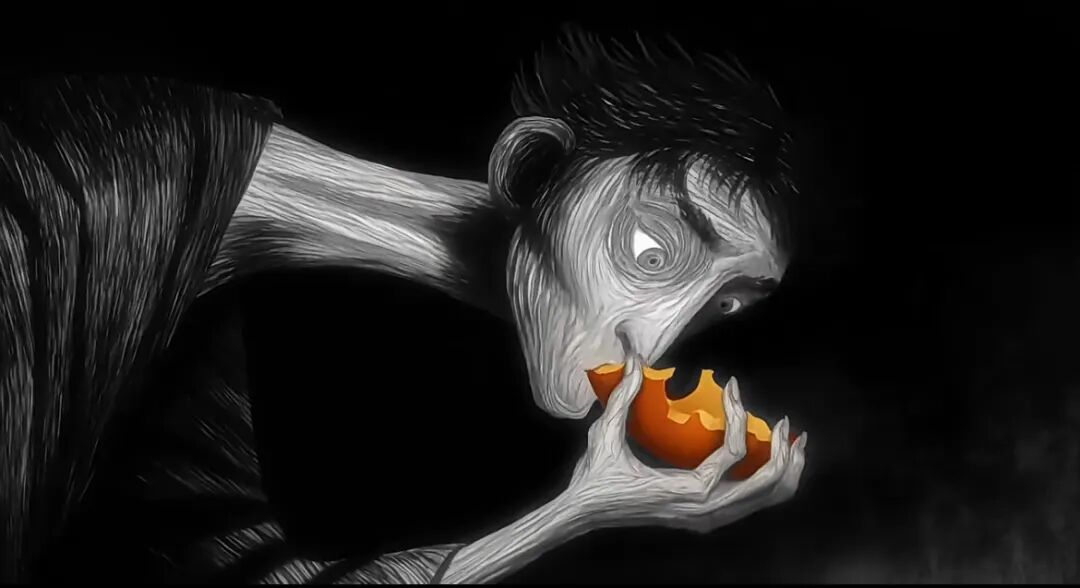
"The reason why we didn't touch AI realistic content is based on the performance of AI at that time. There were still certain problems in terms of delicacy, lines, rhythm, emotional expression, etc., including this uncanny valley effect, which will also make us feel physically disgusted." Kong Defei said.
In the first half of this year, Kong Defei's 5-person small team produced two or three short films with cinematic texture. On average, a 10-minute short film takes a month to produce. Even for AI short films shorter than 5 minutes like *Pumpkin*, Kong Defei spent more than 20 days making it alone.
Everyone says that computing power costs are expensive, but in Kong Defei's view, labor costs have become more expensive after the emergence of AI, and the production cost of a high-quality AI short film is not low. "The advertising monetization path of each team is the clearest at present, but for AI short films, we hope that platforms can act as investors to jointly invest in creating classic content."
This is the new path that Kong Defei wants to explore more after winning more than 100 awards.
"Modeling" with one's own image
Producer Zhou Peng and director Ding Yi participated in the "Literature Super Interface: AIGC Image Experiment" screening event jointly initiated by Tencent News, *People's Literature* magazine and Beijing Informatization Association this year. Under multi-party cooperation, they adapted the serious literary work *The Six-eared Macaque* by writer Xu Zechen. From the finalization of the early script to the completion, this 15-minute short film took the team a month.
Although it is not individual creation, the entire production team only has two or three people. Ding Yi is responsible for the director work, Zhou Peng participates at any time to solve the computing power and human resource problems encountered in the production process, and other staff are responsible for providing opinions to facilitate post-production adjustments.
For Zhou Peng, the biggest challenge in the film and television adaptation of serious literature with AI comes from the ability to express the story. "The expression of serious literature is relatively restrained, which puts forward high requirements for the ability to tell stories, but in the process of creation, we cannot set the tone too high, or completely jump out of the framework of the novel to tell the story."
*The Six-eared Macaque* uses the perspective of a monkey to look at the confusion of people who move to Beijing from other places. In addition to the down-to-earth expression of the content, this AI short film also has a distinct image style: In order to avoid portrait right infringement, the protagonist image of *The Six-eared Macaque* comes from Zhou Peng's real shooting; in order to avoid the "AI taste", the street scenes of the short film also come from real shooting, plus the adjustment of black and white tone, which can greatly reduce the flaws and noise of the picture.

This is also the main tone of Ding Yi and Zhou Peng's short video content. The *Cyber Peng Ge* series they collaborated on all have such characteristics: the colors are black and white, and the protagonists are based on their respective images. In comparison, *The Six-eared Macaque* is more like a sublimation of the *Cyber Peng Ge* series.
Different from Kong Defei's advertising monetization method, Zhou Peng and Ding Yi's content is more of a self-media attribute, mainly monetizing through AI short videos, and the highest price for a single advertisement can reach 400,000 yuan.
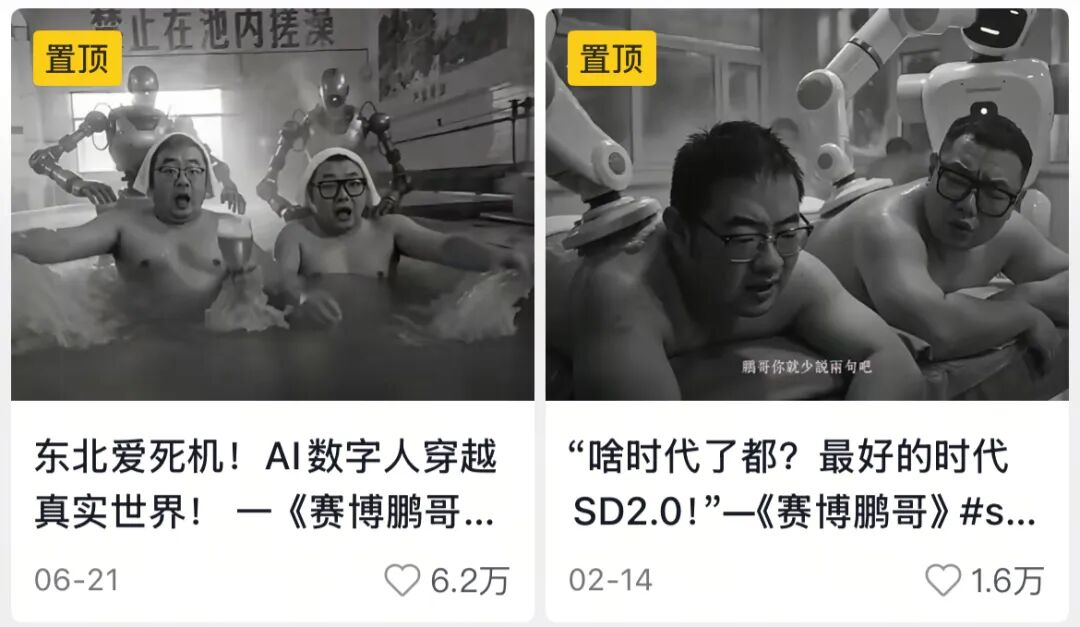
"Short dramas are not suitable for creators of our type to monetize. On the one hand, we don't have enough people and we can't produce content that fast; on the other hand, we prefer to output high-quality content instead of following the assembly line model."
Zhou Peng used to work in the decoration industry, but because the industry was too difficult to survive, he decided to transform to the AI film and television industry. For one thing, the operation technology related to AI is not difficult, and for another, the difficulty of making a film is not too high. At first, he just wanted to make money, and later he began to want to make more valuable expressions.
Because in this industry, everyone is aware that the end result of the traffic flywheel driving out the content flywheel is to accelerate the deterioration of the entire ecosystem. "The actual situation is that 90% of short drama companies have accelerated their closure in May this year. The products that can now enter the top three of the hot list are of very good quality, whether in terms of acting selection or basic settings. Only the best content teams can survive."
For long-term development, we still need to create high-quality content, especially with personal expression. Zhou Peng gave an example: AI can help creators expand a 1000-word work to 10,000 words, but if the story has no soul, does it still make sense?
AI short films, waiting for a hit work to appear
The commercialization of AI short films still takes some time. In this process, some people regard it as a springboard to shooting long films, while others expect a hit work that can revolutionize the current industry situation to appear.
Before making AI short films, Ding Yi worked in the advertising industry and also participated in the shooting of some documentaries.
For him, one of the benefits of making AI short films is that he can win more awards. In Ding Yi's view, whether it is shooting a long film or a documentary, it takes a certain amount of time to polish, but in this period of time, more AI short films can be polished to win opportunities for himself, which has higher cost performance.
This opportunity not only means that his talent can be seen, but also means that he may have the opportunity to shoot long films. "For young director creators, this is the only antidote to be seen by platforms."
At a time when platform projects are reduced and young practitioners have fewer opportunities, making achievements in the AI field has become the choice of many people. Many young people have continuously won awards through AI short films. For them, winning awards in the AI short film field may get a "ticket" to shooting live-action long films.
At the "Literature Super Interface: AIGC Image Experiment" screening event, a post-2000s AI short film creator with many award-winning experiences told Hedgehog Commune that compared with the omnipotence of AI, live-action shooting has irreplaceable functions: "You may use AI to create the top of Mount Everest, but you can never convey the feeling of you climbing to the top of Mount Everest."
Zhou Peng is still evolving his AI short film content, making his works transition from black and white to color. The biggest difficulty is that the content generated by AI is not perfect enough at present, and the audience is more and more resistant to the uncanny valley effect brought by AI content.
But he believes that such technical problems can be solved within a year, followed by the profit period of high-quality AI short films. "Good AI short films, like long films, also need to sit down and think slowly, polish repeatedly to find the right feeling." Zhou Peng said. As far as he knows, some people have already begun to settle down to create such content.
In the process of studying technology, Zhou Peng once wanted to sign up for an AI training course, but later he became a teacher in this class. But for him, there is a paradox here: all his training content comes from practical experience, but these experiences are too time-sensitive to keep up with the iteration speed of AI forever.
For creators of AI short films, in the era of rapid AI iteration, technology is often relatively cheap, and the most important thing is still good content.
"Consumers don't care if you use AI or not, they only care if it's a good story." Kong Defei said that he is still optimistic about the commercialization prospect of high-quality AI short films. "The reality is that people will complain about shoddy content, but they will also pay for good content practically.
When AI allows everyone to directly reach a score of 60 to 70, someone needs to push the standard to 90 points or even higher, and the entire industry is always waiting for such a hit work to become popular.
This article is from the WeChat official account "Hedgehog Commune" (ID: ciweigongshe), written by the editorial department of Hedgehog Commune, and authorized for release by 36Kr.