Chinese and US giants are scrambling for CPUs
On July 29 local time in the United States, Arm released its financial results for the first fiscal quarter of fiscal 2027 (corresponding to the second quarter of 2026) ending June 30. The earnings report shows that Arm's revenue in the first fiscal quarter reached 1.29 billion US dollars, a year-on-year increase of 22%, setting a new quarterly revenue record once again.
Its net profit was 270 million US dollars, or 0.25 US dollars per share, doubling from the 130 million US dollars profit and 0.12 US dollars earnings per share in the same period last year. Excluding items mainly consisting of stock-based compensation, the earnings per share under the Non-GAAP caliber was 0.45 US dollars, a year-on-year increase of 29%.
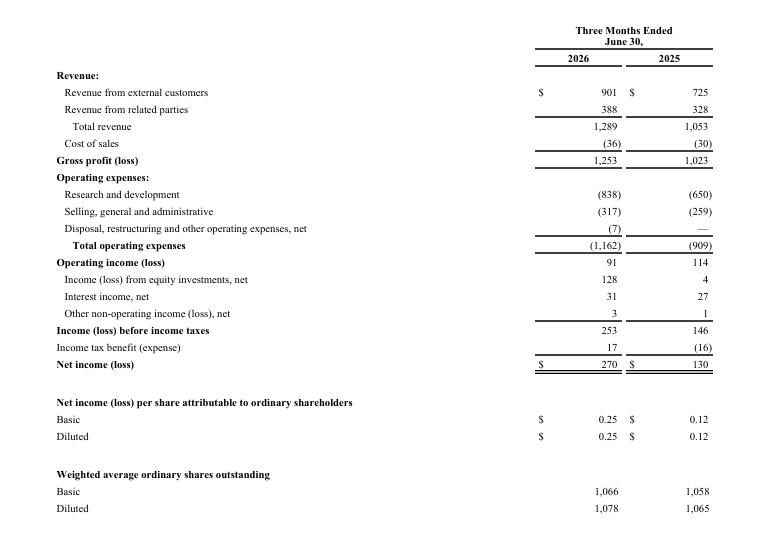
Key financial data from Arm's first fiscal quarter earnings report
This strong performance failed to fully satisfy the market. Due to Arm's cautious outlook on smartphone royalties for the second fiscal quarter, its share price once fell by 8% in after-hours trading, reflecting that under the current semiconductor stock sell-off, investors have become extremely sensitive to any potential risks.
01 Data center becomes the strongest growth engine
Arm's performance in the first fiscal quarter beat the general expectations of the market and analysts across all key metrics. Revenue was higher than the company's own guidance and the market estimate of 1.26 billion US dollars. Earnings per share exceeded the upper limit of the company's guidance of 0.40 US dollars, and was also higher than the average analyst expectation of 0.40 US dollars compiled by FactSet.
Among them, royalty revenue reached 715 million US dollars in the quarter, a year-on-year increase of 22%. The growth momentum comes from two aspects:
First, the continuous adoption of higher-value technologies such as the Armv9 architecture and Arm CSS has raised the royalty rate per chip;
Second, the surge in deployment of Arm architecture-based chips in data centers has driven royalties in this segment to double, becoming the core highlight of this quarter's performance.
Shipments of Neoverse, Arm's high-performance processor core architecture designed specifically for data centers, cloud computing and AI infrastructure, have exceeded 1.5 billion cores. What is more noteworthy is its growth rate - the first 1 billion cores took six years to ship, while the latest 500 million cores took only nine months.
Haas summed up this trend as "growth is accelerating", indicating that Arm is rapidly increasing its market share and value capture capabilities in the continuously expanding data center market.
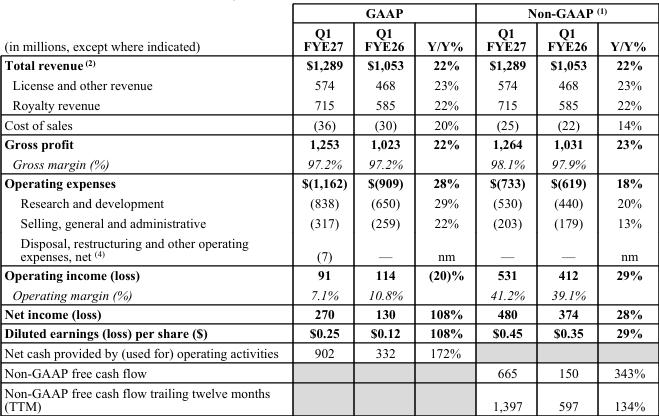
Revenue data of Arm's two major business segments
On the other hand, licensing and other revenue increased by 23% year-on-year to 574 million US dollars, setting a new record for first fiscal quarter licensing revenue. Strong market demand, the signing of multiple high-value licensing agreements and the contribution of backlog orders jointly drove this growth.
The annualized contract value (ACV), which measures normalized licensing revenue in the future, reached 1.732 billion US dollars this quarter, up 13% year-on-year, indicating that the foundation for steady growth of licensing revenue remains solid.
A recent report from market research firm IDC states that spending on Arm-based accelerated server platforms has nearly doubled in the past two quarters and has surpassed x86 platforms.
02 Chinese and US customers are competing for AGI CPUs
As a key step in Arm's strategic extension from a pure technology licensor to a product provider, its self-developed chip business AGI CPU showed far-exceed-expected explosive performance in the first fiscal quarter.
When launching the AGI CPU in March, Arm set a revenue target of 1 billion US dollars for fiscal 2027 and fiscal 2028. However, in the first fiscal quarter, the growth rate of customer demand has far exceeded the initial expectation, and the total demand for fiscal 2027 and fiscal 2028 has exceeded 2 billion US dollars.
According to Haas, Arm has continued to add many new customers in the United States and China, and the overall order pipeline value continues to increase. Oracle has also agreed to purchase this new chip. In terms of production capacity, the first batch of products has been delivered to multiple customers, and the manufacturing capacity required to support the initial target has been secured.
Haas further said: "Our continuous efforts with partners to expand manufacturing capacity make us more and more confident that we can deliver products at the scale our customers need. On the supply side, I feel much better than I did 90 days ago."
Analysts at Jefferies once predicted that by fiscal 2031, Arm's self-developed chip sales are expected to reach 18 billion US dollars, exceeding the company's own forecast of 15 billion US dollars.
03 Comprehensive expansion of the AI ecosystem
The boundary of AI is expanding rapidly, spreading from data centers to PCs, smartphones, automobiles and even physical worlds such as intelligent robots. This trend brings structural growth opportunities to Arm's computing platform.
In the data center, the momentum of AI infrastructure migrating to the Arm architecture has been endorsed by top global cloud providers and chip manufacturers this quarter.
NVIDIA announced that its Arm architecture-based Vera CPU has entered full production, with performance up to 50% higher than comparable x86 systems and 2x higher energy efficiency, and will serve as the CPU foundation for its next-generation AI infrastructure.
Google emphasized that its Arm architecture-based Axion CPU is the core of its AI infrastructure strategy and acts as the host CPU for its latest TPU AI system.
Amazon AWS expanded the deployment of its Graviton platform and announced a multi-year agreement with Meta to deploy tens of millions of Graviton5 cores to support agent workloads.
Microsoft expanded its Azure Cobalt 200 virtual machines built on Arm Neoverse CSS. Qualcomm also announced plans to enter the AI data center CPU market with its Arm architecture-based Dragonfly C1000.
In the edge and end device sector, the new generation of computing devices is spawning two new categories: efficient mobile AI PCs and high-performance agent platforms.
NVIDIA launched RTX Spark, the first agent PC built on the Arm Compute Subsystem (CSS), which can run complex agents and large AI models locally. This system is expected to be launched later this year by leading OEMs such as Acer, ASUS, Dell, HP and Lenovo.
For mobile AI PCs, the same OEMs are expanding the Windows on Arm ecosystem with new AI PCs equipped with Qualcomm Snapdragon, while Google's investment in AI-powered Chromebooks has also expanded the accessibility of end-side AI in the PC market.
The same economic factors also extend to the physical world. Vehicles, robots, industrial systems and autonomous machines require efficient, safe real-time computing capabilities.
NVIDIA recently expanded its physical AI platform and launched the humanoid robot platform Isaac GR00T powered by Jetson Thor, which combines an Arm architecture-based CPU and NVIDIA Blackwell GPU.
The entire Arm software ecosystem is also continuing to grow, currently supporting more than 22 million developers worldwide. Performix, launched in the first fiscal quarter, has received support from Microsoft, MongoDB, Redis and SAP, helping developers and agents analyze and optimize workloads on Arm infrastructure.
04 Uncertainty in the smartphone sector
Looking ahead to the second fiscal quarter, the midpoint of Arm's performance guidance is higher than the average market expectation.
Arm expects revenue to be around 1.38 billion US dollars, higher than the average analyst estimate of 1.34 billion US dollars. Under the Non-GAAP caliber, diluted earnings per share is 0.47 US dollars, which is also higher than analysts' expectations of 0.43 to 0.44 US dollars.
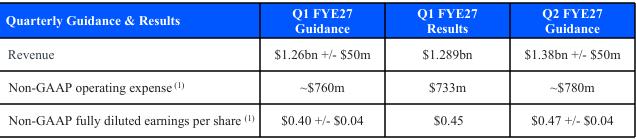
Arm's revenue and earnings guidance for the second fiscal quarter
However, behind these positive outlooks, the market has also captured a hint of uneasy signals.
Chief Financial Officer Jason Child predicted on the conference call that smartphone royalty growth in the second fiscal quarter would be about 10% to 15%, and mentioned that memory shortages could impact the production output of handset manufacturers.
Although Arm focuses more on high-end phone customers, which can buffer the impact of the decline in total industry shipments to a certain extent, this warning has been amplified under the current fragile market sentiment and has become the direct trigger for the after-hours share price decline.
This article is from the WeChat official account "Tencent Tech", written by Worth Paying Attention To, and published by 36Kr with authorization.