AI cannot come up with the next "Wang's Conjecture"
In the past few days, an article titled "Wang's Conjecture" has gone viral across social media.
It was originally a feature profile written by Guangxi Daily for mathematician Wang Hong. The article became so popular that physical copies of the newspaper were impossible to find, forcing the newspaper office to announce a reprint. Even the price was driven up from 1 yuan to as high as 60 yuan per copy on second-hand trading platforms.

Image source: Guangxi Daily official WeChat account
On July 23, 35-year-old Wang Hong won the Fields Medal. Her most well-known achievement is the proof of the 3D Kakeya Conjecture, which she completed with mathematician Joshua Zahl in 2025.
This problem can be traced back to a needle with no thickness: if you want to turn it to face every possible direction in 3D space, what is the minimum area required?
The problem sounds like a geometry question that could be drawn on an elementary school student's exercise workbook, but the answer Wang Hong and Zahl provided fills a full 127 pages.
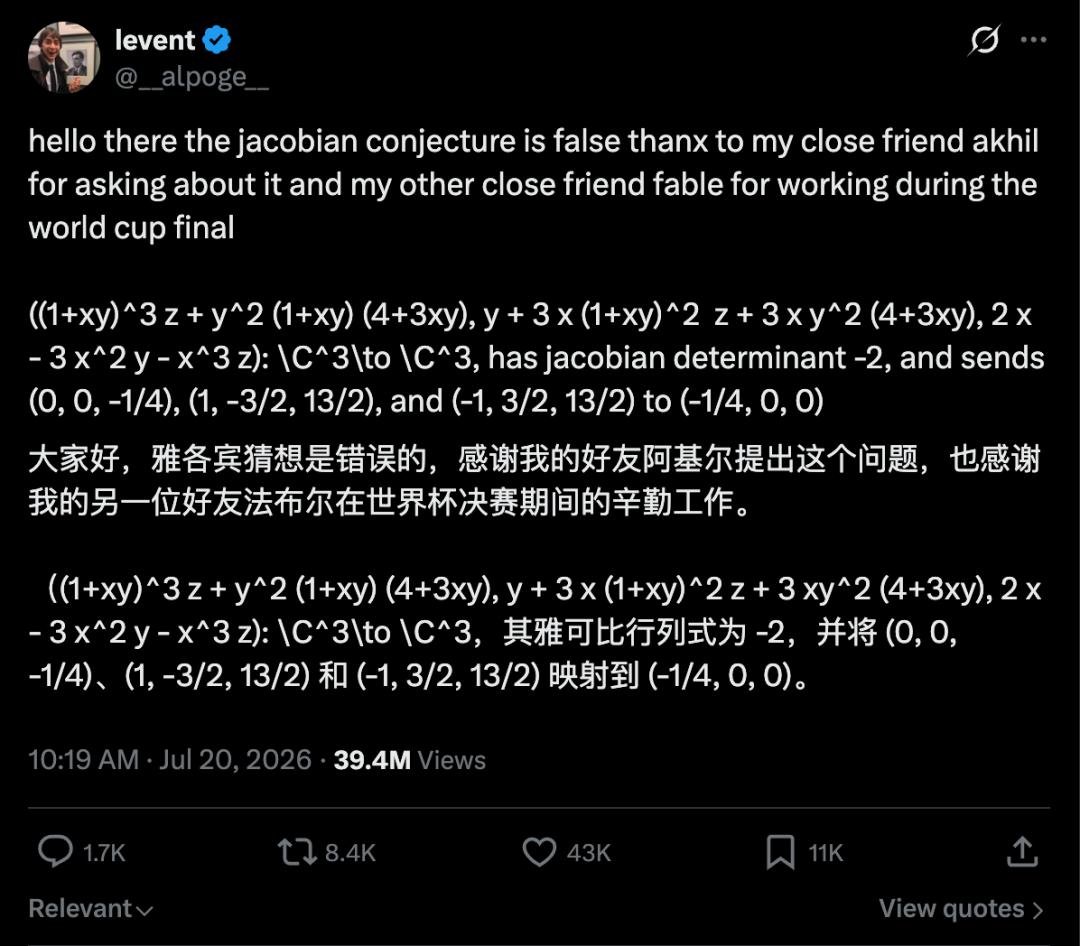
Thanks to Fable for its hard work
On the other side, OpenAI's GPT-5.6 Sol Ultra solved the half-century-old Double Cover Conjecture with a 3-page proof; Anthropic's Fable 5 helped mathematicians find a very short counterexample that overturned the 87-year-old Jacobian Conjecture.
Social media is flooded with news of AI's superhuman feats: "A mathematician was woken up in the middle of the night by Claude", "One prompt overturns an 80-year-old conjecture". OpenAI and Anthropic are racing to prove which other mathematical conjectures can be solved by their flagship models, fully immersed in the fantasy that large language models are "omnipotent".
However, even though AI has learned to prove complex mathematical conjectures, it still cannot come up with the elevator that existed in Einstein's mind.
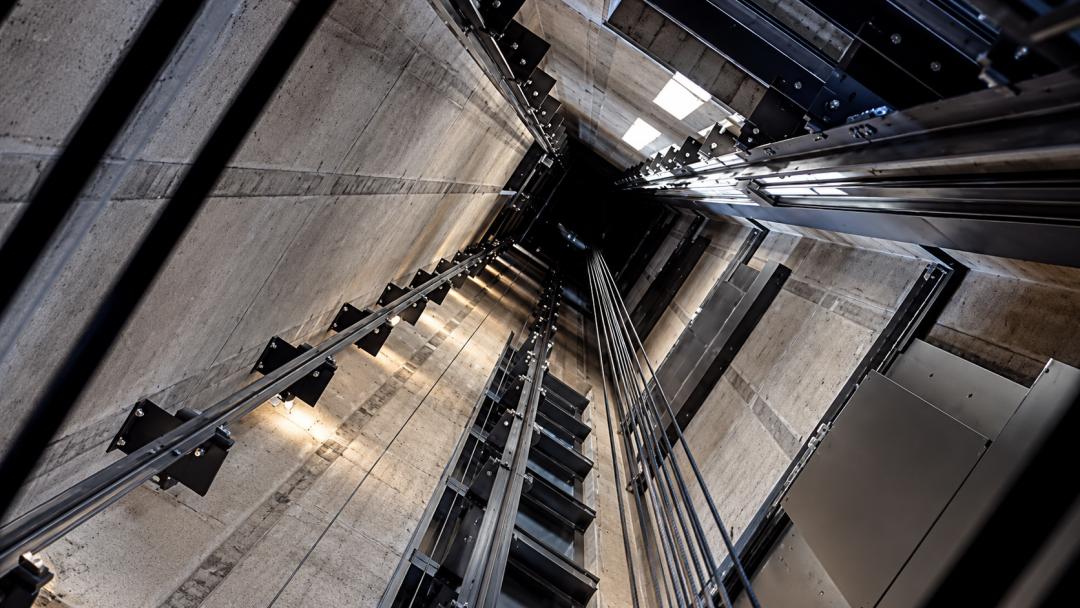
A windowless elevator is suspended in outer space.
The rocket ignites, and the elevator begins to accelerate upwards. You release the apple in your hand, and it falls to your feet. A person standing inside the elevator cannot tell whether the apple fell because there is a nearby planet exerting gravity, or because the floor under their feet is accelerating upwards to catch up with the apple.
In 1907, Einstein derived the principle of equivalence from a similar thought experiment: gravity and acceleration are indistinguishable within a local scope. He later called this "the happiest thought of my life".
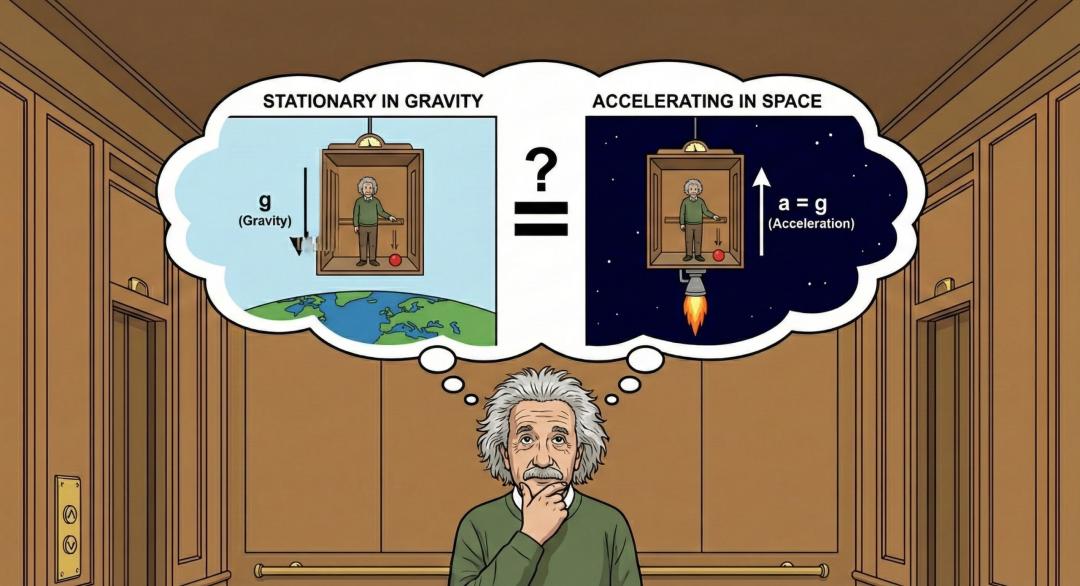
More than a hundred years later, Google DeepMind researcher Tom Zahavy brought this elevator to the attention of AI.
The question he raised is: If AI is only given the knowledge available before the birth of general relativity, can it independently conceive of this elevator and then derive the principle of equivalence from it?
Zahavy's answer is no. This July, Google DeepMind presented its position paper "LLMs can’t jump" at ICML 2026. The paper directly states that large language models cannot complete the most critical creative leap in scientific discovery.
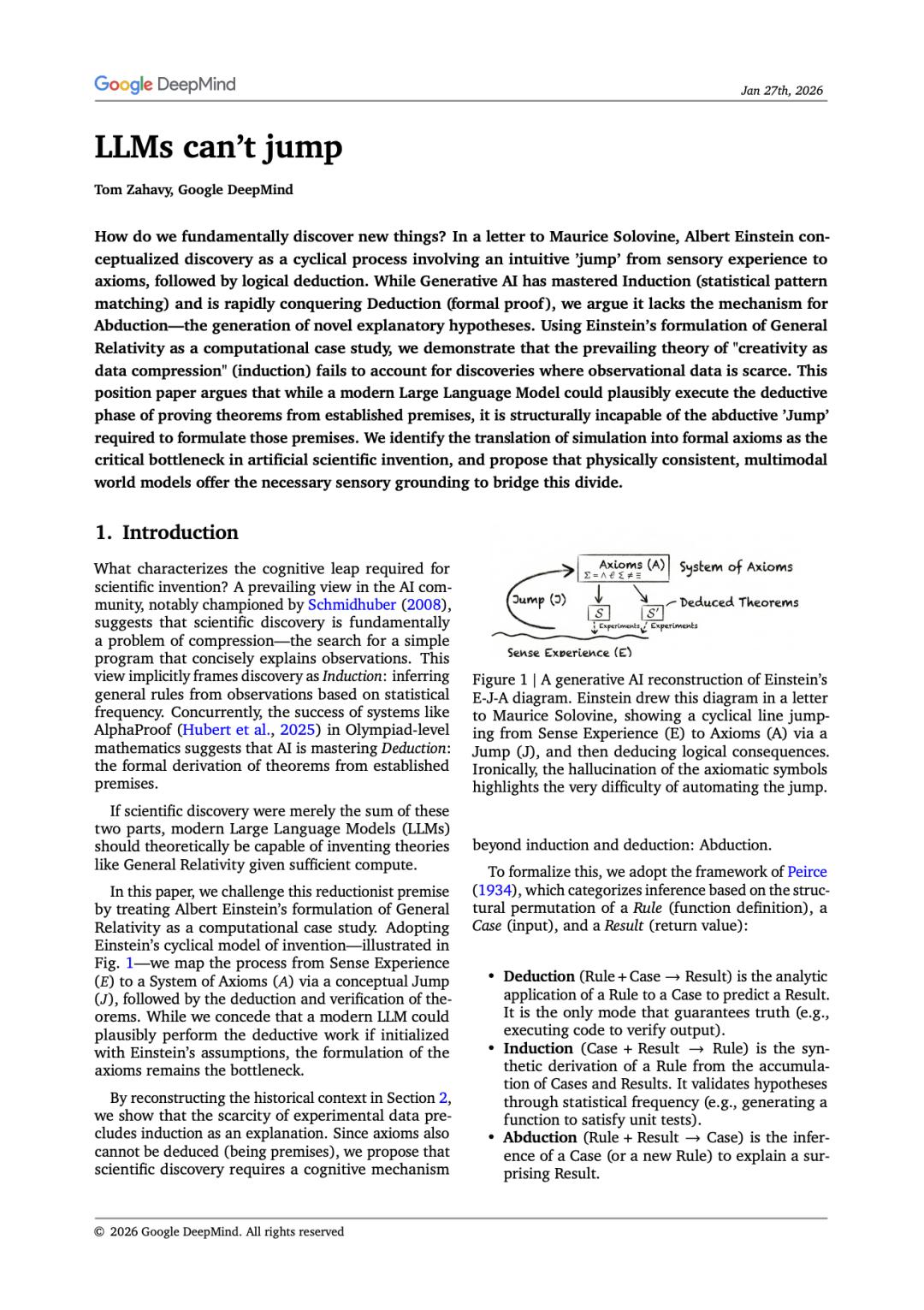
Paper link: https://philsci-archive.pitt.edu/28024/1/Scientific_Invention_Position_Paper%20%2817%29.pdf
Tom Zahavy, a researcher at Google DeepMind, believes that today's large language models are already very good at finding patterns from data and are learning to prove complex conclusions along axioms, but they lack the third type of reasoning required for scientific invention: when facing a problem with no existing answer, proactively propose new explanations, new concepts, and even replace the original axioms.
The paper gives this action a vivid name: Jump.
Three Levels of Cognition
To understand why jumping is a limitation of large language models, we must first understand the underlying mechanism of human thinking and invention.
The paper borrows the trichotomy of human reasoning from American logician Charles Sanders Peirce:

Induction: Input + Output -> Rule. Find patterns from a large amount of observation data and fit out laws.
Deduction: Rule + Input -> Output. Based on existing axioms and premises, carry out rigorous logical derivation to ensure the process is error-free.
Abduction: Rule + Output -> New Input (or New Axiom). When encountering unknown phenomena or the failure of old theories, jump out of the original framework out of thin air and put forward brand-new hypotheses and assumptions.
To describe these three types of reasoning with a more vivid metaphor, we can assume that we pick an apple from a tree every day, and when we let go of it, it falls to the ground every single time.
After seeing this happen many times, we conclude that "apples usually fall downwards" — this is called induction: finding patterns from many examples. This is the core capability that large language models use when learning which words, facts and phenomena frequently appear together from massive amounts of text.
After we already know the law of gravity, we can predict in advance that the next apple will also fall to the ground when released. This is called deduction: accepting a set of rules, then deducing what results they will bring in specific scenarios. Solving mathematical problems and writing formal proofs mostly fall into this category.
With the help of formal verification tools (such as Lean) and reinforcement learning, AI can already solve most of the extremely difficult math problems at the IMO level, and even automatically generate rigorous mathematical proofs.

One day, you release an apple, but it floats in the air. You start to suspect that the elevator you are in might be in free fall, so both you and the apple lose the sense of weight. This is called abduction: seeing a strange phenomenon, and proposing a new hypothesis that can explain it.
Therefore, at the current stage, AI can complete induction to find patterns from existing materials, and deduction to derive answers within existing rules, but "induction + deduction" is not equal to scientific invention. All 0-to-1 breakthroughs in the history of science are essentially a "JUMP".
Einstein's famous E-J-A diagram shows that: starting from sensory experience (Experience, E), scientists must go through a "Jump (J)" that cannot be explained by pure logic, to leap to a brand-new axiom system (Axioms, A), before they can carry out subsequent deduction.

Einstein's E-J-A diagram reconstructed by AI
These are precisely the insurmountable gaps that large language models cannot cross.
Einstein Doesn't Need Big Data
A belief has long been popular in the AI circle — "creativity is essentially data compression". This theory holds that scientific discovery is nothing more than finding a more concise program to compress and explain complex observational data.
In this paper, DeepMind uses the birth history of general relativity to refute this assumption.
Between 1907 and 1915, when Einstein was constructing general relativity, there was no massive amount of anomalous data in the physics community that needed to be "compressed".
At that time, Newtonian mechanics worked very well in most scenarios, and experiments did not pop up a conspicuous error box requiring everyone to rewrite physics. Einstein first noticed that two seemingly unrelated phenomena might actually be the same thing, then turned this new hypothesis into a calculable and verifiable theory.
This is exactly what the paper calls "jump": before the answer appears, replace the premise for understanding the problem first.
The paper also analyzes Einstein's derivation process between 1913 and 1915. At that time, Einstein collaborated with mathematician Grossmann to write the draft, and they were once extremely close to the final answer. Grossmann even found the Riemann curvature tensor, and derived a form extremely close to the modern field equation.
However, due to a fatal mistake, they mistakenly believed that the tensor could not reduce to the classic Newton's law of gravitation in the weak-field static scenario (violating the Newtonian limit). They thought this path led to a dead end, thus abandoning the correct geometric path, delaying the birth of general relativity by two full years.

Zahavy, a researcher at DeepMind, admits that if Einstein's physical assumptions are input as initial conditions into a modern AI theorem proving system today, AI does have the possibility to discover this reasoning loophole faster than Einstein and correct the proof path.
But this still does not count as invention. Deduction (A -> S) is only the downstream verification process, AI can deduce the precession of Mercury based on the "equivalence principle", but the premise is that humans must first feed the "equivalence principle" to AI as an axiom.
Large Language Models Only Repeat, Can They Never Truly Create?
When "induction" has no driving force and "deduction" cannot create premises, Einstein completed that "leap" through abduction.
In 1907, Einstein conceived the "happiest thought of his life": a person falling freely from the roof cannot feel his own weight.

This is the famous "elevator thought experiment": in a windowless closed elevator, if the elevator is accelerating upwards at a constant acceleration in deep space, the feeling of objects falling inside the elevator is exactly the same as that in the Earth's gravitational field.
The paper emphasizes that Einstein completed this abductive leap not through text or symbolic calculation, but through embodied simulation. He "placed himself" in that virtual physical scene, directly manipulating and perceiving the bodily sensations of space, acceleration and gravity.
Einstein once wrote: "In my thinking mechanism, neither written language nor spoken language seems to play any role."
When the language and mathematical symbols describing curved spacetime did not yet exist, he anchored abstract symbols in physical sensory experiences, thus completing the leap from sensory experience to brand-new axioms (E -> A). This is exactly the flaw of LLMs — the "Chinese Room" is disconnected from real symbols.
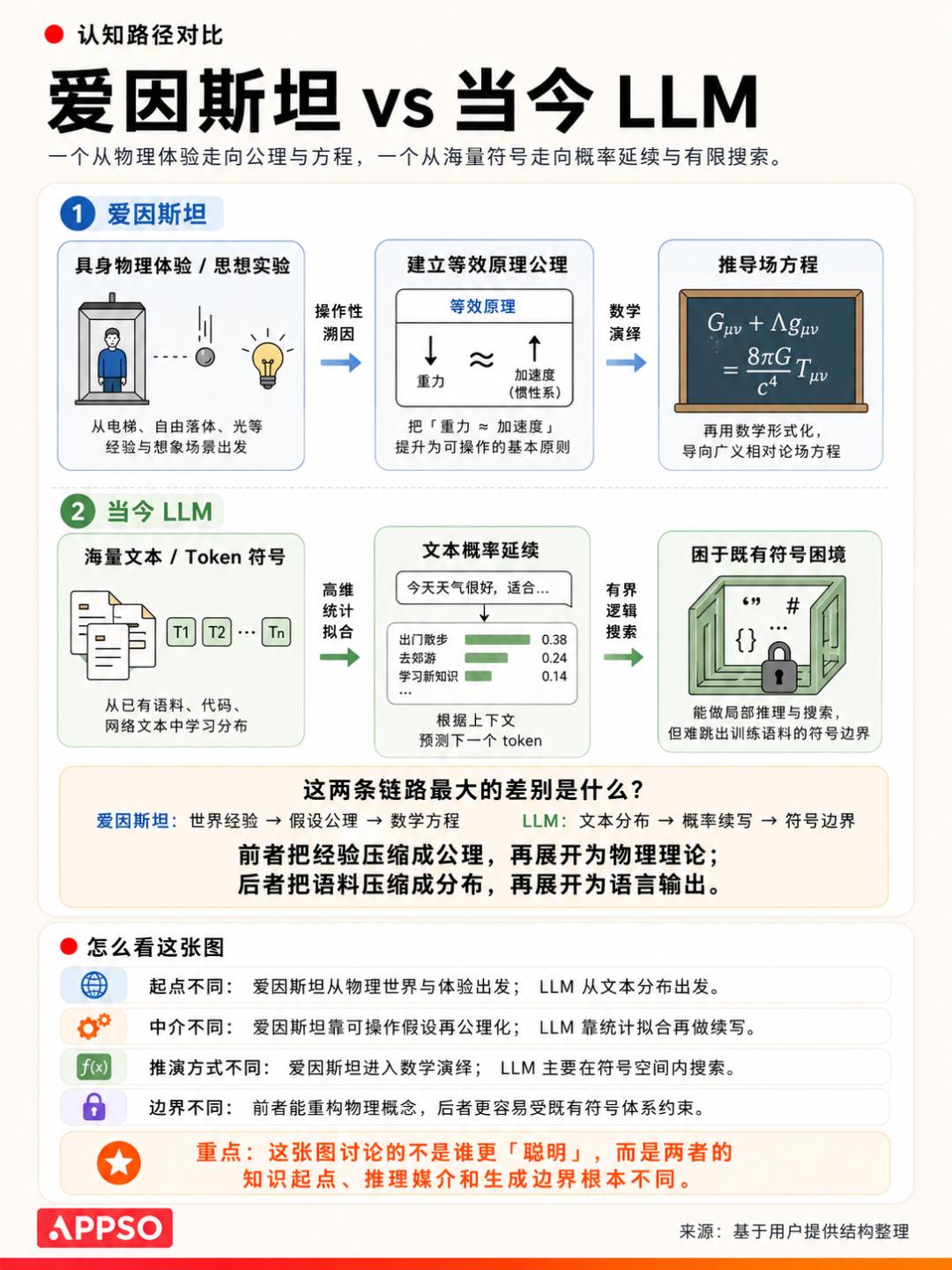
Essentially, an LLM is a "Chinese Room" running in high-dimensional space. What it processes is the statistical probability between tokens, and it lacks perceptual interconnection with the real physical world.
