Transactions of ultra-luxury properties have surged, and the logic of the high-end market is about to change.
Since the beginning of this year, new signals have emerged in the high-end market.
A one-sentence summary: Moderate contraction in total volume and drastic structural differentiation.
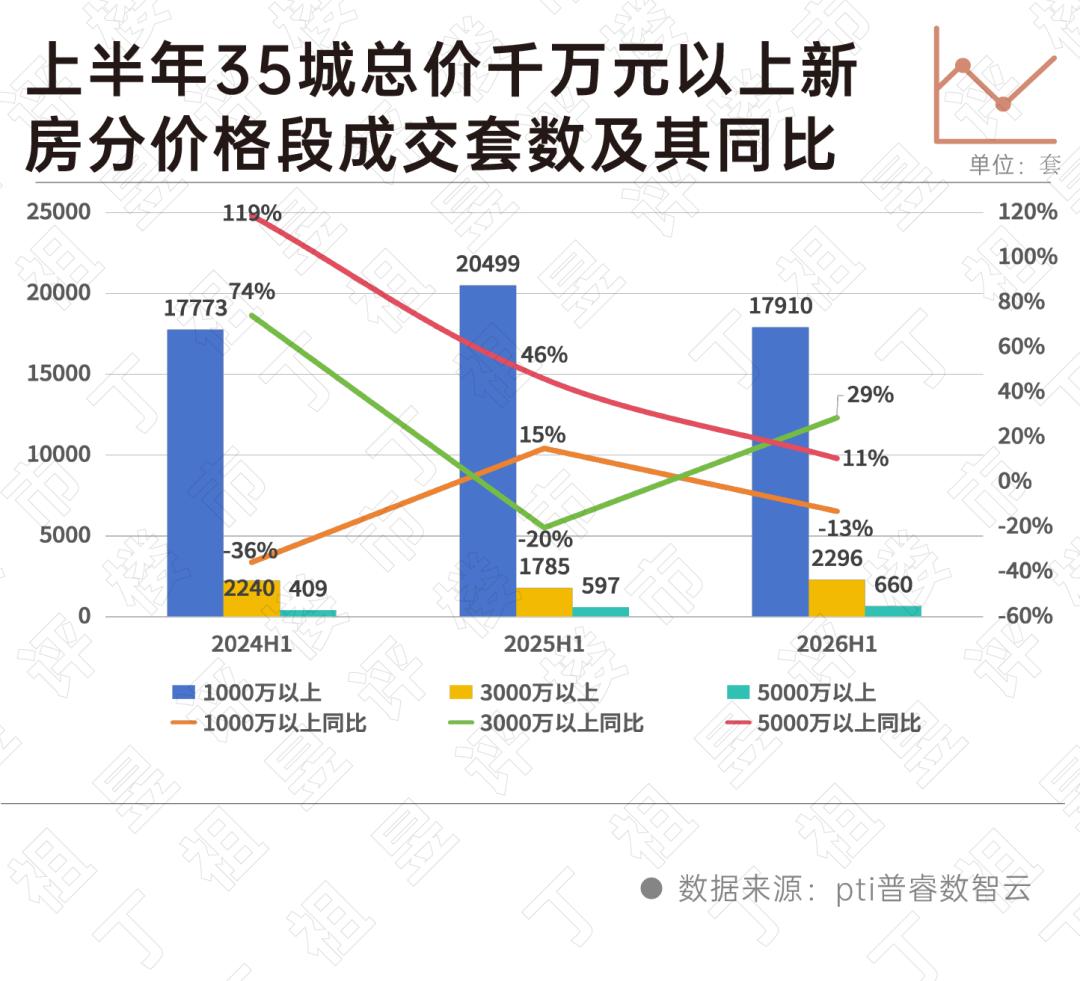
At the data level, the total transaction volume of luxury homes priced above 10 million yuan in 35 key cities in the first half of the year decreased by 13% year-on-year. In contrast, the transactions of luxury homes priced above 30 million yuan and 50 million yuan increased by 29% and 11% respectively.
This means that the property purchase demand of high-net-worth individuals has not disappeared, but has shifted to "selective allocation".
Under the general trend of "top luxury orientation" in the high-end market, in-depth logical changes are taking place in both the macroscopic urban pattern and the microscopic performance of price segment structure, project de-stocking efficiency and other aspects.
01
Monitoring data from Pti Puri Digital Intelligence shows that in the first half of the year, a total of about 17,900 new commercial residential properties priced above 10 million yuan were transacted in 35 cities, a decrease of about 13% compared with the same period in 2025, but still maintaining a positive growth of about 1% compared with the same period in 2024.
Looking at the transaction trend of high-end residential properties in the past three years, the first half of 2025 is the peak transaction period of high-end residential properties in the past three years. In the first half of 2026, the transaction volume fell back to 18,000 units, which is still in the high range in history.
There are two signals behind this data: First of all, the decline in 2026 is not a trend recession, but more a digestion of the overdraft effect of the previous year. In addition, the property purchase demand of high-net-worth individuals has not disappeared, but has shifted to "selective allocation".
The change in demand further promotes the evolution of the high-end market to the "top luxury orientation" trend.
According to the data, top luxury properties priced above 30 million yuan surged against the trend, with a year-on-year increase of 29%, and those priced above 50 million yuan also increased by 11%.
It means that the ultimate demand for home improvement that takes into account asset allocation investment continues to be strong.
02
In the past, the pattern that Shanghai and Beijing monopolized the national high-end residential market was broken in 2026, and "decentralization and spillover" of high-end purchasing power has become the core trend.
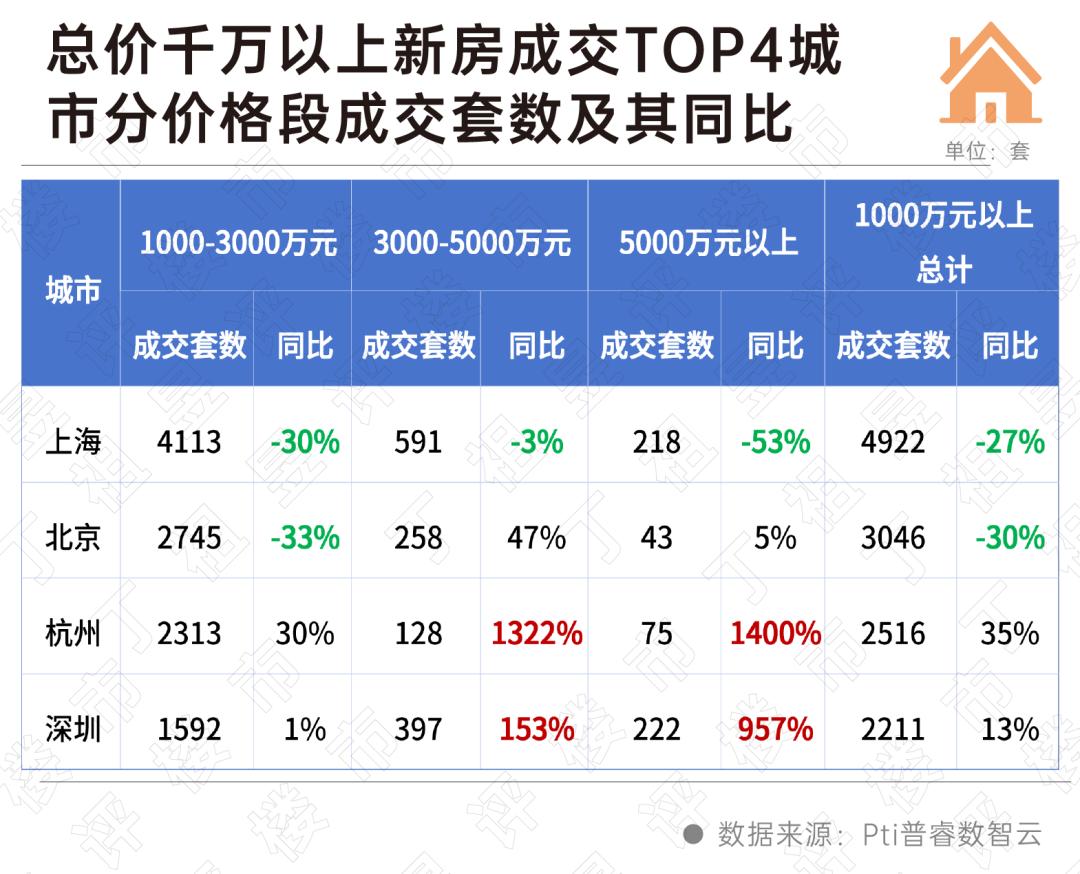
According to the data, the absolute transaction volume of high-end residential properties priced above 10 million yuan in Shanghai still ranks first in the country, with 4922 units transacted in the first half of the year, but a year-on-year decrease of 27%. Beijing ranks second with 3046 units, with a decline of 30%.
The status of the high-end markets in Shanghai and Beijing is stable, but their leading advantage has narrowed. It should be noted that in the first half of 2024, Shanghai and Beijing together contributed about 65% of the transactions above 10 million yuan; by the first half of 2026, this proportion has dropped to about 55%.
Instead, the rapid rise of "new high-end cities" such as Hangzhou, Shenzhen and Chengdu has taken place.
Hangzhou jumped to the third place with 2516 units, a year-on-year increase of 35%, followed by Shenzhen with 2211 units, a year-on-year increase of 13%.
Behind this is not only the supply constraint of reduced new supply in first-tier cities and the market entering a natural digestion period after the short-term demand of high-net-worth customers is met, but also the support of the wealth effect generated by the industrial upgrading of new first-tier cities.
From the perspective of the top luxury price segment above 30 million yuan, the differentiation in the middle segment of 30 million to 50 million yuan has intensified: Shanghai (591 units, -3%) and Beijing (258 units, +47%) show divergent trends, reflecting the differences in land supply structure between the two cities; Hangzhou (128 units, +1322%) and Shenzhen (397 units, +153%) have risen sharply, showing that high-end purchasing power is spilling over from traditional core cities to emerging high-end markets with strong industrial momentum.
The market of top luxury properties priced above 50 million yuan has the most drastic fluctuations — Shanghai's transaction volume of 218 units decreased by 53% year-on-year, while Hangzhou's 75 units increased by 1400% year-on-year, and Shenzhen's 222 units increased by 957% year-on-year.
The extreme fluctuations in the top luxury market are not only restricted by the supply rhythm of individual projects, but also reflect the rapid rotation of top wealthy people among different cities — where there are scarce high-quality projects, capital flows there.
Hangzhou has emerged suddenly and become the biggest variable in the high-end market.
In the first half of the year, Hangzhou's new residential transactions above 10 million yuan reached 2516 units, a sharp year-on-year increase of 35%, and the total volume surpassed Shenzhen to rank third in the country.
Transactions in all total price segments have "exploded in an all-round way": 2313 units were transacted in the 10 million to 30 million yuan segment, a year-on-year increase of 30%; 128 units were transacted in the 30 million to 50 million yuan segment, a year-on-year increase of 1322%; 75 units were transacted in the segment above 50 million yuan, a year-on-year increase of 1400%.
The core driving force behind this explosive growth is: Since the second half of 2025, a number of high-end projects in core locations of Hangzhou have entered the market intensively, effectively matching the previously suppressed demand. The superposition of industrial upgrading and urban renewal has spawned a brand new high-end residential market in a short period of time.
Second-tier cities such as Chengdu and Xiamen have achieved structural breakthroughs, and the trend of sinking high-end purchasing power is clear.
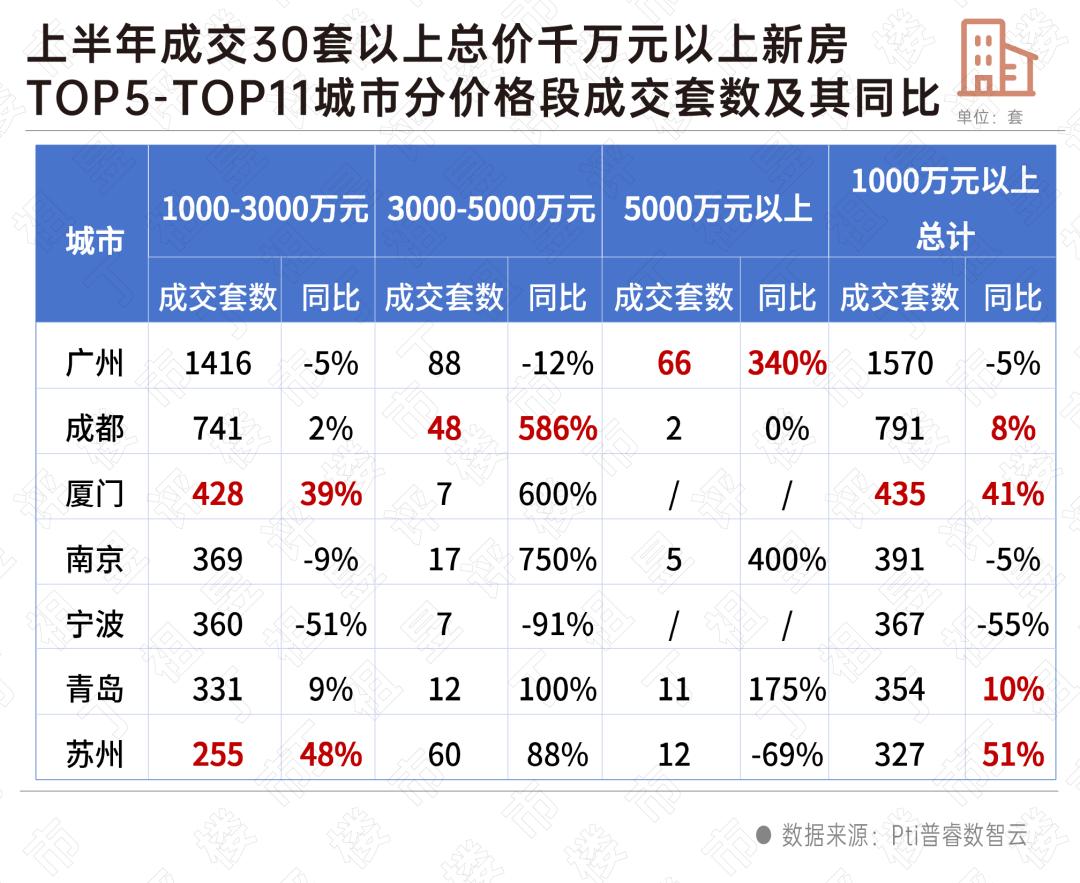
Chengdu transacted 791 luxury homes priced above 10 million yuan, a year-on-year increase of 8%, and 48 units in the 30 million to 50 million yuan segment, a year-on-year increase of 586%. The high-end purchasing power of the western central city is waking up rapidly.
Xiamen transacted 435 luxury homes priced above 10 million yuan, a year-on-year increase of 41%, ranking first among the 11 cities in terms of growth rate.
It is worth noting that Ningbo transacted 367 units, a year-on-year decrease of 55%, and Nanjing transacted 391 units, a year-on-year decrease of 5%, which means that the differentiation of urban industrial foundation and wealth agglomeration capacity is directly reflected in the high-end residential sector.
03
Project de-stocking rate is the core indicator to measure the efficiency of matching supply and demand in the high-end residential market.
In the past, it was normal for high-end projects in high-quality locations in core cities to be sold out as soon as they opened, with a cumulative de-stocking rate of 100%, but this pattern has changed significantly in the first half of 2026.
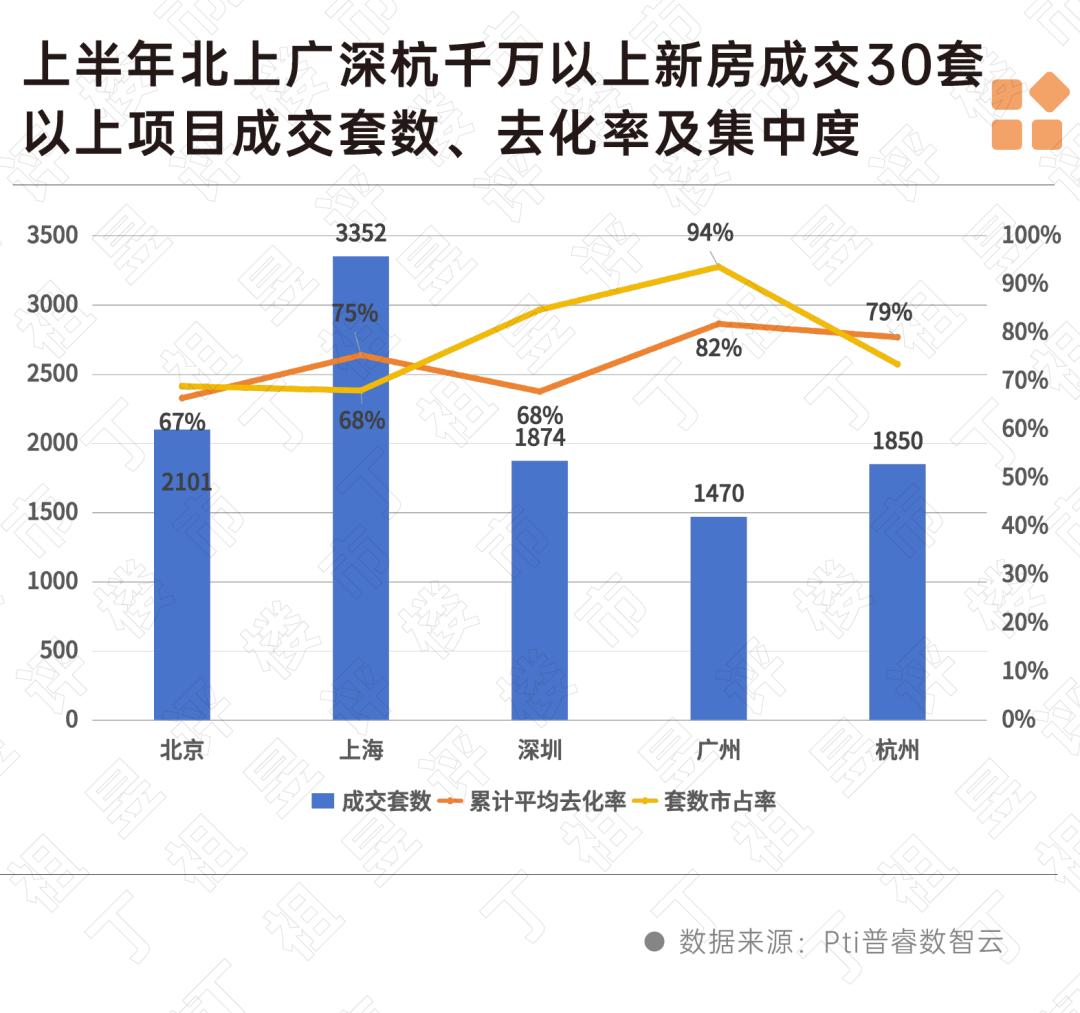
The normal market of "clearing projects at opening, all units sold out on the first day of opening" for high-end residential properties no longer exists: the cumulative de-stocking rate of high-quality projects priced above 10 million yuan with more than 30 units transacted in the five core cities of Shanghai, Beijing, Shenzhen, Guangzhou and Hangzhou is generally between 60% and 80%. Compared with the past market performance where projects were sold out at opening and the de-stocking rate exceeded 90% within three months, the overall "ceiling" of the de-stocking rate of high-end projects has moved down.
The de-stocking rate levels vary significantly between cities: the cumulative de-stocking rates of projects with more than 30 units transacted in Guangzhou and Hangzhou are 82% and 79% respectively, which are generally higher than the around 70% of Beijing, Shanghai and Shenzhen.
The de-stocking structure presents a pattern of "stable main body in the middle and intensified differentiation at both ends": only 40% of the projects in the five cities achieve a high de-stocking rate of more than 80%, which is the absolute main force of the market; the proportion of projects with medium and high de-stocking rate of 50%-80% is close to 40%, which can sell steadily but is difficult to clear quickly; the remaining 20% are projects with medium-low and low de-stocking rates, most of which are constrained by problems such as non-core locations, product mismatch, and high pricing, and the de-stocking pressure continues.
From the perspective of the proportion of projects with high de-stocking rate, the proportion of projects with high de-stocking rate in Shanghai is significantly higher than that of the other four cities, while the proportion of projects with medium-low de-stocking rate in Hangzhou is relatively high, which is consistent with the supply and demand pattern of concentrated entry of new residential properties above 10 million yuan in Hangzhou in the first half of the year and intensified market competition. Projects with low de-stocking rate (<30%) are distributed in all five cities, but they are concentrated in projects in non-core locations or projects whose product positioning does not match the regional customer group well.
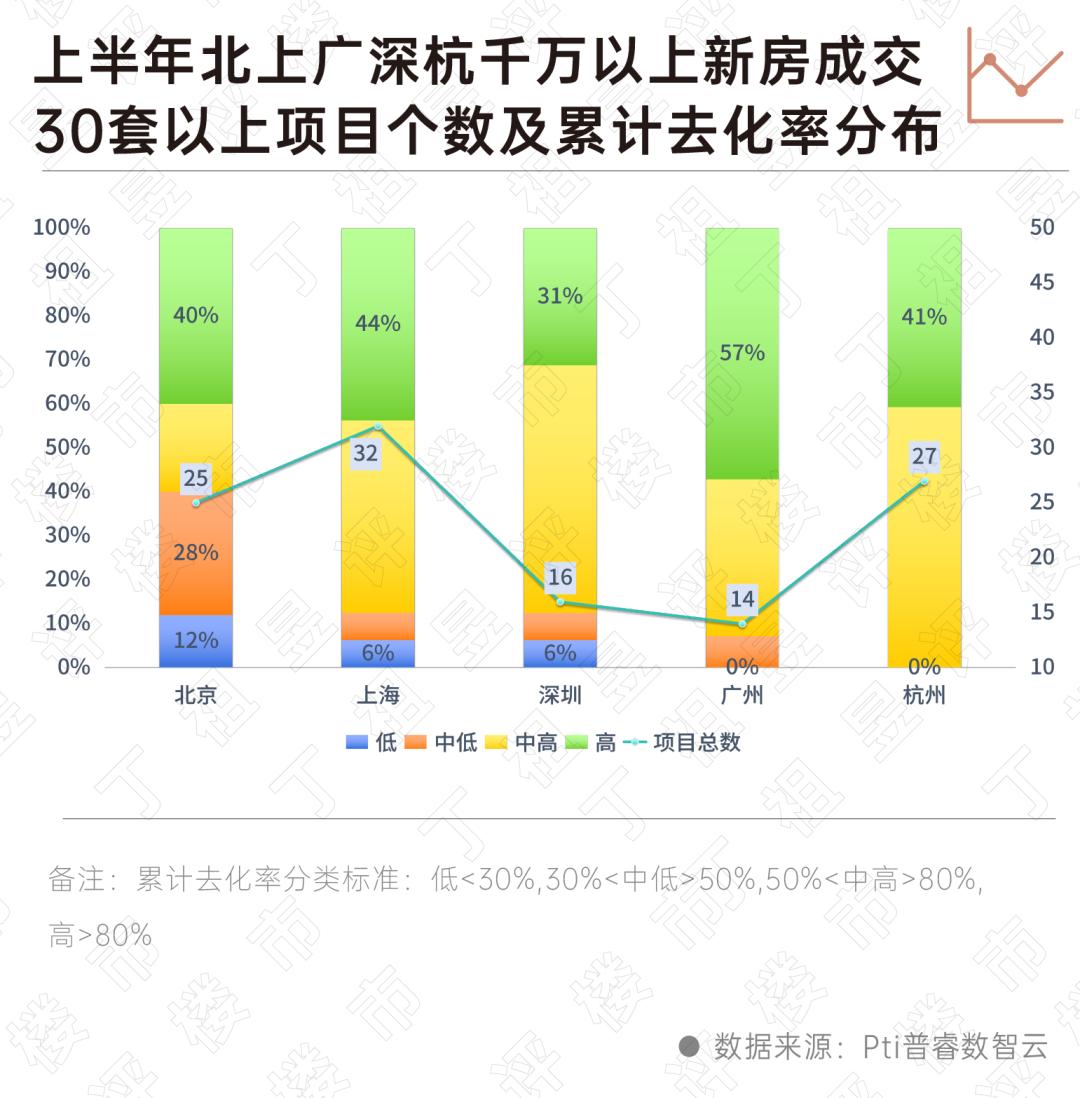
In the first half of 2026, high-end residential projects in the five cities show three clear signals:
First, the overall center of de-stocking rate has moved down significantly compared with before, and the "sold out on the first day" effect of 100% rapid clearance is no longer the norm;
Second, there are gradient differences in de-stocking efficiency between cities, and the overall de-stocking speed of Shanghai and Shenzhen is ahead of other cities;
Third, the concentration of projects with high de-stocking rate is about 40%, which means that more than half of the projects in the market are facing the reality of medium and low de-stocking speed, and the market competition of high-end residential projects is shifting from the stage of "whether it can be sold" to "how fast it can be sold".
So, is there a successful model for high-end residential properties to "sell quickly"?
Combined with the analysis of the top 5 projects in terms of transaction volume of high-end residential properties in the five major cities, it is found that the successful model is not uniform, but essentially the combined effect of the five variables of "location × supply × product × pricing × launch rhythm" determines the level of the cumulative de-stocking rate of the project. Any single-dimensional advantage is no longer enough to support the project to continue to sell well and de-stock quickly.
The breakthrough paths of the high-end markets in different cities are completely different: Shanghai and Shenzhen have verified the classic logic of "core location + scarce supply"; Beijing has demonstrated the development path of product quality + priority of price under policy constraints; Guangzhou and Hangzhou represent the evolution direction of the high-end market in new first-tier cities from "single point breakthrough" to "multi-point blooming". This pattern of "competition among many strong players" is exactly the typical feature of the rapid expansion period of the high-end market.
There are several changes in the high-end market in the first half of this year:
The high-end market is trending towards "top luxury orientation", and the requirements of high-net-worth individuals for product strength and location value have increased significantly.
The urban pattern is being reshaped, and the "decentralization" trend of the high-end market is irreversible.
The competition logic of the high-end market has switched from "whether it can be sold" to "how fast it can be sold". At present, the de-stocking performance of high-end projects is more of a comprehensive game of five core variables: location endowment, scarce supply, product strength, pricing strategy, and launch rhythm. A single location or product advantage can no longer support the project to continue to sell well.
As the vane of the real estate market, the transaction performance of the high-end residential market not only reflects the asset allocation preferences of high-net-worth individuals, but now has also become an important barometer of urban competitiveness and economic vitality.
This article is from the WeChat official account "Ding Zuyu Comments on Real Estate", written by Puri Research and the Editorial Department, and published with authorization by 36Kr.