The Chinese market recorded a 32% decline. Porsche responded that it is not guided by sales volume scale, has not set up factories in China, and can respond flexibly to market changes. Earlier, it announced that it would cut another 5,000 jobs in Germany.
Porsche's latest financial report features the trend of "declining sales volume and rebounding profits".
On July 29, Porsche released its financial results for the first half of 2026.
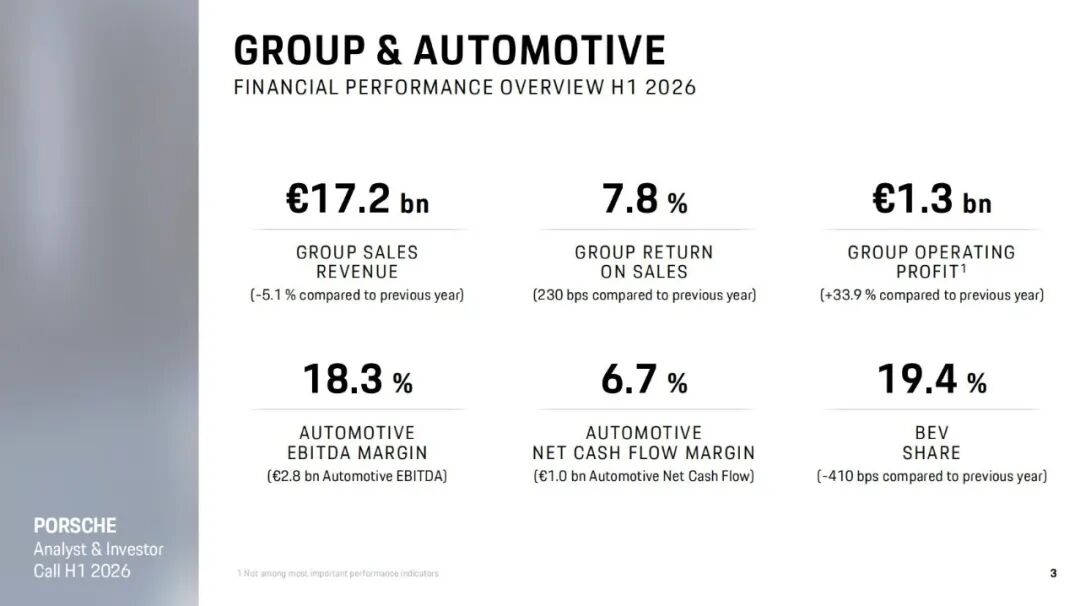
In the first half of this year, Porsche delivered approximately 122,300 vehicles worldwide, a year-on-year decrease of 16.5%; in the same period, the delivery volume of new energy vehicles was about 23,700 units, down 30.8% year on year, and the share of pure electric vehicles in the automotive business dropped to 19.4%. In the first half of this year, Porsche delivered around 14,500 vehicles in China, representing a 31.93% year-on-year decline.
During the reporting period, sales revenue fell from 18.157 billion euros in the same period last year to 17.229 billion euros, down 5.11% year on year; operating profit increased from 1.007 billion euros to 1.348 billion euros, up 33.9% year on year; the sales return rate was 7.8%, compared with 5.5% in the same period last year. Among them, the profitability of the automotive business has improved, with an operating profit of about 1.2 billion euros, an EBITDA margin of 18.3%, and the average selling price (ASP) per vehicle continues to rise.
The financial data also shows that the contribution of the Chinese market to Porsche's total revenue dropped from 15% to 12%, reflecting the challenging market environment, especially in the luxury vehicle segment. Porsche stated that it adheres to the strategy of "valuing value over sales volume" in the Chinese market, instead of pursuing market share through discounts.
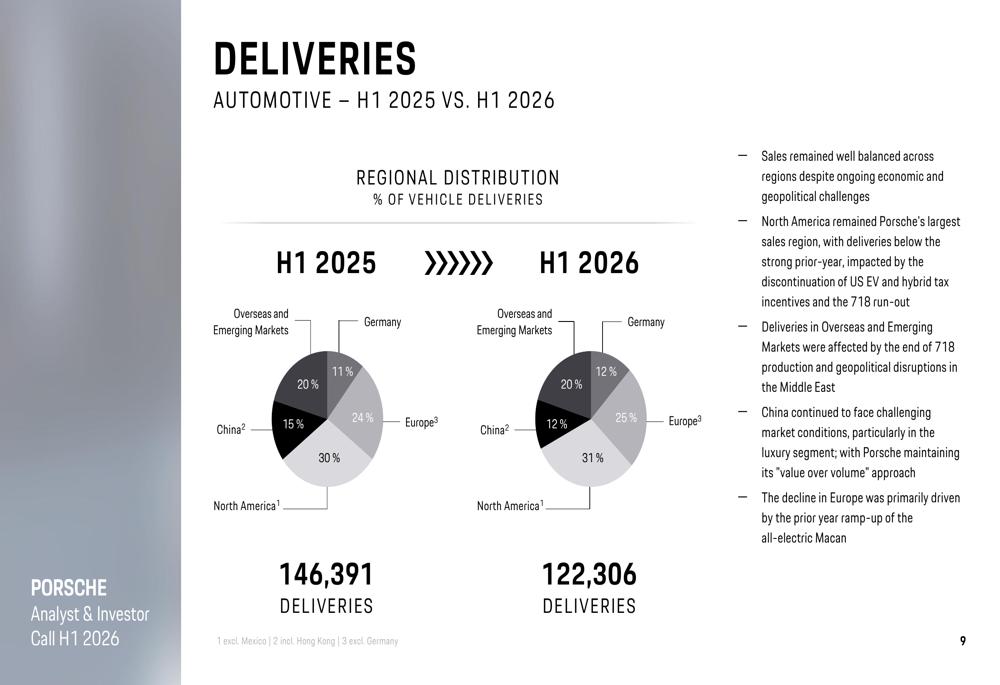
At the investor communication meeting on July 29, Porsche stated that its operating performance was dragged down by the severe macroeconomic and geopolitical environment, with influencing factors including the adjustment of US import tariffs, the slower-than-expected mass production ramp-up of luxury pure electric vehicle models, and temporary product gaps. In response, Porsche will continue to push forward adjustments and implement measures to optimize its organizational structure and product matrix: on the one hand, make the product line more aligned with consumer demands, and on the other hand, continuously consolidate its global business layout, so as to improve profitability and the enterprise's ability to resist risks.
"The overall environment of the Chinese market remains under pressure, and the competition in the luxury car segment is particularly fierce. Porsche has always adhered to the business strategy of prioritizing value over sales volume in this market, and does not take sales scale as the guidance." Porsche analyzed that it has no local production capacity constraints as it does not build factories in China, so it can flexibly adjust European production capacity and production plans, and this layout has become an advantage at the current stage.
This time, Porsche also further disclosed its "Strategy 2035", which is internally regarded as a framework for resetting the course, a comprehensive plan aimed at comprehensively enhancing competitiveness and financial robustness.
It is understood that Porsche's "Strategy 2035" will be implemented in a coordinated manner around four major directions: controlling overall costs, focusing on the core product matrix, improving operational efficiency, and rationally managing investment. At the specific implementation level, Porsche said that it will gradually implement the strategy through a series of measures, including streamlining the product matrix, focusing on the core sports car business and cutting off inefficient non-core segments; improving operational efficiency and building a lightweight organizational structure; reducing overall operating costs and lowering the break-even point; planning capital investment rationally and strictly controlling ineffective expenditure; continuously concentrating business focus and deeply cultivating main businesses.
Porsche's "Strategy 2035" not only involves future product strategies, but also covers its management strategies. Porsche believes that the series of measures in the four major directions will help lower the break-even point and improve the enterprise's risk resistance capacity.
It is worth noting that Porsche will continue to implement the layoff plan in the German market.
Image source: NBD Media Asset Library
According to Xinhua News Agency, German sports car manufacturer Porsche announced on July 27 that it will cut another 5,000 jobs in Germany by 2035. According to the plan, this layoff will involve production plants and R&D centers in the Stuttgart area, where Porsche's headquarters is located. At the same time, the company also announced that it will take other cost reduction measures, including suspending salary increases in the next few years, reducing bonuses, and further linking employee bonuses to the company's operating performance.
Previously, Porsche had announced that it would cut about 1,900 jobs in the Stuttgart area by 2029, and about 2,000 employees would not have their fixed-term labor contracts renewed after expiration. This means that the total number of jobs cut by Porsche in Germany will reach about 8,900.
This is another round of large-scale layoff plans launched by the company recently, aiming to reduce labor costs and enhance competitiveness. Porsche stated that the new round of layoffs will be implemented in a "responsible manner that takes into account the interests of employees" to minimize the impact on employees.
In fact, Porsche has shifted from its previous "expansion" development to a greater focus on profit and efficiency in the past two years. The optimization of personnel is only part of Porsche's strategic adjustment. In addition, Porsche has also carried out a series of business reform measures such as organizational streamlining and channel optimization this year.
In May this year, Porsche announced the adjustment of its executive board structure, which will reduce the number of functional departments from 8 to 7, and abolish the vehicle IT department. At the same time, Porsche also announced the streamlining of three subsidiaries to further focus on core businesses and improve the overall operational efficiency of the enterprise.
Image source: Porsche official website
On June 30, Porsche China stated that Porsche Centers in Jining, Shandong, Huaian, Jiangsu, and Xingning, Nanning, Guangxi terminated their dealership businesses on that day, and the Porsche Center in Wuhu, Anhui will terminate its sales business on July 31, while the after-sales service will still operate normally. According to the reporter's understanding, the above adjustments at the dealer level are all part of Porsche's previous plan to streamline the dealer network.
The staff of Porsche China said that facing the challenges brought by the market environment and the transformation of the automotive industry, Porsche actively responds to market changes, continues to deepen the strategy of "quality over quantity", and further integrates the dealer network in China. Porsche China fully respects the decisions made by partners based on their own development. For the recent operational adjustments of several dealers, it will cooperate with partners to ensure the continuity and high quality of customer services.
As early as the "2025 Financial Press Conference" in the first quarter of this year, Michael Rietes, who took office in January, had already sent a signal of continuous reform, stating that he would further promote the launched efficiency improvement plan and devote more energy to the core business, with the goal that "we must make the company leaner, more efficient, and make products more competitive".
This article is from the WeChat official account "National Business Daily", author: HUANG Xinxv, editors: CHENG Peng, YU Tingting, DU Hengfeng, proofreader: LIANG Luyue, published with authorization from 36Kr.