From partnership to equity stake, why did Uber increase its holdings in Momenta twice in a single year?
Global mobility giant Uber has placed a hefty, real-money bet on the final outcome of autonomous driving.
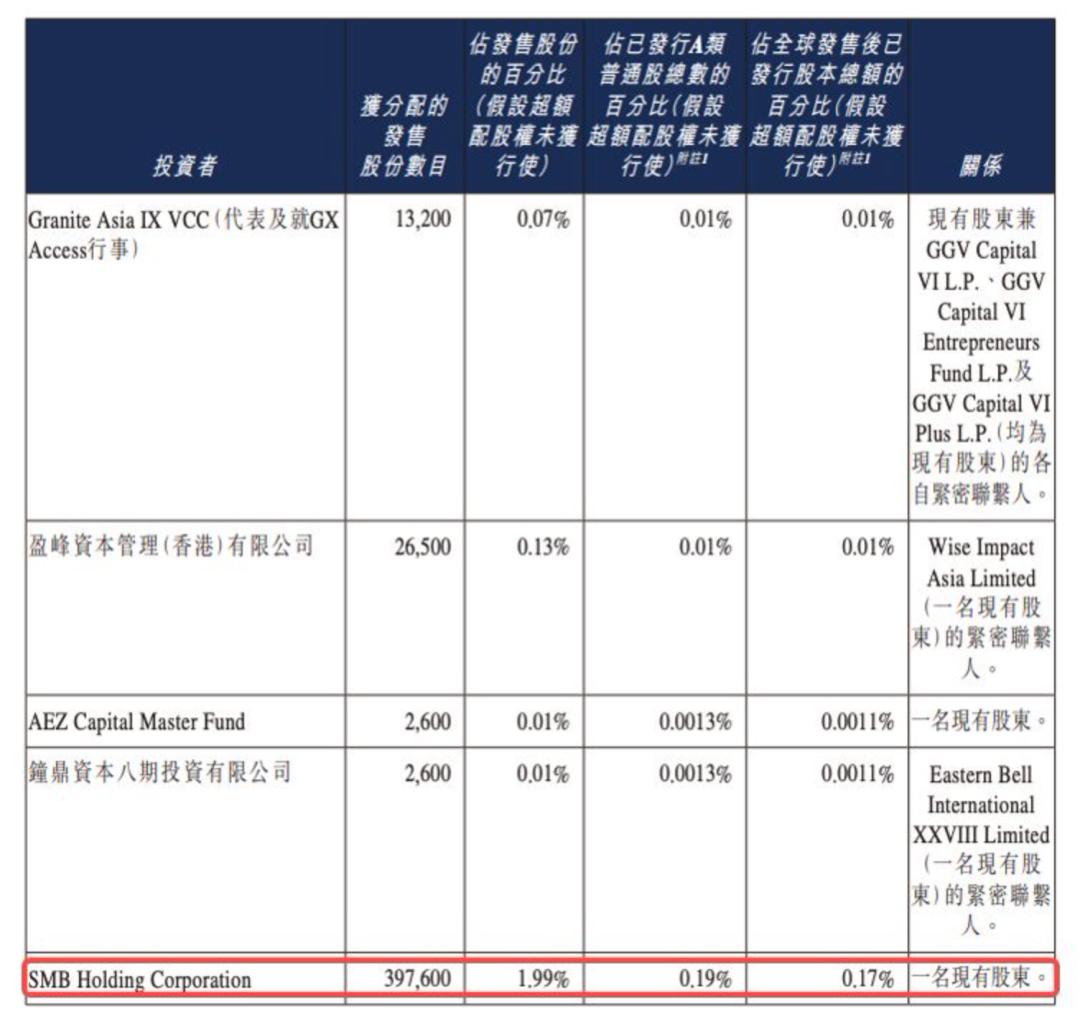
SMB Holding, a wholly-owned subsidiary of Uber, has made two follow-up investments in Momenta within a year: it participated in the Series C financing in September 2025, and increased its stake in Momenta's IPO placement again in July 2026.
Meanwhile, Momenta announced that it has officially obtained the license issued by the German Federal Motor Transport Authority (KBA), allowing it to conduct L4-level autonomous driving tests across Germany. This is also the first time a Chinese enterprise has obtained the L4 test qualification covering urban roads nationwide in Germany.
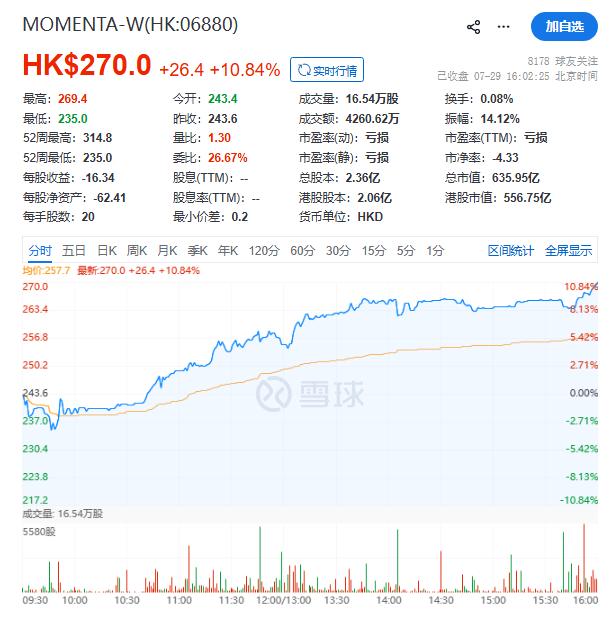
Affected by this news, Momenta's share price surged by more than 10% during intraday trading.
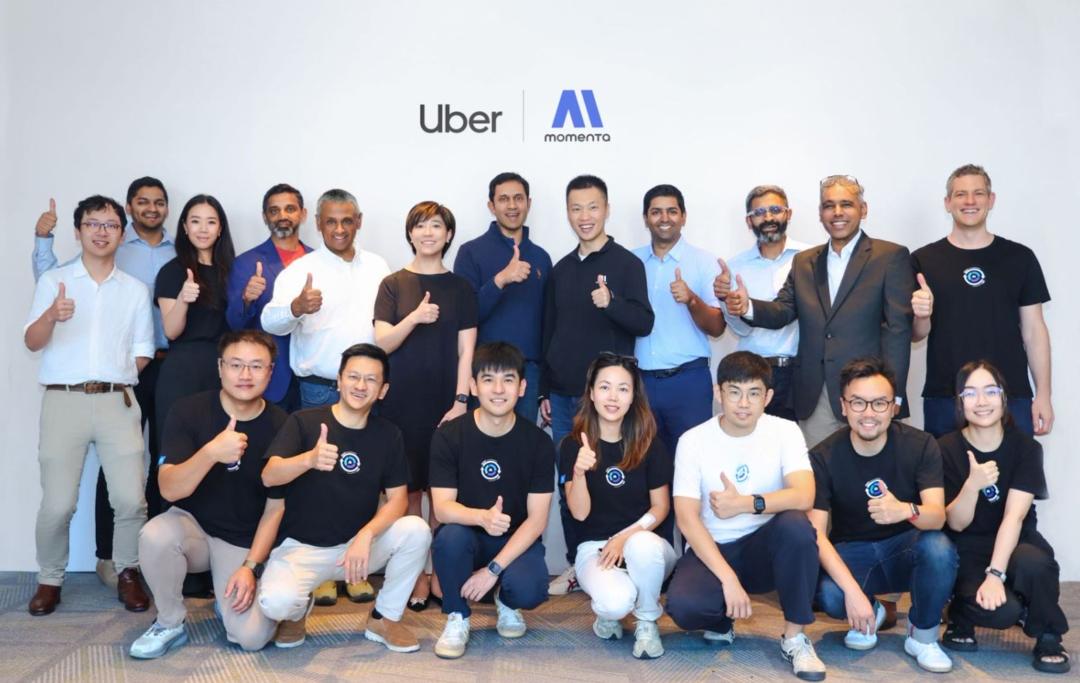
In 2025, Momenta and Uber announced a strategic cooperation to integrate Momenta Robotaxi into the Uber platform, and in the same year, the two sides announced that Munich, Germany would be the first launch city of the project. Media speculate that the acquisition of this licensed plate is to prepare for the further expansion of Uber's European projects.
This shows that the two sides have upgraded from business partners to close teammates with "business cooperation + capital shareholding".
This is by no means an ordinary financial investment. At the critical inflection point where autonomous driving has bid farewell to pure technical verification and fully entered the stage of large-scale commercial implementation and cross-region and cross-category reuse, Uber's continuous increased investment is an ultimate bet of the global mobility giant on the final outcome of the industry and the world model-driven driverless route.
Uber Made Two Investments in One Year: From Independent R&D to Alliance
Uber's two moves should first be understood in the context of its own strategic evolution. Uber has a huge user entry, real-time order network, profound urban operation experience and global market resources.
However, a core problem has always been in front of it: how to obtain stable and reliable autonomous driving capacity in a low-cost, high-efficiency and large-scale manner?
To this end, Uber invested heavily in building an autonomous driving R&D system in the early years, with a cumulative investment of billions of dollars, but it has always been difficult to achieve large-scale commercial operation. At the end of 2020, Uber sold the relevant business unit.
The multi-billion-dollar attempt reversed Uber's strategic direction — from independent R&D to forming alliances.
The core competitiveness of mobility platforms lies in scenario scheduling, user operation and ecological integration, rather than underlying algorithm R&D and vehicle-grade engineering polishing. Therefore, Uber does not need long-cycle, high-risk investment to reinvent the wheel. What it needs is "who can make Robotaxi run faster in more cities, with more controllable cost, more flexible deployment and more leading technology".
Momenta precisely meets these demands.
Momenta did not enter the Robotaxi and Robovan sectors from scratch, but reused the data, algorithms, models and engineering capabilities already formed in its mass production business. Through the same set of world model base platform, it supports L2 and L4 collaboratively, which can reduce the cost of repeated R&D and regional adaptation, and shorten the project implementation cycle. Its strategic rhythm is well-paced: it uses massive mass-produced vehicles to complete the closed loop of data and commercial scale, and then uses large-scale driverless business to open up high-value scenarios.
For Uber, this means it can obtain a cross-city, cross-country and sustainably evolving technical partner without bearing huge R&D costs.
Under the "industrial cooperation + capital shareholding" framework, the two sides have become a close "community of shared interests". Uber is not only an industrial cooperation partner, but also a shareholder that continuously increases its stake.
Uber's vote of confidence in Momenta is an industry-level judgment made by a leading mobility player based on in-depth insight into the sector. Uber's professional and authoritative endorsement has enhanced Momenta's global brand credibility and cooperation trustworthiness, which weighs far more than the endorsement of ordinary investment institutions.
From "Concept" to "Delivery"
Uber's confidence in making such a heavy bet fundamentally comes from Momenta's solid mass production achievements.
At present, the driverless industry is shifting from the safety and technical verification of "whether it can run" to the commercial competition of "whether it can deliver quickly, operate stably and replicate across regions at a controllable cost". Pure L4 companies have been polishing in a single city for many years and still find it difficult to achieve large-scale operation, while solution providers that only focus on L2 mass production cannot reach the technical and commercial ceiling of driverless driving.
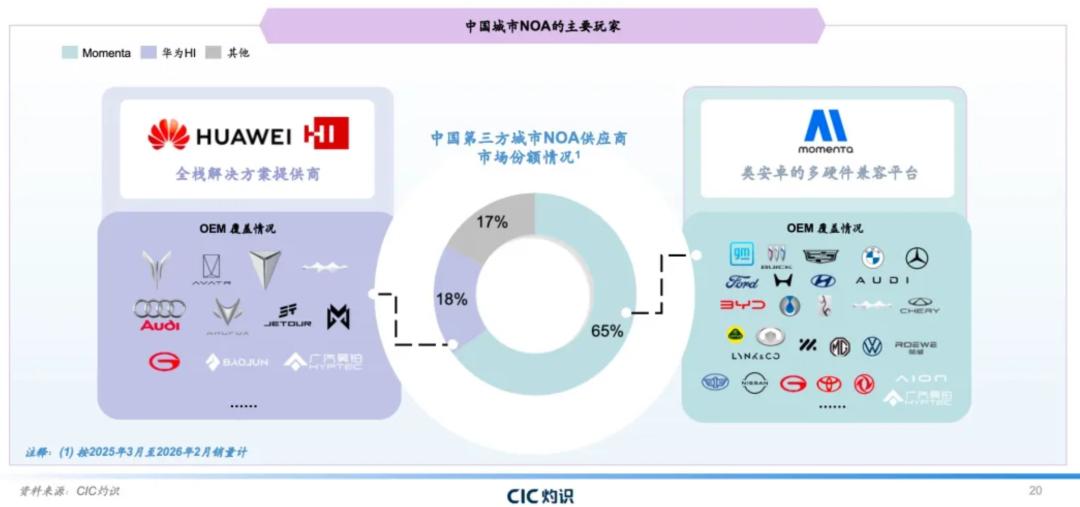
Momenta bridges this "gap". According to data from CIC Consulting, Momenta's market share in China's third-party urban NOA market is as high as 65%, ranking first in the industry. 9 of the world's top 10 automakers have carried out cooperation with it. The cumulative delivery at the mass production end has exceeded 1 million units, covering more than 100 mass-produced models, and it has secured more than 210 designated models. Its mass production delivery efficiency continues to accelerate — the system delivery of 100,000 vehicles can be completed in less than 40 days at the fastest.
This is also the long-term moat that Uber values most.
Momenta's first-mover advantage in mass production delivery stems from its unique architecture of "one base, multi-line growth". Through the same set of world model base platform, it supports the parallel development of L2 and L4, greatly reducing the cost of repeated R&D and regional adaptation, and shortening the cycle from technology to implementation.
"Mass production nurtures driverless technology, and driverless technology feeds back mass production" — mass-produced vehicles run on roads around the world every day, providing a steady stream of high-quality data for the world model; while the technological breakthroughs of driverless driving in high-complexity scenarios in turn improve the upper limit of the capabilities of mass production solutions.
Multiple growth curves have taken clear shape. Just this week, Momenta has achieved a number of new progress: in the Robotaxi sector, Momenta has successively obtained L4 test licenses in Shenzhen and across Germany; the Robovan business has been put into operation in Suzhou. It is reported that the L4 test license issued by the German Federal Motor Transport Authority to the company is not only the recognition from the world's strictest traffic regulatory authority, but also means that it has occupied the bridgehead leading to the entire European continent.
From Suzhou, Shanghai, Wuxi and Shenzhen to Munich in Germany and Abu Dhabi in the UAE, Momenta's global footprint has extended to Asia, Europe and the Middle East, gradually covering the whole world, and its "new growth curve" is being realized at a high speed.
The rapid expansion of business has also driven leapfrog growth in revenue: from 2023 to 2025, Momenta's revenue increased from 743 million yuan to 2.413 billion yuan, tripling in three years with an average annual compound growth rate of over 80%.
Trillion-level Increment Space: Competing for Ecosystem Rather Than Single-point Advantage
The trillion-level increment of autonomous driving is clearly visible, but the dividends will not be evenly distributed. The trend of "the strong get stronger" is irreversible.
CIC Consulting predicts that by 2030, the global and Chinese Robotaxi market size will grow to about 81.8 billion US dollars and 38.1 billion US dollars respectively, and the penetration rate of Robotaxi in China is expected to reach 11.9%, higher than the global 5.7%; the global and Chinese Robovan market size will reach about 85 billion US dollars and 53.5 billion US dollars respectively, with the market penetration rate reaching 6.9% and 14.0%; the global and Chinese Robotruck market size will reach about 33 billion US dollars and 16.5 billion US dollars respectively, with the market penetration rate reaching 0.6% and 1.2%.
The market is expanding, while the number of industry players is decreasing, and resources are accelerating to concentrate on leading suppliers.
Momenta focuses on an open, migratable and reusable global platform model, which naturally adapts to the diverse cooperation needs of overseas automakers and leading mobility giants — what they want is not a "black box" supplier, but an open partner that can integrate into their own ecosystem and support global deployment. Uber's continuous follow-up investment itself is recognition of this model.
Nowadays, the competition in autonomous driving has entered the "home run" stage, evolving into a comprehensive competition covering data closed loop, engineering capabilities, cross-scenario reuse and global operation ecosystem. The market needs all-round top players, not partial specialists who only excel in a single point.
From the law of technological precipitation, the leader in the L2 mass production track will most likely continue to lead in the future L4 mass production cycle. Urban NOA provides the best training ground for L4-level autonomous driving, continuously hones the model's generalization ability through real scenarios, continuously precipitates the vehicle-grade engineering system, and at the same time cultivates user awareness and regulatory recognition. Therefore, NOA is the starting point of commercialization, while L4 is the long-term final outcome of the industry.
Conclusion
In the short term, Uber's two rounds of heavy bets within a year are a comprehensive recognition of Momenta's technical strength, mass production delivery, commercial implementation and globalization capabilities, significantly enhancing the recognition of Momenta in the capital market and the industry.
In the long run, the final battle of autonomous driving is a comprehensive competition of data closed loop efficiency, engineering delivery, cross-scenario technology reuse and global compliance implementation. With the world model base platform it has built, Momenta has blazed a path of "mass production as foundation, driverless technology breaking bottlenecks, technology reuse and global expansion", which also explains why global mobility giants are willing to continuously invest heavily in it, and its development space is being opened at an accelerated pace.
This article is from the WeChat official account "Finance Story Collection" (ID: cjgshui), written by Wan Tiannan, edited by Chen Jiying, and published with authorization from 36Kr.