90% of managers misidentify the root causes for the poor performance of global collaboration
Operating global business is inherently more challenging than running local operations. But outstanding managers treat cross-border collaboration as a system that can be proactively designed, instead of a dilemma that can only be passively tolerated. Organizations built following the ideas laid out in this article deliver higher decision-making efficiency, lower costs for sustaining internal collaboration, and are able to gain a head start in markets where competitors are ramping up their expansion. National culture only shapes the perceived experience of cross-regional collaboration; the design of operational mechanisms determines whether collaboration can ultimately achieve success.

A senior strategic executive from a Fortune 100 company in the United States recently raised a question to me, a query that managers across the globe often bring up in similar forms. The Asian team under his leadership delivers solid performance, but he has noticed that very few corporate strategies originate in the Asian region, and the innovative outputs generated by the Asian team can hardly flow back and integrate into the company's global strategic system. At present, a large number of disruptive innovations are emerging from Asia, which undoubtedly represents a missed opportunity. Prompted by this trend, he asked: "Is it always difficult for teams in the Asian region to take the initiative to speak up and share their perspectives?"
This question was raised in all sincerity, and it is fair to say that he already has a fairly deep understanding of the issue. It implies a widespread perception: most Asian teams grow up in a cultural environment that prefers indirect communication. However, after comparing the company's headquarters with its largest Asian team, he and I found that the data revealed a completely different truth: the root cause of collaboration failure lies in the institutional and mechanism level, not in culture.
Culture is of course a factor. For many Asian teams, speaking freely across hierarchical boundaries does not come naturally. But culture is neither the full cause of the problem, nor the primary solution. The real crux lies in multiple factors at the mechanism level. My colleagues and I have identified these factors through years of cross-regional research. These studies include the Global Collaboration Index survey, hundreds of hours of leadership interviews, and a series of workshops with ten global companies, ranging from Fortune 10 to Fortune 500 enterprises, as well as Chinese tech giants that are on their path to globalization.
Our relevant research focuses on the United States and China — the two major markets with the most prominent geographical distance, cultural differences and language barriers across the globe, while the scope of research also covers India, Mexico, Southeast Asia, East Asia and Western Europe. At the beginning of the project, we originally expected that culture would be the top cause hindering global collaboration, but the facts proved otherwise. Research shows that seven core elements determine the effectiveness of cross-border team collaboration.
This article will clarify: the vast majority of managers will fall into the same misunderstanding when dealing with global collaboration challenges — devoting huge amounts of energy to addressing friction amplifiers (elements that managers have limited control over, or can barely change at all). In fact, they should focus on trust and synergy enablers (elements that leave room for artificial adjustment); it is these elements that determine whether the three aforementioned types of collaboration friction will eventually evolve into substantial business problems.
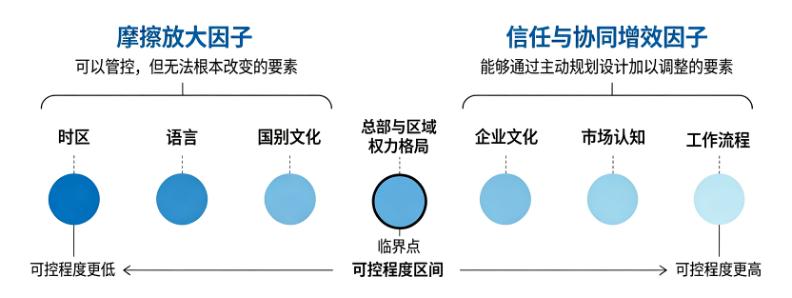
Friction Amplifiers
These are three core elements that affect global collaboration. You can exercise moderate control over them, but you cannot fundamentally change them: time zones, language, and national culture.
Time zones amplify friction: There are always people who need to attend online meetings at 5 a.m. or late at night.
Language amplifies friction: An employee who can distinguish subtle differences and assess potential risks in their native language inherently has an advantage over colleagues who need to use a second language to complete the same work, even if the latter has a more rigorous analytical logic.
National culture amplifies friction: If proactively offering suggestions across hierarchical boundaries is not the norm, team members' expression of opinions will naturally be restricted; once all communication is carried out in a second language that is commonly used globally, this problem will be further exacerbated.
The above elements are not completely unmanageable: on-site market visits, personnel assignments, and long-term language learning can all play a role in improvement. "You don't really understand it until you are in it," an executive from a Fortune 10 company once told me. That is true, but 95% of the people on his team will never be — and are not allowed to — experience it in person there. (Data from a Fortune 500 company shows that managers at the vice president level and above score 15 points higher than frontline managers and junior employees on the Global Collaboration Index, with advantages reflected in multiple dimensions including market awareness, engagement enthusiasm and goal alignment.) Travel visits can only benefit senior employees. Frontline employees bear the heavy burden of daily collaboration, but may never have the opportunity to visit the target market in person or travel to the headquarters.
When carrying out global business, if you ignore the impact brought by friction amplifiers, it is like running a marathon with a stone in your shoe: everyone can hold on for the first mile, by the tenth mile most people are hobbling, and many outstanding core employees will eventually choose to drop out halfway.
Trust and Synergy Enablers
These are the other four core elements that affect global collaboration, which you can optimize and adjust through proactive planning and design: the power structure between headquarters and regional branches, corporate culture, market awareness, and work processes.
Power structure between headquarters and regional branches. The power structure between headquarters and regional branches is a key fulcrum. It determines how regional leaders view global online meetings: whether it is a substantive strategic consultation, or a mere formality of progress synchronization; it also determines that when the regional side puts forward "this set of solutions does not apply to the local market", whether this statement will be regarded as a valuable market insight, or interpreted as passive resistance.
We have repeatedly observed a typical imbalance: when separately surveying the perception of trust and discourse power among headquarters teams and regional teams, most of the two sides recognize that there is mutual trust (they feel they are respected), but generally believe that they have limited influence and insufficient say. Under such a mechanism, the right to speak will fall into the hands of those who are best at actively fighting for resources, rather than those who have the most in-depth understanding of the market; in the end, it is often the loudest party that prevails, rather than the one with the wisest opinions whose views are adopted.
Corporate culture. Different from national culture, corporate culture has room for transformation, but it is very difficult to successfully implement it overseas. The CEO of a Fortune 100 company once lamented that she was shocked: the phrase "do the right thing" is interpreted in completely different meanings by teams in the United States, India, China and Latin America. Enterprises are very likely to stumble here when expanding overseas: many companies have never localized and translated their own corporate culture, let alone clearly explain it to overseas employees who have completely different language backgrounds and thinking presuppositions. Corporate culture is often condensed into short slogans, carrying a large number of unwritten rules behind it; after being spread across languages, the implicit rules are very likely to disappear. Employees can only guess for themselves what choices the enterprise expects them to make when facing difficult decisions.
Market awareness. It is crucial for headquarters to build market awareness, and investing resources in this area can bring the highest return: a headquarters that fully understands the frontline market has higher decision-making efficiency, is better at seizing opportunities, and will give more trust to regional teams. No matter which management seminar you bring up this point, everyone will nod in agreement. But once you ask the participants what systematic methods they have adopted to accumulate market awareness, the scene is often silent. This type of market information accumulation mostly relies on scattered, spontaneous actions, and highly depends on a small number of outstanding "bridge figures" to put in extra effort. If an employee who has spent two or three years deeply understanding a certain market is transferred to another region, the first-hand market experience he has accumulated will also be lost accordingly.
Work processes. Processes are where collaboration resistance is concentrated. The vast majority of enterprises continue to use processes designed for headquarters; headquarters employees are in the same office space, and can clarify the boundaries of decision-making power face to face: who is responsible for which type of decision, which matters need to be discussed by both parties, and which matters can be finalized independently by the local team. When a crisis hits, co-located teams can set up war rooms to focus on tackling tough problems; but cross-border teams separated by 12 time zones with blurred decision-making power cannot replicate this model at all. Enterprises need to build a set of working mechanisms adapted to global scenarios, which is different from the original working mode designed for the headquarters.
Global Collaboration Cost
One of the regional leaders we cooperate with manages a multi-billion-dollar business at a U.S. enterprise. On paper, she has only one core task: to win the local market. In reality, she has to take on two jobs: from 9 a.m. to 6 p.m., she completes her own business; from 6 p.m. to midnight, she undertakes extra unseen work — explaining the market status to the headquarters that rarely visits the local area, providing basis for various decisions, and translating the headquarters' instructions into plans that the local team can implement.
We call people who take on this type of dual work bridge figures. They can be senior managers or frontline employees; their implicit core job is to maintain the communication bond within the multinational enterprise: pass background information between headquarters and the market, bear the pressure of cross-time zone communication, and promote decision-making implementation across languages and hierarchies. All multinational organizations cannot do without such people, but very few enterprises recognize their value, provide them with convenience, and give them corresponding incentives. The various implicit burdens that these people continuously undertake are what we call global collaboration costs.
The instinctive approach of enterprises is often to require bridge figures to hone their resilience and adapt to the existing system. But the root of the problem is precisely this flawed system, where all the friction is ultimately borne by the bridge figures. This is also why expatriate work is often regarded by most people as a short-term experience, rather than a career direction worthy of long-term dedication. The stronger the employee's ability, the more collaboration burden they need to take on, and many top talents eventually choose to leave. Among the enterprises we surveyed, the turnover rate of such bridge figures is about twice that of local employees.
Enterprises should not regard bridge figures as costs that need to be controlled. They are one of the most valuable talents of multinational corporations, a scarce resource that should be protected, cultivated and incentivized, rather than being forced to adapt to an organizational structure that constantly consumes them and squeezes those who undertake core work.
Feasible Improvement Paths
Companies that are struggling with global collaboration issues can take a series of actions to improve the situation.
Conduct self-assessment against the seven core elements. Gather your leadership team together and score yourselves honestly. The focus is not on getting a perfect score; but on identifying the gap between where resources are currently invested and where optimal efforts should be focused.
Deliberately design the boundaries of decision-making power. There is no need to pursue absolute equality between headquarters and regions. The key is that the setting of powers and responsibilities has clear purposes. Define them one by one for different regions: which opinions are for reference only, and which have decision-making authority; plan the escalation and reporting path in advance before a crisis hits, to avoid that when the brand is at risk, everyone can only wait for the headquarters staff to go to work before making a decision. At the same time, establish a normalized reporting channel for innovations and ideas from key regions, and cannot simply rely on employees to take the initiative to fight for the opportunity to speak; if this type of work is not included in anyone's job responsibilities, the promotion of innovation can only rely on ad-hoc responses.
Establish a systematic market awareness mechanism at the headquarters. Treat market awareness as a shared organizational asset, rather than the personal ability of a few employees. Implement a reverse reporting mechanism, where regional teams share frontline observations with the headquarters; sort out frequently asked questions to form a Q&A knowledge base; build a regional information sharing platform to preserve the market experience that is easily lost with personnel transfers.
Set up normalized strategic suggestion channels. Innovation and disruptive changes are increasingly taking place in markets across the globe. Most headquarters have not built formal channels to allow teams rooted in the market to participate in upstream planning and strategy formulation; performance appraisals are usually oriented towards annual goals, lacking incentives for long-term layout. Create a formal strategic summit to collect, co-create and integrate ideas from frontline markets, which can not only absorb high-quality ideas, but also deepen the interpersonal connection between headquarters and regional teams.
Make corporate culture clear and tangible. Complete the localization and translation of corporate culture, so that employees with different language and growth backgrounds can understand the unwritten norms behind the corporate culture. The condensed slogans may lose part of their textual aesthetics, but the team can clearly understand what value orientation the enterprise adheres to in difficult times.
Streamline work content and standardize collaboration methods. This is the measure we have observed to deliver the fastest results: on the premise of ensuring that the goals of headquarters and regions are aligned, reduce the total number of global meetings by 20% to 25%; schedule cross-border meetings intensively from Monday to Wednesday, to avoid occupying employees' time every night. Design and promote a unified template for asynchronous written communication, so that the whole company uses the same set of standards, instead of dozens of different formats. This seems trivial, but one of our clients calculated that this set of adjustments can save a lot of costs every year, reducing the losses caused by ineffective time consumption, repeated work and talent turnover.
Protect and reward bridge figures. Include contributions related to cross-regional connection in performance appraisals, promotion criteria, and the talent evaluation system. At the very least, provide humanized arrangements (employees who attend late-night meetings do not need to be at their posts punctually early the next morning); going a step further, give substantive incentives. By doing this, enterprises can not only retain top global business backbones, but also send a signal to all employees who undertake this type of work: the "second job" they put in extra effort for is seen and valued, and it is an indispensable part for the enterprise to win the market.
In the final analysis, operating global business is inherently more challenging than running local operations. But outstanding managers treat cross-border collaboration as a system that can be proactively designed, instead of a dilemma that can only be passively tolerated. Organizations built following this set of ideas deliver higher decision-making efficiency, lower costs for sustaining internal collaboration, and are able to gain a head start in markets where competitors are ramping up their expansion. National culture only shapes the perceived experience of cross-regional collaboration; the design of operational mechanisms determines whether collaboration can ultimately achieve success.
Keywords: #Globalization
Zak Dychtwald | Text
Zak Dychtwald is the founder and CEO of BridgeWorks Global, a cross-regional collaboration lab, and the author of the book Young China: How the Restless Generation Will Change Their Country and the World.
Zhou Qiang | Proofreading
This article is from the WeChat official account "Harvard Business Review" (ID: hbrchinese), written by HBR-China, and published with authorization by 36Kr.