The stock market crash is only the first hurdle, and the life-or-death critical test for South Korea is yet to come.
South Korean retail investors are only one step away from going from nouveau riche to bankrupt.
As of July 13, more than 1.2 million leveraged retail accounts across South Korea's entire market have hit the margin call line. Among them, about 320,000 to 360,000 accounts have been fully force-liquidated by brokerages. The forced liquidation rate has skyrocketed from 2.1% to 10%, leaving massive losses in its wake.
As usual, news came out that bankrupt investors had jumped off buildings. No related reports were found in domestic formal media, so I asked a South Korean friend of mine. He is an old-timer I met at the gym, speaks fluent Chinese, is widely read, and is a pretty interesting person. He said no South Korean media had covered such incidents either, and the only news was that the number of patients visiting psychological clinics had surged. "No one has jumped yet, but it's only a matter of time."
I asked him if he traded stocks, and he said yes. I teased him, "Don't go jumping off a building, okay?" He replied instantly, "I haven't lost any money, why would I jump?" I followed up, "How did you make profits?" He replied again right away, "No leverage."
That's how calm a clear-headed person is.
01
Chinese investors are shedding sympathetic tears for the South Korean stock market, but there is no need to do so at all.
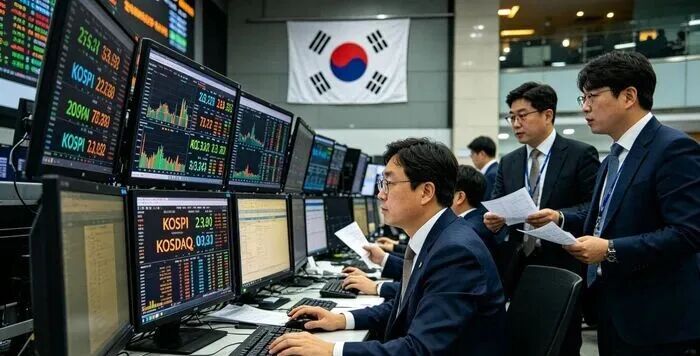
The KOSPI started at 2284 points on April 9, 2025, and peaked at 9385 points on June 19, 2026, more than quadrupling. Now it has fallen back to the 5000-6000 point range, which is a quite significant drop. However, there is still a net increase of twice its original value. The leading stocks still have substantial upside potential. For example, Samsung Electronics is currently priced at 230,000 won, about three times its level a year ago. Theoretically, there is no need to adhere to "long-termism" at all. You can easily make huge profits just by holding your positions for a year. If you can't earn such easy money, who can you blame?
Then have South Korean investors made money? Most of them have.
With a population of 50 million, South Korea has more than 100 million stock accounts, meaning everyone on average holds two accounts, and the whole nation is participating in stock trading. The accounts that have been blown up or force-liquidated so far are just a drop in the bucket, far from a situation where the whole nation loses money.
In this "genuine bull market" rally, a considerable number of South Korean investors have made profits, and they do not need sympathy from Chinese investors. It is the leveraged traders who have suffered heavy, devastating losses. Even if someone really jumps off a building, there is no need to sympathize with them. Since you choose to play the thrilling high-risk game, you should be mentally prepared for the corresponding consequences.
Every mature capital market has to go through such tests.
02
The South Korean stock market has been in a frozen state of "strict government protection" since the 1997 Asian Financial Crisis, and has never developed into a mature market. It shows the characteristics of a developing capital market: a high proportion of retail investors with a strong tendency to gamble.
In fact, a high proportion of retail investors is not a problem in itself. If the stock market becomes an exclusive playground for the super-rich, it will lose the function of distributing capital dividends. It is normal for retail investors to enter the market, but they need to keep a correct mindset. Retail investors should be self-aware: with limited capital that cannot withstand huge fluctuations, they should not engage in high-risk high-return thrill-seeking games.
What determines the maturity of a capital market is not the proficiency of small and medium investors, but their mindset. Taking the US stock market as an example, there has long been a rumor in China's capital market that "there are no retail investors in the US stock market". In fact, retail funds have long accounted for about 40% to 60% of the US stock market, which is not a low proportion. The vast majority of individual investors in the US just trade very infrequently and have a low presence. Most US individual investors make long-term investments in the stock market for their retirement funds and children's education funds, and are the mainstay that stabilizes the US stock market. In recent years, the activity of US retail investors has increased. A few years ago, there was even the famous drama of retail investors besieging Wall Street short sellers, but the overall style is still long-term oriented and stable.
The stable mindset of US investors is not innate, but "taught" by the Great Depression in the 1930s. In the 1920s, after World War I, the United States rapidly completed industrialization, its economy grew at a high speed, and emerging industries sprang up. The unprecedented prosperity of the industrial economy also drove the stock market, and a nationwide stock trading boom swept across the US, with all people pouring into the stock market. Inspired by "wealth myths", small and medium investors fell into fanaticism. At first, every penny of savings from the elderly, wages from young people, household money from housewives, and funds from small and medium business owners flowed into the stock market. Later, people even went to extremes to borrow money to trade stocks. All wealth vanished in the "Black Week" of October 1929, leaving millions of Americans in a situation where they could not make a living. This four-year global crisis left a huge psychological shadow on Americans that lingers to this day, and their investment style has since become "calm and pragmatic".
Europe, the birthplace of modern finance, learned the lesson even earlier. In the 18th and 19th centuries, the European financial market was hit by constant turmoil: the South Sea Bubble educated the British, the Mississippi Bubble educated the French, and the startup crisis educated the Germans.
The history of modern finance is filled with lessons of fanaticism and greed. However, all late-developing financial markets cannot avoid paying this tuition fee in person. As the saying goes, "Words cannot persuade people as effectively as experiences, which can leave a deep impression on people once they happen". This time it is South Korea's turn to pay the tuition.
03
The strong gambling tendency of South Korean stock investors does not stem from some obscure cultural factor or national character, but from the slow development of the South Korean stock market.
In 1956, the South Korean stock market officially opened. However, the South Korean economy, ravaged by two wars, was already in tatters, and the capital market had a very low presence. It was not until the early 1980s that the South Korean stock market entered an active period. The good days did not last for a few years before the 1997 Asian Financial Crisis hit. Since then, the South Korean stock market has entered a "newbie protection period" under strict government control, and became completely stagnant. Under "protective policies" such as restricting foreign capital and short selling, zombie enterprises were rampant and market liquidity was extremely low. It took more than ten years for the KOSPI to climb from 1200 points to 1400 points, making it a veritable "graveyard for investments". In such a stock market, there is no value for long-term investment, and the only way to make money is to speculate on individual stocks with fast in and fast out trades.
South Korean investors are not born gamblers; they are trained to be so by the South Korean stock market. A stock market with no long-term investment value can only attract gamblers. People who do not like gambling will never enter the market, and those who do enter are aiming for the high-risk bet that "a bicycle can turn into a motorcycle", so how could they not have a strong gambling tendency?
After years of such a closed, uncompetitive environment in its domestic stock market, South Korean investors have developed a prevalent gambling culture, firmly believing that "the bigger the storm, the more expensive the fish". They gambled from the domestic market to foreign markets, rushing to wherever there is high volatility, and even came to China's A-share market to chase profits. The result is predictable: nine out of ten bets lose, and the one remaining is a particularly huge loss.
Protection can never produce a mature capital market. Unless you quit the game entirely, you will eventually leave the newbie zone one day. In fact, not all South Korean investors are unaware of this. The older generation of investors can still take profits when the market is good, while young people who have not paid the tuition fee in person have become the new batch of harvested leeks.
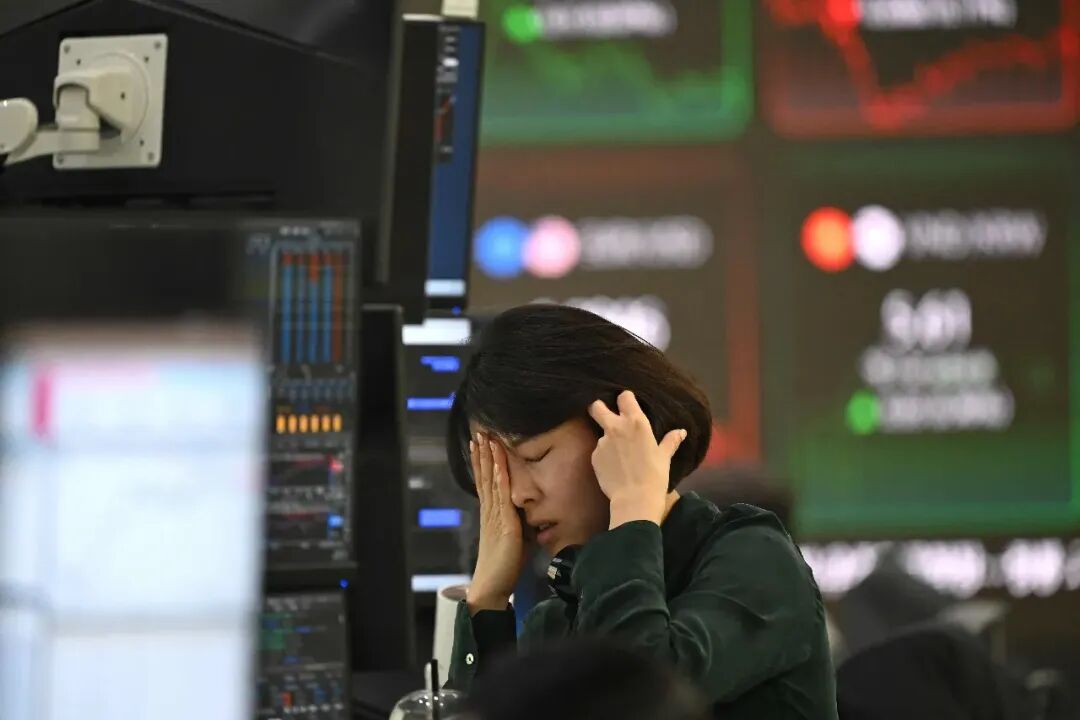
The young South Korean investors are exactly the group that lost all their capital by using heavy leverage in this stock trading round. South Korean media reported that 62% of the investors whose accounts were blown up in this round are aged between 20 and 30. These young South Koreans used several times of leverage to fight for their first bucket of gold in life, but ended up with their first bankruptcy. Who can they blame? Since you have the courage to burn your boats, you should be prepared for the consequence of losing all your property and everything collapsing. Their situation is pitiable, but not worthy of sympathy.
In fact, a similar situation occurred in the Chinese stock market a few years ago. In 2020, the fund investment craze became extremely popular, and a large number of young Chinese investors flocked into the market, borrowing money to buy funds even made the hot search list. They turned the financial circle into a fan circle, and the outcome was also very bleak.
Leeks can never be completely harvested, as they regrow when the spring breeze blows. If you can never get out of the newbie zone, there will always be endless leeks to harvest. Perhaps this time South Korea is different. This unprecedentedly volatile market shock is the opportunity for the South Korean stock market to step out of the newbie zone.
04
A 50% drop within a month is a very sharp decline, and the losses are extremely heavy. However, so far the impact on the South Korean economy is still controllable.
First of all, South Korea's financial system had anticipated this sharp drop in advance. In May, South Korean regulators and financial institutions had already started tightening leverage and issuing warnings. These preventive measures have contained the scale of risks to a certain extent. So far, account blow-ups have mainly occurred among retail investors, concentrated in single-stock leveraged ETFs, and there are no signs of large-scale blow-ups among major institutional investors, so no systemic financial risk has formed yet.
Secondly, the real economy has not been impacted yet. The semiconductor industry is still in a growth cycle, and the fundamentals of real enterprises are solid, acting as a firewall to prevent the spread of financial risks. Samsung Electronics and SK Hynix, whose combined weight accounts for 40% of the stock market, both have normal operating performance and growth expectations. The cash flow, cash reserves and debt ratio of the two enterprises are all healthy, and they have not been affected by the "run" on stock prices. If the damage of the stock market crash is limited to the virtual financial layer, the losses are still controllable, and can be gradually digested by future growth.
The main risk facing the South Korean economy in the future is not the stock market itself, but the trend of public opinion and government policies. South Korean economic populism has a strong public opinion foundation. After the large-scale stock market volatility, voices such as "foreign capital is harvesting domestic wealth" and "chaebols set up a trap" have already emerged. If the government, under the huge pressure of public opinion, reverses the reform direction and returns to the highly restrictive, over-regulated newbie zone, it will not only fail to alleviate the current crisis, but also make all the previous "tuition fee" paid in vain. This stock market turmoil is indeed a watershed for South Korea's national destiny. If it withstands the pressure and continues the direction of market-oriented reform, it will usher in a bright future. On the contrary, if it reverses the course of history, returns to the old path of high control and frequent intervention, and introduces a new round of harsh measures targeting enterprises, the future of the South Korean economy will be truly worrying. The stock market crash is not only a test for investors, but also a major test for the government's decision-making body.
As for those who choose to jump off buildings after their accounts are blown up, we can only express our regret. The capital market is not a greenhouse for growing delicate flowers. Everyone involved is an adult, and it is only natural to pay the price for your own choices.
This article is from the WeChat official account "Kongfu Finance" (ID: kongfuf), written by Guan Buyu, published with authorization from 36Kr.