American consumers are starting to get carried away in live-streaming rooms.
Overseas consumers are also getting hooked on "live-stream shopping".
In the past, they were more accustomed to the "shelf e-commerce" model, where they discovered products on social media and then jumped to e-commerce platforms to place orders. Now, they are keen on waiting in live-stream rooms for influencers to share quality products and place orders directly, and many of them are even obsessed with live-stream auctions.
The logic of traditional e-commerce is "products find users", while the rise of live-stream e-commerce has turned new consumption habits into "users find products". Product discovery and purchase can be completed seamlessly on the same platform.
Data confirms all these trends. During this year's TikTok Shop US mid-year promotion, the overall business volume nearly tripled compared with the same period last year; the growth of live-stream e-commerce was particularly rapid, increasing by more than 225% year-on-year. Among them, the live-stream auction model performed exceptionally well — the hourly average GMV is 4 times that of ordinary live streams, and the monthly average GMV growth rate from January to April this year is 6 times that of other live-stream formats and 14 times that of short videos.
Interest-based e-commerce has extremely shortened the transaction chain. Overseas consumers, like Chinese consumers, are beginning to get hooked on the "watch and buy" model.
In addition, for Chinese cross-border merchants, this change means that they no longer just put "Made in China" products into containers and ship them overseas, but build brand awareness through vivid video content, and even guide production reversely through comments from consumers.
The overseas market is no longer a situation of "blind men touching an elephant" for them.
The "watch and buy" interest-based e-commerce model has begun to achieve stable operation
Overseas tech giants have tried for many years to make overseas users get hooked on "interest-based e-commerce", but none of them succeeded.
Amazon Live has never gained much popularity since its launch, and Instagram and Facebook have successively shut down their live-stream e-commerce businesses in the US. The Southeast Asian market has long been dominated by the "search + shelf" model of Shopee and Lazada, and content-based shopping guidance has never achieved sustainable development.
In fact, the overseas market is not short of traffic, what it lacks is a platform that allows users to "browse with interest".
And TikTok Shop has made it happen.
In the final analysis, the core difference lies in the operation method — TikTok did not force the shopping cart function at the very beginning. Instead, it spent several years cultivating a huge and highly sticky influencer ecosystem, allowing users to get used to "discovering new and interesting things" on the platform. After "discovery-based consumption" became part of users' daily behavior, it seamlessly connected China's mature supply chain and merchant resources, making content, products and transactions integrated on the platform.
This rhythm of "content first, transaction second" is also the key missing step in all previous failed attempts.
At the same time, TikTok Shop is also experimenting with different interactive modes in this process, such as the "live-stream auction" model in this mid-year promotion.
In these special live-stream rooms, products are no longer coldly hung in the shopping cart waiting for selection. Hosts start auctions of some scarce and trending products (such as Pokémon trading cards, characteristic crafts) at a starting price of 1 US dollar. The 10-second countdown beating in the center of the screen will trigger a price increase and reset the countdown every time a user places a bid.
Among them, sports trading card merchant Hobby Box leveraged this highly interactive live-stream format to achieve a GMV of 3 million US dollars in just 2 months; Chinese tea ware merchant Artistry Collections turned the "kiln opening" process into a blind box experience, and the GMV of a single live session easily exceeded 25,000 US dollars.
For users, live-stream auctions are no longer boring TV shopping. The highly interactive, participatory and entertaining shopping experience perfectly hits the psychology of European and American users who pursue freshness and excitement, making them willing to stay in the live room for dozens of minutes.
It is worth noting that the fundamental reason why this model develops rapidly in the US market is that the United States has a profound auction culture around the world. Relying on the core status of New York and a huge group of collectors, it consistently ranks first in the global art auction turnover, and consumers have a very high acceptance of "bidding".
TikTok Shop only reactivated this consumption gene through live streams and content. When the platform superimposes new experiences with familiar local methods, the purchase button pressed by users is the most direct vote of approval.
When brands find a "smarter" way to communicate
In addition to the innovation of business models, TikTok Shop is also reshaping the brand globalization path of Chinese merchants.
In the past, an outdoor billboard in New York Times Square cost millions of dollars at every turn, and the conversion effect could not be measured; when traditional social media product discovery links jumped to independent sites or Amazon, a large number of users were lost at every step. There has always been a huge "breakpoint" between brand communication and sales conversion.
TikTok Shop connects this "breakpoint" with a content closed loop. Vivid short videos are three-dimensional "product manuals" and "scenario demonstration dramas". Product discovery to order completion is done on the same platform, and the smooth "what you see is what you get" link makes the conversion rate rise sharply.
The story of Shenzhen-based power tool brand Fanttik is a very typical case.
In 2021, Fanttik's existing power tool business hit a bottleneck. In the following two years, the team was downsized from 800 people to 150 people, and people left almost every month, but the sales of the company's products did not improve.
The turning point came in July 2023, when TikTok Shop US was launched. A month later, a short video went viral.
In the video, a middle-aged American man with a big beard rushed out and shouted: "No dad, husband or boyfriend will not like this Christmas gift..." He used the Fanttik electric screwdriver to disassemble toys, tighten screws, and install doorknobs, with neat and agile movements.
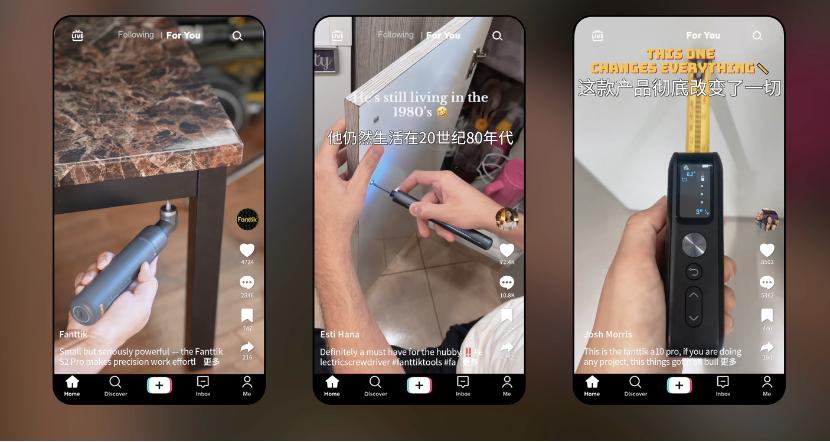
This immediately caused a sensation in the comment area. Just this one video made Fanttik sell 100,000 electric screwdrivers in two months, with sales of about 30 million yuan. On the day of the explosive order, the office that had been silent for two years became lively again.
This also reveals a fact: brands are not "built" by advertising, but "grown" by content.
The reason why Fanttik adhered to the content strategy in the past two years but did not get results is that content and transaction were two separate lines — users watched the video and had to go to independent sites or Amazon to search and place orders, and a large number of impulsive consumption was lost during the jump. After TikTok Shop was launched, the two lines intersected. As of April 2026, more than 32,000 influencers have promoted products for Fanttik, and its US sales have approached 100 million US dollars in three years.
Chinese bone conduction headphone brand SHOKZ is the same case.
Bone conduction and open-ear non-intrusive design are very novel technical concepts. It is difficult to really impress consumers only by introducing performance parameters on e-commerce platforms.
SHOKZ's solution on TikTok is to present the product in extremely real sports scenarios.
SHOKZ has built a huge influencer matrix, which does not focus on boring parameters, but shows real experience. Among them, the top tech influencer @iJustine collaborated with several small sports influencers to shoot a review video, which got 760,000 views; the more viral one is swimming blogger @Royal Crown, who shot an underwater extreme training video wearing SHOKZ headphones, and the single video directly reached 10.9 million views. In the comment area, overseas netizens who were shocked by the waterproof and firm features of the product are asking for purchase links.
Recently, leveraging the popularity of the Boston Marathon, SHOKZ launched a series of short documentary videos of the event. The footage focused on sweaty runners in the real competition, intuitively showing the core advantages of the headphones: "stay firm even with intense shaking, open-ear design does not hurt the ears".
With the scenario-based product discovery model, SHOKZ won the top 1 of the open-ear headphone category in the US market during the mid-year promotion, and the core single product's sales surged 30 times.
On the front end, TikTok Shop uses short videos and live-stream product discovery to solve the "want to buy" demand and accumulate brand value, and on the back end, it uses FBT official logistics to guarantee the "dare to buy" experience. The globalization of Chinese merchants is no longer a simple act of selling goods, but planting brand roots in overseas consumers' minds.
Factories are saying goodbye to the hard days of "blindly stocking goods based on experience"
The most profound transformation of interest-based e-commerce also takes place in the deepest part of China's manufacturing industry.
In the era of traditional foreign trade, countless white-label brands and original factories have extremely strong manufacturing capabilities, but they can only stay at the bottom of the smile curve — doing OEM for brands or competing with low prices. The sales chain is too long, and factories are too far away from end consumers, so they can only stock goods based on subjective judgment, and overstocking and clearance are almost their fate.
This situation is being changed by TikTok Shop.
In May 2024, a waterproof hair removal device named Hatteker sold more than 2,000 units per day steadily at its peak, with annual sales of 5 million US dollars. After the sudden explosion of the single product, the person in charge of Hatteker looked for the source of the hit product in the background of TikTok Shop, and was surprised to find that the sales surge was driven by an overseas "amateur" influencer with a small number of fans.
The shooting method of the video is simple and even rough: the influencer scraped the Hatteker hair removal device frantically on a bulging colorful balloon, and the balloon remained intact, intuitively proving that the blade is "sharp but will not hurt the skin". During the break of use, the influencer casually threw the hair removal device under the faucet to rinse.
The video intuitively demonstrated the waterproof feature of Hatteker. However, what really made the product sales take off was a highly praised real comment from an overseas user under the video: "Can this thing be used while taking a shower?"
This question made the Hatteker team capture the real pain point of North American consumers.
After reaping the benefits, the Hatteker team encouraged influencers to use all kinds of unexpected props (such as scraping kiwifruit) to subtly and vividly present the painless experience. Some influencers even laughed while demonstrating hair removal, which is both funny and highly convincing.
"If traditional e-commerce is the relationship between stores and people, what exists on TikTok Shop is more the relationship between people and people," Chen Xing, the boss of Hatteker, sighed. Seeing overseas users leave comments and express their preferences in various languages, this instant communication across half the globe made these factory merchants feel the real feedback from consumers for the first time.
Interest-based e-commerce turns every complaint from users into the direction of product innovation. In the past, factories guessed demands based on subjective experience, now users tell them the answers directly.
However, after the traffic comes, how factory merchants who do not understand English and overseas logistics can receive orders smoothly is also a new problem.
The emergence of TikTok Shop's full-hosting model provides another layer of guarantee for merchants hidden in the back end of the supply chain: it not only directly knocks on the door of overseas users through content, but also has the platform to support them behind the scenes, solving all worries for merchants going global.
Dongguan-based marker pen merchant "Speed Transfer Shop" has a deep understanding of this.
As one of the first merchants to settle in the full-hosting model, the founding team of Speed Transfer Shop has only 5 people. These 5 people also need to be responsible for order processing, delivery and handling overseas customer complaints. They had no manpower and energy to make short videos. After becoming a full-hosting seller on TikTok Shop, all their energy can be focused on product selection and content communication.
The two post-90s founders Gan Chuanwei and Zhang Chao had a simple and crude product selection logic when they first did cross-border e-commerce: follow whatever others sell, which led them into the price involution and grabbed orders by lowering prices.
After settling in TikTok Shop in June 2023, the first thing they did was to "cut the product line": more than 200 kinds of messy stationery were streamlined to 100 kinds, all focusing on the painting track. Then they formed a 3-person short video team, whose members are 20-something art teachers and editors.
A double-line outline pen that can draw a fluorescent double-line effect and is suitable for handwritten greeting cards is naturally suitable for presentation through short videos. The views of this video also exceeded 12 million, and the sales volume is three times that of other e-commerce platforms.
When colorful graffiti appeared in the influencer's short video accompanied by dynamic BGM, the originally ordinary white-label stationery was successfully packaged as a "European and American party artifact", achieving explosive growth. Before August 2024, Speed Transfer Shop had an average daily order volume of about 500 orders; after the hit product appeared, the average daily order volume increased to 4,000 to 10,000 orders. On Black Friday 2024, the single-day order volume exceeded 12,000.

In addition, the JIT logistics model launched by TikTok Shop in cooperation with the full-hosting model — which is driven by actual orders to arrange delivery, allows factory merchants to use short videos to "test products" at low cost and fast pace. After the video becomes popular and definite overseas orders are received, domestic factories start production and delivery, which directly solves the problem of overstocking and clearance that factories had in the past.
The results of TikTok Shop's mid-year promotion also show that the business volume of merchants using overseas warehouse delivery under the full-hosting model surged 3 times compared with last year's Black Friday.
In the "most crowded" promotion season, why does TikTok Shop achieve explosive growth against the trend
The results of this mid-year promotion, viewed in the context of the entire US e-commerce landscape, have completely different significance.
According to the 2026 Top 10 US E-commerce Platforms list released by US e-commerce data research institution Marketplace Pulse, the 2026 US e-commerce platform sales ranking is: Amazon leads with 300 billion US dollars, eBay 39 billion, Temu 22 billion, TikTok Shop and Walmart are tied for fourth with 15 billion US dollars each, but TikTok Shop has only grown for just two years since its launch.
The comparison of growth rates can better illustrate the problem. According to eMarketer's forecast, TikTok Shop's US sales in 2026 will reach 23.4 billion US dollars, a year-on-year increase of 48%, which is almost more than 6 times that of traditional e-commerce giants; in the segmented track of social e-commerce, according to eMarketer data, TikTok Shop has occupied 18.2% of the US social e-commerce market share, and it is expected to expand to 24.1% in 2027, and it is already the absolute leader in this field.
Another key background of this mid-year promotion is the "most crowded" promotion season in history. Amazon Prime Day was advanced to the end of June, and Walmart Deals and Target Circle Week followed at the same time. In the summer when giants all entered the market and promotion nodes are extremely dense, TikTok Shop delivered a report card of nearly 2 times overall growth, which itself is a demonstration of the competitiveness of the interest-based e-commerce model.
