Mapping | Where Have Talents From Top Foreign Fast-Moving Consumer Goods Enterprises Been Poached To? (Trial Reading)
Career Bonus (ID: ZhiChangHongLi)
Estée Lauder is pushing the professional managers it has trained for more than a decade into the job market with the greatest intensity in nearly 80 years.
In May, this beauty giant raised its global layoff target from 7,000 to nearly 10,000, accounting for 17.5% of its total employees, with total restructuring costs reaching 1.748 billion US dollars. More than 70% of the newly cut positions come from department store counters — those brand managers and sales supervisors who manage regional sales teams and memorize the shade number of every liquid foundation are leaving in batches.
This can hardly be said to be the problem of a single company. In January this year, Procter & Gamble welcomed the first Indian-origin CEO in its 189-year history, replaced the heads of its four major business segments within half a year, and planned to cut 7,000 non-manufacturing management positions within two years; Unilever's new CEO screened 200 key management positions one by one, and stated that a quarter of them would be replaced, saying "no one can hide". Over the past year and a half, at least half of the world's top 10 beauty companies have changed their CEOs, and six have announced layoffs involving more than 20,000 people in total.
The business of these giants in the Chinese market is not all performing badly. Estée Lauder has gained more market share in China in 7 of the past 8 quarters, its e-commerce GMV increased by more than 40% in the first half of this year, and SK-II has regained strong sales momentum in China; Unilever recorded a mid-single-digit growth in China in the fourth quarter of last year.
However, looking back at the long-term talent flow in the market, from Procter & Gamble, Unilever to L'Oréal, almost all multinational FMCG giants operating in China are experiencing the erosion of their once-dominant market share by rising local players. Three structural pressures, namely "the rise of local brands", "global cost control and organizational optimization" and "urgent digital transformation", jointly drive the frequent mobility of high-end talents in the FMCG industry.
Before the arrival of the AI and embodied intelligence era that grabbed all the spotlight, high-end talents from foreign FMCG companies were once highly sought-after in the market.
By sorting out their talent flow directions, Career Bonus finds that the migrating "graduates of the FMCG Huangpu Military Academy" have rewritten the power pattern of China's consumer market, and their mobility paths also reflect the different talent training priorities of their "alma mater enterprises".
When the organizational experience of large companies encounters the flexible operation methods of the local market, when standardized brand management collides with precise operation for segmented consumer groups... some high-end talents successfully transfer the full-link brand capabilities honed in Procter & Gamble's "70-20-10" training model, the systematic thinking of Unilever's "skill monetization", and the professional depth of L'Oréal's "full beauty industry chain layout" to new tracks with greater growth potential.
Where have they gone?
Procter & Gamble · A Giant Vessel ╱ 01
Unilever · Skill Monetization and Systematic Empowerment ╱ 02
L'Oréal · Empowering the Full Beauty Industry Chain ╱ 03
AB InBev · Expanding Outward from the Catering Industry ╱ 04
Epilogue ╱ 05
Talent Flow List of 4 Leading Foreign FMCG Enterprises ╱ Appendix
Procter & Gamble · A Giant Vessel
Upcoming content: History of Procter & Gamble China |What Kind of Talents Does Procter & Gamble Want |Talent Development - How to Nurture Employees
In 1988, Procter & Gamble (Guangzhou) Co., Ltd. [1] was established, and Procter & Gamble officially entered the Chinese market. In 2008, Procter & Gamble reached its peak of development, becoming the 6th largest company by market value in the world with rapidly growing operating revenue. One year later, its total market share in China reached about 47%, and its cleaning and care product market share once hit 50.5%.
In 2014, the situation took a sharp turn for the worse — Procter & Gamble began to face more fierce competition challenges in the Chinese market.
In September of that year, Premier Li Keqiang delivered the speech of "Mass Entrepreneurship and Innovation" [2] at the Davos Forum, which inspired the entrepreneurship enthusiasm of Chinese people and gave birth to more local brands.
As early as 2011, new domestic consumer brands had gradually matured, and Procter & Gamble had already faced a wave of strong competitors such as Blue Moon, Nais, CHANDO and Herborist. The rise of the entrepreneurship boom and the entry of new competitors undoubtedly further impacted Procter & Gamble's market position.
Apart from external market competition, the rigidity of internal mechanisms and the mismatch of organizational power have also eroded Procter & Gamble's ability to cope with challenges from the root. Procter & Gamble has a huge organizational structure, and the headquarters-centralized expatriate-led model makes the reporting chain very complicated.
On the one hand, Chinese employees have limited promotion space within Procter & Gamble, and most positions above band4 level are held by foreign employees; on the other hand, decisions for the Chinese market need to be approved by the US team, but the US team cannot timely understand the rapid development of the Chinese market, leading to high internal communication costs, reduced sensitivity to market changes, and difficulty in internal innovation.
Therefore, the negative public opinions about Procter & Gamble in the market at that time did not focus on negative layoff incidents or talent training issues, but on the authorization problem of its headquarters.
Although many people have "left the ship" one after another, many employees who have worked at Procter & Gamble have full recognition of this professional experience.
[1] Procter & Gamble formed the first joint venture in China, Procter & Gamble (Guangzhou) Co., Ltd., together with Guangzhou Soap Factory, Hutchison Whampoa (China) Co., Ltd. and Guangzhou Economic and Technological Development Zone Construction Import and Export Trading Company.
[2] It refers to the national strategy of "mass entrepreneurship and innovation". On September 10, 2014, Premier Li Keqiang first proposed it at the Summer Davos Forum in Tianjin, stating that "we should set off a new wave of 'mass entrepreneurship' and 'grassroots entrepreneurship' across the 9.6 million square kilometers of land, and form a new momentum of 'innovation by all'". It aims to promote China's economy to transform from factor-driven to innovation-driven by stimulating the vitality of innovation and entrepreneurship across the whole society.
Talent Selection: Seven-Layer Funnel Mechanism
How does Procter & Gamble attract talents with high loyalty?
The answer lies in the strict talent screening system and sound talent development system.
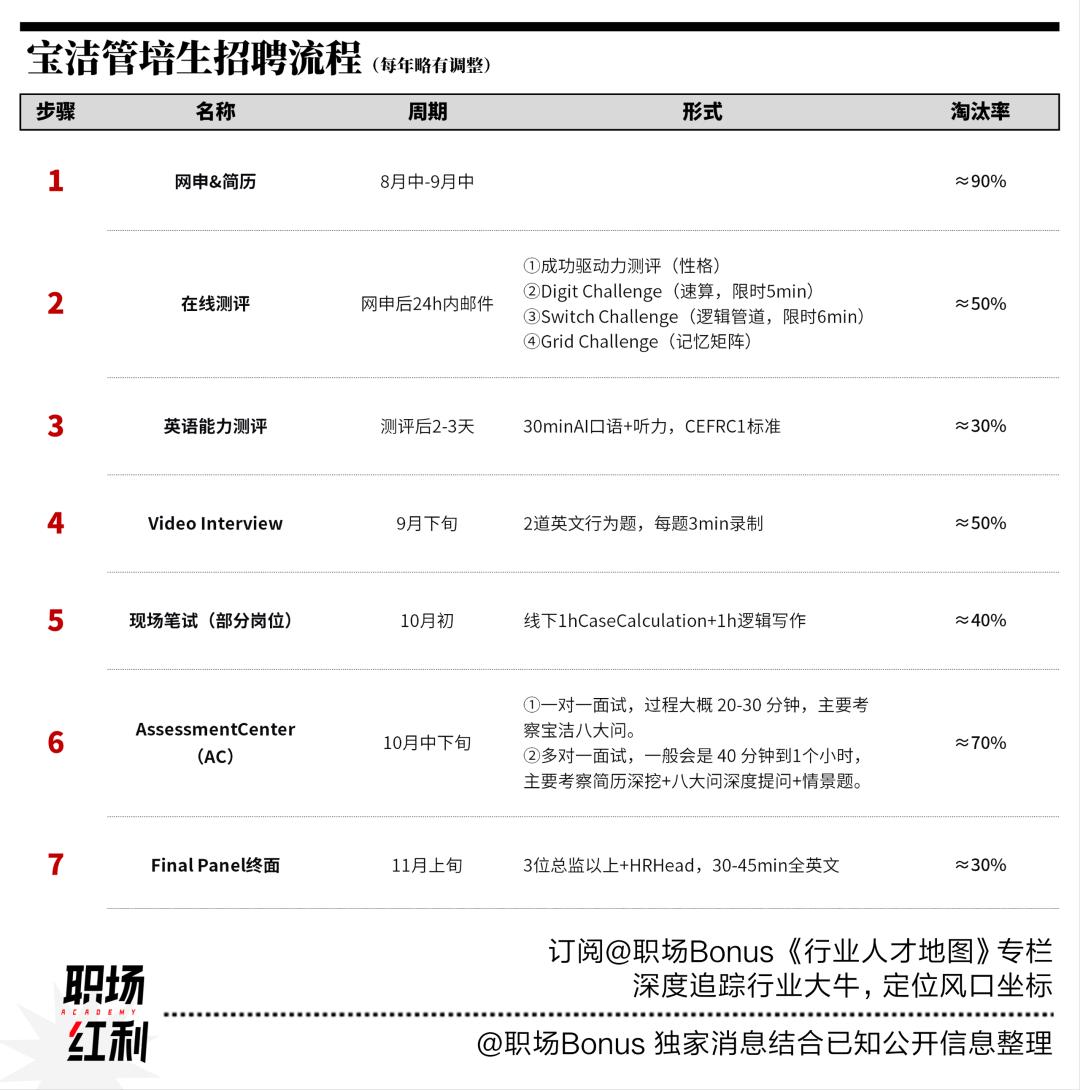
Public data shows that in 2020, the application-to-admission ratio of Procter & Gamble's management trainee program reached 5000:1, with nearly 100,000 applicants, and the final number of admitted candidates for all positions was only around 20. Applicants need to spend three months passing the seven-layer funnel: online application, assessment, English test, video interview, written test (optional), assessment center, and final interview.
Career Bonus (ID: ZhiChangHongLi)
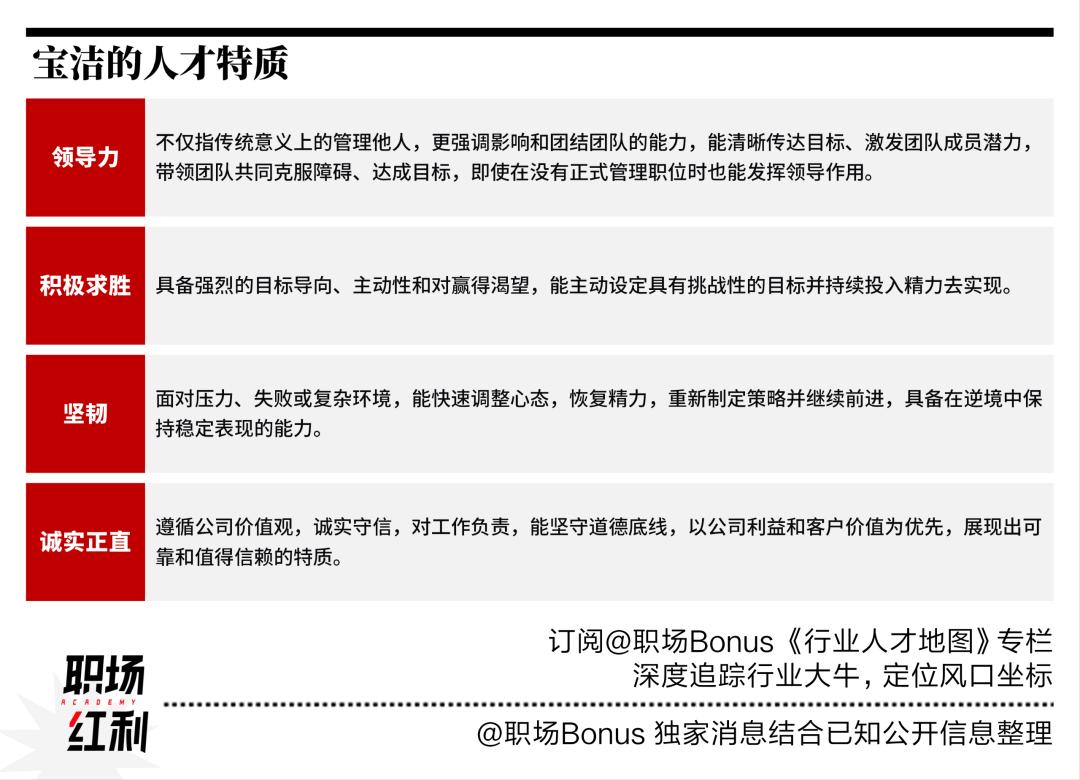
After this screening, Procter & Gamble obtains talents that meet its expected profile: graduates from 985/211 universities and QS top 50 universities, with excellent English proficiency (CET-6 score ≥500 / IELTS score ≥7.0 / TOEFL score ≥100), no major restrictions for core departments (marketing, sales, HR), a small number of departments prefer science and engineering and matching majors; with past high-level internship experience, overseas internship experience, awards in business competitions or impressive campus experience; with characteristics of leadership, ambition for winning, integrity and resilience.
Career Bonus (ID: ZhiChangHongLi)
Talent Development: "70-20-10" Rule
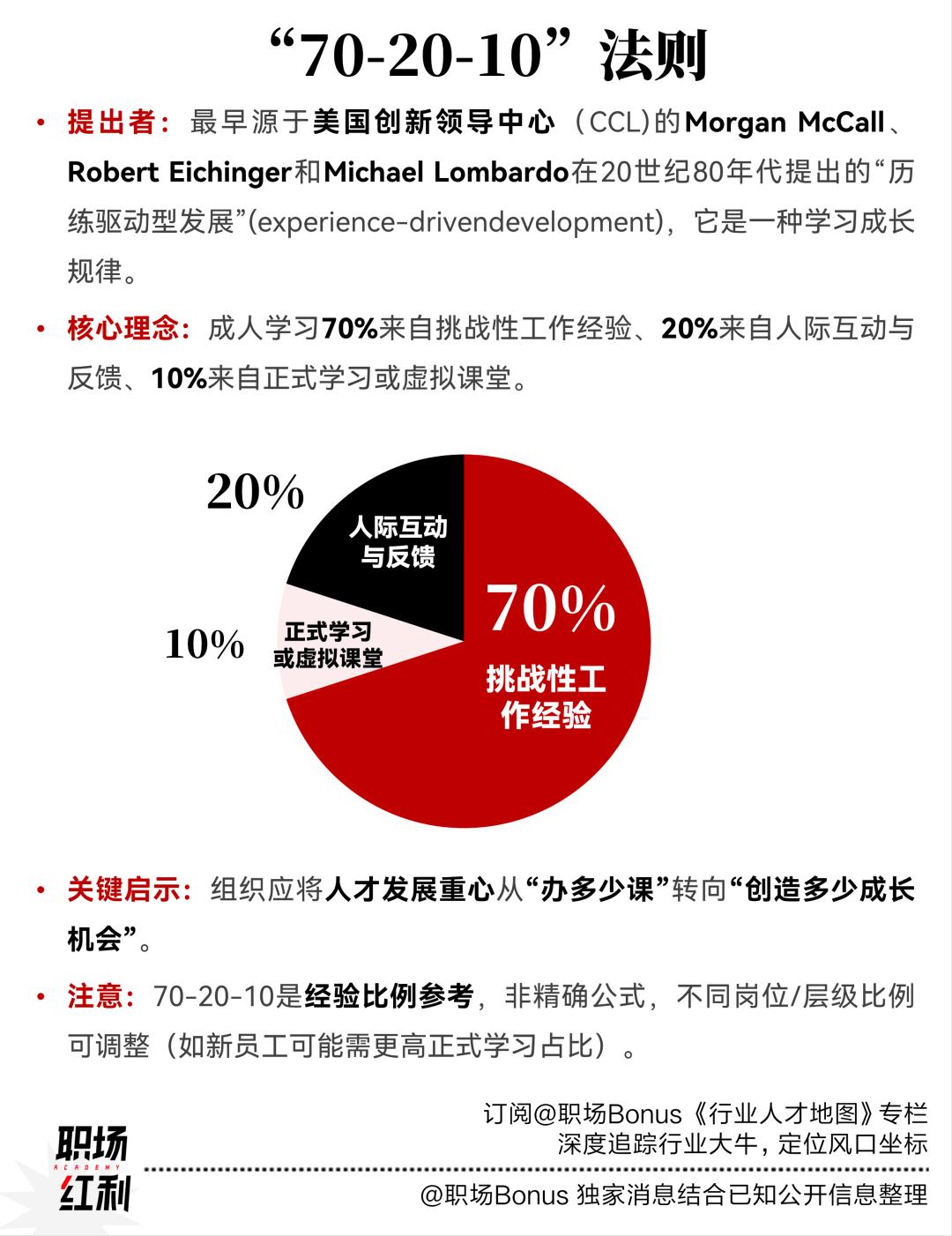
As one of the earliest foreign enterprises to train local professional managers in China, Procter & Gamble introduced the management trainee system in China, and built and deeply implemented its talent development system based on the "70-20-10 Rule".
The core concept of this model is "people do not learn mainly through classes, but through learning by doing, learning by asking, and learning by teaching". Therefore, in Procter & Gamble's talent development system, 70% of learning comes from practice, 20% of learning relies on peer communication, and 10% of learning focuses on classroom training.
Career Bonus (ID: ZhiChangHongLi)
Among them, project practice learning is undoubtedly the most important part. Specifically, carefully selected fresh graduates will start from grassroots positions, and experience several job rotations across different departments and functions, with each rotation period lasting 2 to 3 years. In addition, when there is a vacant position in the company, the company will arrange suitable employees for the position, and employees can also apply for it voluntarily.
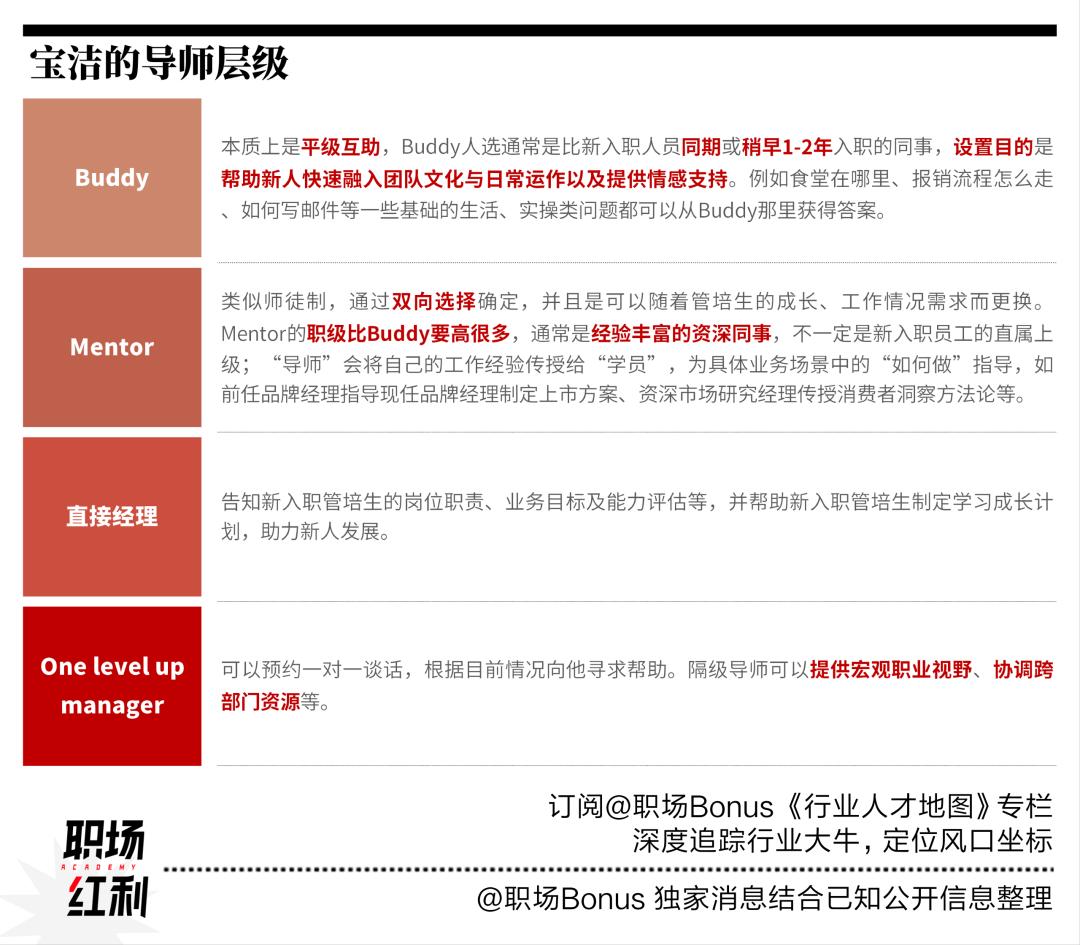
Procter & Gamble's management trainee system is equipped with a corresponding mentorship system, which usually includes four levels: "Buddy", "Mentor", "Direct Manager" and "One Level Up Manager", providing a complete support system for new management trainees from onboarding integration to career development, and further to strategic vision building.
Career Bonus (ID: ZhiChangHongLi)
In addition, Procter & Gamble also provides employees with a clear development path.
Procter & Gamble adheres to the internal promotion mechanism, providing enough promotion opportunities for young people, and all its management personnel are promoted from internal employees. This not only brings clear promotion paths and more promotion opportunities for management trainees, but also avoids solidified values and interest involvement brought by external recruitment, ensuring that the management has a deep understanding of Procter & Gamble's culture and values.
The Huangpu Military Academy That Is Good at Cultivating CXOs
Upcoming content: Why It Can Cultivate Outstanding Talents | Advantages of Its Training System | What Outstanding Talents It Has Cultivated
The sound talent development system and clear career development path have made Procter & Gamble an undisputed top talent incubator in the industry — the Huangpu Military Academy of the FMCG sector.
Among them, the "early responsibility" emphasized within Procter & Gamble further gives its employees natural advantages in entrepreneurship.
From the first day a management trainee joins Procter & Gamble, they take on substantive work functions — after two years of work, they may be independently responsible for a brand or a major group customer, managing sales of over 1 billion US dollars. "Compared with other people, they have operated large-scale projects earlier, have more stable mentality when facing large projects, and have the ability to handle affairs, so they are more likely to succeed in entrepreneurship." A senior industry insider commented.
Katherina, a professional career coach with years of experience as a consumer goods headhunter, told Career Bonus that thanks to the systematic advantages of Procter & Gamble, the management trainees it cultivates generally have high comprehensive quality, they are good at using logical expression to transmit information efficiently, and they also have clear ideas about their own advantages or career development directions.
Therefore, when their growth at Procter & Gamble reaches the ceiling, leaving the company becomes their next choice.
There used to be a joke in the industry that "Procter & Gamble is very good at cultivating CEOs", which fully shows that Procter & Gamble not only cultivates talents for itself, but a large part of these outflowed talents have become CXOs of other companies.
Combining public information and headhunters' personal accounts, Career Bonus finds that executives who left Procter & Gamble have four career transition directions:
……
(The trial reading part ends. To read the full article, please purchase the "Industry Talent Map" series collection under the original WeChat post. Thank you for your support to paid content!)
