Why is Momenta's Physics AI worthy of attention?
When Momenta submitted its prospectus, Yu Kai, the founder of Horizon Robotics, posted a Weibo note, stating in essence that Horizon has never claimed the titles of "the first stock of autonomous driving chips", "the first stock of autonomous driving" or "the first stock of Physical AI", and is a "rather boring" company. This Weibo post did not name any specific party, but its timing perfectly aligned with the "first stock of Physical AI" label, which inevitably sparked widespread speculation.
In fact, this post is more like a starting point. What is really worth exploring is the implication behind this label. Meanwhile, Momenta's prospectus and its stock price trend in the first week after listing have already provided many clues.
This article follows these clues to discuss some relatively uncommon views in the market: to separate and calculate the two accounts of how much the company is worth and how much its narrative is worth.
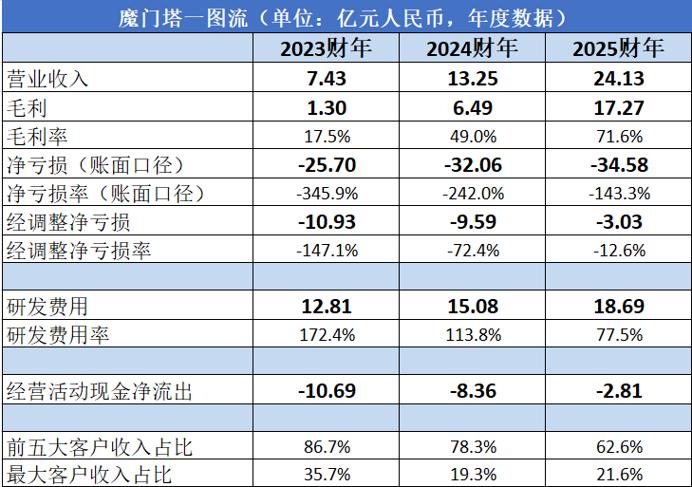
(Momenta's financial results one-pager below, unit: 100 million yuan, all data is from Wind, sorted out by Financial Insight)
01 Mass production for self-sustainability, Robotaxi is still under development
One flywheel and two legs are the core strategy of Momenta.
The flywheel refers to the technical closed loop composed of data-driven algorithms, massive road test data, and closed-loop automated toolchain. The two legs refer to the mass production business, which develops customized intelligent driving solutions for automakers to earn one-off technical development service fees and continuous software licensing fees based on vehicle model sales; the other refers to the large-scale autonomous driving business, namely Robotaxi, which targets the longer-term and more thorough L4 full autonomous driving.
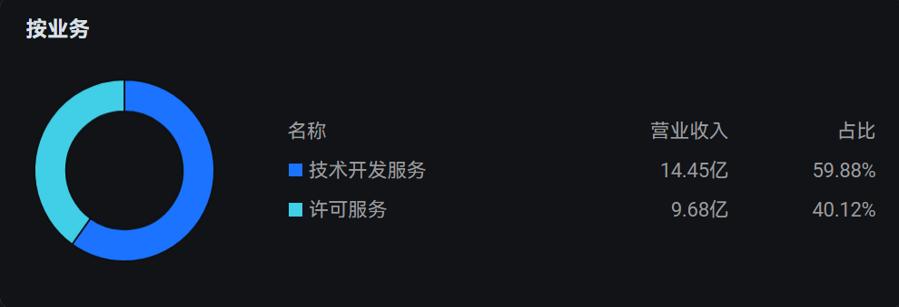
Judging from financial data, this strategic deployment has been recognized by the real industrial market at the current stage. Momenta's software licensing revenue rose from 23 million yuan in 2023 to 968 million yuan in 2025, with a three-year increase of more than 40 times, and its proportion in total revenue also increased from 3.1% to around 40%.
The characteristic of licensing revenue is extremely low marginal cost. The mass production scale of automakers forms a positive cycle with it, and the positive feedback of the "flywheel" operation is also reflected in gross profit. The company's gross margin surged from 17.5% in 2023 to 71.6% in 2025.
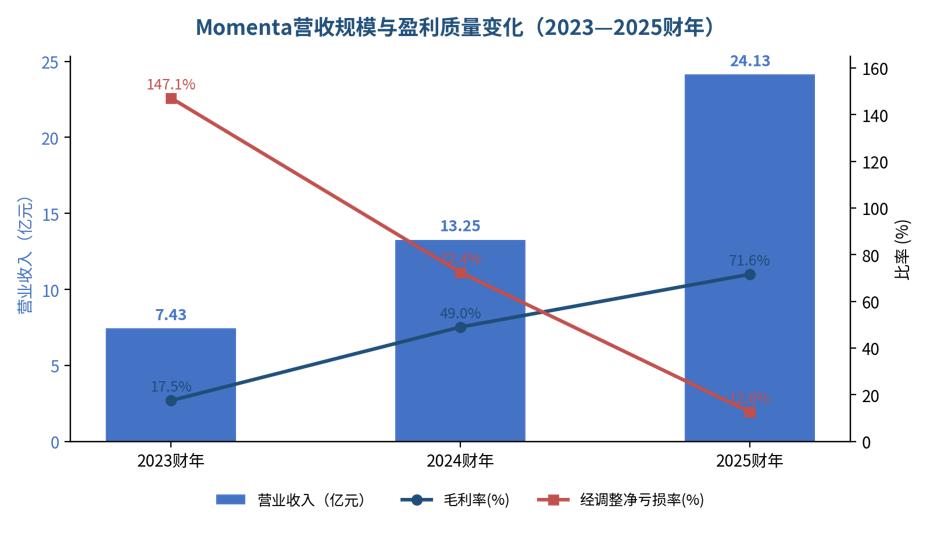
Data source: Momenta prospectus and corporate financial reports, FY 2023-2025
From the perspective of revenue by business segment, the revenue structure shows a single-leg support, with mass-produced vehicle solutions contributing almost all revenue, while the commercial monetization of Robotaxi on the other side has not yet started.
The mass production leg has indeed achieved certain economies of scale. Before listing, the number of vehicles equipped with Momenta's mass production solutions exceeded 1 million, with more than 210 cumulative designated models, covering almost all mainstream automakers in China, and 9 of the world's top 10 automakers have cooperated with it. The company also mentioned a detail: it took 24 months to achieve 100,000 mass production deliveries for the first time in 2022, and now it can be completed in as fast as 40 days. The delivery efficiency has jumped from the "year" level to the "day" level, and the flywheel efficiency is being realized.
But the progress of the other leg still needs to be accelerated. The Robotaxi business is currently mainly in the stage of cooperation with platforms such as Uber, Grab and Sunydao Mobility, and pilot projects in Munich, Germany and other regions, and has not yet generated large-scale revenue. In the prospectus, the item of other L4-related revenue is still zero at present.
02 Fundamentals are improving, Momenta is gradually gaining self-sustainability capability
Then look at the profitability side.
There is a set of figures in the prospectus that are easy to misinterpret: Momenta's book net loss under the IFRS standard expanded from 2.57 billion yuan in 2023 to 3.458 billion yuan in 2025, rising instead of falling in three years. Looking only at this line, it is easy to draw the conclusion that the company's losses are increasing.
After analyzing the financial reports, we found that the bulk of this book loss comes from the fair value change of convertible and redeemable preferred shares. The faster the company's valuation rises, the larger this non-cash book loss will be, which has no direct relationship with the actual operating performance. After excluding these one-off and non-cash items, Momenta's adjusted net loss has actually been narrowing year by year.
It decreased from 1.093 billion yuan in 2023 to 959 million yuan in 2024, and further narrowed to 303 million yuan in 2025. The corresponding loss rate also dropped from 147% to 12.6%. The net cash outflow from operating activities is also narrowing, from 1.069 billion yuan to 281 million yuan, and the company's cash reserve on account exceeds 10 billion yuan.
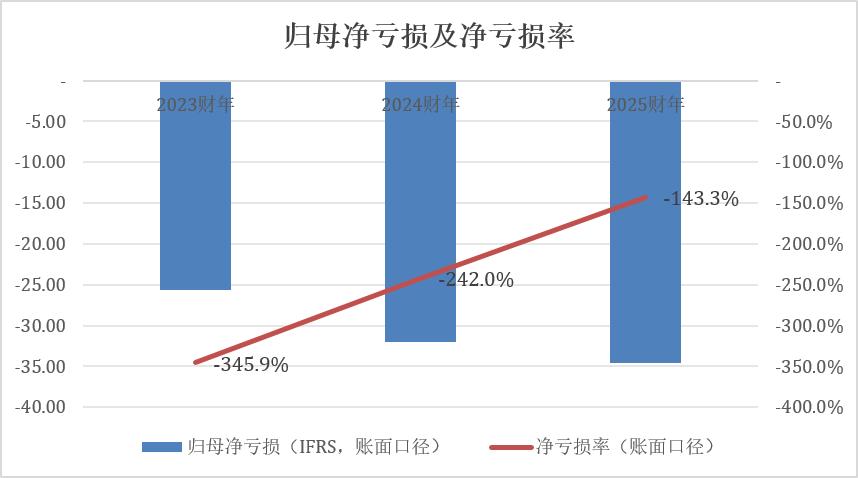
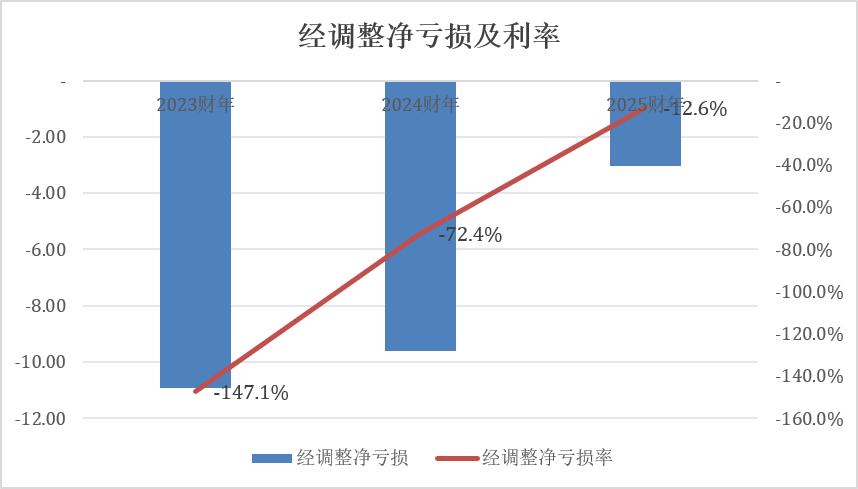
These figures together indicate that Momenta is transforming from a company that relies on financing for blood transfusion to a company that is getting closer and closer to self-sustainability.
Overall, Momenta's fundamentals are improving.
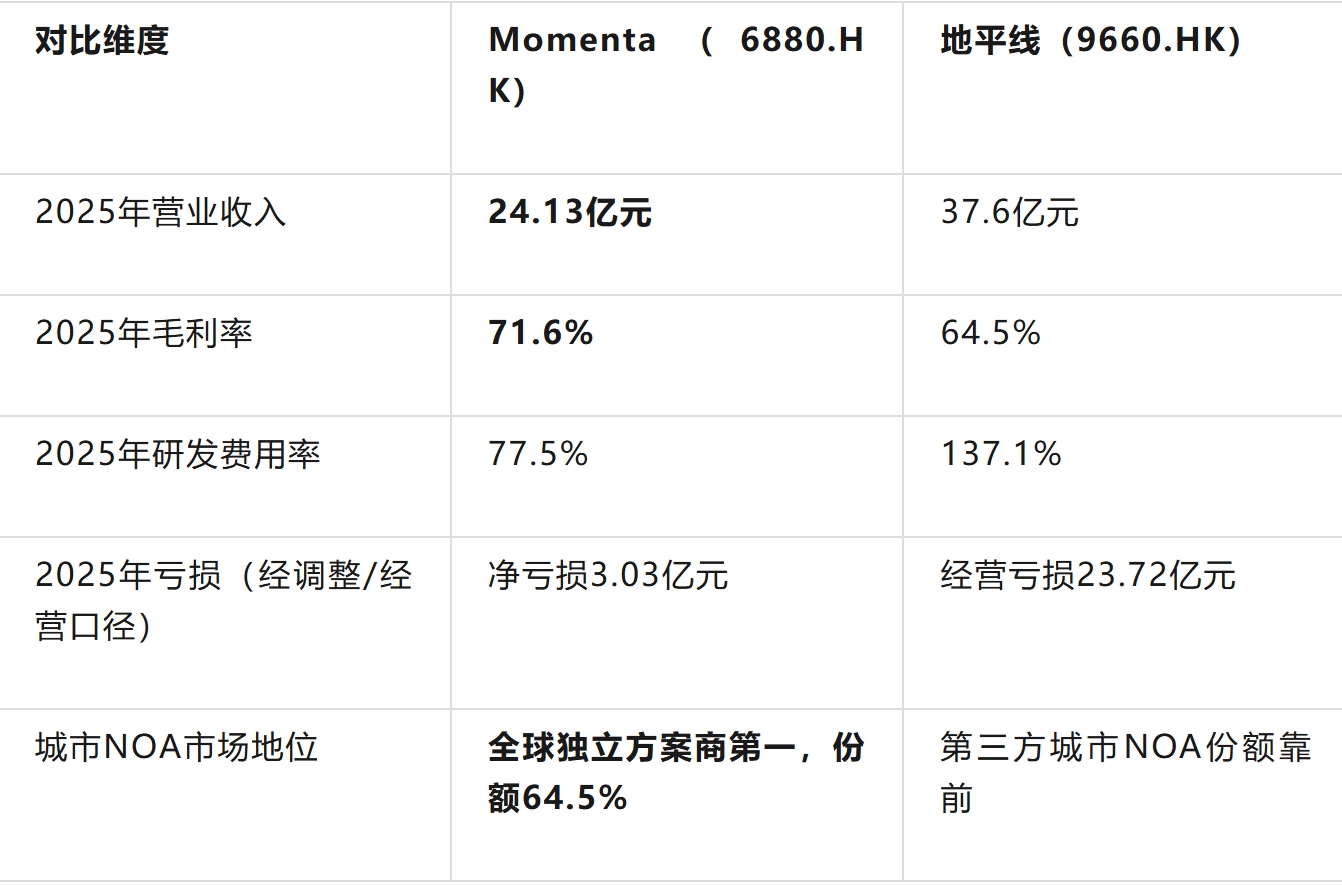
We compare its performance with its listed peer Horizon Robotics. The two companies' narratives are becoming more and more similar: one cuts into hardware from software, the other starts from the integration of software and hardware, and they are converging on the same track.
Comparison of key indicators between Momenta and Horizon Robotics (2025)
Data source: 2025 annual financial reports and prospectus disclosure information of the two companies
Looking at this table separately, Momenta's revenue scale is smaller than that of Horizon Robotics, but its gross margin is higher, because it adopts a purer software licensing model without the drag of chip hardware costs; its R&D expense ratio is much lower than that of Horizon Robotics, as it does not have self-developed chip links, so the investment intensity is inherently lighter; although the loss caliber cannot be directly compared, Momenta's adjusted net loss rate has narrowed to 12.6%, which is significantly closer to break-even than Horizon Robotics.
03 25x price-to-sales ratio, pricing for expectations
But as a technology-driven enterprise labeled "Physical AI", this fundamental performance is not enough to support the current valuation.
There is an unusual detail in Momenta's IPO this time: it did not set a price range, but directly fixed the issue price at HKD 295.6 per share, which indicates strong market demand. The final base issue size is about HKD 58.9 billion, and can reach HKD 68 billion if the greenshoe is fully exercised. 14 cornerstone investors subscribed for nearly half of the issue size, the public offering was oversubscribed by 413 times, and the international offering part attracted institutional orders of more than HKD 1 trillion. Calculated at this price, the company's total market value once exceeded HKD 700 billion, corresponding to 2025 revenue of 2.413 billion yuan, with a price-to-sales ratio of about 25.1x.
This is a noteworthy figure. The valuation logic of traditional automotive component suppliers or automotive-grade software providers is far less generous. This high valuation metric can only be measured by the narrative of Physical AI.
Economist Robert Shiller proposed in "Narrative Economics" that once a story forms a viral spread, it will affect asset prices like an epidemic, even if the fundamentals have not changed synchronously. To some extent, the term "Physical AI" is playing such a narrative role — it makes the valuation of an intelligent driving software company incorporate a robot story that has not yet happened in advance.
What I want to remind here is: of the HKD 700 billion market value, how much is priced for the already delivered intelligent driving solutions, and how much is priced for the unfulfilled robot narrative, these two parts need to be viewed separately.
04 In the first week after listing, the market has given a preliminary answer
If the level of valuation is a matter of opinion, then the stock price trend after listing is the vote cast by the market with real money.
Data source: HKEX public trading data, July 8 - July 13, 2026
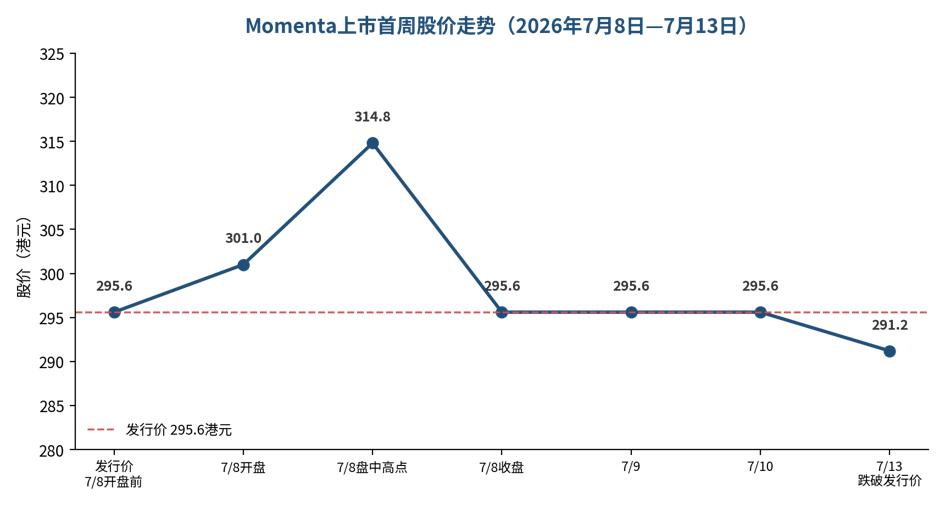
On the first day of listing on July 8, Momenta opened 1.83% higher at HKD 301, and once rose to HKD 314.8 during the session, with an increase of more than 6%, then fell back and closed exactly at the issue price of HKD 295.6, no more, no less. On the two trading days of July 9 and July 10, the stock price change was 0% — for a newly listed new stock with extremely high subscription enthusiasm, this trend is not common, and it is more like funds are deliberately maintaining the price.
The real signal appeared on July 13, the 4th trading day after listing: the stock price fell below the issue price, closing at HKD 291.2, down 1.49%.
This break of issue price occurred during the greenshoe support period. According to the rules, the stabilizing operator could buy shares at a price not higher than the issue price to support the price, and theoretically still had available funds. The break of the issue price indicates two possibilities: one is that the selling pressure is too great for the supporting party to bear, and the other is that the supporting party actively chooses not to defend HKD 295.6 any more. Either way, this in itself is a not-so-mild signal.
Conclusion: Every AI ticket remains to be verified
Jensen Huang has repeatedly stated in the past year that Physical AI is the next wave of the AI industry, and this judgment is supported by industrial logic — digital AI has entered a stock stage of slowing growth and homogeneous involution, and AI that can perceive, understand and operate the physical world indeed points to a market space far larger than the pure digital world.
This is not an empty statement. The global Physical AI track attracted more than USD 6.4 billion in financing in the first quarter of 2026 alone, and the direction is real.
But a real direction does not mean that every ticket on this track is worth the price. Momenta has indeed done many things correctly in the past ten years. Judging from its financial performance, the company is gradually achieving self-sustainability.
What is really worth paying attention to is how much of the HKD 700 billion figure is priced for the "intelligent driving software supplier Momenta", and how much is paid in advance for the identity of "Physical AI foundational model builder".
The stock price trend in the first week after listing has given a preliminary signal. No matter how good the narrative is, it ultimately needs to be verified by the actual revenue generated by robot business and L4 businesses such as Robotaxi. A sufficiently attractive label is not enough. At present, the label of the first stock of Physical AI still needs further verification from the market.
This article is from WeChat official account "Financial Insight", the author is a researcher focusing on financial report research, and is published by 36Kr with authorization.