Elon Musk's "most boring" company raises 27 billion yuan in financing
In the impression of most people, Elon Musk is a synonym for "the future": as fossil fuels cause severe pollution, Musk created Tesla; as labor shortage is an inevitable trend, Musk developed Optimus and OpenAI; as humanity will eventually head into space, Musk founded SpaceX and proposed the Mars immigration plan. Even the well-known sci-fi animation *Rick and Morty* set a role for Musk, believing that he has enough technological strength and unique capabilities to help the grandfather and grandson defeat the rebel robot forces.
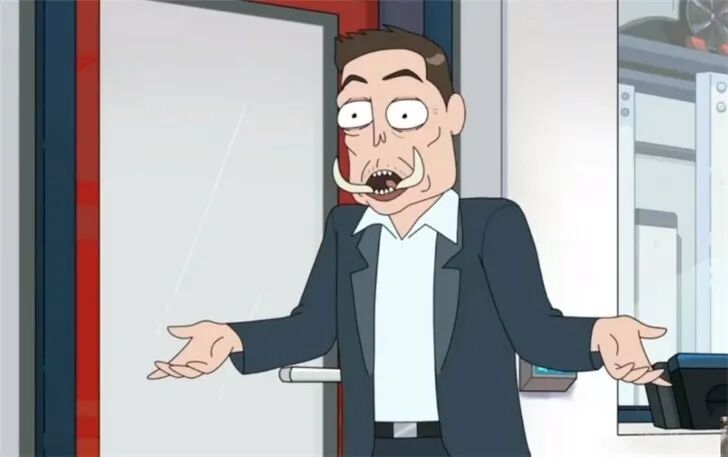
(This character was even voiced by Elon Musk himself, Source: video screenshot)
But in fact, this is only one side of Elon Musk. As a business magnate who aims to transform the world in all dimensions, Elon Musk's business map also includes a very pragmatic infrastructure project. Founded in 2016, this project is mainly focused on digging tunnels in cities to improve the overall traffic efficiency of the city. Probably even Elon Musk himself thinks the contrast between this project and Optimus, SpaceX is too prominent, so he simply gave the project a very self-mocking name, called The Boring Company, a company that is literally named "boring".
Elon Musk does not treat this project as a casual pastime. While SpaceX is accelerating its space exploration, The Boring Company has quietly grown into a super unicorn with a valuation of tens of billions of dollars. According to reports from multiple media outlets, The Boring Company has launched a new round of financing, planning to raise at least 40 billion US dollars (equivalent to about 271 billion RMB) at a valuation of 200 billion US dollars (equivalent to about 1.3535 trillion RMB).
The Underground Version of SpaceX
In many sci-fi works, authors will describe in detail how human beings develop the underground world. For example, the famous animation *Neon Genesis Evangelion (EVA)* depicts "Tokyo-3", a city that can be entirely settled underground. Another well-known sci-fi work *The Wandering Earth* sets the scene that all human beings live in huge underground fortifications. The reason behind this is not complicated: since the underground world is not directly exposed to atmospheric circulation and sunlight, it has a stable climate with constant temperature and humidity. If the problems of food and water supply are solved, it will become a very ideal living environment.
Corresponding to real life, Apple's "Cloud in Guizhou" follows this logic: large-scale data centers generate a huge amount of heat during operation, and overheating will affect the operation of machines and bring safety risks. Therefore, it is necessary to configure high-spec cooling systems, which means huge cost expenditure — according to statistics from the International Energy Agency (IEA), cooling systems can account for up to 30% of the total energy consumption of computing centers. Located in the Hengduan Mountain area, Guizhou, which is dominated by karst landforms, perfectly solves this problem. The caves of all sizes in its territory almost perfectly simulate all the characteristics of the "underground world".
The same logic lies behind Elon Musk's decision to found The Boring Company.
Back to December 17, 2016. That night, Elon Musk posted a tweet saying: "The traffic is driving me crazy, I really want to build a tunnel boring machine and dig a tunnel directly". At first, not many people took this sentence seriously. After all, people have long been accustomed to the "tech otaku" persona of Elon Musk, and are used to his radical and whimsical remarks on social media. But a few days later, people found that something was unusual:
First, Elon Musk directly changed the profile of his personal social media account to "Tunnels (yes, tunnels)"; a few weeks later, people noticed that three university research teams came to the SpaceX headquarters with "hyperloop prototype pods" for testing. Through the video released by the Massachusetts Institute of Technology, people saw that these "high-speed train prototype pods" were traveling at high speed in a deep tunnel.
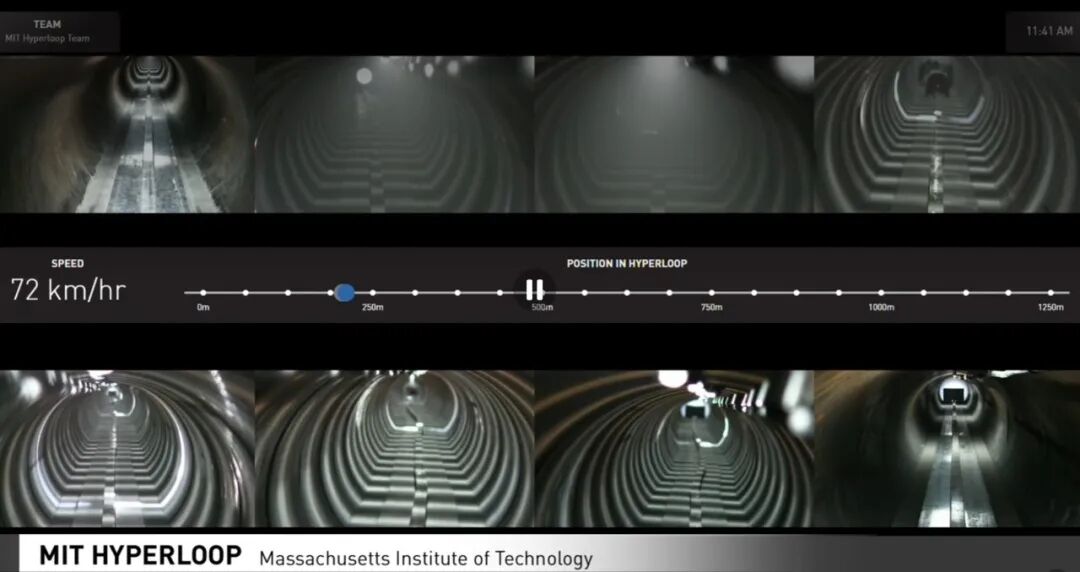
(Test footage, Source: Social media)
A few weeks later, Elon Musk appeared in Bloomberg's exclusive interview, but he did not appear as the founder of Tesla, nor did he represent SpaceX. The whole interview was more like a conversation from "ordinary citizen" Mr. Musk, who complained that the traffic on his only way to work was very bad, there were traffic jams almost every day, and the traffic would be completely paralyzed once jammed, which made him physically and mentally exhausted, so he decided to found a company named "The Boring Company" to completely solve this problem — the word "Boring" in English means both "dull" and "drilling".
Mr. Musk said that in his opinion, ground traffic is "beyond remedy", because the current traffic system is built around a two-dimensional plane. Under this premise, when a large number of people and vehicles appear in a small area at the same time, "congestion" becomes an inevitable result. The so-called "traffic command system" essentially only coordinates the right to use "plane space". To completely solve the problem, we need to make the traffic network "three-dimensional". Flying into the sky like SpaceX is one solution, and The Boring Company is trying another solution, which is to expand underground.
Specifically, Mr. Musk believes that in order to completely get rid of the restrictions of ground traffic and pursue higher efficiency, the traffic system of future cities will definitely build a tunnel network with 10, 20 or even more than 30 layers, which are respectively dedicated to private cars, railways and other means of transportation. To achieve all this, he has invited the engineering team to dig a huge pit about 15 feet (about 4.5 meters) deep and more than 50 feet (about 15.24 meters) wide in the parking lot of SpaceX. He told Bloomberg that this huge pit will be the entrance for the tunnel boring machine to start working in the future.
At this point, everyone realized that Elon Musk was not just complaining casually, and "tunnel digging" was indeed his new entrepreneurial project.
In Elon Musk's plan, The Boring Company has two main businesses. One is to design more advanced tunnel boring machines to greatly increase the tunneling speed and reduce costs, so as to build multi-layer traffic networks under cities on a large scale; the other is to design a high-speed means of transportation dedicated to the underground traffic network, which Elon Musk named Hyperloop.
The prototype of Hyperloop was first formed in 2013. According to Elon Musk's idea, if we can build safe and reliable underground tunnels and transform them into a sealed low-pressure environment, we can design a super high-speed means of transportation with a speed of 700 miles per hour (about 1127 kilometers per hour) based on technologies such as maglev. The three university research teams mentioned earlier went to the SpaceX headquarters to participate in the test, which was exactly Elon Musk's selection of the design scheme for Hyperloop.
The subsequent development path of The Boring Company has also been closely carried out around these two business lines: in April 2017, the first tunnel boring machine purchased by The Boring Company was officially put in place; in December 2018, The Boring Company announced that a test tunnel had been completed in Los Angeles, with the first phase being about 2 miles long, used to test the feasibility of self-driving electric vehicles for daily transportation through underground tunnels; in 2019, The Boring Company won the bid for the Las Vegas Convention Center Loop (LVCC Loop) project, and successfully completed it in 2021 with an overall budget of 48.7 million US dollars, transporting more than 4400 passengers per hour during peak hours.
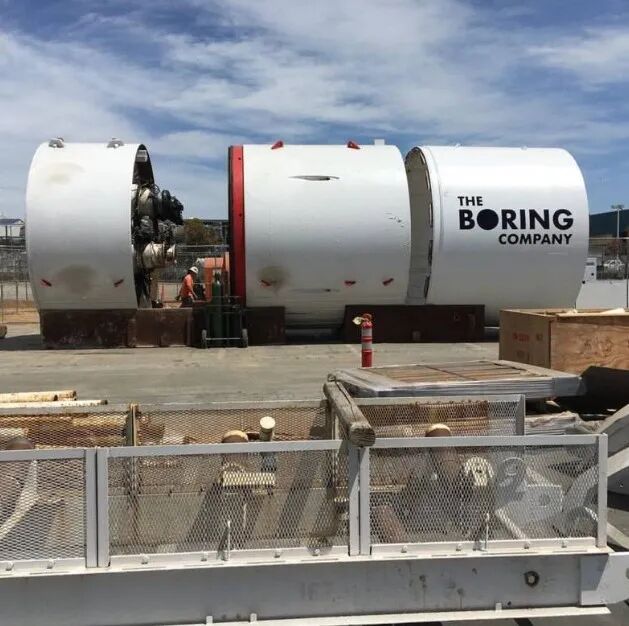
(The tunnel boring machine exposed by SpaceX employees, Source: Social media)
In 2023, The Boring Company released their self-developed and improved tunnel boring machine Prufrock. The tunneling speed of Prufrock exceeds 1 mile per week (about 1.6 kilometers per week), far exceeding the industry's conventional rate of 0.1–0.3 miles per week (about 0.16–0.48 kilometers per week). In addition, Prufrock can also convert the excavated materials into "Boring Bricks" to reduce disposal costs and carbon emissions. Before this round of financing, Prufrock has been iterated to the Prufrock MB2 version, which is claimed to have a 15% increase in power compared with the first-generation Prufrock-MB1, and has completed tests in Tennessee.
Advancing in Controversy
Therefore, although the name of The Boring Company contains the word "Boring", their business is actually not boring at all. They just change the direction physically to explore the future lifestyle of human beings, which is very "Musk-style". Such a project obviously will not lack capital support. So far, The Boring Company has completed 3 rounds of financing, with investors including Elon Musk himself, Peter Thiel's Founders Fund, HSG, Future Ventures, DFJ Growth, and Vy Capital.
Before the launch of this round of financing, The Boring Company's latest financing was the Series C financing led by HSG and Vy Capital, with a valuation of 5.7 billion US dollars at that time. That means compared with the previous round of financing, the valuation of The Boring Company has nearly quadrupled now.
But the other side of the adjective "very Musk-style" is that this project is very likely to arouse controversy due to its overly aggressive positioning.
Since The Boring Company started its specific business, the accusations of damaging the environment and ignoring production safety have never stopped. For example, in October 2025, the Nevada regulatory authorities accused The Boring Company of violating environmental protection regulations nearly 800 times in total since the start of its business, 100 of which occurred after the company signed the agreement of "complying with regulations for safe production" with the Nevada regulatory authorities in 2022. The Nevada regulatory authorities accordingly proposed a fine of more than 3 million US dollars.
Another example is that in November 2025, a firefighter exposed that he was burned by chemicals used in the process of tunnel excavation during a safety inspection of the Las Vegas Convention Center Loop (LVCC Loop) project. A large number of media quickly followed up and further pointed out that in addition to this firefighter, several other employees involved in tunnel excavation also suffered similar chemical burns.
In the industry, these controversial incidents are widely cited to falsify the business model of The Boring Company. The American industry journal *Tunneling Journal* once published an article stating that building a long enough and safe tunnel requires a long process of planning and environmental approval, public facilities such as sewers need to be relocated or avoided, and a large number of negotiations with different land owners are involved. Under this premise, the fact that The Boring Company, which was established only two years ago, was able to win the Las Vegas project looks very much like a conspiracy between "a tourist city and a businessman who is good at hype". The successive cancellation of urban projects in Los Angeles, Chicago, Baltimore and other cities after Las Vegas is also a strong circumstantial evidence.
However, these accusations are actually not a big deal, and can be completely regarded as the arrogance and hostility of the old forces towards new things. The real embarrassing point for The Boring Company is that, as we mentioned earlier, their initial idea has two main businesses: tunneling at lower cost is one line, and manufacturing the dedicated transportation vehicle Hyperloop is the other line.
But the reality is that the R&D of Hyperloop has been stagnant. Hyperloop One (formerly known as Virgin Hyperloop), a startup derived from Elon Musk's original idea, declared bankruptcy in 2023. Before that, Hyperloop One had conducted the first-generation product test in 2020, and the maximum speed of the test result was only 172 kilometers per hour, which is far less impressive than China's high-speed rail. What is more ironic is that the first commercial project of The Boring Company, the Las Vegas Convention Center Loop (LVCC Loop), which has been mentioned countless times earlier, is actually operated by 9 Model Y vehicles.
Jarrett Walker, an American public transport expert, thus made unsparing mockery, saying that this company is "the result of excessive hype", and that "it confused the municipal government and investors with the vision of an efficient subway, claiming that passengers do not need to get off, but the result is just a paved road tunnel".
Therefore, in this round of financing with a valuation of more than 200 billion US dollars, the biggest highlight is whether the main cash flow will flow to the already applied tunnel boring machine business, or to the Hyperloop that has not been implemented for a long time and has remained in the concept stage.
In addition, there is an Easter egg that The Boring Company may really combine with SpaceX.
At the International Space Station R&D Conference in 2017, someone once put forward a whimsical idea, suspecting that the "bad traffic plan in Los Angeles" might be a cover. Compared with the earth, Mars actually needs to expand its underground space to avoid terrible cosmic radiation and create a living environment suitable for human beings.
Elon Musk did not deny this, saying: "I do think that mastering tunnel digging technology is very helpful for Mars exploration. The optimized design of Mars tunneling machines will definitely be different from that of Earth tunneling machines, but in any case, a lot of mining activities are needed to obtain raw materials (including water ice). In addition, underground habitats can be built, where radiation shielding can be obtained... If you want, you can even build a complete city underground."
In this light, when SpaceX completes the largest IPO in history and reserves sufficient resources to fulfill the Mars immigration plan, The Boring Company just decides to restart financing after a 4-year interval at this window period. The combination of the two may indeed be an expected future.
This article is from WeChat official account "Dong 40 Tiao Capital", author: Pu Fan, published with authorization from 36Kr.