SK Hynix: The memory sector bids farewell to the "skyrocketing surge narrative", has LTA become a "safe haven"?
SK Hynix (SKHY.O) released its Q2 FY2026 financial results (ending June 2026) after U.S. stock market hours in the morning of July 29, 2026 Beijing time. The key points are as follows:
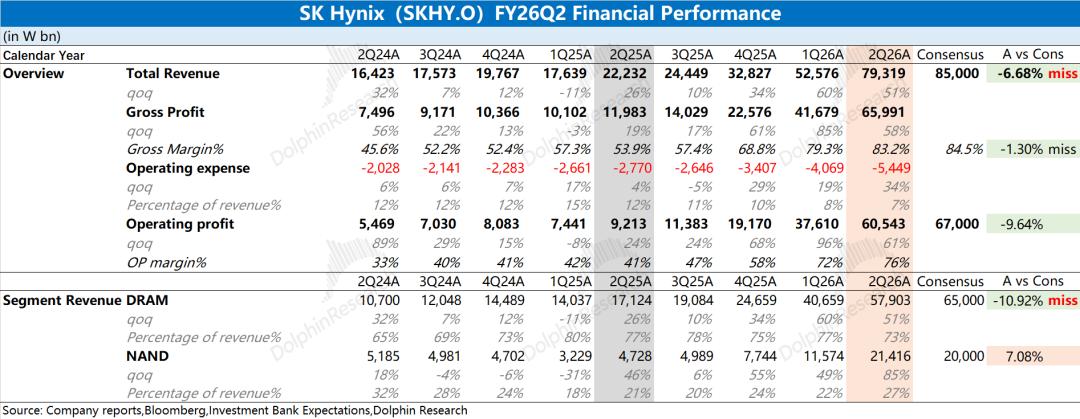
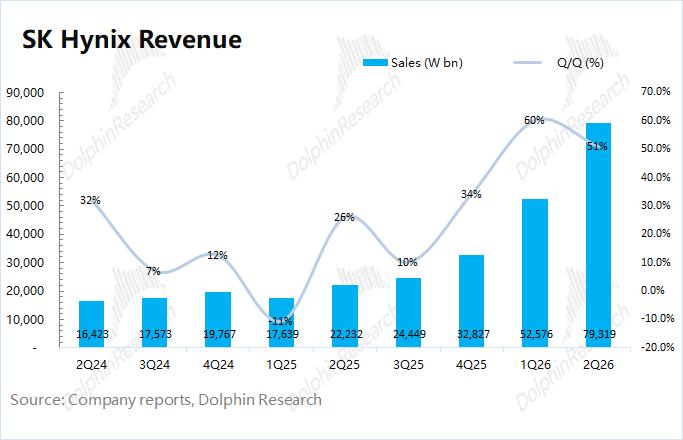
1. Core Metrics: SK Hynix posted revenue of 79 trillion won this quarter, up 51% quarter-on-quarter (QoQ), falling short of market consensus of 85 trillion won. The growth was driven by both DRAM and NAND business expansion, with the core contributing factor being the price hike of memory products.
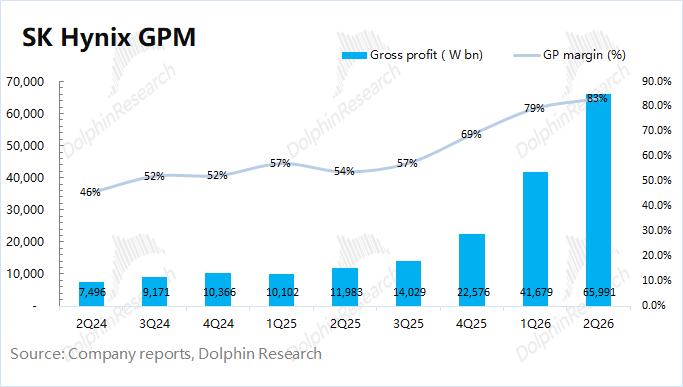
The gross margin for this quarter came in at 83%, below market expectation of 84-85%, which was mainly boosted by rising prices of DRAM and NAND products. As the company's gross margin has already exceeded 80%, there is relatively limited room for further upward movement.
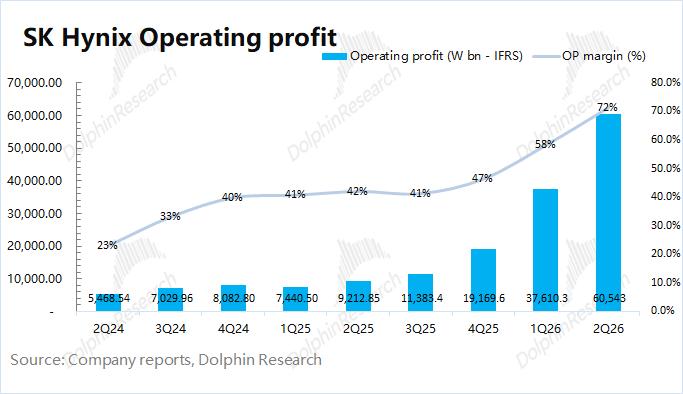
2. Core Operating Profit: SK Hynix recorded core operating profit of 60.5 trillion won this quarter, up 61% QoQ, lower than market expectation of 67 trillion won. The growth was primarily driven by robust revenue increase and gross margin improvement.
The company's core operating expenses (R&D expenses + SG&A expenses) stood at 5.4 trillion won this quarter, up 34% QoQ. Against the backdrop of substantial revenue growth, the core operating expense ratio for the quarter dropped to 7%.
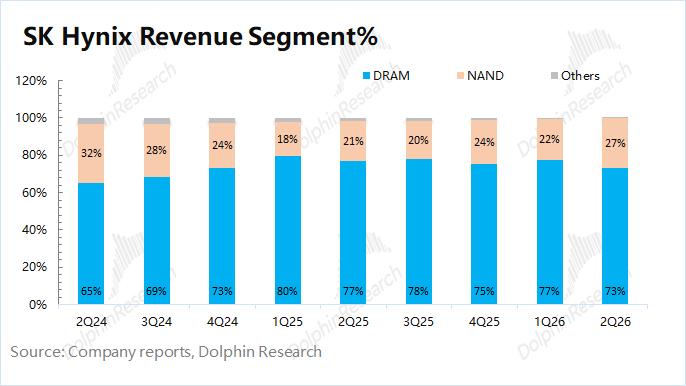
3. Business Overview: All of the company's businesses are centered on the memory sector, with almost all revenue coming from DRAM and NAND.
a) DRAM Business: Revenue reached 57.9 trillion won this quarter, up 42% QoQ. Unit shipments rose by roughly 8% (high single-digit) QoQ, while prices increased by around 30% QoQ, far lower than the traditional 55% QoQ growth of DRAM in the second quarter. This is because the company previously shifted production capacity to HBM, leaving relatively low exposure to traditional DRAM.
HBM Development Progress: HBM4 started shipping in the second quarter, with production capacity ramping up in the second half of the year; HBM4E has already been sampled to clients in the first half of the year.
b) NAND Business: Revenue hit 21.4 trillion won this quarter, up 85% QoQ. Unit shipments grew by 15% QoQ, and prices rose by over 50% QoQ, in line with the price increase of the NAND market.
Dolphin Research's Overall View: Past earnings are old news, the sustainability of performance is what matters now
Against the backdrop of widespread expectations for sharp memory price hikes, SK Hynix's latest earnings report is underwhelming, with both top-line performance and gross margin falling below market expectations.
Specifically, the miss in SK Hynix's latest earnings report mainly comes from the DRAM business (accounting for over 70% of total revenue). SK Hynix's DRAM business grew 42% QoQ this quarter, with shipments up by a high single-digit rate (around 8%), and the average selling price (ASP) of DRAM products rising by roughly 30% QoQ.
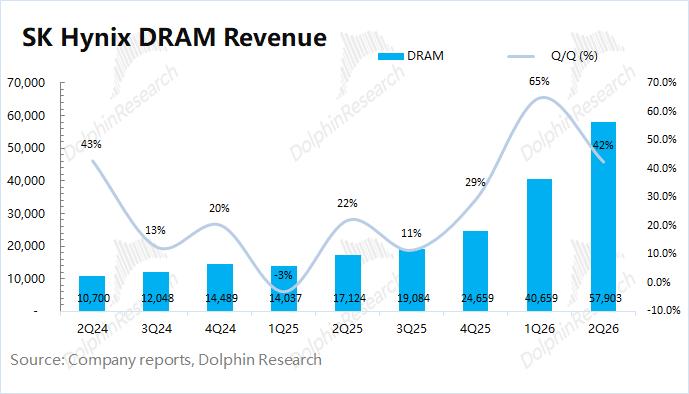
Compared with the over 50% QoQ growth of traditional DRAM market prices in the second quarter, SK Hynix's ASP increase is clearly weaker. This is because SK Hynix previously diverted more production capacity to the HBM sector, resulting in the company having relatively low exposure to traditional DRAM, and the recent price hike effect failed to drive its performance to meet market expectations.
The company's full-year guidance (in line with expectations): ① 2026 DRAM shipments will increase by around 25% year-on-year (YoY); NAND shipments will grow by roughly 18% YoY; ② 2026 capital expenditure will reach around 40-45 trillion won, equivalent to roughly 300 billion U.S. dollars, which matches market expectation of 42-45 trillion won.
The 10% post-market drop is a direct response to the company's underperforming results this time. The subsequent rebound is mainly due to the company's first official confirmation in the presentation that LTA includes prepayment and other financial mechanisms, though no specific amount has been disclosed yet (Micron has disclosed prepayments and RPO).
New LTA information from SK Hynix's earnings report: The company has signed 10 LTA agreements that include deposit terms (first official confirmation), covering core clients with a typical contract term of 5 years. Terms vary across different clients and different products.
Beyond SK Hynix's latest earnings report, the current main focus of the market is:
1) The long-term sustainability of AI Capex
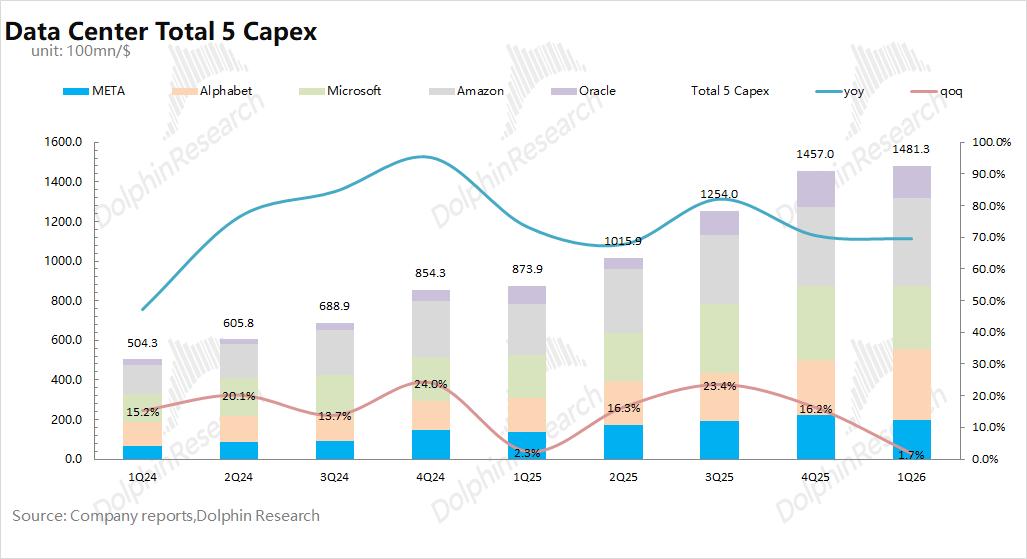
Memory is a key link in this round of AI Capex chain, and CSPs are the main "final payers". Mainstream institutional expectations for the 2026 capital expenditure of the top 5 CSPs (Google, Meta, Microsoft, Amazon, Oracle) have risen to over 800 billion U.S. dollars, up 82% YoY. After three consecutive years of high growth, the market has started to worry about the sustainability of AI capital expenditure.
Google released its Q2 earnings report last week, and although the company raised its full-year capital expenditure guidance to 195-205 billion U.S. dollars (previous guidance was 180-190 billion U.S. dollars), this increase (around 10 billion U.S. dollars) only meets market expectations. The market mostly attributes this growth to memory price hikes, rather than a real improvement in AI demand expectations.
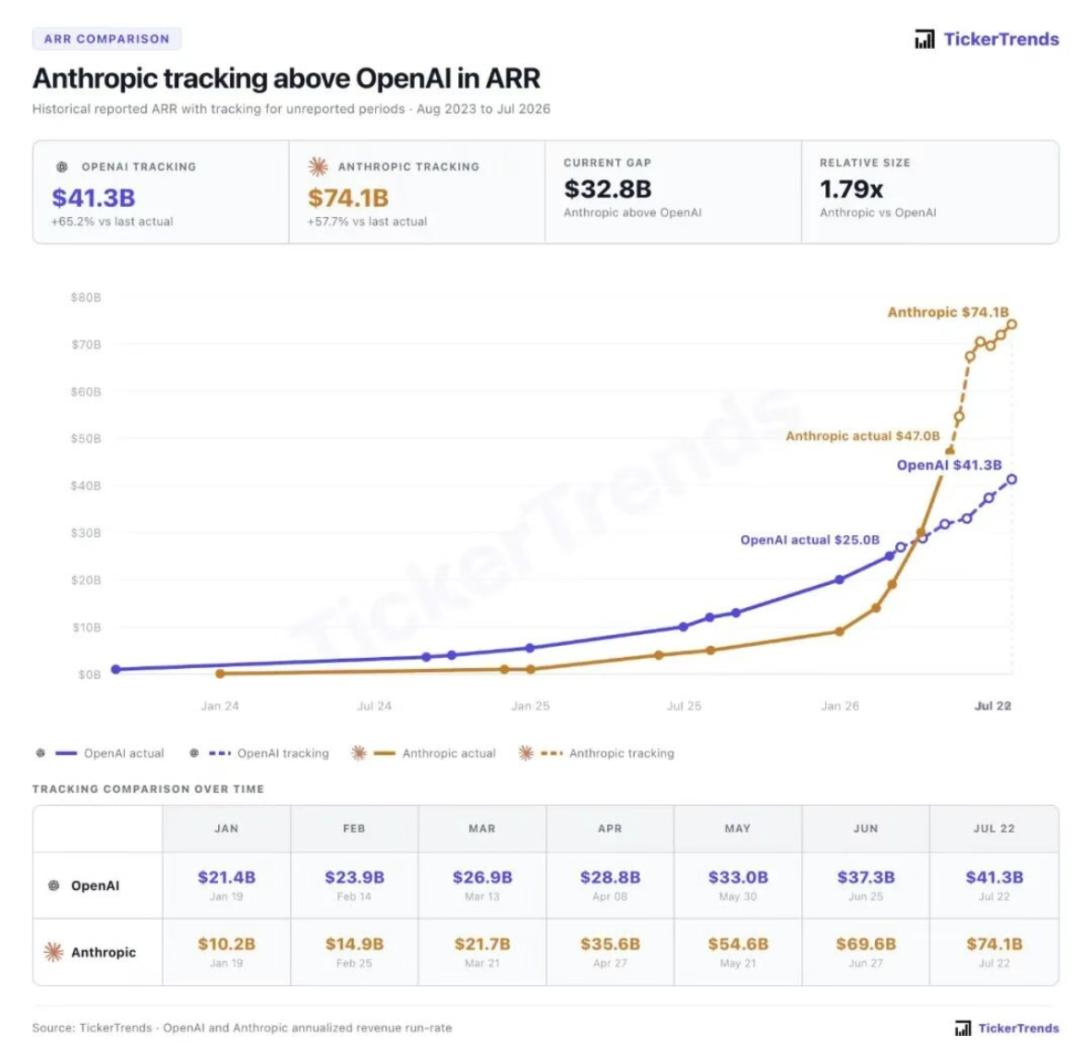
Coupled with the impact of events such as Meta's computing power outsourcing and the release of the K3 model, the market's concerns about the decline of Token prices and the economic feasibility of models in the future have further intensified. Especially according to the latest data tracked by TickerTrends, Anthropic's ARR is still growing, but the growth slope has started to slow down. Against the backdrop of slowing ARR growth of mainstream large language models, the market will further assess the economic returns, and worry that major tech firms will become more cautious with their AI Capex.
2) Divergences remain on the peak of memory cycle, but the downward growth slope is a market consensus
The sharp price hikes of memory are actually resisted by downstream clients (mobile phone makers, major CSPs). Recently, vendors including OPPO and Vivo have begun to refuse to accept price increases. A large share of the profits in the industrial chain has been taken by memory manufacturers (their gross margin has risen above 80%), which is "unhealthy" in itself, indicating that the memory industry is still unable to break away from its cyclical nature.
Divergences on the memory cycle:
a) Some mainstream institutions expect memory prices to decline in the second half of 2027: Major memory manufacturers have significantly raised their capital expenditure plans. Dolphin Research estimates that the 3 leading memory makers' capital expenditure in the memory sector will exceed 95 billion U.S. dollars in 2026, up over 30% YoY. The accelerated investment from original manufacturers may lead to earlier capacity release and bring forward the arrival of the downward cycle.
The relatively optimistic view is that LTA can weaken the cyclicality and delay the downward cycle: The market expects SK Hynix's LTA to lock in 60-70% of its volume and price for the next 5 years, with the typical 5-year term structured as 2+3 or 3+2: the price is fully fixed in the first 2-3 years, and partially floating in the later 2-3 years.
LTA can improve the visibility of the company's earnings to a certain extent, but it does not cover most of its production capacity after all. If the company's management can release more incremental information on LTA (such as renewed enhanced LTA, higher capacity coverage, and the amount of financial guarantee), it will boost market confidence (providing downside protection when the cycle goes down).
Compared with the divergences over the memory cycle, the downward slope of memory growth has become a market consensus. According to TrendForce data, the ASP of memory products in 2026 saw a 90%+ QoQ increase in Q1 and a 50%+ QoQ rise in Q2, while the market only expects a roughly 15% QoQ price increase in Q3. The slope decline from 90% to 50% and then to 15% will further aggravate the market's concerns about the downward memory cycle.
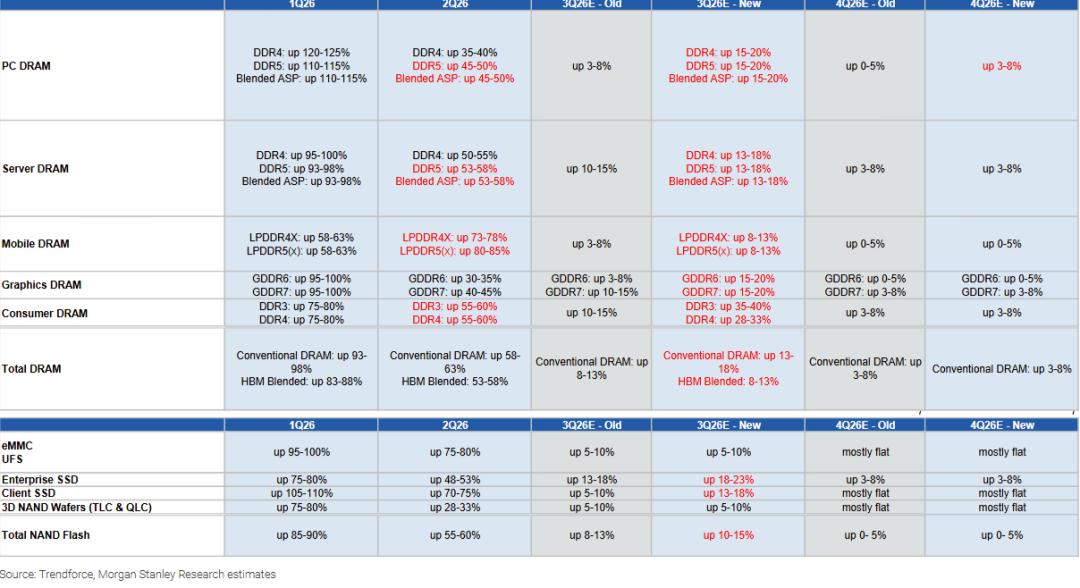
Most current mainstream institutions expect memory prices to start declining in the second half of 2027, and the market is concerned about whether the company can deliver more stable performance when the cycle goes down, which brings the focus back to the LTA agreements signed by major manufacturers.
In terms of LTA, Micron, which has the "U.S. local advantage", is the most proactive and dominant among the three leading memory makers, leading to its valuation being significantly higher than that of SK Hynix.
① Price locking capability: Micron has set both price caps and floors to secure its profit margin. The market believes that SK Hynix's LTA adopts a fixed price in the early stage and a flexible pricing mechanism in the later stage.
② Financial guarantee disclosure: Micron has disclosed 22 billion U.S. dollars of financial guarantees and the RPO (Remaining Performance Obligation) amount from clients. SK Hynix mentioned in this earnings report that LTA includes deposit clauses, which boosted confidence after market hours (the stock price rebounded from a 10% drop to positive), but the company's management did not disclose specific amounts and details in the subsequent earnings call (the stock price turned negative again).
Overall, under the current fragile AI market backdrop, SK Hynix's underwhelming performance will further shake market confidence. Mainstream institutions currently expect memory prices to decline in the second half of 2027, and the company's current 4x PE is priced in such a scenario. Amid concerns over the downward cycle, even the historically low valuation is not safe (if memory prices decline earlier than expected, it will reduce earnings and push up PE indirectly).
Judging from the second derivative of memory price changes, the skyrocketing phase of the memory industry is over. Compared with the current quarterly results, the market cares more about the company's ability to secure LTA agreements to fend off downside cyclical risks. The company mentioned in this earnings report that its LTA includes deposit terms (new incremental information), but the management did not give specific amounts and details in the subsequent earnings call.
Compared with Micron, which has clearly released specific data on prepayments and RPO, SK Hynix's LTA is obviously weaker, which is hardly enough to boost market confidence and narrow the valuation gap between SK Hynix and Micron.
For the full set of data charts related to SK Hynix's earnings report, please refer to the following:
This article is from the WeChat official account "Dolphin Research" (ID: haituntouyan), author: Dolphin Analyst, republished with authorization from 36Kr.