Elon Musk's two core assets are currently under simultaneous scrutiny from the market.
On July 29, SpaceX's stock price once dropped to $107.01 in intraday trading, down more than 20% from its IPO issue price of $135, and down more than 50% from its post-listing peak of $225.64.
Calculated based on the peak valuation of about $2.6 trillion in the early stage of listing, SpaceX's market value has evaporated by approximately $1.2 trillion, which is equivalent to losing the entire Tesla.
On the other side, the day after Tesla released its second-quarter financial report, Tesla's stock price closed 14.52% lower at $319.69, marking its largest single-day drop in more than a year; the company's market value evaporated by about $2145 billion (about 1.5 trillion RMB) in a single day, making it the worst-performing constituent stock of the S&P 500 index on that day. As of now, Tesla's stock price has not rebounded, still about 18% lower than before the financial report was released.
If we only look at revenue and delivery data, this financial report is not bad. In the second quarter, Tesla delivered 480,126 vehicles globally, hitting an all-time high for the same period; its revenue reached $28.24 billion, a year-on-year increase of 26%, which also exceeded market expectations.
However, the focus of the market has changed: due to the continuous increase in investment in AI, Robotaxi, Optimus and related infrastructure, Tesla's capital expenditure in the second quarter reached $5.8 billion, and free cash flow turned to -$1.1 billion — this is the first time the company has recorded a negative quarterly free cash flow in more than two years. At the same time, the company maintained its full-year capital expenditure guidance of more than $25 billion.
In addition to cash flow, there are two other pieces of information worthy of attention.
According to the split calculation of the cumulative paid passenger mileage disclosed in Tesla's financial report, the Robotaxi fleet added about 700,000 miles of paid operating mileage in the second quarter of this year, which is lower than the about 1.1 million miles in the first quarter, a month-on-month drop of about 36%.
At this quarter's earnings call, when Musk talked about the Cybercab deployment plan, he said that Tesla will first use Cybercab test vehicles equipped with steering wheels and pedals to accumulate driving data, and then gradually expand the deployment of the steering wheel-free version. This shows that although Tesla currently has about 10 million vehicles on the road continuously collecting real road data, Cybercab, as a new vehicle platform, cannot directly rely on the data of existing models, and still needs to complete data accumulation and verification for its own platform.
The capital market is willing to give Tesla a valuation much higher than traditional automotive companies, largely not because of how many cars it sells, but because of the belief that Robotaxi and Optimus can drive the next stage of growth. Among them, one of the most important logics of Robotaxi is that Tesla can rely on nearly 10 million cars to continuously collect real road data, continuously strengthen its autonomous driving capabilities, and eventually form a data flywheel that continuously reinforces itself.
The problems exposed this time have made the market begin to doubt: To what extent can the data flywheel that Tesla has long emphasized support the future of Robotaxi?
A
Robotaxi has always been one of the most important narratives in Tesla's valuation system.
This narrative is built on a very simple logic: Tesla has the world's largest fleet of smart cars.
As of the second quarter of this year, the company has about 10 million cars continuously running on roads around the world, and the number of global paid FSD (Full Self-Driving) users is close to 1.5 million. Every day, a large amount of real road data is continuously transmitted back to train autonomous driving models.
Musk has also emphasized many times that Tesla's real competitive advantage is not lidar, nor high-precision maps, but this fleet that continuously generates real driving data. Once enough data is accumulated, FSD capabilities will continue to improve, eventually forming a Robotaxi network, which will then attract more vehicles to join and generate more data, forming a continuously reinforced data flywheel.
According to this narrative, as real road data continues to increase, Robotaxi should enter a stage of continuous expansion.
However, according to the split of the cumulative Robotaxi mileage data disclosed by Tesla, analysts found that the new paid mileage in the second quarter was about 700,000 miles, down about 36% from the about 1.1 million miles in the first quarter.
It should be noted that what Tesla showed in this financial report is the cumulative paid operating mileage of Robotaxi, not quarterly operating data — from the chart, the cumulative mileage is still rising, and the Robotaxi business seems to maintain growth. In other words, the cumulative data masks the change in quarterly operating rhythm, while the split quarterly data presents a different picture.
Robotaxi has always been described as a business that can continuously reinforce itself relying on the fleet, data and operating scale: as the number of covered cities increases and the number of vehicles expands, the paid mileage and real road data should also grow accordingly. However, the operating data for the second quarter shows that this narrative has at least not been steadily fulfilled at the expected pace.
At the same time, a response from Musk at this earnings call added a premise to this story that had not been fully discussed before.
When talking about the Cybercab deployment plan, he said that Tesla will first use Cybercab test vehicles equipped with steering wheels and pedals to continue accumulating driving data and complete calibration for the Cybercab chassis, before rapidly expanding the deployment of the steering wheel-free version.
Although any autonomous driving company needs to complete testing and verification for the new platform when launching a new model, when this judgment falls on Cybercab, it is difficult not to trigger the market's reflection on valuation.
After all, for Tesla, Cybercab is not an ordinary model.
When Cybercab was released in 2024, Tesla gave it a very clear positioning: it has no steering wheels and pedals, and is a model specially built for fully autonomous driving operations. Musk predicted at the time that Cybercab would be priced below $30,000 and start production in 2026.
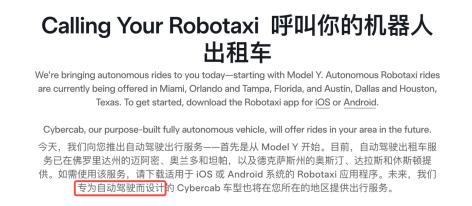
More importantly, Cybercab carries Tesla's vision for the final form of Robotaxi. As early as the 2019 Autonomy Day, Musk proposed that the real Robotaxi in the future will no longer need steering wheels and pedals ("There will not be steering wheels, pedals."), and the vehicles can independently receive orders, pick up and drop off passengers, and complete the entire operation process without the participation of human drivers.
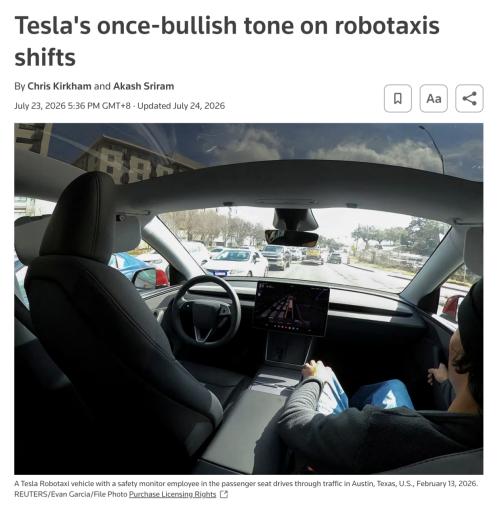
In contrast, the Model Y that currently operates Robotaxi services in Austin still retains steering wheels and pedals, and each vehicle is equipped with a safety supervisor. The operating model is still significantly different from the final form envisioned by Musk.
In other words, the current Model Y Robotaxi is more like verifying the Robotaxi operation system; while Cybercab is the core carrier that Tesla hopes to truly realize the driverless business model.
That is precisely why Musk's statement that "Cybercab still needs to re-accumulate exclusive driving data" is particularly worthy of attention.
It shows that the real road data accumulated by Tesla for nearly ten years cannot allow Cybercab to skip the verification stage directly. The transition from Model Y to Cybercab is not a simple software migration. For Tesla, which has always emphasized the "data flywheel", this means that the data it has accumulated cannot be copied to each new generation of platforms infinitely and cost-free.
For the capital market, this means that the fulfillment timeline of Robotaxi may have to be pushed back further.
In fact, this is not the first time the market has waited for Tesla to deliver on its Robotaxi promises.
In 2019, Musk once said that 1 million Robotaxis would be put into operation by the end of 2020; in the following years, he repeatedly predicted that Tesla would achieve real driverless driving in the next year. However, it was not until 2025 that Tesla launched a limited-scale Robotaxi operation in Austin, USA, and it is still in the expansion stage of a small fleet in a few cities.
The promises Musk has drawn are starting to feel unfulfillable.
B
The slowdown in Robotaxi expansion is only part of the test facing Tesla's valuation logic.
In the past few years, the reason why Tesla has long obtained a much higher valuation than traditional automotive companies is not just that it can produce and sell electric vehicles. What really opens up room for imagination is the new business represented by Robotaxi, Optimus and AI capabilities.
These businesses have not yet generated large-scale revenue and profits, but are considered likely to reshape transportation, labor and manufacturing in the future.
Musk has described Robotaxi and Optimus as Tesla's most important future businesses for many years. In 2024, he even said that Optimus is expected to bring Tesla to a value scale of $5 trillion; the new compensation plan announced in 2025 further lists 1 million Robotaxis, 1 million Optimus units, as well as profit and market value targets as core assessment indicators.
In other words, Tesla's valuation is no longer based solely on how many cars it sells today, but on how much profit these new businesses can ultimately generate.
But now, these narratives are gradually moving from concept demonstration to commercial verification stage.
Robotaxi has begun to provide paid services. What the market wants to see is no longer just whether vehicles can complete autonomous driving, but also whether the fleet can continue to expand, whether operating mileage can accelerate growth, and when this service can generate real revenue and profits.
The test faced by Optimus is more direct.
In 2024, Musk said that he hoped more than 1,000 Optimus units would complete "useful work" in Tesla's factories by 2025; then he further set a target of producing 10,000 Optimus units in 2025. However, as of the second quarter of this year, Optimus is still mainly used for internal training, data collection and function development.
Tesla said in its latest financial report that the first-generation Optimus production line is being installed, and official production is expected to start later this year; Musk also reminded that early production will be very slow because many of the robot's about 10,000 parts require redesigned supply chains.
In other words, what the market can see so far is still mainly action demonstrations, production plans and long-term capacity targets. Optimus has not yet reached the commercialization stage that can be measured by orders, selling prices and gross profit margins.
At the same time, AI as a production capacity has also begun to be included in Tesla's ROI management.
According to previous reports from The Information, Tesla has limited the cost of employees using external AI tools to $200 per person per week starting from July 6, and additional approval is required for exceeding the quota. This measure shows that even in this company that emphasizes AI the most, external AI tools have begun to be included in cost management: usage itself is no longer equivalent to productivity, and investment needs to justify its returns.
The change in the focus of the capital market is directly reflected in shareholder questions.
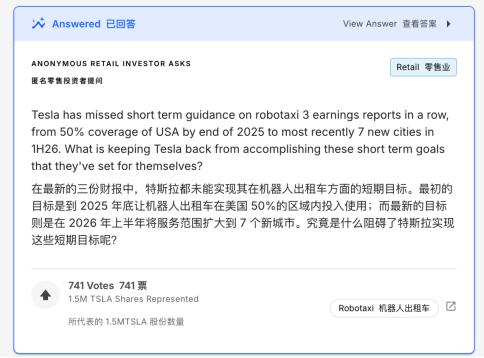
On Tesla's official investor Q&A platform, the question that received the highest number of votes this quarter directly points to why the company failed to meet the short-term guidance of Robotaxi for three consecutive times. This question received 741 votes, representing about 1.5 million Tesla shares.
Previously, the capital market has been valuing Musk based on "the future"; but now, the market is starting to reprice Musk's future based on "the speed of fulfillment".
It is precisely under this background that the discussion about whether Tesla and SpaceX will merge has suddenly changed from a long-standing assumption to one of the most concerned issues at this earnings call.
When asked if the two companies could merge, Musk did not directly deny it. He said that the cooperation between Tesla and SpaceX is increasing, but the merger of the companies is not suitable for discussion on the earnings call and must go through proper procedures. Tesla's general counsel later also called SpaceX an important partner of Tesla, and said that the two sides already have a number of mutually beneficial transactions.
The reasons given by those who support the merger are not difficult to understand: Tesla and SpaceX have already cooperated in areas such as batteries, manufacturing technology, artificial intelligence infrastructure and the chip factory Terafab. JPMorgan Chase believes that the operational integration of the two companies is quite in-depth, and the sharing of engineering talents, AI infrastructure and Musk himself may create conditions for a future merger. Gwynne Shotwell, president of SpaceX, also once said that integrating the companies may help simplify the management of Musk's portfolio of enterprises.
However, considering the reality, the two companies are in different value cycles. SpaceX has a more mature business and more concentrated control, while Tesla is a publicly listed company with a wide range of public shareholders. If the transaction pricing favors either party, shareholders of the other party may feel that they are paying for Musk's overall strategy.
As for whether the merger can really happen, that is another question — the key is that this discussion itself has sent a noteworthy signal: The capital market has begun to re-examine the value of other assets under Musk's control, and whether these assets can provide more solid support for Tesla's future.
The current situation is that several core businesses that Musk relies on to support Tesla's future valuation have not been fulfilled at the pace previously expected by the market.
C
For a company whose market value has long been built on future expectations, when a business enters the commercialization stage, the market begins to focus on revenue, profit and cash flow, and is no longer satisfied with technical demonstrations and visions, which is an inevitable process.
The future must eventually be delivered, which is the very meaning of the existence of the capital market.
But the capital market can easily ignore another thing: Fulfillment itself is the thing that takes the most time.
Looking back on Musk's entrepreneurial career over the past 20 years, the capital market has always overestimated the speed, while Musk has always stretched the timeline.
In 2017, Tesla fell into the famous "Production Hell" due to the ramp-up of Model 3 mass production, and its free cash flow continued to be under pressure. The market once worried whether the company needed to raise funds again, or even whether it could survive. Musk later recalled that Tesla was only a few weeks away from bankruptcy at that time.
In the following years, the Berlin Gigafactory and Texas Gigafactory were built one after another, Tesla's capital expenditure remained at a high level, and its free cash flow also fluctuated significantly. It was not until the Model 3 and Model Y completed large-scale production and the energy storage business gradually expanded that the company returned to a stable cash flow stage.
The development of SpaceX is the same.
The first three launches of Falcon 1 all failed; Falcon 9 went through years of iteration to establish a stable reusable capability; Starlink gradually became one of the most important sources of revenue for SpaceX after launching thousands of satellites continuously and years of capital investment.
For Musk, negative free cash flow is not the first time it has happened.
Very often, negative free cash flow is not the end of the story, but the most expensive stage before the story is fulfilled.
This is also the most special part of Musk's business model: he does not tell all the stories at once and then wait for them to be fulfilled at the same time; instead, he constantly uses the already fulfilled business to support the unfulfilled