Taobao Convenience Store is expanding its business territory.
A year after the end of the food delivery war, the battlefield of instant retail is shifting from the subsidies visible to consumers to the warehouse-stores distributed across cities.
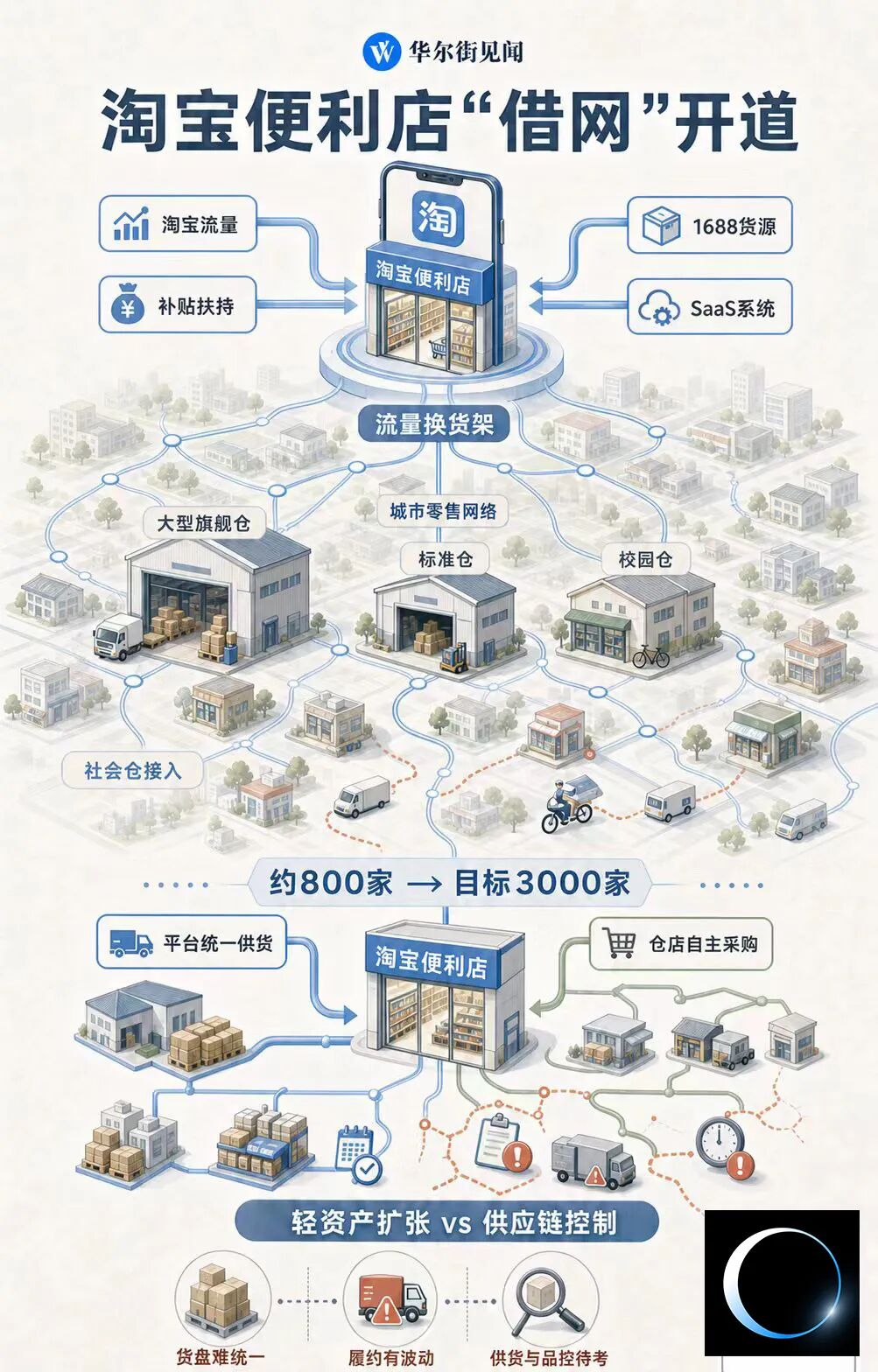
When counting stores in the renovation period and operation ramp-up period, the online supermarket format "Taobao Convenience Store", which was launched less than 9 months ago, has been set up in about 800 locations.
This scale is already at a similar level to "Squirrel Convenience", the lightning warehouse business under Meituan.
The goal of Taobao Flash Purchase goes far beyond that. The store expansion target of "Taobao Convenience Store" by the end of the fiscal year in March 2027 is 3,000 stores.
However, what Taobao Flash Purchase aims to build is not a traditional convenience store network that relies on foot traffic from the streets.
All-weather Tech has learned that "Taobao Convenience Store", the online supermarket-style instant retail format under the Taobao Flash Purchase system, currently has an average of over 10,000 SKUs planned per main warehouse, covering categories including daily necessities, alcohol and snacks, beauty and personal care products, etc.
This type of online supermarket-style flash purchase warehouse mainly undertakes online orders, and realizes 30-minute delivery through scattered layout and pre-stocking in the city.
Compared with traditional convenience stores, its operation relies more on commodity turnover, inventory management and fulfillment efficiency.
However, Taobao Flash Purchase does not focus on undertaking the operation links, but hands over site investment, stock preparation and daily operation to cooperative merchants and service providers, to access the existing socialized warehouse and distribution network of instant retail in a "light asset" manner.
This model allows Taobao to quickly make up for the near-field supply at a relatively low cost, but whether a warehouse network operated by partners can form a stable commodity portfolio and fulfillment capability remains to be verified.
Exchanging Traffic for Shelves
Although Taobao Convenience Store is named after "convenience store", it is a different business from ordinary roadside convenience stores.
A person close to Taobao Flash Purchase revealed that Taobao Convenience Store was launched in October 2025, mainly expanding stores in collaboration with regional merchants. The platform provides merchants with category planning, pricing guidance, product selection capability and supply chain support, while service providers undertake investment attraction and subsequent operation support in some regional cities.
Taobao Convenience Store does not have a fixed appearance.
In Beijing, it may be a flash purchase warehouse hidden in a non-street-facing location that only takes online orders; in county towns, some merchants have opened retail complexes of hundreds of square meters, adding ready-made food formats such as tea drinks and cooked food in addition to packaged food and daily necessities.
Behind the "thousand stores with thousand faces" is the extremely open, even slightly loose cooperation mode of Taobao Flash Purchase.
Taobao Flash Purchase currently mainly provides four types of resources: traffic entrances brought by the Taobao App and multiple ecological positions, supply sources including 1688 and brand co-branding, Aoxiang SaaS system and dedicated operation docking, as well as a number of support measures including special funds.
Partners retain great autonomy in operation: they can not only "join with their existing stores", but also access competing platforms such as Meituan and JD at the same time.
For merchants who already operate lightning warehouses or supermarket convenience stores, after meeting the audit standards of Taobao Convenience Store, they only need to access the system, adjust part of the commodity structure and add the online store entrance to complete the initial transformation.
The publicity caliber of investment promotion staff for potential franchisees is more direct: "Friends who have already opened other lightning warehouses or supermarket convenience stores can upgrade to Taobao Convenience Store for free and get subsidies."
Taobao Convenience Store also reduces the operation pressure of merchants through account period and fee exemption.
Investment promotion information shows that some commodities can enjoy an account period of up to 98 days, where merchants sell goods first and settle payment later; it also provides commission exemption, logistics discounts and digital tool support.
Taobao Flash Purchase hopes to use the 1688 and Tmall brand resources to provide the warehouse-stores with a screened commodity pool, reducing the cost for operators to find suppliers and test new products.
However, considering that the same set of commodity portfolio may not be suitable for all regions, service providers and warehouse-stores can still add regional commodities according to local consumption habits.
The above-mentioned person close to Taobao Flash Purchase told All-weather Tech that the profitability of Taobao Convenience Store relies more on the expansion of the transaction scale of the entire ecosystem and the improvement of operation efficiency, rather than charging high fees from individual merchants or passing on costs to them.
For merchants, this is a low-threshold access solution.
From Taobao's perspective, it uses traffic and subsidies in exchange for shelf scenarios that are physically closer to consumers.
According to the platform's investment promotion plan, Taobao Convenience Store currently plans three types of warehouses: flagship warehouses of over 800 square meters, standard warehouses of over 400 square meters, and campus warehouses of over 150 square meters.
According to *Retail Business Finance*, standard warehouses need to reserve about 100 square meters, and flagship warehouses need to reserve about 300 square meters, to accommodate 2000 to 3000 brand SKUs coordinated by the platform.
All-weather Tech learned from people close to Taobao Flash Purchase that in the business model of brand consignment sales, cooperative merchants mainly provide storage and sorting services, and obtain service income accordingly, without bearing the inventory risk of corresponding commodities.
Taobao Flash Purchase has previously tried more instant fulfillment of original brand commodities in the near-field scenario.
In September 2025, Tmall launched the "Instant Purchase" service, with more than 260 first batch of brands including Decathlon, Midea and PurCotton accessing Taobao Flash Purchase through flagship stores or authorized exclusive stores.
For example, Decathlon connected its Tmall flagship store with 208 offline stores across the country, with the stores acting as the acceptance points for instant retail orders.
But not all brands have such dense offline outlets. Taobao Convenience Store can play the role of such a front shelf.
Imagine this scenario: at ten o'clock in the evening, a consumer finds that a certain brand of diapers that the family has long used is used up, and there is no same brand and size in the nearby supermarket. This type of demand has clear brand and specification preferences, and it is difficult to find a substitute temporarily.
If this product can be purchased instantly through the brand supply of the lightning warehouse, consumers do not have to wait for the express delivery to arrive the next day.
The value of Taobao Flash Purchase to brand merchants has thus risen, and it has taken a place in the instant retail fulfillment chain of brand commodities.
Differences Between Offense and Defense
Taobao Convenience Store can expand rapidly in a relatively light way, which to some extent takes advantage of the social warehouse network cultivated by Meituan for many years.
In the past few years, Meituan has expanded lightning warehouses to more than 50,000 by relying on traffic, delivery and warehouse opening support. However, most of these warehouse-stores are operated by third parties, and the platform's control over supply is still limited.
After subsidies faded and the industry turned to stock competition, operators are more willing to access new platforms to share costs.
A number of regional merchants told All-weather Tech that under the influence of food delivery subsidies in the past year, the order structure of Taobao Flash Purchase and Meituan in some warehouse-stores has shrunk from the original 20/80 ratio to 30/70, and in some individual regions it is close to 40/60.
For Meituan, it is difficult to form a stable and controllable supply only by relying on traffic and fulfillment. It has begun to shift from expanding the scale of warehouse-stores to strengthening control over commodity portfolios, supply chains and store operations.
In April this year, Meituan upgraded its supply chain service platform "Lightning Help", proposing to improve the commodity portfolio quality, procurement efficiency and operation capability of warehouse-stores;
At the same time, it increases direct control over store operations through strongly controlled brands such as Squirrel Convenience.
Meituan also provides an independent search entrance and discounts for its own convenience brand "Squirrel Convenience" on its main site, and highlights the "official self-operated" label on some store pages.
For Meituan, the value of getting personally involved in operation is not only to increase revenue.
Gu Ben, an early operator of lightning warehouses, told All-weather Tech that as a traffic and fulfillment platform only, although Meituan can see user and order data, it cannot fully grasp the product selection logic of third-party warehouse-stores, and the chain of front-line operation feedback from stores to the platform is also longer.
Through directly operated or strongly controlled stores, Meituan can directly verify product selection and operation methods, and then try to extend the experience to a larger warehouse network.
Meituan has previously tested a similar path on its own alcohol-focused lightning warehouse "Yima Wine Delivery": screening high-frequency products according to order data, then jointly developing channel-exclusive products with wine enterprises, extending its control to procurement and production links.
However, the number of SKUs for alcohol is relatively limited and the standardization degree is high, while the commodity portfolio of comprehensive convenience stores is far more complex.
Gu Ben pointed out to All-weather Tech that part of the current commodity portfolio of Squirrel Convenience is still mainly based on products that have been verified by other leading warehouse-stores, and its ability to independently discover new products and define commodity portfolios has not been fully proven.
Zhang Shukun, a FMCG supplier who has long supplied goods to lightning warehouses, also said that the main reason for lightning warehouses to develop their own brands is to reduce brand premium and increase channel gross profit, but except for categories that are easy to standardize such as water and drinks, most players have not formed the channel awareness and product development capability similar to Hema.
Deeper involvement in store operations will also change the relationship between Meituan and social warehouses.
By the end of March this year, the number of Squirrel Convenience stores has exceeded 700. In the comprehensive convenience lightning warehouse market where thousand-store brands are very few, Squirrel Convenience has ranked among the top in the industry.
Orders of third-party warehouse-stores are highly dependent on the platform. Once Meituan develops its own strongly controlled brands, whether traffic, subsidies and activity resources will tilt towards Squirrel Convenience will inevitably become a concern for operators.
What Taobao Convenience Store takes advantage of is exactly this gap.
It does not need to catch up with Meituan head-on and compete directly in terms of warehouse network scale and fulfillment capability. As long as it attracts social warehouses to access Taobao at the same time with lower access thresholds and the attitude of "not directly participating in operation", it can quickly supplement retail supply.
For Taobao Flash Purchase at the current stage, the expansion of warehouse-store supply is related to both the unit economic model and the retail territory.
Compared with food delivery, retail orders usually have higher unit price and wider categories, which helps to spread the fulfillment cost and improve UE (unit economics).
If instant retail can also increase the opening frequency of the Taobao App, drive advertising, e-commerce transactions and membership consumption, the investment of a single order can also be digested by other value created by users in the Taobao ecosystem.
Stability Remains to Be Tested
Today, Taobao can use traffic and subsidies to attract warehouse-stores that originally served Meituan.
Tomorrow, competitors can also adopt the same method to guide warehouse-stores to invest more inventory, manpower and activity resources in other platforms.
Non-exclusive cooperation relationships, opaque warehouse-store operations, and uneven operation capabilities — these problems that Meituan is trying to strengthen control to solve are also unavoidable tests for Taobao.
Although the commodity loss of lightning warehouses is lower than that of fresh food front warehouses, it does not mean that this is a business that can be operated in an extensive way.
At present, the third-party lightning warehouse market is still relatively fragmented, and one of the reasons is that consumers have limited loyalty to warehouse-store brands.
Users care more about whether there are needed goods nearby, whether the price is low enough, and whether the delivery is fast enough. "We have products that others don't have, and our products are cheaper than others" is still an important competition rule.
This determines that warehouse-stores must not only pursue scale, but also continuously optimize product selection, inventory depth, procurement price and restocking speed. These links exactly require strong coordination capabilities, and are also the most difficult parts to make up for under the weak control model of Taobao Convenience Store.
Gu Ben believes that service providers have uneven operation capabilities, and store performance is prone to large fluctuations. The rapid increase in the number of signed stores does not mean the formation of a stable and standardized supply.
"Warehouse-stores in various regions may adopt different commodity portfolios and procurement channels, so it is difficult to unify commodity prices, inventory depth and restocking efficiency. Some operators may even rely on subsidies to maintain orders and daily operations," said Gu Ben.
The supply system is another test.
Zhang Shukun told All-weather Tech that currently, lightning warehouses generally adopt a mixed mode of central warehouses, regional distributors and express delivery coexisting.
Central warehouses can gather the procurement demands of scattered warehouse-stores, help the platform negotiate directly with brand owners, and then complete restocking through regional allocation.
"For Taobao Convenience Store, building a large central warehouse is the only option to reduce costs," Zhang Shukun said. Without this link, commodities often need to go through regional distributors or distribution logistics, and multi-layer circulation will push up procurement costs and extend the restocking cycle.
However, under the open cooperation mode, the central warehouse cannot cover the entire commodity portfolio of all warehouse-stores.
In addition to the brand commodities coordinated by the platform, warehouse-stores in various regions will still purchase regional brands, local best-selling products and temporarily out-of-stock products on their own. What Taobao Convenience Store actually faces is two coexisting systems: unified supply by the platform and independent procurement by warehouse-stores.
The two systems eventually appear under the same "Taobao Convenience Store" entrance, but consumers will not distinguish who purchased the commodities.
For example, a carton of milk coordinated by the platform can be traced to a unified supplier and product batch; for another product temporarily replenished by the same warehouse-store from a local wholesaler, its purchase certificate, shelf life and storage process need to be recorded by the operator himself.
Once problems such as expired or improperly stored products occur in independently purchased commodities, the actual responsibility may belong to the cooperative merchant, but "Taobao Convenience Store" is still the brand that consumers will first notice and complain about.
For Taobao, which is eager to complete the near-field network, 3,000 stores are only the starting point in terms of scale; how to maintain the standards of supply and quality control without significantly making the model heavier is the real test in the next stage.
This article is from the WeChat official account "All-weather Tech" (ID: iawtmt), written by Liu Yichen, authorized for release by 36Kr.