Consumer Market in H1 2026: Recovering While "Making Waves"
NRI Consumer Panel (affiliated to CTR in China) latest data shows that in the first half of 2026, the sales of China's urban fast-moving consumer goods (FMCG) market decreased by 0.3% year on year, among which the sales in the second quarter rose slightly by 0.8% year on year, and the overall consumer demand is still in a mild recovery stage.
In terms of city tiers, the performance of tier-1 and tier-2 cities remained stable in the first half of 2026, with sales increasing by 0.6% compared with the same period of last year. Affected by the "reverse Spring Festival celebration" and the contraction of gifting channels in the first quarter, lower-tier cities, especially county and town areas, were under obvious pressure. With the fading of festival effects and the return of daily consumption, the sales growth rate in the second quarter rebounded to 1%, surpassing that of tier-1 and tier-2 cities. By region, the sales in the western region increased by 1.3% year on year, while other regions saw declines of varying degrees.
Category performance continues to diverge. The food category has maintained positive growth for two consecutive quarters, with a sales growth rate of 1.8% in the first half of the year, showing obvious rigid demand attributes. The sales volume of the beverage category increased significantly, but due to the decline in the average purchase price, the sales of the beverage category decreased obviously, and the year-on-year decline of the dairy products narrowed in the first half of the year.
Data from the off-home sample group of NRI Consumer Panel shows that in the first half of the year, off-home foot traffic in tier 1 to tier 5 cities across the country increased by 5% year on year, and consumption scenarios in sports venues and schools performed prominently. However, the overall off-home consumption expenditure declined year on year. While returning to off-home scenarios, consumers still maintain rational consumption habits.
Data from the National Bureau of Statistics shows that the growth rate of national service retail sales reached 5.3% in the first half of the year, and service consumption has become a key engine of growth. Offline scenario consumption such as cultural, sports and leisure activities and catering continues to heat up, while off-home FMCG consumption places more emphasis on cost-effectiveness and matching with scenario-based rigid demands.
Offline Channels: Divergence of Business Formats Intensifies
In the first half of the year, the divergence of various business formats in offline channels continued to intensify. The modern channels as a whole continued to face pressure, while formats focusing on people's livelihood rigid demands and high cost-effectiveness accelerated their penetration.
The sales of modern channels (including hypermarkets, supermarkets, and convenience stores) decreased by 2.5% year on year. Among them, the convenience store format saw the most obvious decline, with significantly reduced sales and penetration rate. In contrast, the small supermarket format, which serves as a rigid community supply point, showed strong resilience, with sales increasing by 3.6% year on year.
Among leading retailers, Walmart Group continued to maintain its leading position in the market, with its market share increasing by 1.2 percentage points year on year in the first half of the year. Sam's Club remains the core growth driver. Coupled with Walmart's simultaneous promotion of the intensive launch of community stores and the comprehensive upgrade of private brands, multi-channel collaboration has driven the group's overall penetration rate to rise by 3.7 percentage points.
Hema also delivered a strong performance, with its market share growing by 1.2 percentage points. Hema Fresh optimized consumers' in-store experience by strengthening its lifestyle scenario positioning, and its penetration rate exceeded 11%. Super Box NB accelerated its national market expansion through a prudent store opening strategy, with its penetration rate rising by 1.5 percentage points. By the end of June, the number of operating stores across the country increased from 409 at the beginning of the year to 550.
In the SPAR system, Jiajiayue relied on its advantages in fresh food operation and regional supply chain to maintain its overall market share, achieving a 0.2 percentage point increase in the northern region.
The pressure on traditional supermarkets to transform and upgrade continues to increase. The share of China Resources Vanguard Group and Yonghui Superstores decreased by 0.2 and 1 percentage points respectively in the first half of the year.
Some retailers achieved breakthroughs through differentiated operations. Regional retailer Biyoute gave full play to its supply chain advantages, adhered to the positioning of people's livelihood consumption, and achieved steady sales growth. Jingdong 7FRESH focused on consumers' demand for fresh food quality, deeply integrated online fulfillment and in-store services, and its sales increased by 23% year on year.
Emerging formats maintain an expanding trend. Bulk snack stores are accelerating their penetration into tier-1 and tier-2 cities, with the penetration rate in these cities increasing by 5.4 percentage points. Since 2026, brands such as Haoxianglai and Mingmangmang have accelerated their expansion in tier-1 and tier-2 cities, extending their store layout from outer suburbs to core residential areas. Although lower-tier cities are still the main battlefield, consumers in tier-1 and tier-2 cities have become a new source of increment for the bulk snack store industry.
The discount trend continues to deepen. The penetration rate of discount formats reached 7.8% in the first half of the year. Lehuohou, under Meituan, has laid out stores in multiple cities simultaneously, seizing the market relying on digital capabilities and a mature supply chain system. At the end of June, Super Box NB opened 6 stores in Beijing at the same time, expanding its hard discount market presence in the northern region. Jingdong's hard discount stores expanded outward from northern China, and achieved a penetration breakthrough in the eastern region with its large-store, full-category and high cost-effective format model. Discount has become the core track of the stock competition in offline retail.
Online Channels: Steady Growth, Instant Retail and AI Drive Pattern Changes
Data from NRI Consumer Panel shows that in the first half of 2026, online FMCG sales increased by 9% year on year, and the growth rate of mainstream e-commerce platforms has become increasingly divergent. Driven by content marketing and shelf scenarios, Douyin's penetration rate increased by 2.5 percentage points. Pinduoduo's growth rate accelerated significantly in the second quarter. Relying on its cost-effective brand image and normalized multi-billion subsidies, it further penetrated the consumer market, with its penetration rate increasing by 4.9 percentage points in the first half of the year.
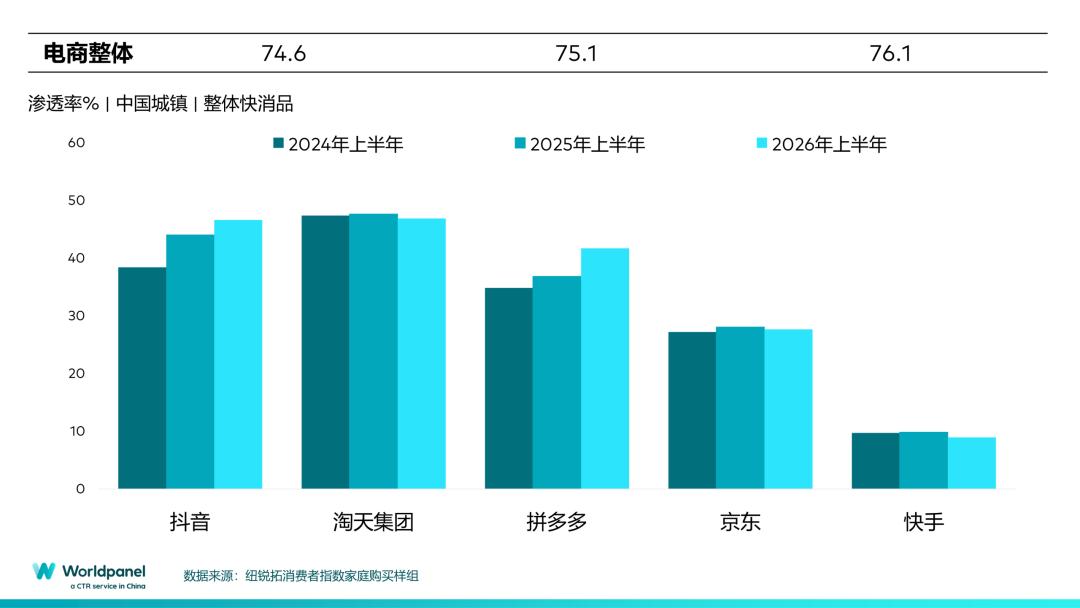
The 618 Shopping Festival, as the core mid-year e-commerce node, is changing its role. Data from NRI Consumer Panel shows that during the promotion period (4 weeks ending June 12) compared with the non-promotion period (4 weeks ending May 15), although sales during the promotion are still growing, the growth rate has slowed down year by year. Normalized promotions continue to dilute the incremental effect of centralized large-scale promotions. In terms of categories, personal care and home cleaning categories performed prominently, and categories with strong stockpiling attributes remain the key categories for the promotion.
2026 is known as the "first year of AI-native shopping festival". Data from CTR Xinghan Mobile User Analysis shows that as of April 2026, Chinese AI apps have covered nearly 900 million users. In this promotion, AI has moved from a back-end auxiliary tool to the front end, embedded in consumers' price comparison, recommendation and payment processes, while assisting merchants' marketing and customer service processes, becoming an important link to drive the efficiency improvement of the promotion.
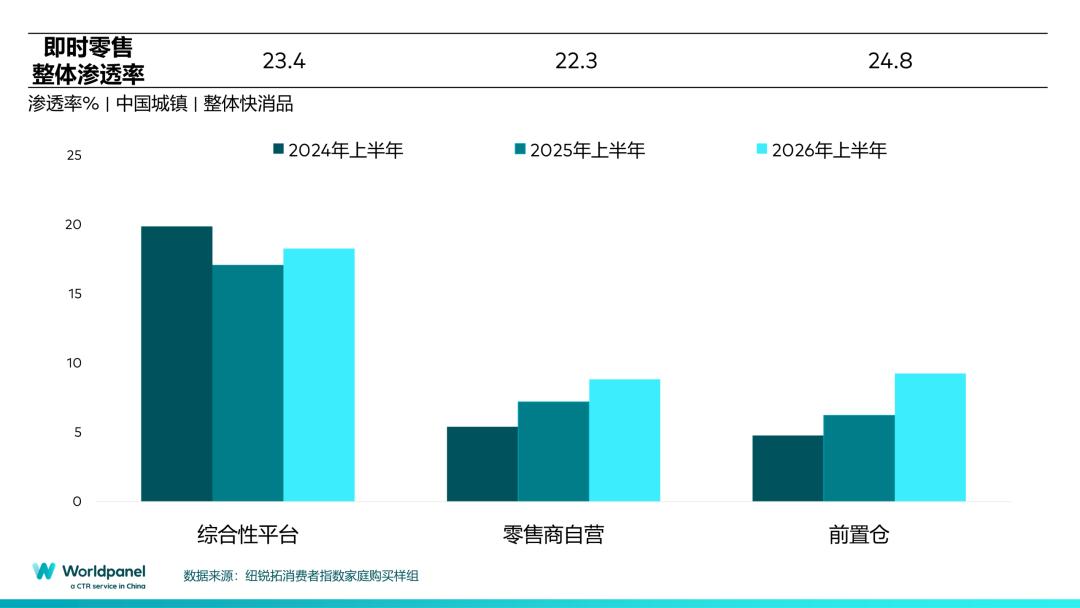
Instant retail (including the front warehouse model, comprehensive platforms, and retailer self-operation) maintains steady growth, with its penetration rate reaching 24.8% in the first half of the year, up 2.5 percentage points year on year. Tier-1 and tier-2 cities are still the core source of growth, and the penetration rates of the three main models have all achieved simultaneous growth.
The comprehensive platform model is represented by Meituan and Taobao Flash Purchase, which relies on a wide range of offline merchants and traffic advantages to achieve rapid expansion across all categories and multiple scenarios. The front warehouse model is represented by Pupu Supermarket and Dingdong Maicai, which consolidates its advantages in core cities with fulfillment efficiency and leads in purchase frequency performance. The retailer self-operation model is represented by the home delivery business of chain supermarkets, which deepens community coverage relying on offline stores and has become an important starting point for the digital transformation of offline retailers.
Private Brands: Quality-to-price Ratio Drives Daily Penetration
The rapid development of private brands has become one of the most notable highlights in the FMCG market. Data shows that in the first half of the year, the sales of retailers' private brands increased by more than 60% year on year, driven by both penetration rate and purchase frequency. More than 53% of urban households in China purchased private brands in the first half of the year, with an average purchase frequency of 4.5 times. Consumers' perception of private brands has changed from "occasional trial" to a regular option in daily shopping.
The penetration rate in tier-1 and tier-2 cities is particularly prominent, exceeding 70%. In terms of categories, the food category still occupies a dominant position. In terms of channels, modern channels are still the main places for consumers to purchase private brands. Offline formats such as supermarkets and membership stores, relying on the advantages of scenarios and supply chains, take up most of the private brand sales.
Among leading players, the sales proportion of Walmart's Great Value and Marketside has increased most significantly. After comprehensive renewal and upgrading, private brands have become an important part of Walmart's format transformation and upgrading. Product development follows three core principles: adhering to simple ingredients, adhering to cooperation with leading brands, and adhering to stable quality-to-price ratio. Combined with the layout of community store formats, differentiated product line distribution is adopted to meet the needs of different consumer groups.
Private brands are being upgraded from "shelf supplements" to the core competitiveness of retailers, becoming a key force to deliver differentiated value propositions and capture consumer mindshare.
Conclusion
In the first half of 2026, China's consumer demand is still in mild recovery, and the performance of various channel formats is accelerating divergence. The structural adjustment of offline channels continues, online channels maintain growth resilience, and private brands have become an important weapon for retailers to seize the market. Consumers' increasing emphasis on shopping experience promotes the scenario upgrading of physical stores and the optimization of instant retail fulfillment. Emerging formats such as bulk snacks and hard discounts accelerate innovation and penetration, and the integration of online and offline ecosystems deepens, continuously reshaping the competitive landscape of the retail market. At the same time, AI technology has penetrated from auxiliary tools to the whole shopping chain, opening up new paths for improving merchant operation efficiency and upgrading consumer experience.
In general, returning to the essence of quality-to-price ratio, deepening differentiated capabilities, and accelerating digital integration remain the core direction for the industry to capture incremental opportunities.
This article is from the WeChat Official Account "CTR Insight", and is authorized for release by 36Kr.