Datong: Cultural Tourism Megahit, Undervalued Commercial Hub?
From the millennium-old ancient capital that served as the political core of the Northern Wei Dynasty and the auxiliary capital of the Liao and Jin dynasties, to the "Coal Capital" that supported the national energy lifeline after the founding of the People's Republic of China, and then to the "viral ancient city" that receives 60 million visitors every year, Datong has gone through multiple identity transitions, leaving unique commercial imprints in every transformation.
The cultural heritage of this millennium-old ancient city is solidified into world-class aesthetic value at the Yungang Grottoes. The coal era has left a solid economic foundation and high consumption stickiness within the acquaintance-based local society. Meanwhile, the renewal of the ancient city, the collaboration between Hanging Temple and *Black Myth: Wukong*, and the viral popularity of the Fo Xiaoban cultural and creative IP have pushed this city to the forefront of national cultural tourism traffic.
But the complexity of Datong lies in the fact that it neither follows the dual-driven development path of industry and cultural tourism seen in cities like Chengdu and Changsha, nor enters a shrinking phase after resource depletion like Hegang and Yumen. It is more of a special case — cultural tourism traffic surges in, while local industries are still going through the pains of transformation; the city sees net outflow of population, but the purchasing power of high-net-worth groups has not left; commercial projects are highly concentrated in the old town, and the existing commercial base is not weak.
The solid underlying foundation is countered by a rigid, unbreakable market structure. The booming cultural tourism traffic can hardly nourish the retail sector in shopping malls; consumers with license plates starting with "Jin B" (Datong's plate prefix) still drive to the outlet malls in Beijing every weekend for consumption.
Recently, Winshang Network conducted on-site visits, multi-party research and big data monitoring, trying to clear the fog and explore the real status of Datong's commercial market: Is it a underestimated commercial lowland, or a charming trap obscured by cultural tourism traffic?
01.
The Misunderstood Urban Fundamentals
Coal Capital Heritage and Cultural Tourism Traffic
Cultural tourism is the facade, while commerce is the underlying foundation. The facade can be propped up by traffic, but the underlying foundation can only be built gradually by population, income and daily consumption. Datong is a city with limited effective consumption scale, severe consumption outflow, and cultural tourism traffic that cannot support local commerce. Its commercial base is far thinner than the bustling night view of the ancient city suggests.
■ Datong is the second largest city in Shanxi Province, but its total economic output (GDP) ranks 8th in the province, lagging behind cities such as Lüliang and Changzhi. Negative population growth has continued for many years, and the main group that has left is young people with the strongest consumption vitality. But on the other hand, a large number of people working in public institutions, the energy industry and "old money" families are settled in Pingcheng District, maintaining stable demand for quality consumption such as watches, light luxury products and automobiles.
■ Coal is the industrial gene engraved into the city, and it is also the core anchor of local consumption. However, Datong has taken the lead in the province and even the whole country in the transformation and development of related industries such as new energy and computing power. There is a new matching opportunity being formed between the consumption logic of these highly educated, high-income young talents and the supply logic of consumer brands.
■ In terms of geographical location, Datong is located at the junction of Shanxi, Hebei and Inner Mongolia provinces. This seemingly easily accessible location has turned it into a "consumption lowland" that is siphoned by surrounding strong cities. After the opening of the Beijing-Zhangjiakou High-Speed Railway, the travel time from Datong to Beijing has been shortened to less than two hours.
■ The outbreak of cultural tourism traffic has not naturally turned into dividends for local commerce. Tourists' consumption is highly concentrated on tickets, accommodation and characteristic catering, and rarely spills over to the retail formats in shopping malls. More importantly, cultural tourism traffic has a strong tidal effect: it is extremely crowded in peak seasons, but long and quiet in off-seasons.
We can use a "Cultural Tourism City Spectrum Matrix" to more clearly locate Datong's position, with the cultural tourism dependence as the vertical axis and the local industry support as the horizontal axis, different cities fall into four completely different quadrants:
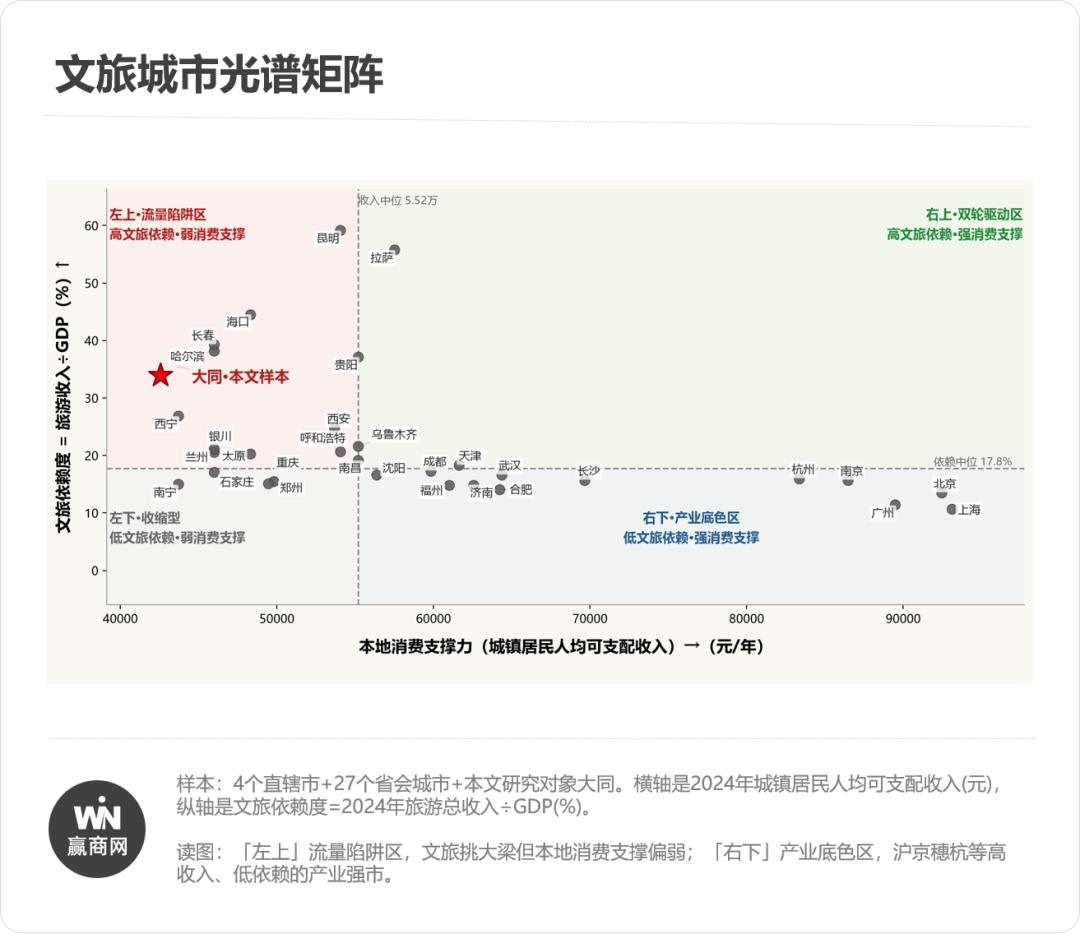
The 62 million traffic is more like the moon reflected in the water — visible but untouchable, charming but hard to monetize. Objectively speaking, Datong is stuck in the middle stage of resource-based city transformation. On one hand, it maintains stable consumption resilience relying on the coal industry base and the transformation and development of related industries; on the other hand, it is moving forward wrapped in the aura of cultural tourism traffic, presenting a highly contrasting "semi-mature" commercial state.
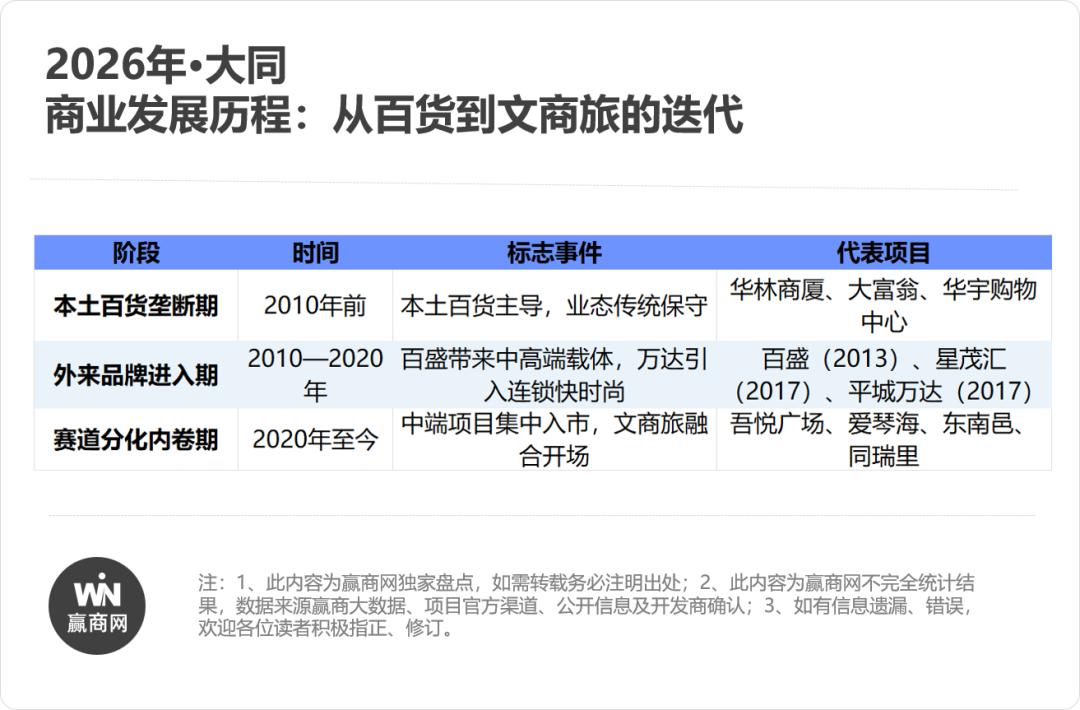
Under the interweaving of these forces, Datong's commercial evolution history has completely replicated all paths of commercial iteration in China's third- and fourth-tier cities, and finally formed a differentiated branch due to the intervention of cultural tourism. The whole process can be roughly divided into three stages:
02.
Supply and Demand Debate
Datong's Commerce: Oversupply or Undersupply?
The problem of Datong's commerce has never been a quantity problem, but a quality problem. The official statistics based on the overall carrying capacity of the city and the industry's judgment based on the quality of effective supply are not contradictory. Instead, they accurately outline the core contradiction: the digestion of old and inefficient supply is slow, and there are no sufficient conditions for new high-quality supply to land.
When we shift our focus from urban fundamentals to the specific commercial market, the most core and controversial cognitive divergence emerges.
In December 2023, the Datong Municipal Bureau of Commerce clearly stated in its official reply to the proposal of the Municipal Political Consultative Conference: The commercial real estate in the central urban area is oversupplied, far exceeding the international standard warning line of 1.2 square meters of commercial real estate per capita in first-tier cities. With the potential incremental supply and community commercial area added, the total volume has reached a saturated state.
But in the perception of local consumers and industry practitioners, high-quality commerce in Datong has always been scarce. There are very few options for high-quality malls that gather chain brands, or differentiated social scenarios, and mid-to-high-end consumption eventually flows to Beijing and Taiyuan.
The two seemingly opposing conclusions are actually based on two completely different statistical calibers. Behind the divergence lies the most essential structural contradiction of Datong's commerce.
Horizontal Comparison Across the Province: Datong Is Not a "Underachiever" in Commerce
When we compare Datong horizontally with other cities in Shanxi Province, we will find that its commercial fundamentals are not poor.
According to Winshang Big Data, among the major prefecture-level cities in Shanxi, Taiyuan has a permanent population of about 5.5 million and a commercial stock of about 3 million square meters, ranking first in per capita commercial area; Datong has a permanent population of 3.04 million and 918,700 square meters of concentrated commerce, with a per capita commercial area of 0.3 square meters per person, second only to Taiyuan, and higher than Jinzhong (0.26 sqm), Linfen (0.24 sqm) and Changzhi (0.21 sqm).
Datong is not an "underachiever" in Shanxi's commercial sector. On the contrary, it is the leader of the second echelon, with commercial volume and population scale relatively matched in the province, and even more "abundant" than cities of the same level.
Understand Datong Through One Map: Over-Density in the Core Area
Looking at Datong's commercial map, almost all important commercial projects are concentrated in Pingcheng District without exception. Pingcheng District, with less than one-fifth of the city's total area, gathers about one-third of the population and the vast majority of commercial projects; while peripheral districts such as Yungang District and Xinrong District, as well as mining areas and old industrial zones, have significantly weak commercial supporting facilities.
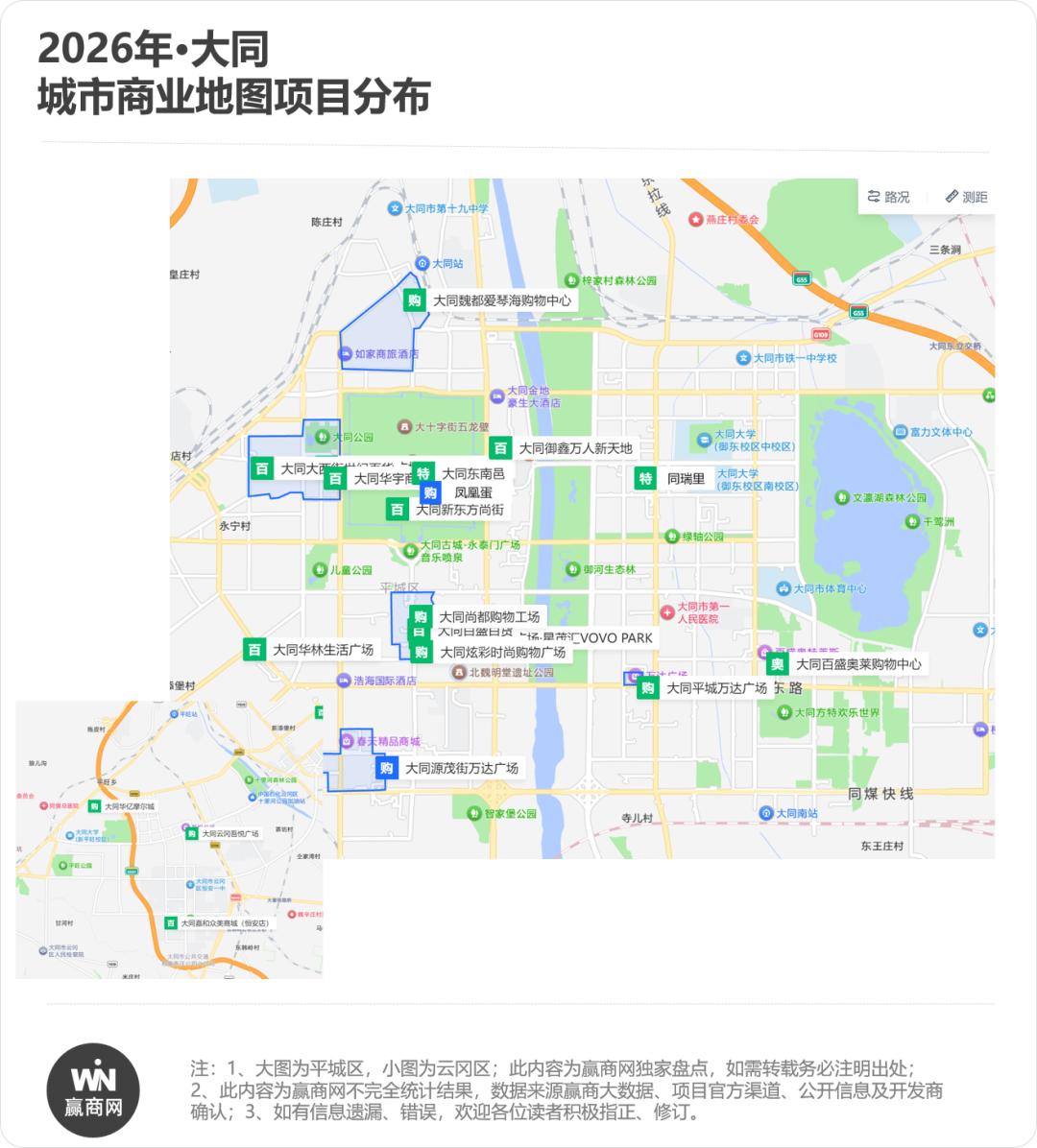
Divided by the Yu River, Datong's commerce has formed a clear "One City, Two Axes" pattern:
The West Yu Old Town Axis: it is the base of traditional commerce, with the Qingyuan West Street business district, Ancient City business district and Yongtai South Road business district clustered together, having the highest commercial density, and it is also the core statistical area for the official "oversupply" theory;
The East Yu New District Axis: it is the new center of urban outward expansion, with a small number of commercial projects and significant gaps in supporting facilities. However, limited by the speed of population import, blind new construction will easily lead to high vacancy rates.
The government includes professional markets, street-side shops, community supporting facilities, and commercial outlets in the ancient city into the statistics. The existing commercial volume in the core area alone has far exceeded this threshold.
Competition Pattern: Rise and Fall of Local Operators and Steady Development of Chain Brands
Established local operators used to be the main force of the city's commerce. Hualin was once the overlord of the Jiaochang Street business district. Hualin Commercial Building, Hualin Xintiandi and Hualin Life Plaza together constitute the consumption memory of old Datong residents. However, with the cultural tourism transformation of the ancient city and the impact of e-commerce, the passenger flow of Jiaochang Street has dropped by half, and Hualin has to split and rent out the prime ground-floor shops.
Huayu Group used to be more ambitious. This local group, which started in Taiyuan and expanded to Beijing and Sanya across regions, owns projects such as Huayu Shopping Center, Huayu Baihuagu and Beijing Huayu Fashion Shopping Center, but it declined due to capital chain problems. The Xingmaohui VOVO PARK under Kaide Shijia was once the first shopping mall in Datong, but main brands such as UNIQLO withdrew due to problems on the owner's side.
Foreign chain commercial operators have secured their basic market. Over the past 13 years, the three stores of Datong Parkson have been deployed in a step-by-step manner. The first store firmly occupies the high-end consumer market, with strong performance in light luxury and beauty categories; the second and third stores operate at a mediocre level. Coupled with Parkson's national contraction (multiple stores in Beijing, Shanghai and Xi'an have closed), the department store model in low-tier cities is going through pains. Pingcheng Wanda Plaza is firmly positioned as a family-oriented all-customer mall in the East Yu area, with stable weekend passenger flow. The standardized operation, brand resources and financial strength of chain commercial management have become advantages to go through cycles in a market with limited effective consumption scale like Datong.
New forces are also growing. Southeast Yi takes the ancient city renewal as the entry point, building cultural scenarios, B&B courtyards and owner-operated shops into a model of cultural-business-tourism integration. The upcoming Phoenix Egg project, which is scheduled to open in 2028, will enter the youth consumption and social scenarios with a more lightweight operation logic.
International Gourmet City: Strong Catering Sector, But Most Brands Do Not Enter Shopping Malls
Datong has another undervalued consumption ace — catering. The city is named "Chinese Gourmet City". Time-honored brands and local brands such as Fenglinge, Zini 369 Coarse Grain Season, Hongya Restaurant, Kaige Restaurant, Northern Wei Family Banquet, Garden Hotel, New Century Roast Duck and Xijindao form a highly recognizable food map.
However, the strength of Datong's catering sector has not directly turned into passenger flow dividends for shopping malls. The catering sector in shopping malls is mostly filled by chain brands such as Haidilao, Xibei, tea and coffee brands, while local time-honored brands are absent. Occasionally, local brands such as Longjuxiang Shaomai Restaurant, Xijindao and Qijia Tofu Soup settle in.
This not only reflects the maturity of the local catering ecosystem, but also reversely indicates that: The "content attractiveness" of shopping malls is not strong enough to attract leading catering brands to take the initiative to enter.
03.
Commercial Landscape Atlas
Three Major Sectors, Three Ways of Survival
Datong's commerce is never a flat map. Divided by the Yu River, it is cut into three worlds with completely different temperaments. Each sector has its own projects, brands and survival logic. Combined together, they form the complete picture of Datong's commerce.
If the debate over statistical calibers defines Datong's commerce from a macro perspective, then in the real urban space, under the pattern of "One City, Two Axes", the three major business districts are respectively presenting completely different commercial ecosystems.
"Stock Game" of Old Shopping Malls
The Yongtai South Road business district is a municipal-level commercial center defined as "one core, one sub-center, one characteristic" in Datong's commercial outlet planning. Kaide Shijia Plaza Pedestrian Street was rated as one of the first batch of "High-Quality Pedestrian Streets in Shanxi Province" in 2020. The core of this business district is Parkson Shopping Center and Xingmaohui VOVOPARK, which belong to the same owner and are connected through a second-floor corridor, forming a complex of department store and shopping mall.
Parkson Shopping Center is located at the core of the business district, with a clear brand matrix on the first floor targeting mid-to-high-end customer groups: women's clothing includes Weekend Max Mara; beauty brands cover Estée Lauder, Dior, L'Oréal, Shiseido and YSL; the watch area is dominated by Tissot and Longines; digital life brands include authorized Apple stores, Xiaomi Home and Samsung; the boutique area has COSCIA luxury collection store, as well as light luxury brands such as COACH and Michael Kors; casual catering is equipped with Paris Baguette, Heytea, BaWangChaJi and Lego parent-child retail.
This set of brands is not common in cities of the same level — it shows that although Datong has a limited population scale, its high-net-worth consumption base is solid enough to support independent stores of light luxury products, watches and high-end beauty brands.
Separated by a road from Parkson, Xingmaohui VOVOPARK is physically interconnected with Parkson, but there is no effective dislocation in brand positioning. The former main brand UNIQLO on the first floor has withdrawn, replaced by Datong's first Starbucks Reserve store; women's clothing brands include Datong's first ARISEISM and JOOWII; lifestyle brands include Xiaomi Home, Huawei Smart Life Hall, WOW COLOUR and TOP TOY.
Overall, Xingmaohui VOVOPARK tries to create differentiation with first stores and lifestyle formats, but due to owner disputes, its passenger flow and reputation are under continuous pressure. The successive withdrawal of UNIQLO also confirms that the "1+1>2" synergistic effect has not