An average of 3.6 new car models are launched every day, yet less than 60% of all car models can achieve monthly sales of over 1,000 units. Where has Chinese families' willingness to buy cars gone?
In the first half of 2026, domestic retail sales of passenger vehicles fell by 20%, with the profit margin dropping to 3.4%. The price war has lost its effect, the supply side is trapped in an inefficient cycle, and a wave of pre-loss announcements for corporate performance has emerged. China's automotive industry is shifting from a scale competition to a clearance stage measured by profitability and efficiency
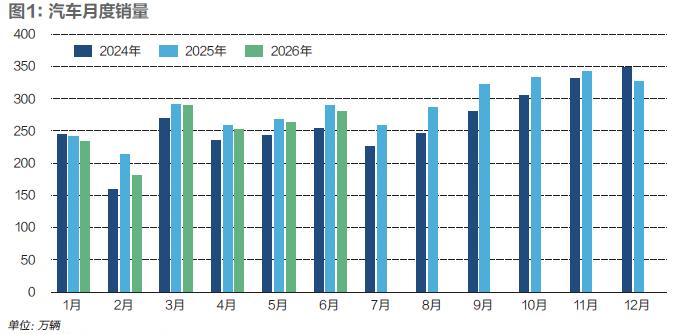
More than half of 2026 has passed, and the automotive industry has submitted its mid-term report card. According to data from the China Association of Automobile Manufacturers (CAAM), from January to June, China's automobile production and sales reached 14.993 million units and 15.017 million units respectively, maintaining its position as the world's largest automobile production and sales market.
Beneath the apparent stable total volume, structural pressures have emerged in an all-round way. In the first half of the year, the cumulative domestic retail sales of passenger vehicles reached 8.7 million units, down 20.2% year-on-year. Data from the National Bureau of Statistics shows that the total profit of the automotive industry from January to June fell by 19.5% year-on-year, with the profit margin dropping to 3.8%. At the 2026 China Automobile Chongqing Forum held in June, Wang Xia, President of the Automotive Committee of the China Council for the Promotion of International Trade, stated that the automotive industry is facing the rare challenge of overlapping declines in sales volume, revenue and profits.
Behind the rare challenge is the fundamental restructuring of the growth logic of the automotive industry. In early May, consulting firm McKinsey proposed in a report that China's passenger vehicle market has entered the stock era. Li Bin, Founder, Chairman and CEO of NIO, endorsed this judgment and further pointed out that the automotive industry has entered the most brutal stage of the final round of competition. As the expansion of scale hits the ceiling of tightening consumption, and technological progress encounters new problems in commercial realization, China's automotive industry is bidding farewell to the era where market increments can cover all problems, and shifting to a restructuring measured by profitability and system efficiency.
The marginal effect of price wars is diminishing, and price cuts are no longer a valid weapon
In the past six months, the automotive industry has clearly seen the backfire of price wars on the market. McKinsey's *2026 China Auto Consumer Insights* report shows that among consumers who purchased cars in the past year, 22.2% hold a negative attitude towards price wars, exceeding the 16.5% who hold a positive attitude. McKinsey believes that the wave of price cuts has strengthened consumers' psychological expectations of car purchase discounts, thereby amplifying wait-and-see sentiment and extending the decision-making cycle. The concern that prices will drop immediately after picking up a new car is turning into real resistance to car purchases.
Wang Xia pointed out that the marginal effect of price wars is accelerating its decline. McKinsey's survey shows that about 20% of consumers said price wars have stimulated their willingness to buy cars, but nearly 20% postponed their car purchase decisions for the same reason. After offsetting the two, the net stimulating effect of price competition has been extremely limited, while the loss of profit per vehicle paid by automakers has actually occurred. According to CAAM data, the average profit margin of the domestic vehicle manufacturing sector in the first half of the year has dropped to 1.5%. This means that when an automaker sells a new car priced at 200,000 yuan, the net profit is only about 3,000 yuan. This profit margin is far lower than the average profit level of 6.1% of industrial enterprises above designated size nationwide, and also lower than the historical performance of the automotive industry in recent years. The average profit margin of vehicle manufacturing was 5% in 2023, dropped to 4.3% in 2024, stood at 4.1% in 2025, and further fell to 3.2% in the first quarter of this year.
The negative impact of price wars on the consumer side has gone beyond the automotive industry. Data from the National Bureau of Statistics shows that the total retail sales of consumer goods from January to June was 24.87 trillion yuan, up 1.3% year-on-year. Among them, retail sales of automobiles reached 1.97 trillion yuan, down 12.6% year-on-year, making it the category with the largest decline. The proportion of automobiles in total retail sales of consumer goods dropped from around 10% to 7.9%. Excluding automobiles, the retail sales of other consumer goods categories increased by 2.8% year-on-year in the first half of the year. The automotive industry, which has long been regarded as the main force driving consumption, has become a drag on the retail sector of consumer goods.
Data source: CAAM, Graphic design: Yan Bin
Opposing price wars has not only become a consensus within the industry, but also a regulatory issue throughout the first half of the year. On January 14, three departments including the Ministry of Industry and Information Technology, the National Development and Reform Commission, and the State Administration for Market Regulation jointly held a symposium, requiring automakers to firmly resist disorderly price wars. On June 11, the Ministry of Industry and Information Technology and the State Administration for Market Regulation directly interviewed automakers suspected of irrational competition, clearly requiring enterprises to strictly abide by the *Price Law of the People's Republic of China* and the *Provisions on Prohibiting Acts of Selling Products at Dumping Low Prices* and other laws and regulations. Industry experts pointed out that the regulatory model has been upgraded to a clear legal basis, and its deterrent force has been greatly enhanced.
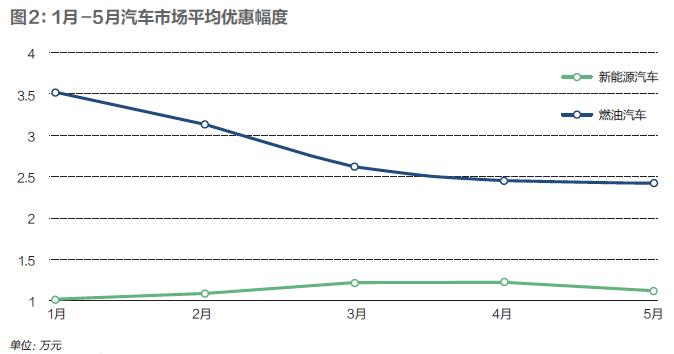
Driven by multiple factors, price wars are cooling down. The report on the trend of the passenger vehicle market price index jointly released by the China Passenger Car Association (CPCA) and consulting firm CAM shows that the average discount of the overall automobile market has narrowed from 35,300 yuan at the beginning of the year to 24,300 yuan in May, and the trend of disorderly price cuts has been initially alleviated.
Wang Xia concluded that the automotive industry is shifting from competing on who can cut prices more to competing on who can survive longer. The underlying logic behind this judgment is that cutting prices more does not necessarily mean surviving longer.
3.6 new cars are launched per day on average, the supply side is trapped in an inefficient cycle
Behind the price war, the bubble on the supply side cannot be ignored.
According to internal industry statistics, about 542 new cars were launched cumulatively in China in the first five months of this year, with an average of 3.6 new cars put on the market every day. For comparison, data from the China Academy of Information and Communications Technology shows that 157 new mobile phone models were launched in the same period. As a durable consumer goods for families, the number of new car launches has exceeded that of new mobile phone models.
However, the "new content" of these more than 500 new cars is limited. According to statistics from industry institutions, among the new cars launched from January to May, there are only more than 100 brand-new models or vertically updated models that are truly equipped with a brand-new architecture, accounting for less than 20%. More than 80% of them are annual facelifts, minor configuration adjustments, new color schemes or co-branded versions, which are essentially old wine in new bottles.
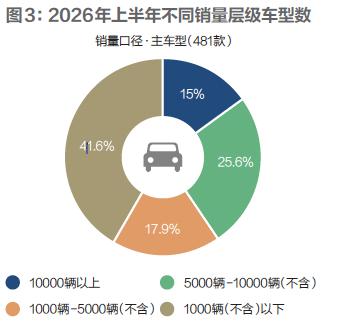
The response of the consumer side to the "old wine" has been reflected in the decline of more than 20% in retail sales, as well as in the sluggish sales performance after the launch of a large number of new cars. The industry generally takes monthly sales of 5,000 units as the reference line for a model with stable market performance. After sorting out third-party authoritative data, *Caijing* found that among the 481 models on sale in the first half of this year, only about 123 models achieved average monthly sales of 5,000 units or more, accounting for less than 26%; about 72 hot-selling models sold more than 10,000 units per month, accounting for 15%; as many as 200 niche or marginalized models sold less than 1,000 units per month, accounting for more than 40% of the total.
The launch of a large number of new cars has not brought more high-volume models, which indicates that the supply of new cars has fallen into a cycle of new car launch, short-lived popularity, and then another new car launch. He Zhiqi, Vice President of BYD, pointed out that the popularity of a new car now cannot last for three months, and it cools down before it gets warmed up. To maintain popularity, automakers can only continue to launch new cars. Li Xiang, Founder, Chairman and CEO of Li Auto, commented on this that there are more and more press conferences, but the information density of each one is getting lower and lower.
Data source: CPCA, CAM
Data source: Industry statistics
What deserves more attention than information density is the continuous accumulation and even waste of costs. Li Bin believes that the current hot sales cycle of new cars has been greatly shortened, and it is difficult for any model to maintain strong sales for a whole year. At the initial stage of new product launch, demand breaks out concentratedly, and orders accumulate rapidly; when the enterprise struggles to complete the capacity ramp-up and the supply chain operates at full load, the market demand drops rapidly. Li Bin said that the capacity has just come up, but the orders are gone; the supply chain has just been fully deployed, but the demand has gone down. The serious mismatch between production and sales rhythm has caused huge waste in the entire industrial chain.
Data from the National Bureau of Statistics shows that from January to May, the cumulative operating income of the automotive industry reached 4.2096 trillion yuan, up 1.4% year-on-year, but the operating cost was 3.7397 trillion yuan, up 2.3% year-on-year. The cost growth rate is significantly higher than the revenue growth rate. Combined with the overall 180% increase in the price of automotive-grade memory chips from March to June, and the price of lithium carbonate rising from 80,000 yuan per ton in the same period last year to 180,000 yuan per ton, the profit margin of automakers has been further compressed.
This has led China's automotive industry into a cycle of increasing production but not increasing revenue. To boost sales volume, new models are launched, which leads to high costs, high costs force price cuts, price cuts erode profits, and insufficient profits force enterprises to grab traffic by launching more new cars. The end of this cycle is a lose-lose-lose situation for automakers, supply chains and consumers.
GF Securities pointed out in a research report that scale, operational efficiency and diversified power structure are the core guarantees for automakers to survive and develop stably, and product differentiation is the key to breaking through the homogeneous price war and realizing excess profits.
Target completion rates generally decline, and the wave of pre-loss performance spreads
In the stock market, some problems that were once covered up by increments have gradually surfaced. The differences between automakers in product structure, brand layout and transformation rhythm have been amplified, which is reflected in the obvious stratification of the target completion rates of automakers in the first half of the year.
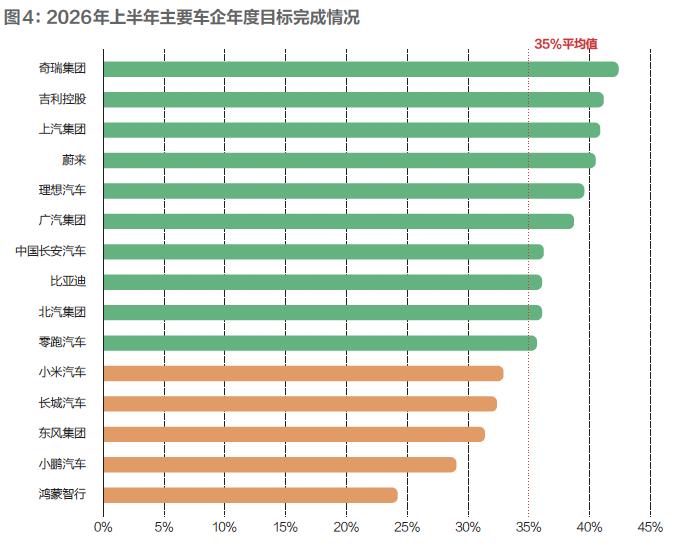
Looking at the annual target completion status of 15 major automakers, none of them has crossed the 50% threshold. Only Zeekr brand in the whole industry has a completion rate close to 60%, and the average completion rate of mainstream automakers fluctuates around 35%. In the same period of 2025, most automakers maintained a completion rate of around 45%.
There are five automakers whose cumulative sales volume exceeded 1 million units in the first half of the year, namely SAIC Motor, BYD, Geely, Chery and Changan.
SAIC ranks first with 2.045 million units, with a completion rate of 40.91%. The proportion of independent brands has reached 71.8%, and the balance between joint ventures and independent brands has undergone a fundamental reversal.
Chery Group ranks first among independent automakers with a completion rate of 42.4%, with cumulative sales of 1.3575 million units in the first half of the year, up 7.7% year-on-year. This achievement is almost entirely supported by the overseas market. Chery exported 943,800 units, a sharp increase of 71.5% year-on-year, accounting for more than 70% of total sales. In contrast, domestic sales were about 413,700 units, down about 42% year-on-year. The fuel vehicle market is being rapidly replaced by new energy vehicles. Chery's traditional fuel products still account for a large proportion, and its brands including Chery, Exeed and Jetour have overlapping pricing and product positioning, and homogeneous internal consumption has further weakened its domestic market share. With 70% of sales relying on overseas markets, how to maintain the basic domestic market is an unavoidable proposition for Chery.
Data source: Enterprise public information
BYD sold 1.8057 million units in the first half of the year, with domestic sales down 39.57% year-on-year, and 792,300 units delivered overseas helped it stabilize its position. Geely Group's completion rate was 41.16%, with exports of 474,200 units, up 158% year-on-year. Among them, Zeekr delivered 178,400 units, up 97% year-on-year, with the average price per vehicle approaching 350,000 yuan, making it the only brand with a completion rate exceeding 50%.
GAC Group (601238.SH) has a completion rate of 38.65%, with new energy vehicles accounting for more than 60%. Changan Automobile (000625.SZ) has a completion rate of 36.23%. Its high-end brand Avatr sold 27,600 units in the first 6 months, compared with 56,700 units in the same period last year. BAIC Group sold 795,000 units cumulatively in the first half of the year, with sales of independent brands reaching 535,000 units, up 14.2% year-on-year.
Great Wall Motor (601633.SH) sold 583,800 units from January to June, with an annual target completion rate of 32.43%. Cumulative exports reached 291,000 units, basically completing the half-year export target; domestic market sales were 292,800 units, with a completion rate as low as 24.4%. Among them, Haval is still the core of sales. ORA has achieved significant growth after positioning adjustment but its volume is small. Wey brand's sales in the first half of the year increased by 29.1% year-on-year, and Tank brand's sales decreased by 10.6% year-on-year. Wey and Tank saw month-on-month sales declines of 27.2% and 29.5% respectively in June.
As some listed automakers have successively released their first-half performance forecasts, the real performance under the appearance of sales data has begun to