Behind the 194 million-yuan award and subsidy dispute of Yihuatong, the revenues of four leading enterprises have declined collectively, and the "subsidy ailment" in the hydrogen energy industry needs to be cured.
The hydrogen energy industry's subsidy dependency syndrome has emerged, leading enterprises in the sector to record losses, while hundreds of billions of yuan in subsidies have triggered inter-enterprise lawsuits.
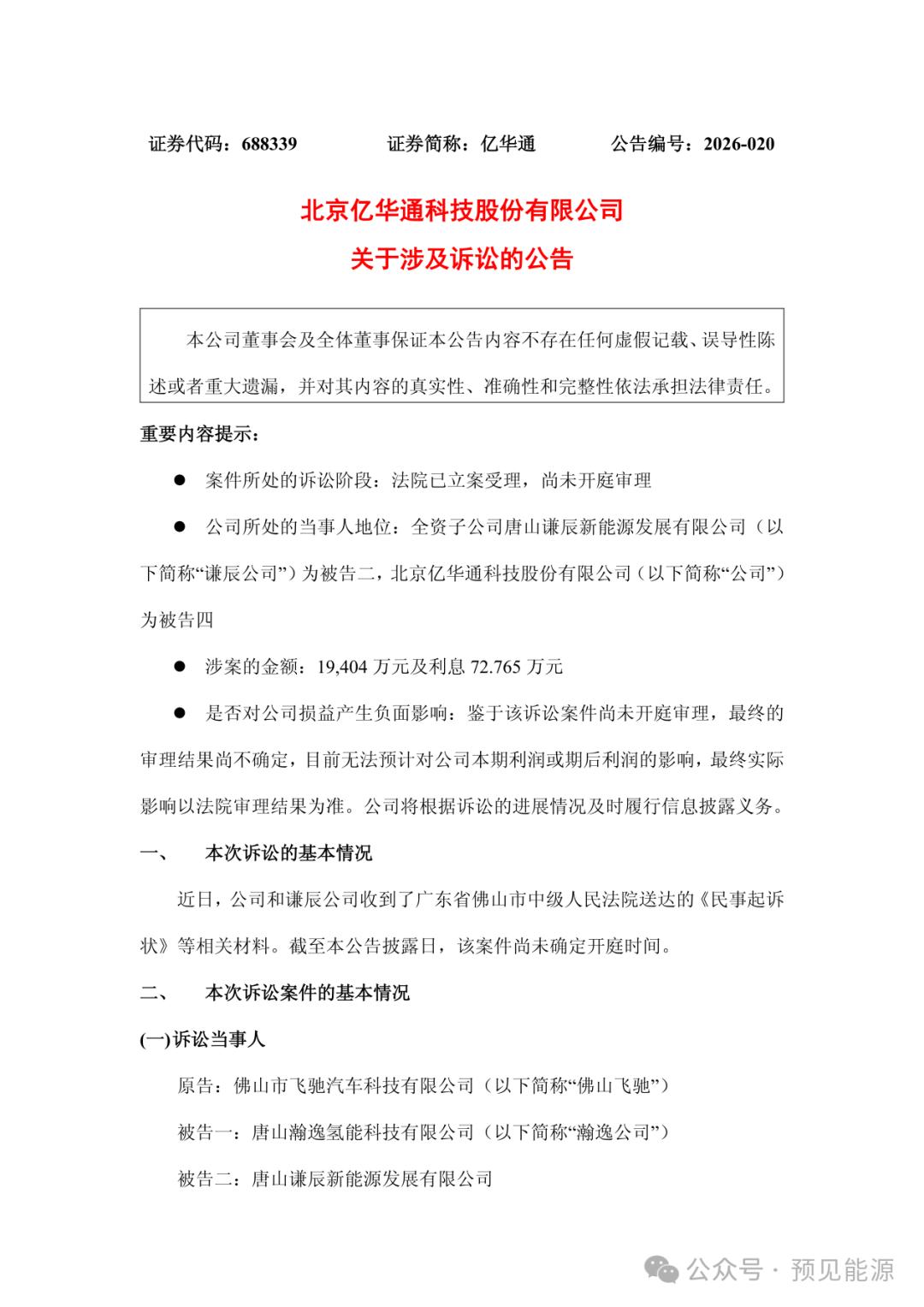
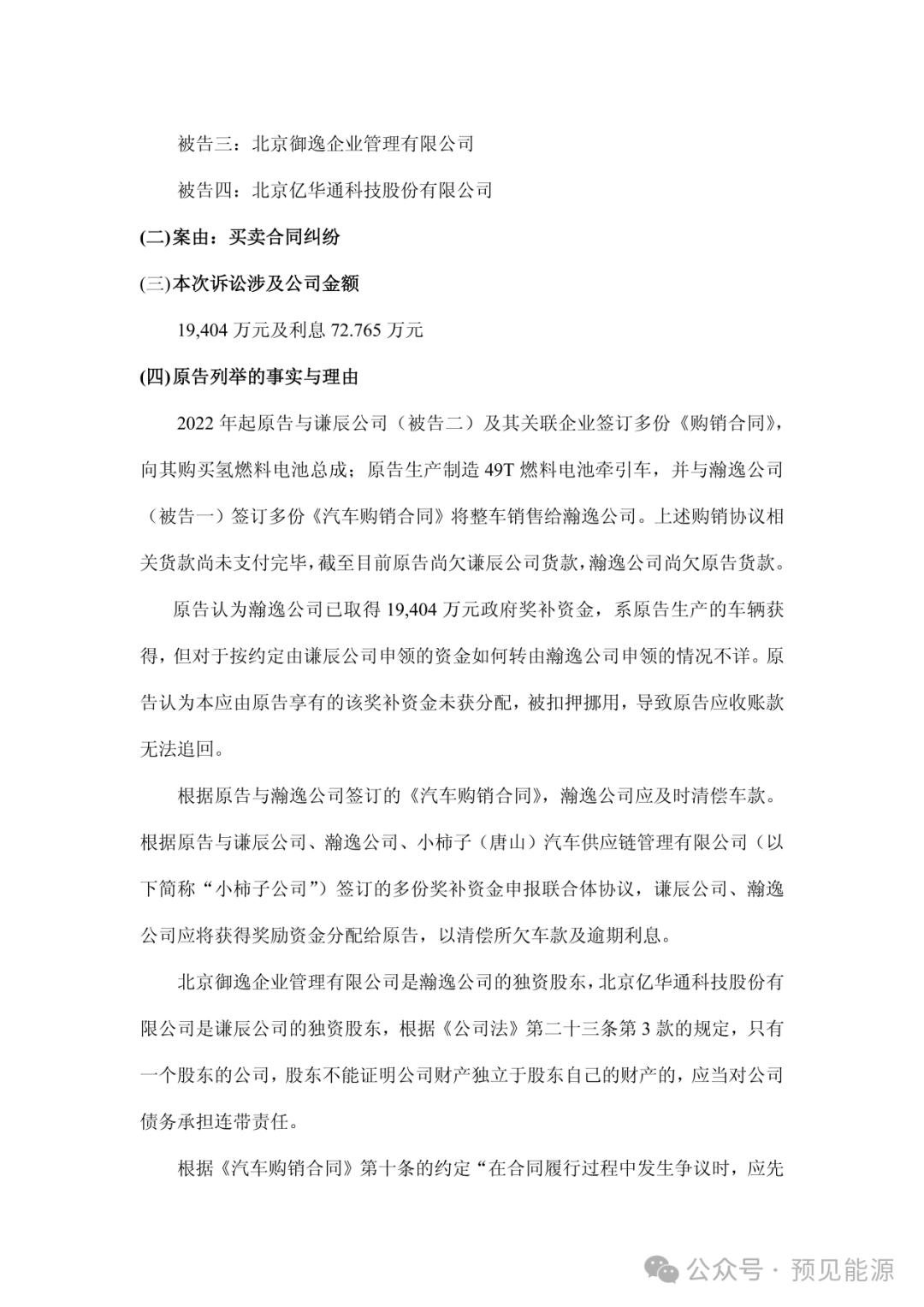
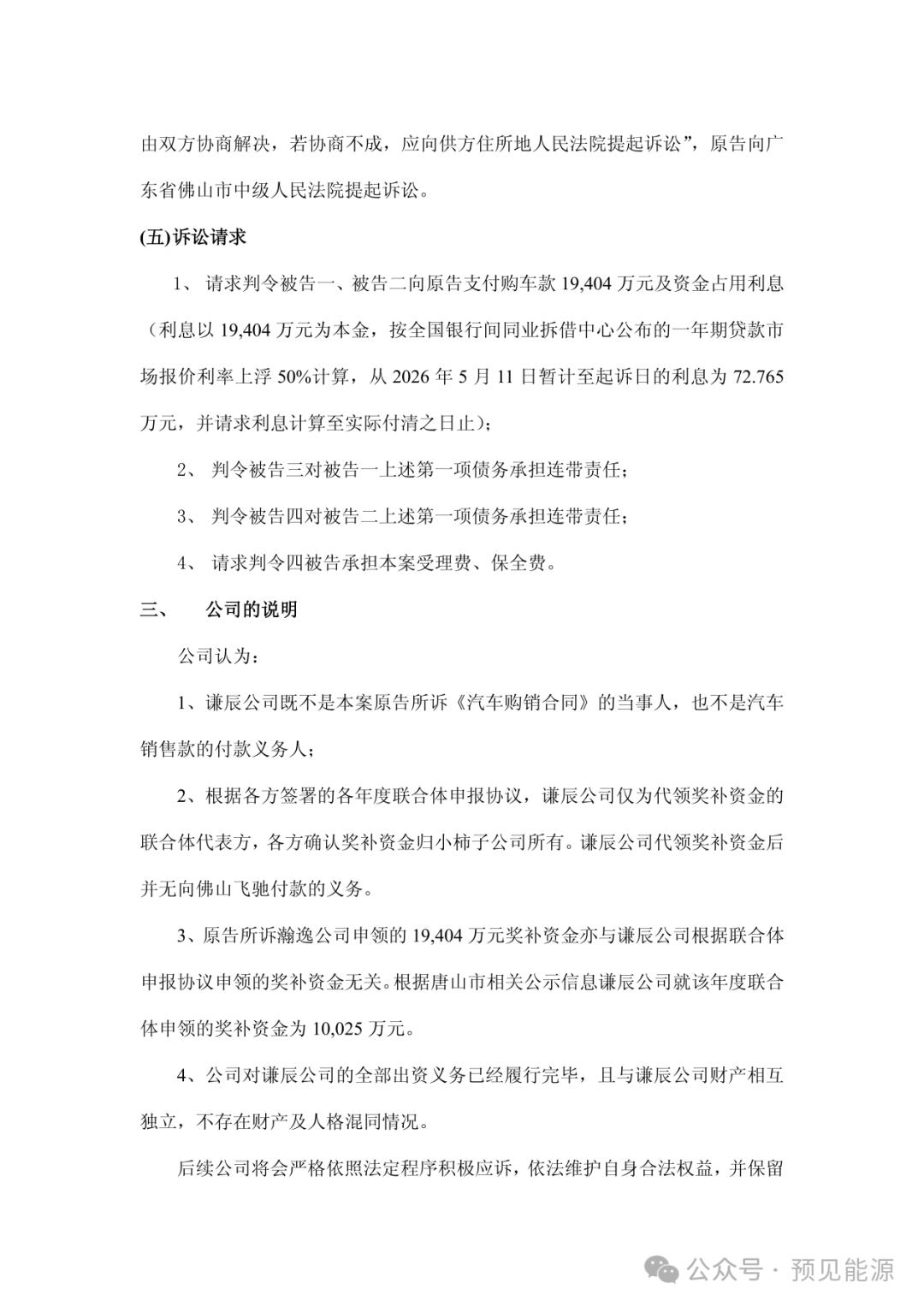
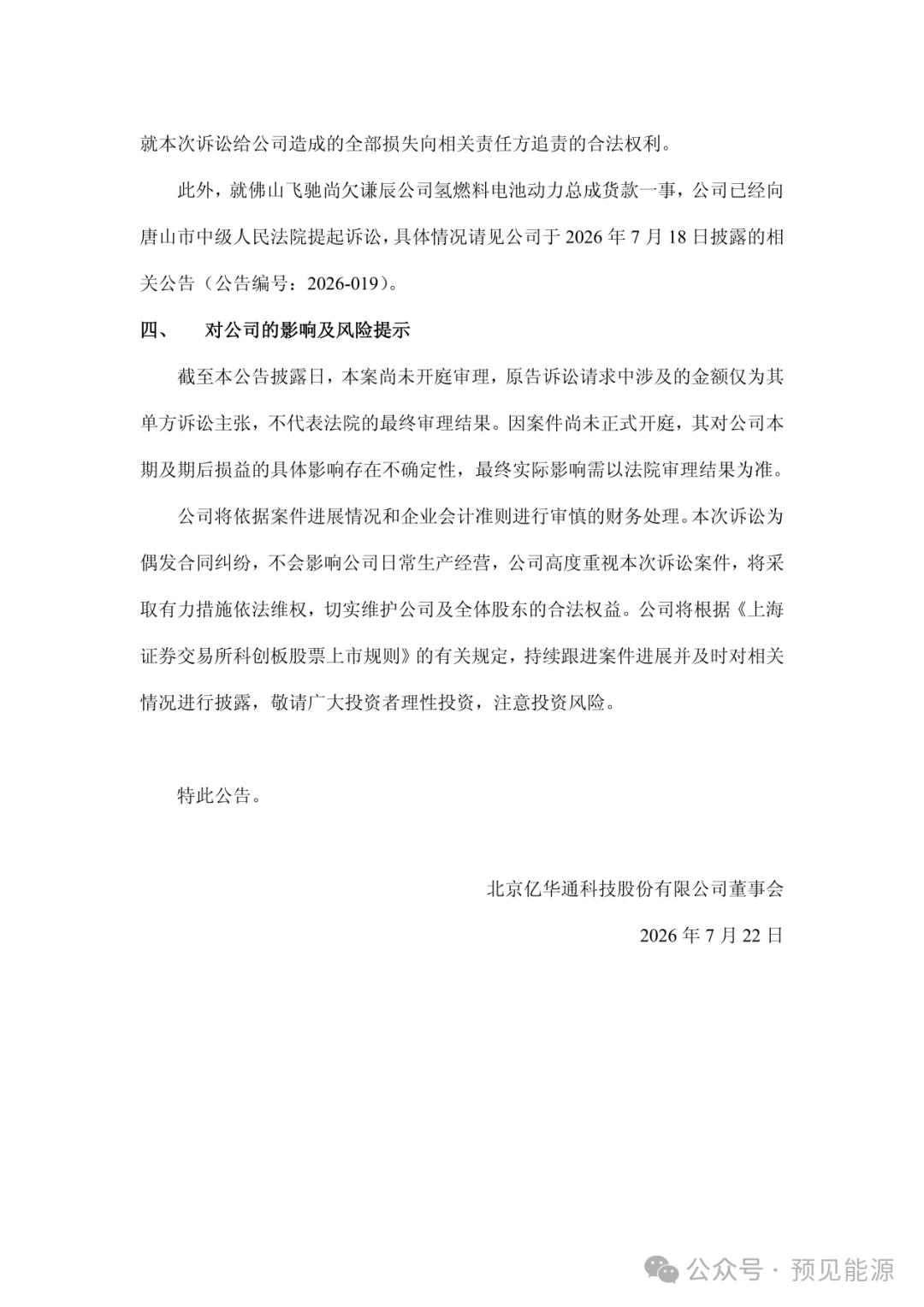
Recently, Foresee Energy noted that Foshan Feichi has filed a lawsuit against Yihuatong, involving 194 million yuan. This is no ordinary payment dispute: the two sides are fighting over who is entitled to a government reward and subsidy fund. Before Foshan Feichi initiated the lawsuit, Yihuatong's subsidiary had already sued Foshan Feichi earlier, claiming for 162 million yuan in overdue payment for goods. The situation of "you owe me, I owe him, he owes you" means the capital chain on the hydrogen energy industry chain that has been covered by subsidies for years has finally developed a crack in court.
This dispute is not an isolated incident. The entire hydrogen energy industry is repeating the same story: subsidies have fostered the market, but the distribution mechanism of subsidies has in turn distorted the market. In 2025, the revenue of four leading hydrogen energy enterprises declined collectively, with a total net loss of about 2.088 billion yuan. Guohong Hydrogen Energy's revenue dropped by 32.2% to 300 million yuan, Yihuatong's revenue fell to 259 million yuan, Guofu Hydrogen Energy's to 346 million yuan, and Re-Fire Technology's to 595 million yuan.
Losses are the norm, and profits are unexpected exceptions.
When a listed company has recorded consecutive losses for 6 years with a cumulative loss of nearly 1.7 billion yuan, but still uses "the industry is in the initial stage of commercialization" to explain everything, the term "initial stage" can no longer maintain the dignity of this industry.
An unclear reward and subsidy fund has dragged four companies into the same lawsuit
The starting point of this dispute dates back to 2022.
Foshan Feichi purchased hydrogen fuel cell products from Qianchen Company on the one hand, and sold the assembled complete vehicles to Hanyi Company on the other. According to normal business logic, Hanyi pays Foshan Feichi, and Foshan Feichi pays Qianchen Company, leaving both sides with clear and settled accounts.
But hydrogen fuel cell vehicles are not ordinary commodities — there is a government reward and subsidy fund behind this business, and the rules for applying for and distributing this fund have turned the simple sales relationship into a chaotic mess.
Four companies signed a "Consortium Agreement for Reward and Subsidy Fund Application".
According to Foshan Feichi's statement: after Qianchen Company, as the representative of the consortium, applies for and receives the reward and subsidy fund, the fund should be distributed to Foshan Feichi to offset the overdue vehicle purchase payment owed by Hanyi Company. Hanyi Company has already received 194 million yuan in reward and subsidy funds, but the money was not transferred to Foshan Feichi as agreed.
Yihuatong's statement is completely different — the 194 million yuan claimed by Foshan Feichi is not the same fund as the reward and subsidy fund applied for by Qianchen Company at all.
For one single reward and subsidy fund, the two enterprises have given completely different explanations of ownership. Government reward and subsidy funds, which were originally designed as a tool for industrial support, have now become the trigger for enterprises to sue each other. It still requires the court to decide whose pocket the money has actually gone into. But one fact is already very clear: when subsidies are misplaced and become the business model itself, enterprises will lose the ability to clarify normal business relationships.
Subsidies are the anesthetic of the entire industry chain
"Replacing subsidies with rewards" is a policy launched by five government departments in 2020, which does not give out funds directly, but issues rewards based on the promotion indicators of demonstration urban agglomerations.
The original intention of this mechanism is "precise incentive", but in actual operation, the application and distribution of subsidies are naturally bound to multiple entities including complete vehicle manufacturers, system suppliers, and operating enterprises. Who is qualified to apply and how to distribute the fund after application depends entirely on a single consortium agreement.
The core problem lies in the time difference. Enterprises need to advance funds for production and vehicle sales first, and then wait for the subsidies to be credited to their accounts. This "advance first, subsidize later" model keeps corporate cash flow in a permanent state of tension. To get through this time gap, enterprises in the industry chain can only advance funds for each other and default on payments to each other.
As of March 2025, the five major demonstration urban agglomerations still have 45.4% of the total reward funds not allocated. If the funds are not disbursed, accounts receivable cannot be collected, and if the accounts cannot be collected, subsequent business operations cannot proceed normally.
Yihuatong's financial data is the most direct reflection of this model. As of the end of 2025, the company's book balance of accounts receivable was 1.988 billion yuan, accounting for 29.50% of its total assets, the proportion of accounts with an age of more than one year was as high as 90%, and the total accrued bad debt reserves reached 903 million yuan. A company with an annual revenue of only 259 million yuan has nearly 2 billion yuan in uncollectible accounts on its books. This is not an individual operational problem, but a failure of the payment system of the entire industry.
Other enterprises are not in a much better situation. Guofu Hydrogen Energy recorded a year-on-year increase of 232.3% in expected credit impairment losses to 73.1 million yuan in 2025, due to the expected failure to recover a large number of accounts receivable from new customers. The impairment loss of financial assets and contract assets of Guohong Hydrogen Energy increased from about 107 million yuan to about 173 million yuan.
Among the four leading enterprises, the asset-liability ratios of Re-Fire Technology and Guofu Hydrogen Energy have both exceeded 50%. The entire industry is "sustaining operations" by relying on subsidies, and subsidies themselves are precisely one of the core reasons for the widespread tight capital chain.
CICC Research pointed out that three major bottlenecks, namely high cost, imperfect infrastructure and insufficient corporate cash flow, restrict the promotion of fuel cell vehicles. The long distribution cycle of subsidy funds and the backlog of accounts receivable will put continuous pressure on enterprise operations.
Zhang Guoqiang, a deputy to the National People's Congress, also pointed out during the 2025 Two Sessions that the cashing time of central reward funds is long, the distribution of local supporting funds is not timely, and the proportion of accounts receivable in total revenue is generally high among enterprises in the sector.
The industry is not in the "initial stage", but in the advanced stage of "subsidy dependency syndrome"
Yihuatong attributes its losses to "the phased characteristics of the hydrogen fuel cell industry in the initial stage of commercial development". But "initial stage" can never be used as a permanent excuse.
In 2025, the average price of Yihuatong's fuel cell systems dropped to 2163.56 yuan/kW, and the gross profit margin of the system business turned from positive to negative, registering -19.82%. The price war has reached such a level that it does not prove the "initial stage" of development, but reflects over-supply, insufficient market demand, and unproven viable business models.
What is more severe is that the market itself is shrinking. In 2025, the output and sales of fuel cell vehicles decreased by 47% year on year. The five major urban agglomerations set a total promotion target of 33,000 vehicles, but only 15,800 vehicles were actually completed, with a completion rate of less than 50%. The market is getting smaller and smaller, and enterprises are recording more and more losses.
More and more enterprises are voting with their feet. In November 2025, Meijin Energy terminated the "hydrogen fuel cell power system and hydrogen fuel commercial vehicle parts production project", and permanently supplemented working capital with the remaining 179 million yuan of raised funds. The cumulative investment in the project was only 73.43 million yuan, with an investment progress of 29.37%. The choice made by a listed company with real capital investment is more convincing than any professional industry report.
The core problem is that the subsidy policy has diverted the attention of enterprises to "how to obtain subsidies" rather than "how to sell products to the market". Consortium agreements, reward and subsidy fund applications, and point assessment mechanisms, these institutional designs have led enterprises to spend a lot of energy on policy arbitrage, rather than on technological breakthroughs and cost control.
The dispute between Foshan Feichi and Qianchen Company is a typical microcosm: four companies signed a consortium agreement, but no one can clearly explain the ownership of the reward and subsidy fund. When subsidies become the core of the business model itself, enterprises will lose the ability to identify and meet real market demand.
Policies are shifting, but enterprises cannot afford to wait for too long
In March 2026, three government departments raised the upper limit of 4-year reward and subsidy for a single urban agglomeration to 1.6 billion yuan, adopting a "point system" to replace the previous "direct cash subsidy" mechanism. The policy design is making progress — shifting from "subsidy upon vehicle purchase" to performance-related binding rules.
The direction is correct, but the implementation rhythm is a problem. After the previous round of demonstration policies expired at the end of 2025, the industry experienced a long policy gap period. Enterprises are waiting amid continuous losses, and continue to lose money while waiting for new policies.
Enterprises have adopted different methods to find a viable way out.
In December 2025, Yihuatong invested 30 million yuan to establish an energy storage subsidiary, entering the long-duration energy storage track, and has signed its first commercial order in March this year.
Re-Fire Technology narrowed its losses last year by cutting costs: administrative expenses were reduced by 55%, and R&D expenses were cut by 42%.
These attempts are still small in scale, but the direction is correct — rather than suing each other in the quagmire of subsidies, it is better to explore real market demand.
The 194 million yuan reward and subsidy dispute has not yet held a court hearing. But what is more noteworthy than the final judgment result is the signal revealed by the case itself: when a government subsidy can be claimed by two enterprises at the same time and taken to court, it shows that this subsidy-dependent business model has reached a point where it must be changed.
Subsidies will not exist permanently, and enterprises cannot survive on accounts receivable forever.
This dispute may only be the tip of the iceberg. Under the surface, no one can clearly tell how many subsidy funds are circulating among several enterprises, how many accounts receivable are hanging on the books, and how many enterprises are maintaining superficial normal operations by relying on "triangular debts".
But it is certain that as long as subsidies remain the core "business model" of this industry, similar lawsuits will not be the last one.