The 2026 Fortune Global 500 list is released: Walmart relinquishes the top position it has held for 12 years.
The highly anticipated 2026 Fortune Global 500 list is officially released today.
FoodTalks notes that a major change in the 2026 list is that Amazon has become the world's largest company, ending Walmart's 12 consecutive years of leading the ranking, and Walmart ranks second on this list.
Last year witnessed the rapid development of global high-tech companies. Meanwhile, the threshold for being included in the list has been raised. The entry threshold (minimum revenue) for this year rose from 32.2 billion U.S. dollars to 33.2 billion U.S. dollars, a 3% increase over a year ago. According to introduction, the total operating revenue of the companies on this year's Global 500 list is approximately 43.1 trillion U.S. dollars, exceeding one-third of the global GDP and representing a roughly 3.2% increase over last year.
Now, let's take a look at which other companies in the food, beverage and catering sectors are featured on the 2026 list.
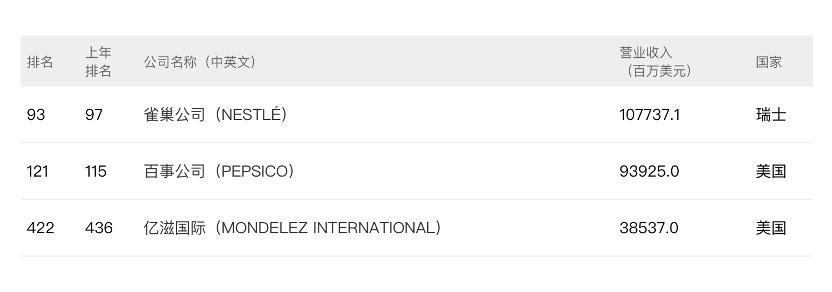
Let's first look at the "Food: Consumer Products" sub-list. On the 2026 ranking, the top three remain the familiar "old trio", namely Nestlé, PepsiCo, and Mondelez International, which has been the most stable top-tier lineup since 2023.
However, multinational packaged food giants are generally facing weak consumption and the resulting competition from private labels.
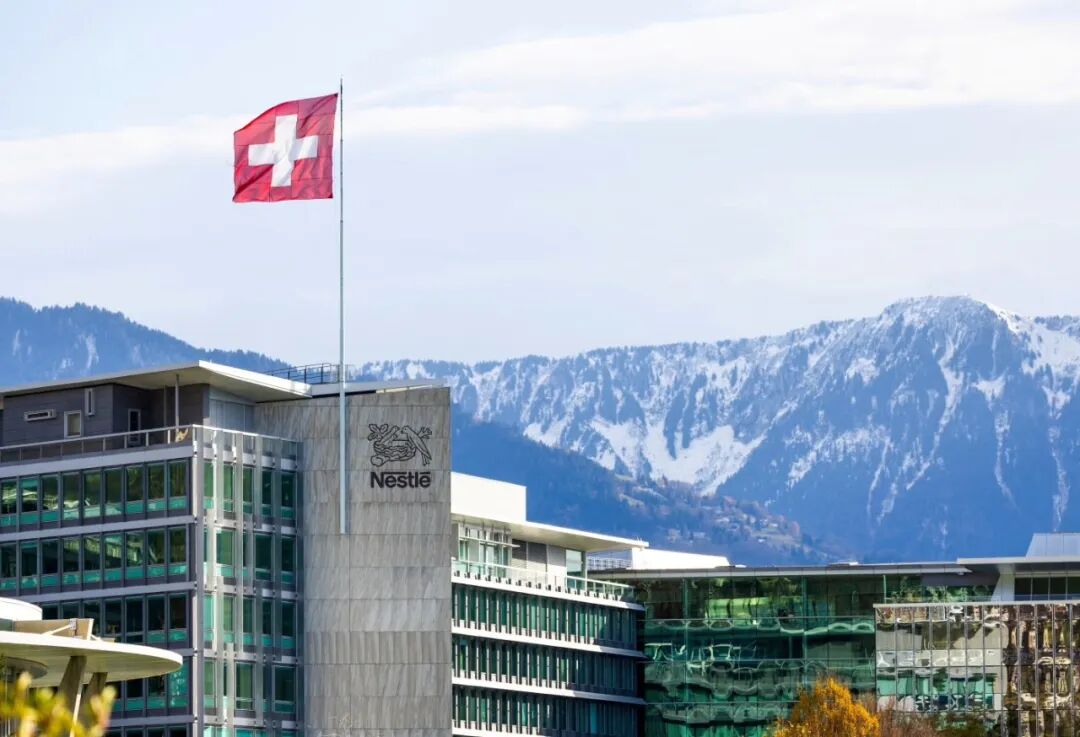
As the world's largest food company, Nestlé, despite a series of major events in 2025, has continued to defend its leading position on this year's list. In 2026, Nestlé ranks 93rd, even 4 places higher than its ranking on the 2025 list.
This stems from the fact that Nestlé's revenue (calculated in U.S. dollars) recorded a 3.8% growth last year, even though its profit dropped by 12%. As FoodTalks previously introduced, when Nestlé released its 2025 performance, both its new CEO and new chairman had been in office for less than half a year, and were facing pressure from investors who expected the company to achieve recovery.
"I am encouraged by the progress we have made in 2025, but we still have a lot of work to do." Among them, Nestlé CEO Philipp Navratil is the third head of the Switzerland-headquartered company in the past two years.
Under his leadership, Nestlé is streamlining its business, including the just-announced sale of 50% stake in its water business that owns Perrier to a U.S. private equity firm. It is also conducting in-depth negotiations with Froneri on the sale of its remaining ice cream business, and plans to continue divesting its mass-market VMS (vitamins, minerals and supplements) business. If these moves are implemented, they are expected to further affect the overall scale of the world's largest food company.
PepsiCo, which ranks right after Nestlé, is also a long-time regular on this sub-list. It ranks 121st in 2026, compared to 115th in the previous year. In 2025, PepsiCo, with an operating revenue of up to 93.925 billion U.S. dollars, made headlines in various ways, including dueling with activist investors and acquiring U.S. prebiotic soda brand Poppi for 1.95 billion U.S. dollars.
Compared with its impressive international business, the North American business facing weak consumption is the pain point for PepsiCo. To address this, PepsiCo plans to streamline its product portfolio, reduce operating costs and cut product prices in North America. For 2026, PepsiCo CEO Ramon Laguarta once predicted that the sales volume, net revenue and operating profit margin of its U.S. snack business will all grow.
As for Mondelez International, it ranks 422nd in 2026, jumping 14 places from the previous year, making the biggest progress among the three companies. In 2025, Mondelez's operating revenue increased by 5.8% year on year, of which organic net revenue grew by 4.3%, mainly driven by an 8% price increase, even though the "sales volume/product mix" declined by 3.7%.
In response, Mondelez CEO Dirk Van de Put attributed the organic revenue growth to "strategic pricing implemented to cope with the record rise in cocoa input costs" and "consumers' continuous loyalty to our iconic brands, even when they are more focused on affordability".
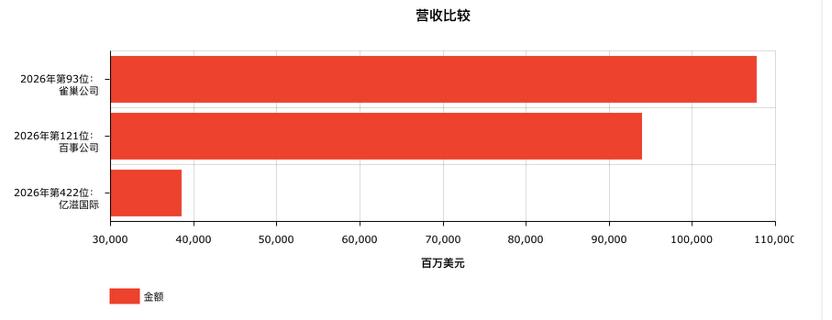
Let's look back at the revenue comparison of these three giants. Although all of them are on the Global 500 list, their actual scales vary greatly, especially for Mondelez. Converted into U.S. dollars, Nestlé's revenue is equivalent to 1.15 times that of PepsiCo and 2.8 times that of Mondelez.
It is worth noting that on this sub-list, Danone Group and Kraft Heinz continue to be absent.
Statistics show that Danone's revenue in 2025 was 27.283 billion euros, and Kraft Heinz's revenue was 24.942 billion U.S. dollars. Last year, Danone focused more on small-scale acquisitions (such as the majority stake in Kate Farms, The Akkermansia Company, etc.), while Kraft Heinz underwent major strategic adjustments, from the planned spin-off to the halt of the spin-off plan, and is currently fully committed to revamping its business under the leadership of its new head.
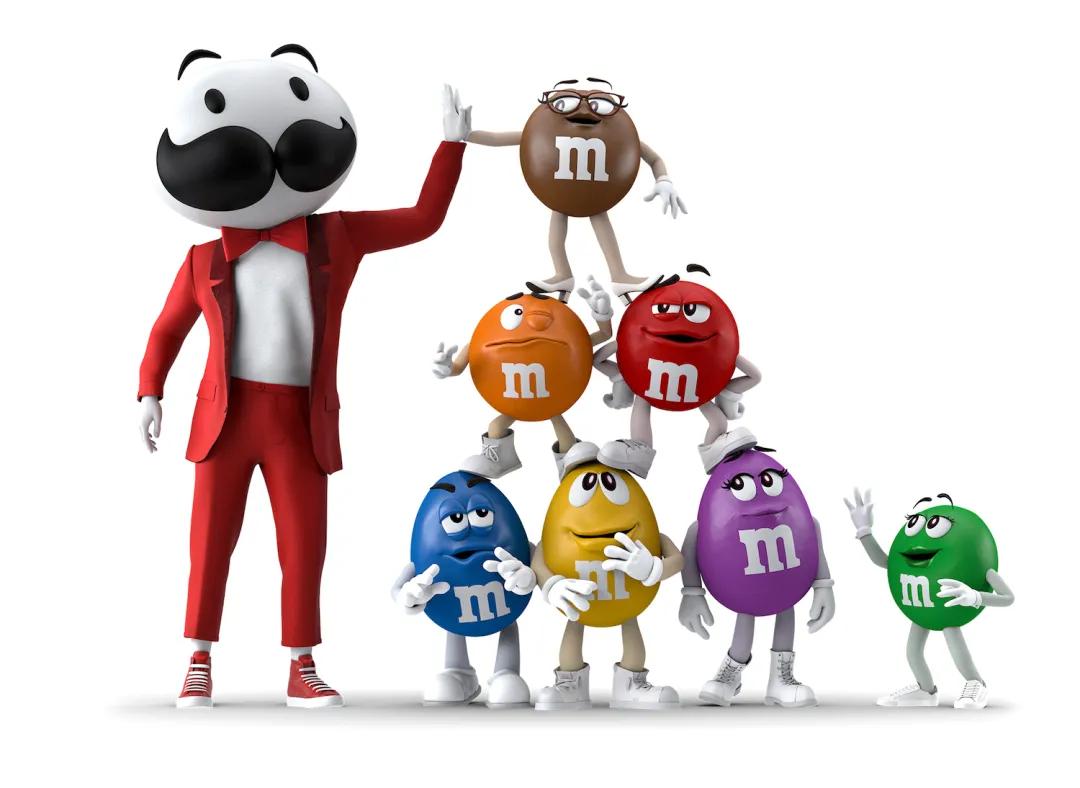
As for Mars, which has always performed strongly but voluntarily does not participate in the Global 500 ranking, its performance in 2025 was quite remarkable, reaching approximately 55 billion U.S. dollars, which does not include the impact of the acquisition of Kellanova (owner of Pringles and other snack businesses) completed in December 2025 (Kellanova's annual sales are at the level of 13-14 billion U.S. dollars).
This means that if Mars chooses to participate in the Global 500 ranking, it will rank second only to PepsiCo on the 2026 sub-list.
Turning to the "Beverage" sub-list of the Global 500, the biggest change in 2026 is that Heineken is no longer on the list.
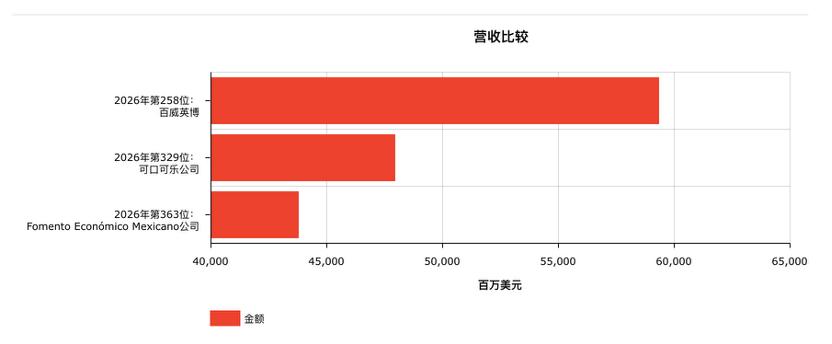
This year, the three companies on the list are Anheuser-Busch InBev, The Coca-Cola Company, and Fomento Económico Mexicano, and the rankings of all three companies have declined. Among them, Anheuser-Busch InBev dropped sharply by 26 places to 258th, The Coca-Cola Company dropped 6 places to 329th, and Mexican beverage firm Fomento Económico Mexicano failed to hold its 349th place for two consecutive years, falling to 363rd.
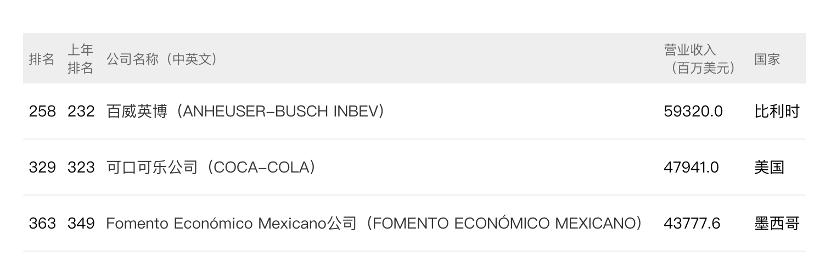
From the perspective of operating growth rate, Anheuser-Busch InBev's revenue fell slightly by 0.8% last year, the Mexican beverage firm's revenue fell slightly by 0.1%, while The Coca-Cola Company even achieved a 1.9% growth. Therefore, it cannot be said that the beverage giants are not working hard, but the mid-tier companies in the Global 500 are extremely competitive.
It is worth noting that Heineken, which returned to the list in 2025 (ranked 500th at that time), disappeared from the list again this year. This is not surprising, as the beer giant faced declining sales volume and its reported profit was dragged down by exchange rate fluctuations last year.
Not long ago, Heineken nominated Rafael Oliveira, from the parent company of Peet's Coffee, as the new CEO and Chairman of the Executive Board, who will officially take office in October. After taking office, he will face multiple challenges, including sales volume growth, investor returns, cost reduction, the excessive number of Heineken breweries, and restoring the company's valuation.
Next, let's take a look at the "Food: Catering Services" sub-list.
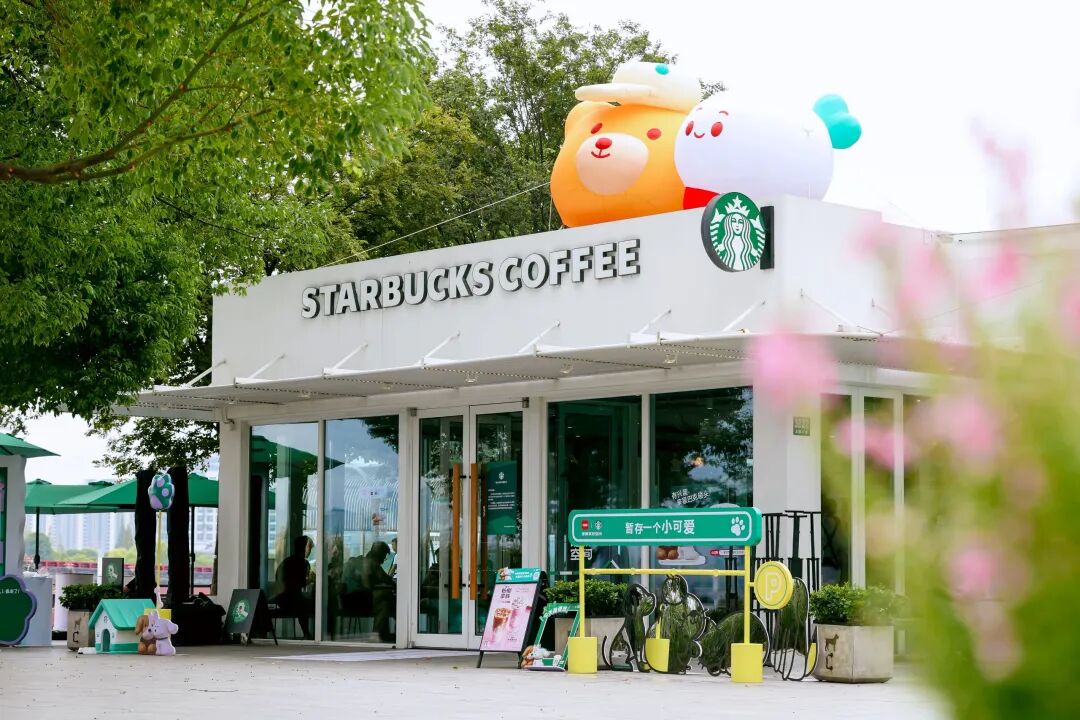
Just like in 2025, there are very few companies in the catering services sector that can make it to the Global 500, with only two companies on the list all the time, namely catering services company Compass Group and coffee chain Starbucks.
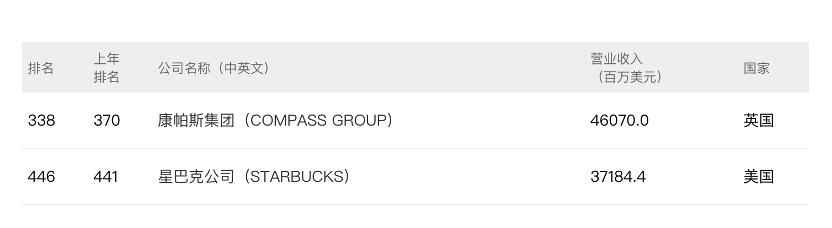
Among them, Compass Group's ranking has increased significantly, jumping from 370th to 338th. As for Starbucks, its ranking dropped from 441st to 446th.
Why are the changes of the two companies so different even though they are in the same sector? Looking at their performance in 2025, Compass mainly benefited from the stable demand and expansion of B2B contract catering. As a C-end retail brand, Starbucks is more directly affected by in-store traffic, consumer sentiment and cost fluctuations, and its growth momentum is relatively weak for the time being. The obvious difference in business models led to one rising and the other falling.
With the return of people to workplaces, the resumption of events and sports competitions, and the continuous offline outsourcing demand of medical and educational institutions, Compass's business is booming, and it also has certain price pass-through capabilities amid inflation, with its revenue increasing by 9.7% last year. As for Starbucks, although its revenue increased to about 37.2 billion U.S. dollars last year, with a growth rate of 2.8%, the growth rate is still far lower than that of Compass and many other companies.
It is worth noting that the latest development is that Starbucks has sold 60% stake in its China business to Boyu Capital, and we can pay attention to the subsequent impact of this transaction on Starbucks' ranking next year.
But it is certain that Starbucks CEO Brian Niccol has high hopes for this. In June this year, he once said: "We already have 22,000 stores outside the United States, and there is no reason why we cannot double this number. In China alone, we can quickly increase the number of stores from 8,000 to 20,000 together with our local partner Boyu Capital."
Well, after looking at the brands familiar to the public, let's turn our attention to the "Food Production" sub-list. In 2025, the competition at the top of the food production sector became more intense, and the divergence between commodity trading and meat processing enterprises was obvious.
On the 2026 list, 9 companies that mainly target B-end customers are on the Global 500 this year, the same number as last year, but the top rankings have been completely reshuffled.
Among them, Brazil's JBS jumped to the 1st place in the industry, rising from 167th last year to 146th, with its revenue increasing from 77.18 billion U.S. dollars to 86.18 billion U.S. dollars (a growth of about 11.7%), surpassing ADM to become the company with the highest revenue in this sector.
In addition, mid-tier companies have made remarkable progress. Among them, Bunge rose sharply from 279th last year to 196th, with its revenue increasing from 53.11 billion U.S. dollars to 70.33 billion U.S. dollars, making the most outstanding progress and now very close to Wilmar International. Olam Group also rose from 369th last year to 302nd, with its revenue growing by about 22.5%. As for Wilmar International, the parent company of Arawana, its ranking also rose slightly from 200th to 195th, with its revenue increasing from 67.38 billion U.S. dollars to 70.42 billion U.S. dollars. Louis Dreyfus rose from 299th to 287th this year.
As for companies in Chinese mainland, New Hope Holding's ranking dropped from 426th to 480th, with its revenue decreasing from 37.28 billion U.S. dollars to 34.46 billion U.S. dollars.
