Batman's company was sold for 4 billion.
Even if you haven't watched *Justice League*, I'm sure you've most likely come across this meme: The Flash is curious about what Batman's superpower is and how he can lead the Justice League, and Batman instantly replies "I'm rich."
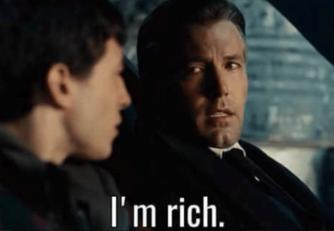
This line of dialogue is obviously designed to be humorous, keeping *Justice League* from becoming a mindless action flick. But never underestimate the phrase "I'm rich" — before Batman was created, all existing superheroes were either aliens, radiation-mutated beings, or inheritors of ancient magic. It can be said that Batman made people realize that "ordinary people also have the chance to become superheroes": regular folks can save the world with their wisdom and willpower, and "wealth" is the key trigger for this entire narrative.
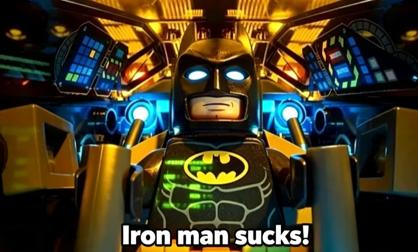
In fact, Iron Man in the Marvel universe has, to some extent, reaped the benefits of Batman's legacy. That's why in *The Lego Batman Movie*, there's a scene where Batman's home entry password is "Iron man sucks!"
Almost as if by fate, Ben Affleck, the actor who played Batman in *Justice League* and *Batman v Superman: Dawn of Justice*, has had a remarkably prosperous financial streak in recent years, notching up consistent commercial successes outside his acting career. Most recently, he's secured a deal worth 4 billion yuan:
According to the latest regulatory filings, Netflix has officially acquired InterPositive, the AI film production company founded by Ben Affleck, for $587 million (approximately 4 billion yuan).
The Low-Key Veteran Artist
To understand InterPositive, it's essential to first look at Ben Affleck's personal career trajectory.
Ben Affleck is a classic example of a naturally gifted talent who found success at a young age. At 25, he collaborated with Matt Damon to film *Good Will Hunting*, a screenplay he co-wrote, and immediately won both the Oscar and Golden Globe for Best Original Screenplay. At 35, he began directing films independently, and by 40, he earned top industry honors including the Oscar for Best Picture and Golden Globe for Best Director for *Argo*. By the time he starred in *Batman v Superman*, he was already widely regarded as a seasoned artist of exceptional skill and integrity, with GQ even asking him in an interview: "Would you be interested in writing and directing a Batman film yourself?"
The flip side of this life story is that, compared to many other actors, Ben Affleck has an unusually strong sense of mission. For example, when asked that GQ question about writing and directing a Batman film, he responded: "I suddenly realized that at some point I lost that passion or fire, and I think it should be brought to life by someone who truly has that dream." In his view, the rise of superhero films signals the further industrialization of cinema: production teams identify every element that appeals to young audiences, then combine them using the most formulaic methods to manufacture a spectacle. He believes that if *Argo*, the film that cemented his career, were made today, it would never get a theatrical release.
To encourage more innovation among film industry practitioners, in 2022, backed by the leading private equity giant RedBird Capital, Ben Affleck and Matt Damon jointly launched the "Artists Equity", an initiative to push production studios to share more profits with behind-the-scenes creators like screenwriters. As they put it: "The divide between studios and filmmakers is growing wider, as if we live in separate worlds that don't understand each other's values... wasting time and resources that could have been used to make films that truly resonate with audiences."
There's also a fun tidbit: some people believe DC cast Ben Affleck as Batman precisely because the "melancholy" shaped by his strong sense of mission perfectly aligns with Batman's character as a man burdened by deep, lingering trauma, allowing him to portray "every nuance of a man trapped in the mire of pain."
And this AI film production company, InterPositive, is another manifestation of Ben Affleck fulfilling that "mission."
Let's go back to 2022, when Ben Affleck and Matt Damon launched the Artists Equity initiative. Ben Affleck's original vision was to adjust organizational structures to ensure "artists, directors, and actors have greater creative freedom and a stronger sense of participation," thereby reinvigorating innovation across the entire film industry. But as the initiative moved forward, he discovered things weren't so simple. First, he realized that shared benefits also meant "shared risk," which placed a heavier psychological burden on production teams. As a result, the plan had to shift from a "performance-based assessment system" to a "bonus structure," where "milestone bonuses" are offered on top of guaranteed base pay.
Second, in 2022, the GPT era arrived. Ben Affleck recalls that everyone felt terrified during that period, himself included. His first reaction was "extreme fear," because he saw that "all the effort, time, and passion I poured into filming stories to bring them to life could seemingly be replicated by a computer with just a few keystrokes."
Facing this massive disruption, Ben Affleck decided to confront this daunting new challenge head-on, just like Batman, to understand what capabilities it truly has and what its emergence means for the film industry and the art of cinema. After a period of observation, he reached his conclusion: "You can't just do all that [what we do] by tapping a few keys... What we do is probably more resistant to AI disruption than most other industries and jobs, but AI can also be a useful tool."
With these thoughts in mind, Ben Affleck decided to dive deeper into AI technology, and InterPositive was born. The core business of InterPositive is developing AI tools designed specifically for film production teams, such as lighting adjustment, shot reconstruction, and fixing continuity issues that post-editing can't resolve.
Thanks to his unique access, compared to other AI film production companies on the market, InterPositive's biggest advantage is that it can directly draw on Ben Affleck's massive library of footage to train its models. But precisely because of this privileged access, under Ben Affleck's strong commitment to artistic integrity, InterPositive is strictly restricted to the role of a "tool": it has no functions related to "image generation" or "script writing" at all, to ensure that "creative control remains in the hands of filmmakers." To further prevent InterPositive's capabilities from overstepping these boundaries, Ben Affleck also required InterPositive to "narrow its datasets to build models that focus specifically on film production techniques."
This is why InterPositive is far less well-known than technologies like Seedacne, Kling, and Sora. Even many people who follow AI film generation technologies closely only heard of this name for the first time in March 2026, when Netflix initially announced its acquisition plan. In a letter published on Netflix's official website, Ben Affleck explained his original entrepreneurial motivation: "We need to protect the element that gives storytelling its humanity: judgment. This kind of judgment comes from decades of accumulated experience, and it is something only humans can possess. I know I have a responsibility to safeguard the power of human creativity, and the people behind that creativity, for my peers and the entire industry."
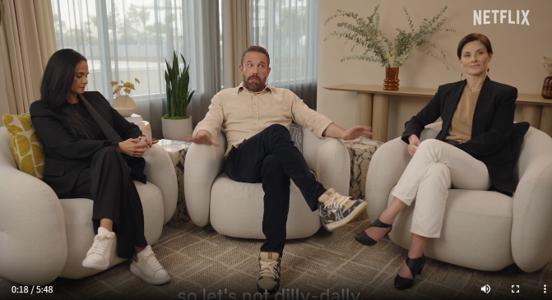
The Contemplative Good Will Hunting
While researching materials, I also came across an interesting old anecdote.
In November 2022 — around the same time he founded Artists Equity and InterPositive — Ben Affleck mocked Netflix in an interview as a "production line" that couldn't maintain the "focus and dedication" required for filmmaking while maximizing output. His stated goal back then was to let talented creators safely make "movies that people still remember 20 years later," and then solve film distribution problems using "data-driven" strategies.
Now that Netflix has officially completed the acquisition of InterPositive, Ben Affleck will join Netflix as a senior consultant. From this perspective, Ben Affleck has, to some extent, grown into a "seasoned businessman" with remarkable flexibility.
But things are not quite that simple. In January 2026, Ben Affleck and Matt Damon appeared together on the famous video podcast *The Joe Rogan Experience* to promote their upcoming new film *The Rip*. Midway through the conversation, host Joe Rogan turned the topic to the most talked-about topic at the time: artificial intelligence, referencing the recent Hollywood strikes centered on AI, and asked the two veteran filmmakers for their views on AI anxiety.
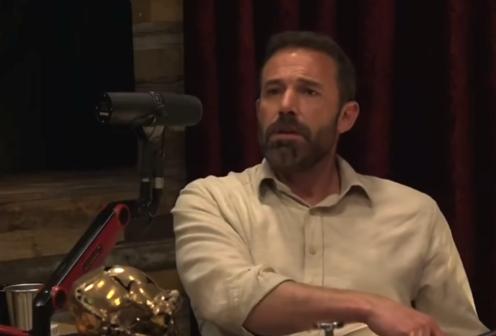
Matt Damon's response stuck to familiar points: AI can't replace human actors, the precious human "artistic experience" (such as how emotions evolve) can't be digitally replicated, and cinema is far more than just "displaying images." Ben Affleck's insights, however, were far more profound: He first compared AI to electricity, noting that it will bring massive changes — some good, some bad, and potentially very harmful — and argued that discussions about AI can't simply claim it will "destroy everything" or "solve everything": we have to look at its specific applications.
With that framework in mind, he talked about his own exploration of AI, mentioning that he has extensively used ChatGPT, Claude, and Gemini. His biggest takeaway is that "By its nature, it goes to the mean, to the average": these models excel at extracting the most statistically likely expressions from a huge corpus of existing text, so they easily produce coherent, familiar content that lacks personal experience and genuine judgment.
When it comes specifically to "AI's impact on Hollywood," Ben Affleck argues that "the most realistic role for AI in the film industry is close to that of CGI and visual effects tools" — processes that already existed before AI, as Hollywood has long used other technologies to "replicate extras, synthesize stadium crowds, and create massive armies that don't exist." With that premise, AI's advantages can be most intuitively applied: high levels of automation, lower costs, and faster speeds.
Finally, Ben Affleck turned to AI's impact on human society, noting that "the adoption of technology in the real world is usually slow and gradual. But AI companies keep emphasizing that in two years the world will completely change and massive numbers of jobs will disappear." He suspects that part of the reason is capital pressure: "AI companies need to build data centers and spend huge amounts of capital expenditure. They can only justify sky-high valuations and investment scales by convincing investors that the next model will be exponentially more powerful and the market will expand rapidly." He also pointed out the fragility of the current AI industry, arguing that "while [large language model] capabilities keep growing, the input-output ratio could deteriorate... if the next generation of models only delivers limited improvements, the capital market's expectation of 'huge leaps with every new generation' will collapse."
In short, it was this podcast that made me realize Ben Affleck is not just another AI entrepreneur leveraging his social influence to put together deals: he has deeply thought through the necessity of AI and the driving forces behind the AI economy. Renowned tech media figure Simon Taylor also gave high praise, saying "Ben Affleck understands AI better than most VCs investing in AI... He dissects AI in a way most tech leaders can't or won't, reminding people that the current exponential growth of AI isn't driven by technology itself."
Perhaps it was precisely these reflections that led him to sell InterPositive and flexibly join Netflix. According to public information, after the acquisition is fully completed, InterPositive's team of engineers and researchers will be further expanded, and they will gain the ability to collaborate with Netflix's existing suite of in-house developed tools. Netflix co-CEO Ted Sarandos stated that in 2026, over 300 Netflix productions will be made using AI tools, which will allow these projects to be completed "twice as fast, at half the cost."
Sarandos said: "We believe great works can only be created by great artists, and AI won't change that. Films are made by filmmakers, and AI just gives them better tools to make better films." In this sense, Ben Affleck has once again become that "Good Will Hunting" figure: settling down to think through those "difficult, unavoidable problems," and then making the best possible choice.
This article is from the WeChat public account "36Post", written by Pu Fan, and published with authorization from 36Kr.