SpaceX's market capitalization has eroded by more than 1.2 trillion U.S. dollars, and Elon Musk's net worth has seen a sharp pullback.
On July 28, U.S. stock market closing data showed that the two core assets under Elon Musk's banner came under simultaneous pressure. The share price of SpaceX, the space exploration technology company, continued its downward trend, nearly halving from its peak in the early listing period; Tesla, meanwhile, hit a new low in share price since 2026. In just a month and a half, SpaceX's market value has evaporated by over 1 trillion U.S. dollars, and Tesla has accumulated a decline of 31% so far this year. The simultaneous slump of these two companies has dimmed Musk's title as a trillionaire within a week, with his personal wealth evaporating by approximately 130 billion U.S. dollars (about 880 billion yuan) in just five trading days; and just a few weeks ago, he had just become the first person in human history to amass a fortune exceeding 1 trillion U.S. dollars.
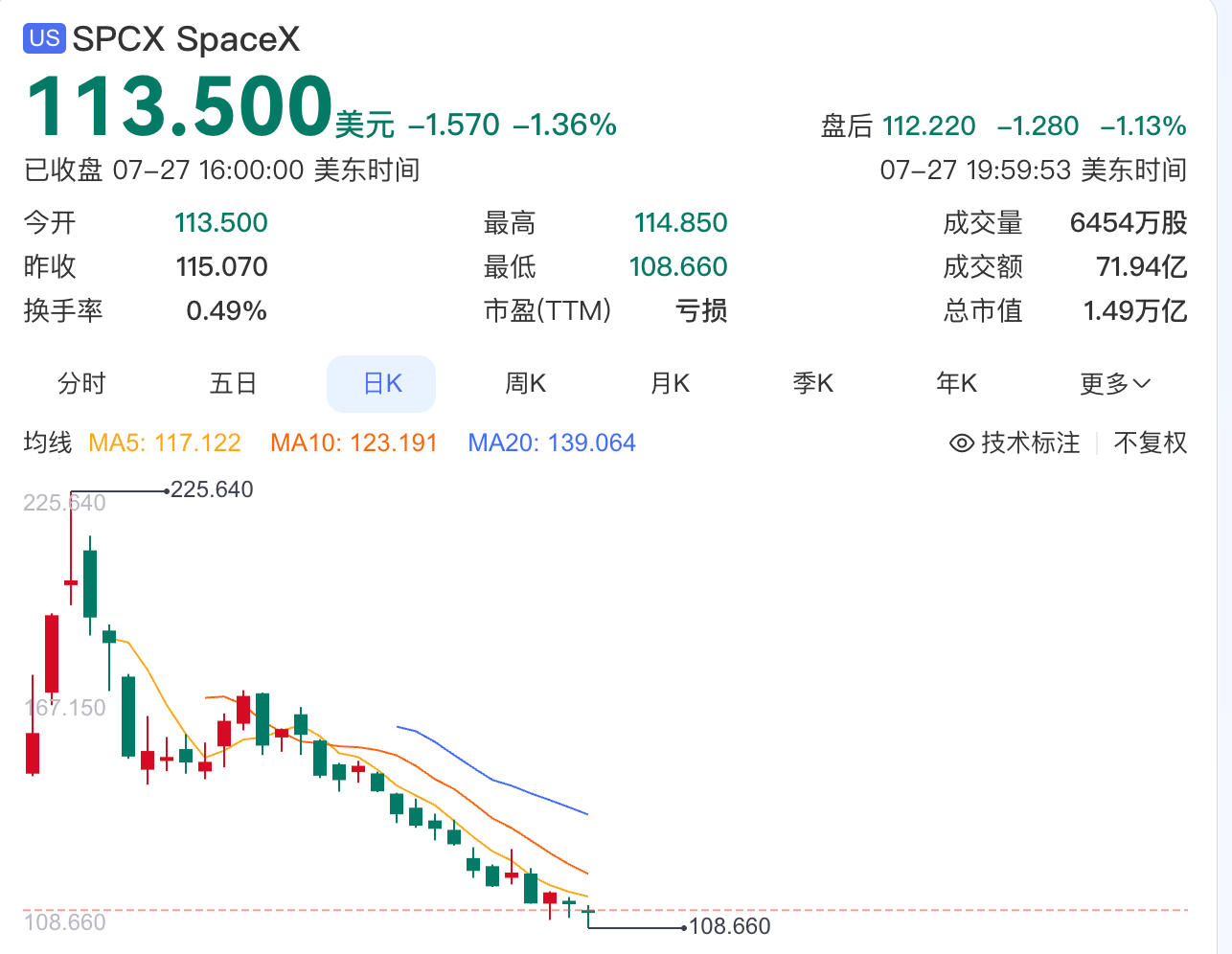
SpaceX Share Price Performance
As the largest IPO project in history, SpaceX landed on the NASDAQ on June 12 with the ticker symbol SPCX. Its offering price was set at 135 U.S. dollars per share, with a basic fundraising scale of 750 billion U.S. dollars. After adding the over-allotment option, the total fundraising reached approximately 862.5 billion U.S. dollars, instantly surpassing Saudi Aramco to set the all-time global IPO record.
In the early stage after listing, market sentiment was frenzied, with retail and institutional funds pouring in simultaneously, driving the share price to surge rapidly. On the first trading day, the stock closed at 160.95 U.S. dollars, up 19.22% from the offering price, corresponding to a total market value exceeding 2.1 trillion U.S. dollars; then buying orders continued to pour in over the next three trading days, hitting an all-time intraday high of 225.64 U.S. dollars on June 16, pushing the total market value to approximately 2.66 trillion U.S. dollars, briefly overtaking Amazon to rank among the top five listed companies in the world by market capitalization. Musk's personal net worth also broke through 1 trillion U.S. dollars accordingly.
The frenzy did not last long, after which SpaceX's share price entered a unilateral downward channel. In the early days of its listing, the market assigned SpaceX a very high valuation premium based on grand narratives such as Starlink commercialization, reusable Starship rockets, and Mars colonization. Even though the company posted a full-year net loss of 4.937 billion U.S. dollars in 2025, and the loss in the first quarter of 2026 further expanded to 4.276 billion U.S. dollars, investors were still willing to pay for its long-term growth potential. However, as Starship test flights were called off at the last minute, project progress fell short of expectations, coupled with a slowdown in Starlink user growth and accelerated layout by competitors such as Amazon's Kuiper Program, market concerns about the pace of its commercial implementation continued to heat up. At the same time, the expectation of restricted share lifting and the overall correction of technology stocks accelerated SpaceX's valuation regression, gradually bringing its share price, which had once deviated from fundamentals, back to a reasonable range.
On June 22, SpaceX plummeted by over 16% in a single day, with its market value evaporating by about 400 billion U.S. dollars in one day. The decline further intensified in July, and in mid-July, the share price fell below the IPO offering price of 135 U.S. dollars for the first time. As of the close on July 27, SpaceX's share price stood at 113.5 U.S. dollars, representing a cumulative retracement of approximately 49.7% from the peak of 225.64 U.S. dollars, with a market value evaporation of over 1.2 trillion U.S. dollars. This is almost equivalent to the entire market value of Musk's other company, Tesla, which is 1.22 trillion U.S. dollars.
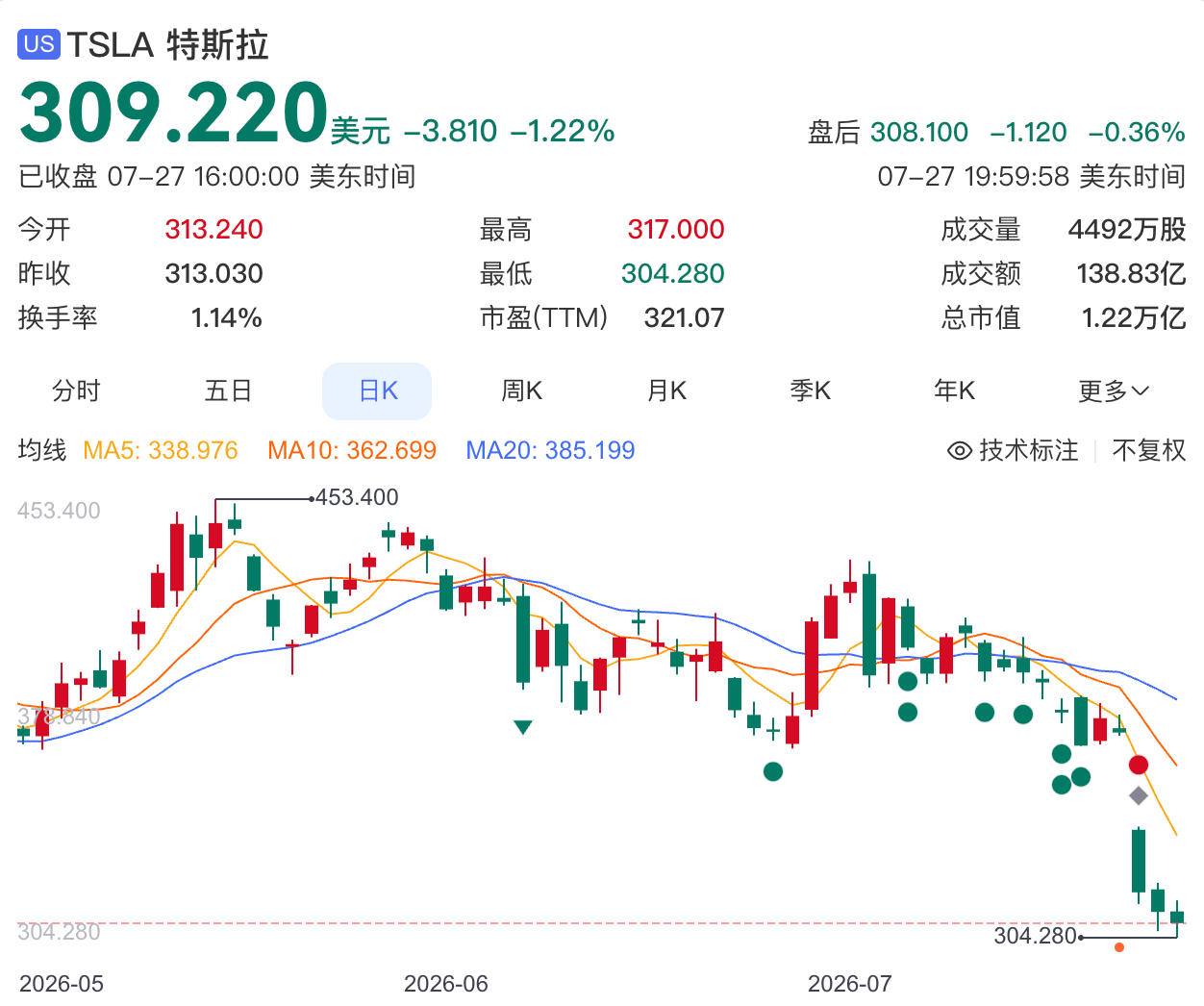
Tesla Share Price Performance
Tesla's share price has also been in a continuous downward slump in 2026, recently hitting a new low for the year. On July 23, impacted by the underperforming Q2 financial results, Tesla plummeted by 14.52% in a single day, marking its largest single-day decline since March 2025, with its market value evaporating by approximately 200 billion U.S. dollars in one day. The downward trend continued in subsequent trading sessions, with Tesla's intraday low touching 304 U.S. dollars on July 27, refreshing its lowest share price level since 2026. Tesla ranks at the bottom among the seven major U.S. tech giants in performance so far this year. Before the plunge, Tesla's forward P/E ratio was as high as 151 times, making it the most expensive stock among the "Big Seven" tech giants; after the crash, its static P/E ratio still reached 289.84 times, far higher than the median of 107.37 times over the past five years.
Financial data shows that Tesla is currently trapped in an operational dilemma of "revenue growth without profit growth", which is the internal factor suppressing its share price. In the second quarter of 2026, the company's total revenue reached 28.24 billion U.S. dollars, a year-on-year increase of 26%, and its vehicle deliveries hit 480,100 units, both hitting all-time highs, but its profitability saw a cliff-like decline. The quarterly operating profit was only 398 million U.S. dollars, plummeting 57% year-on-year, with the operating margin dropping sharply to 1.4% from 4.1% in the same period last year; after excluding carbon credit revenue, the automotive gross margin further fell to 16.3%, as the ongoing price war is continuously eroding the profitability of its core business.
What worries the market even more is its cash flow situation. To support long-term projects such as autonomous driving, humanoid robots, and AI supercomputing, Tesla's capital expenditure in Q2 surged 142% year-on-year, resulting in its free cash flow turning negative for the first time in two years, with a net outflow of 1.09 billion U.S. dollars in the quarter. The company expects full-year capital expenditure to exceed 250 billion U.S. dollars, and it will continue to grow in the next two to three years. The huge money-burning model has triggered widespread investor concerns about its financial health.
Public equity data shows that Musk holds approximately 13% of Tesla's shares and about 42% of SpaceX's equity. When SpaceX's share price surged in the early post-listing period, his personal net worth once exceeded 1.4 trillion U.S. dollars, firmly holding the title of the world's richest man with a large lead over the second place. Since over 90% of Musk's net worth is concentrated in the two stocks of SpaceX and Tesla, his wealth is highly dependent on share price fluctuations. However, with SpaceX's market value halving and Tesla continuing to decline, his wealth has rapidly fallen back below 1 trillion U.S. dollars. Musk even joked on social platforms that he is a "former trillionaire".
This article is from "Jiemian News", reported by LI Kefeng, and published with authorization from 36Kr.