June Ranking of Domestic Automobile Enterprises' Apps: BYD Leads the Scale List, Gravity Domain Tops the Stickiness List, and Structural Differentiation Continues to Deepen
Key Highlights of the Month: The monthly active users (MAU) of the vehicle owner service industry reached 62.87 million, a year-on-year increase of +12.5%. BYD continued to lead the market with 11.76 million MAU, marking a year-on-year growth of +47.7%. Notable structural changes are emerging: Liyiyu claimed the top spot in the engagement rankings with an average daily usage duration of 9.1 minutes per user, while Geely Galaxy nearly doubled its performance with a year-on-year surge of +99.4% — clear structural differentiation is taking place between user scale and engagement levels.
I. Industry Landscape: Steady MAU Growth and Continuous DAU Increase
In June 2026, the de-duplicated monthly active users in the vehicle owner service industry stood at 62.87 million, representing a year-on-year rise of +12.5% and a month-on-month decrease of 1.0%. The daily average active users reached 15.21 million, up 14.9% year-on-year and 0.5% month-on-month. Over the 12-month trend, DAU has climbed steadily from 13.22 million in July 2025 to 15.21 million in June 2026, with a cumulative growth of 15.1%, indicating that the frequency of users opening apps and their engagement levels are continuously improving.
The penetration rate of new energy vehicles keeps rising, hitting 62.8% in June. As the core entry point integrating "digital key + remote vehicle control + community operation", the user scale of automotive OEM apps has grown in tandem with the industry. The average daily usage duration per user is 4.1 minutes, with an average of 3.4 app launches per user per day. The MAU in June saw a slight 0.96% month-on-month decline, ending the previous five consecutive months of positive growth and entering a summer plateau phase.
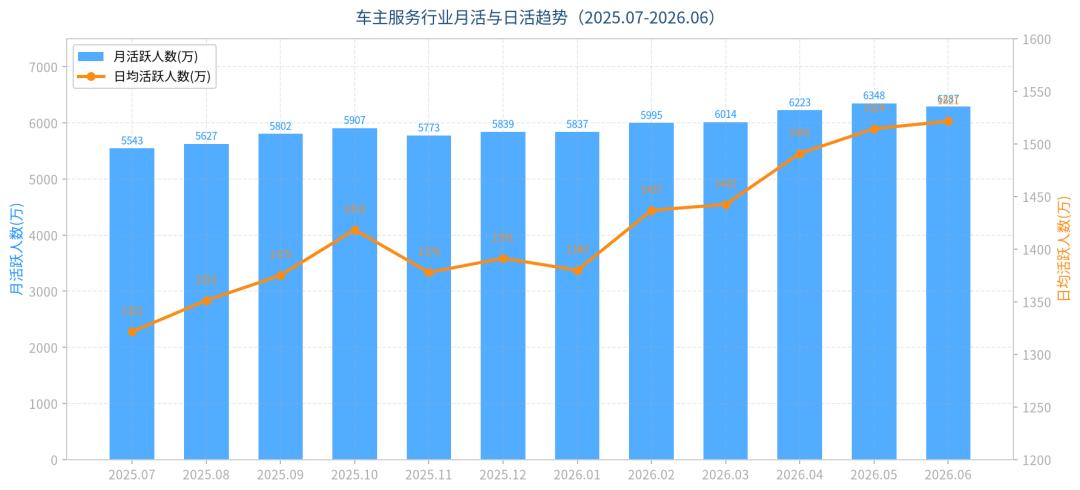
Figure 1: MAU and DAU Trends of the Vehicle Owner Service Industry (July 2025 - June 2026)
II. App Rankings: BYD Takes a Distant Lead, Great Wall Motors Doubles Year-on-Year
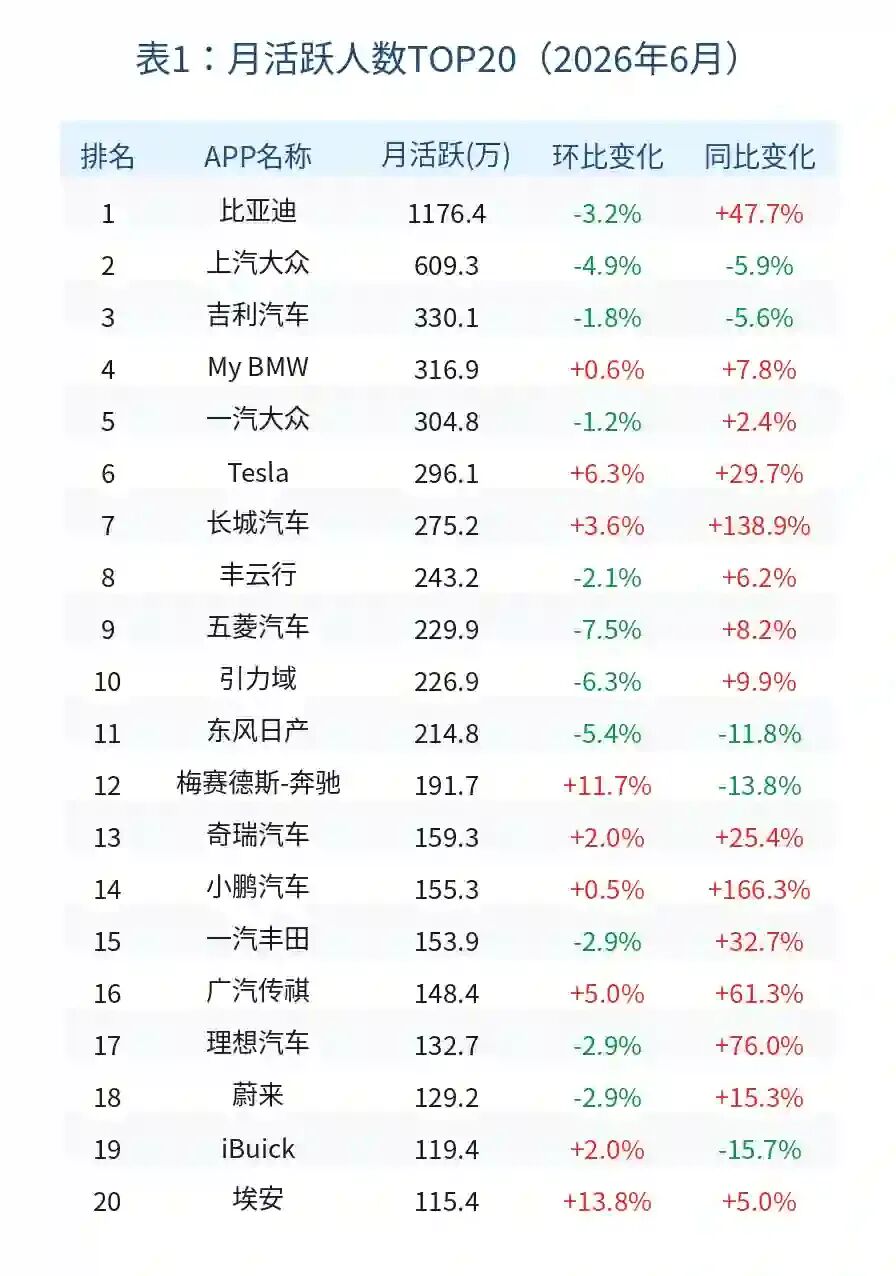
In the June MAU TOP20 list, BYD ranked far ahead with 11.76 million MAU, nearly doubling the second-placed SAIC Volkswagen (6.09 million). Great Wall Motors recorded the most significant year-on-year increase of +138.9%, while Xpeng Motors with +166.3%, GAC Trumpchi with +61.3%, and AITO with +67.8% also delivered outstanding performances. Traditional joint-venture brands generally faced downward pressure: Dongfeng Nissan dropped by 11.8%, Mercedes-Benz by 13.8%, and iBuick by 15.7%.
III. User Engagement: Liyiyu Tops the Ranking, New Energy Vehicle Brands Generally Outperform Traditional OEMs
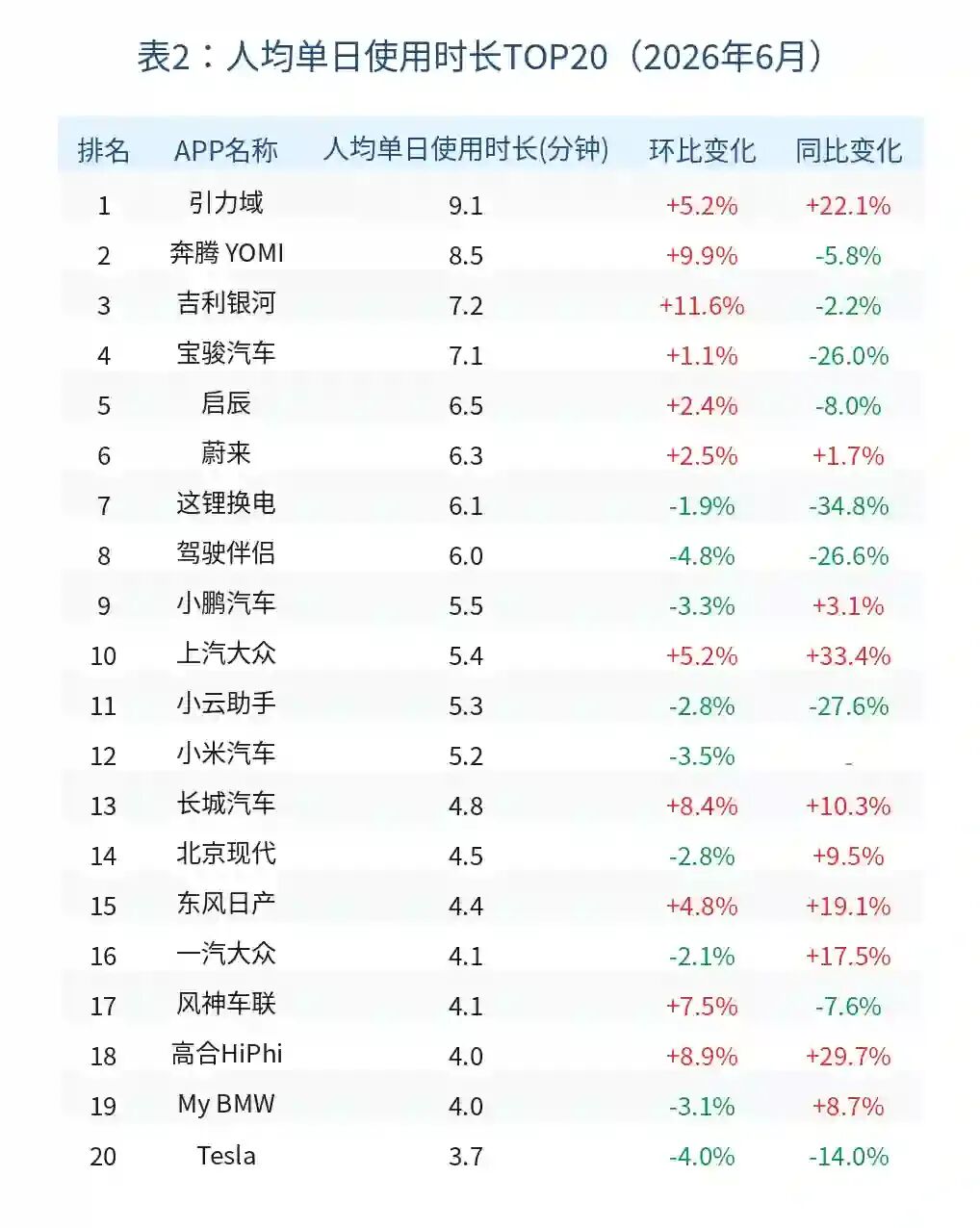
Average daily usage duration per user is the key metric to measure app user quality. In June, Liyiyu took the top spot with 9.1 minutes, far exceeding the industry average of 4.1 minutes. Among the TOP20 apps, the top 10 are mostly new power brands and emerging automotive brands, while traditional OEMs in the bottom 10 are gradually expanding their user base. Observing the ranking structure: Liyiyu (under Changan Automobile) has built high-frequency usage scenarios through a complete service system including test drive/maintenance reservations, car owner community social interactions, and points malls. Leading apps on the list such as Geely Galaxy (7.2 minutes), NIO (6.3 minutes), and Xpeng Motors (5.5 minutes) all excel in "smart cockpit + community operation", and only SAIC Volkswagen (5.4 minutes) among traditional OEMs ranks in the top 10.
IV. Scale and Engagement: Differentiation Between Two Development Paths
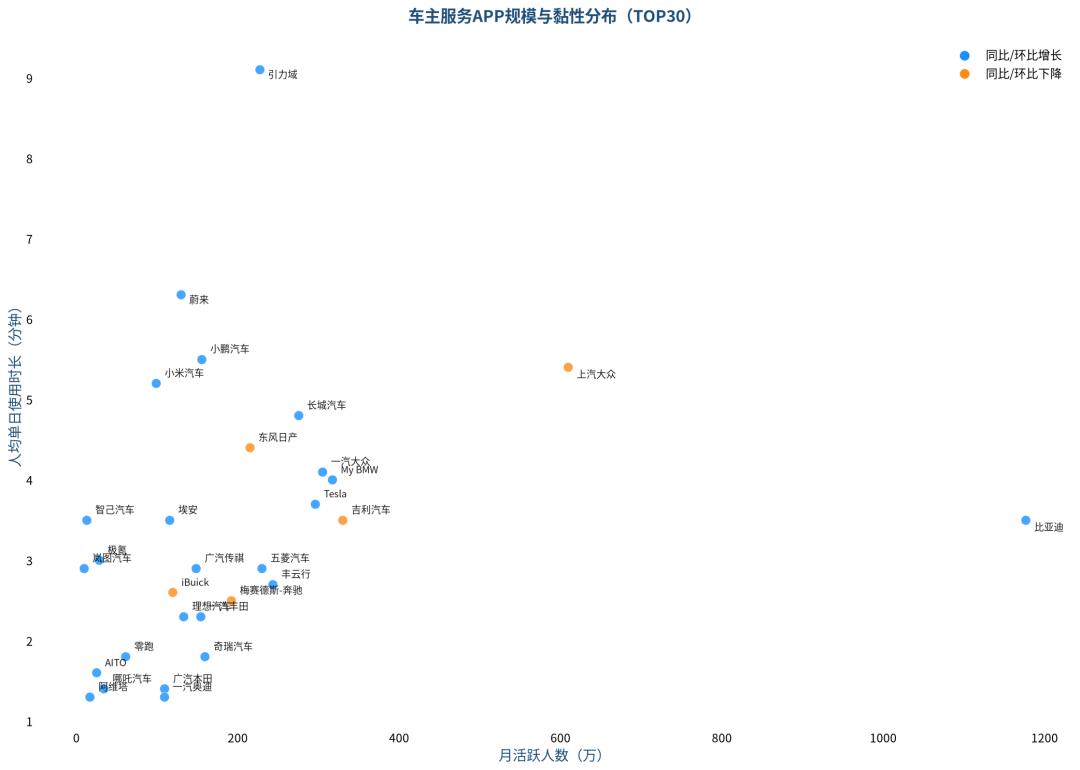
Figure 3: Scale vs Engagement (Blue = Year-on-Year Growth, Orange = Year-on-Year Decline)
Plotting 30 apps in the scale-engagement coordinate system reveals two distinct paths: The high-engagement path is represented by Liyiyu, NIO, Xpeng, and Geely Galaxy, with an average daily usage duration of over 5 minutes per user, where users deeply utilize the vehicle control, community, and service features of the apps. The high-scale path is represented by BYD, SAIC Volkswagen, and Geely Auto, with MAU exceeding millions, but the average daily usage duration per user mostly ranges from 3 to 4 minutes, and the apps primarily serve as a "digital key + basic query" tool.
There is a blank area in the upper right corner of the scatter chart — no app yet combines ultra-high MAU (>5 million) with ultra-high user engagement (>5 minutes). This represents both the industry ceiling and the competitive direction for the next generation of "super apps".
V. New Power Brands vs Traditional OEMs: Two Growth Curves Amid Differentiation
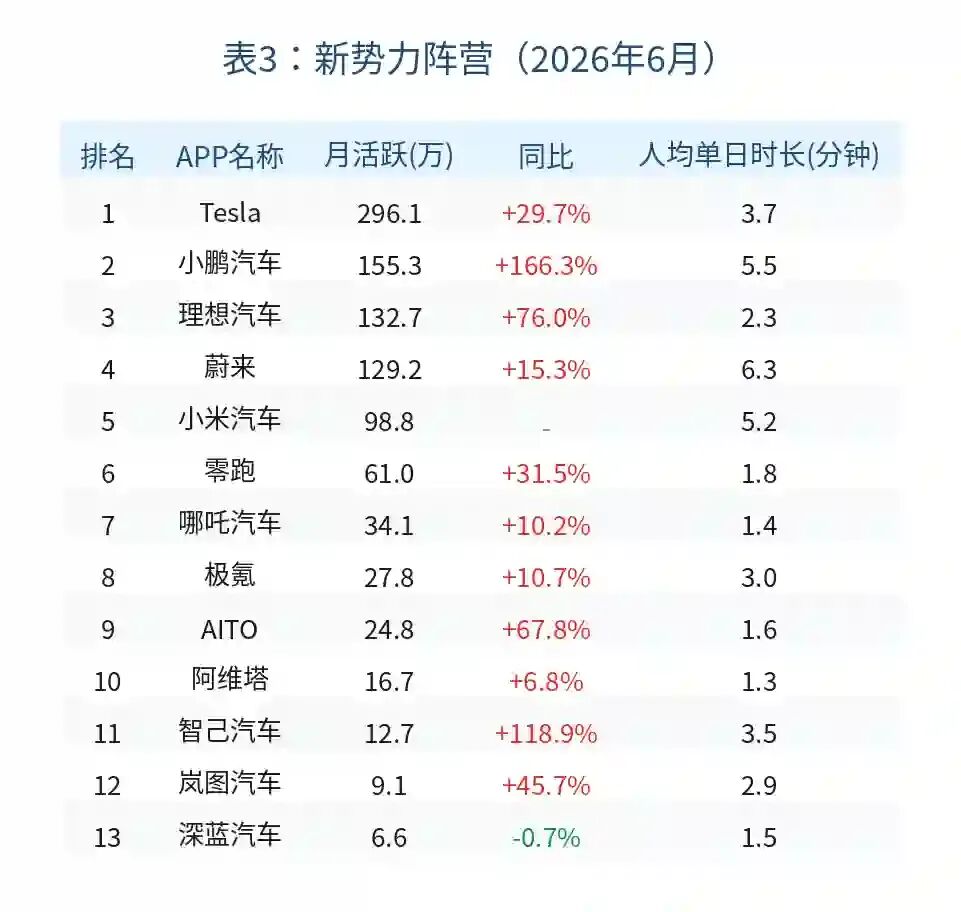
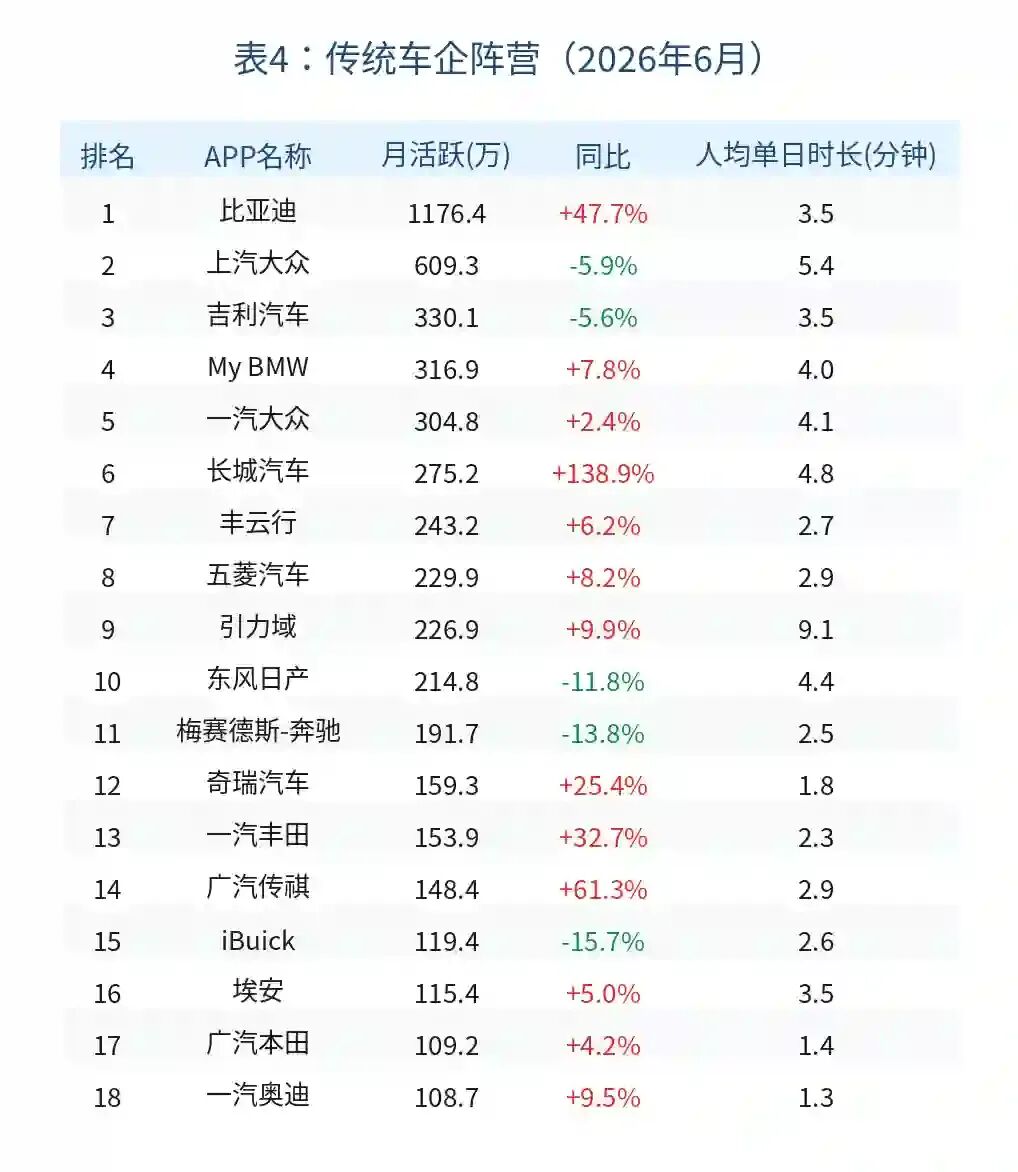
Comparing the two datasets: The new power brand camp generally maintains positive year-on-year growth, and their per-user engagement metrics are significantly higher than those of traditional OEMs. The average daily usage duration per user for Tesla, Xpeng, and NIO all exceeds 3.7 minutes, while most traditional brands fall in the 2-4 minute range. Under the product logic of "software-defined vehicles" adopted by new power brands, the app is an extension of the vehicle experience, rather than a simple after-sales tool.
Among traditional OEMs, SAIC Volkswagen saw a year-on-year decline of 5.9%, Dongfeng Nissan by 11.8%, and Mercedes-Benz by 13.8%, and the MAU of joint-venture brand apps generally faced downward pressure. However, some brands achieved counter-trend growth: FAW Toyota with +32.7% and GAC Trumpchi with +61.3%, showing significant differentiation within the traditional OEM camp as well.
VI. Industry Dynamics in June: OTA Upgrade Wave Drives App Engagement Improvement
In June, multiple automotive OEMs rolled out major OTA updates in a concentrated manner, continuously expanding the functional boundaries of apps and directly driving the improvement of user engagement metrics.
Xpeng Motors released the X-Mind in-vehicle technology framework on June 29, using a predictive world model to create a visual thinking chain for in-vehicle intelligent agents, enabling the autonomous driving system to complete scenario deduction before executing actions. In June, Xpeng's app MAU reached 1.55 million, a year-on-year increase of +166.3%, with an average of 4.6 app launches per user per day, both metrics ranking high among new power brands. A positive cycle has formed between technology releases and increased app activity.
Li Auto released its self-developed foundational large models Maher Mind-Pro and Mind-Edge on June 15, and announced that the new version of its intelligent driving system Maher VLA will be launched in Q3. Although Li Auto's sales in June were 30,895 units, down 14.8% year-on-year, the app MAU still reached 1.327 million, up 76.0% year-on-year, and users' continuous attention to intelligent driving has translated into more app usage.
Arcfox pushed its first OTA update to the Alpha S5 on June 15, introducing the Qwen large model to support end-to-end emotional language interaction and cross-ecosystem queries, adding 5 new features including 4D scene mode, HUD AR navigation, and pet mode. Arcfox's sales in the first half of the year climbed from 5,107 units in January to 25,237 units in June, and its app MAU has entered a rapid growth channel.
SAIC Volkswagen saw the delivery of ID.ERA 9X exceed 9,000 units, and rolled out its first OTA update in June with over 800 interaction experience optimizations. The average daily usage duration per user of its app reached 5.4 minutes, ranking at the top among traditional OEMs, which is consistent with its product strategy of continuous OTA iteration.
NIO recorded a total intelligent assisted driving mileage of nearly 200 million kilometers in May, up 13.7% month-on-month. The urban navigation assisted driving mileage has increased month-on-month for 5 consecutive months, with a compound growth rate of over 20% from January to May. In June, the average daily usage duration per user of NIO's app reached 6.3 minutes, and its "vehicle control + community + service" app architecture is strongly tied to the high-frequency usage of intelligent driving features.
Industry Trend Judgment: Automotive OEM apps are evolving from "remote controls" to "AI intelligent agents". OEMs with continuous OTA capabilities, deep AI integration, and mature community operations have app user engagement significantly higher than the industry average. Liyiyu's top ranking with 9.1 minutes is exactly because it has packaged "reservation services + car owner social interactions + points system" into a complete car-using lifestyle, rather than a single-function utility app. This trend will accelerate in the second half of the year — as more OEMs roll out large-model-driven cockpit upgrades, the strategic value of apps as "mobile AI entry points" will be further highlighted.
This article is from the WeChat public account "Analysys" (ID: enfodesk), authored by Analysys Data, and published with authorization from 36Kr.