Who is abandoning the "box" business?
When a bookstore chooses to move out of a shopping mall, you might dismiss it as a sign of poor management. But when bookstores, outdoor brands, and designer homeware stores all independently shift toward open urban spaces, this becomes a proposition about the very nature of the "closed retail box" itself.
On the morning of July 27th, the One-Way Space store at Hangzhou's Ocean Retail Yue Di Gang mall rolled down its shutters and began the process of clearing out.
This cultural space, once hailed as the "most beautiful bookstore", now holds nothing but scattered cardboard boxes and packing materials. The bookshelves are completely empty, several staff members are tidying up the storefront, and the space that once brimmed with humanistic warmth now looks distinctly disheveled.
With a 2,800-square-meter operating area, this location was One-Way Space's very first flagship store in the Yangtze River Delta region. The final new book launch event was hosted here on July 25th. Recently, all unpacked books in the store were sold at steep discounts. Ironically, this farewell clearance sale became the best book-selling period in the 8-year history of the store.
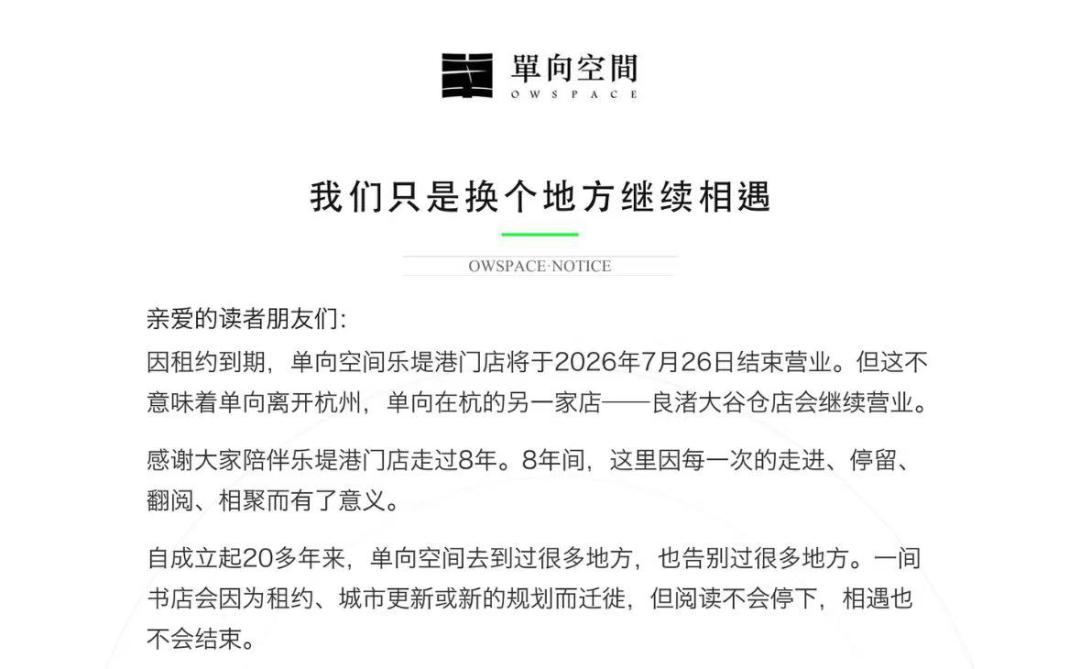
According to the official statement from One-Way Space Hangzhou, the closure of the Yue Di Gang location does not mean the brand is leaving Hangzhou entirely. The One-Way Space store at Liangzhu Grand Warehouse in Hangzhou will remain open for business.
In fact, this is not the first time One-Way Space has withdrawn from a traditional enclosed shopping mall.
In November 2023, the One-Way Space store at Beijing's Chaoyang Joy City announced its closing clearance sale, and officially shut down in December that year. It then relocated to Langyuan Station, a cultural and creative park renovated from old warehouses. From Joy City to Langyuan, and from closing the Yue Di Gang location while retaining the Liangzhu store, One-Way Space's migration path is clear: it is leaving enclosed box-style commercial spaces for open urban public spaces.
And this is just a microcosm of a far larger-scale exodus.
01
The Great Bookstore Exodus
Data from the China Book and Periodical Distribution Association shows that the number of independent physical bookstores across the country plummeted from nearly 30,000 in 2019 to 16,800 in 2024, a 44% drop over 5 years, with over 65% of independent bookstores operating at a loss. This is the hidden survival crisis facing the entire offline physical bookstore industry, which we will not expand on here. We will focus only on those bookstores that are still operating normally but have chosen to leave enclosed mall spaces.
On October 8, 2024, the Tsutaya Books store at Xi'an's Maike Center closed. When this Japanese "most beautiful bookstore" entered China in April 2020, He Jun, then head of project development at Tsutaya Investment (Shanghai), stated that the mid-term plan was to open 1,100 stores across China (including 100 large-scale Tsutaya Books locations and 1,000 medium and small-sized TSUTAYA BOOKSTORE outlets).
But by 2025, it had closed 4 consecutive stores in mainland China — Xi'an (October 2024), Shanghai MOHO (April 2025), Tianjin Isetan (March 2025), and Chengdu Yanlord Landmark (August 2025).
The number of domestic Tsutaya Books locations has shrunk from a peak of 15 to 11. As of now, the "mid-term plan" of 1,100 stores that was once proposed has become a distant, unreachable goal.
It is worth noting that all 4 Tsutaya Books locations closed in 2025 were situated in traditional enclosed shopping malls. Among the 11 currently operating Tsutaya Books stores, 7 are located in non-standard commercial spaces.
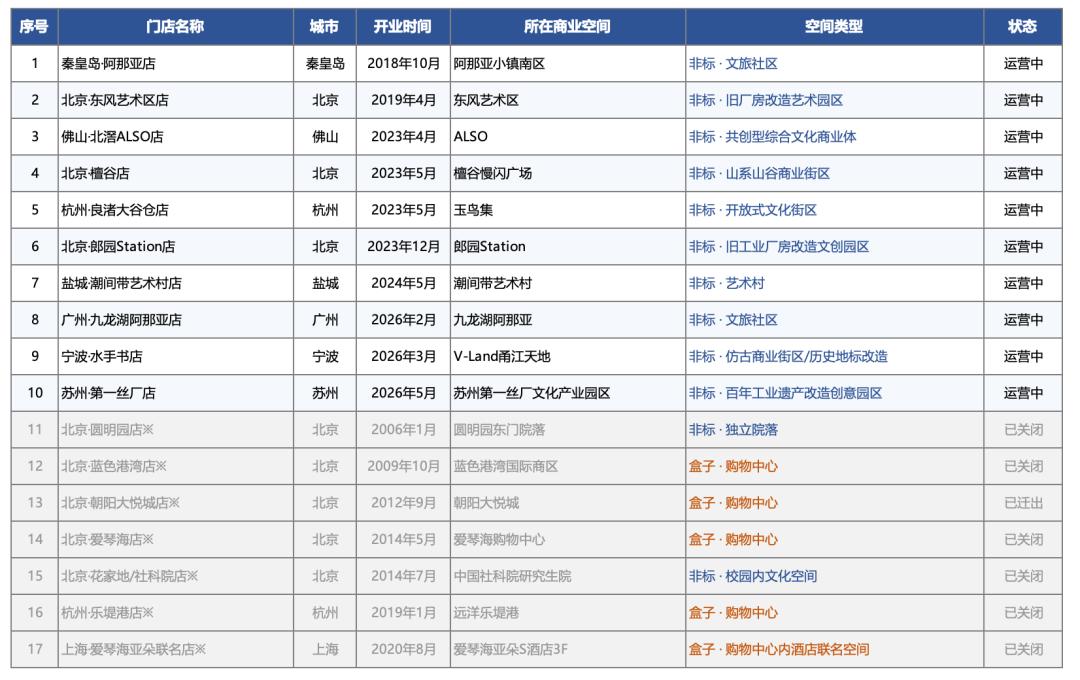
Distribution of One-Way Space's Domestic Stores
One-Way Space's preference for this shift is even more pronounced. Following the closure of the Hangzhou Yue Di Gang store on July 26, all 10 of One-Way Space's currently operating domestic stores are located in non-standard commercial spaces.
In August 2023, One-Way Space opened a bookstore in Tokyo, Japan. It still did not choose a shopping mall or department store, but instead found an independent street-facing storefront in Ginza. Though only 120 square meters in size, the space is elegantly designed and stocks a large selection of Chinese-language books.
In traditional commercial spaces, bookstores were once recruited as a tool to enhance the cultural atmosphere, enjoying relatively low rents in the early stages. But when the lease expires, rents return to market rates, and the per-square-foot revenue of a bookstore can never compete with that of retail or dining outlets.
The more fundamental issue is that the fast-paced foot traffic flow of enclosed mall spaces inherently clashes with the slow, contemplative vibe that a bookstore requires.
02
Who Else Is Leaving?
During a conversation with several friends a while back, a project director of a domestic chain shopping mall candidly admitted that attracting tenants is getting increasingly difficult. Many of the characterful, well-curated brands they had targeted have explicitly stated they will no longer move into traditional enclosed shopping malls. The most typical of these are outdoor sports brands.
In recent years, the outdoor consumption trend has continued to boom across China, and the lightweight, laid-back outdoor lifestyle has become the mainstream consumer preference among young people. Leveraging their natural, relaxed atmosphere, strong immersive display capabilities, and trendy social attributes, professional outdoor brands once became highly sought-after tenants for shopping malls. They moved into the prime ground-floor zones of major enclosed malls, becoming key business formats that drew foot traffic to the malls.
However, since 2025, from global sports giants to emerging trail running brands, a collective migration toward street-facing locations, standalone buildings, and creative parks has been quietly taking place.
Shanghai's Anfu Road is a one-way street less than 900 meters long. In 2025, this old street, which has long been a famous "Citywalk sanctuary" on Xiaohongshu, welcomed two high-profile tenants from international sports brands.
First, on May 20th, Adidas' first global Originals flagship store opened at No. 322 Anfu Road. The Originals global flagship store is Adidas' highest-level store format in the sports fashion segment, second only to the brand's global centers.
A month later on June 28th, top French outdoor brand Salomon turned a century-old 3-story white French-style villa in the middle section of Anfu Road into their experimental retail space in China. In fact, as early as April 2024, Salomon had opened their immersive outdoor experience store at Chengdu Luxelakes CPI.
On May 6, 2025, Norwegian outdoor brand GORE®WEAR launched its first global brand flagship store in a ski culture-themed space in Shanghai's Huangpu District. The space features an exhibition area on Danish skiing history, and regularly hosts film screenings, skills workshops, and brand events — all ideal platforms for the brand to tell its full story to consumers.
In November 2025, British cycling lifestyle brand Rapha opened its first mainland China store on Donghu Road in Shanghai's Xuhui District. They named the store "Clubhouse": it spans two floors, with a coffee bar and cycling apparel display area on the first floor, and a cycling gear zone and experience area on the second. Outside the store, there is an outdoor lounge area and bike racks, where cyclists can stop for a coffee after a ride and then continue exploring the tree-lined neighborhoods nearby. The store organizes 3 to 4 morning cycling activities every week: what they sell is no longer just cycling apparel, but the full lifestyle of the cycling community.
Similarly, the store expansion track of emerging trail running brand Outopia clearly shows a trend of "gradually moving away from enclosed mall spaces". In September 2022, their first store opened at Shanghai Kerry Parkside, and the following year they moved into Shanghai HKRI Taikoo Hui. But by 2024, their third store was located at Chengdu Here CyPARK, a new concept cycling-themed commercial park with no enclosed indoor corridors, where running tracks and greenways run through the entire space.
For outdoor brands, which rely heavily on deep connections with their users, open spaces, personalized decor, and independent, flexible operating models are absolutely essential — elements that traditional commercial spaces simply cannot provide.
These brands no longer follow the flow of random foot traffic; they follow the right scenarios, and the right communities.
At the same time, a large number of independent designer homeware brands and high-end lifestyle multi-brand stores are also withdrawing from traditional commercial spaces.
In March 2022, designer homeware brand ziinlife relocated its Beijing offline flagship store from a traditional commercial district to Langyuan Station. Li Fei, the store manager, said, "This kind of structure and design could never be achieved inside a traditional shopping mall." She further explained the logic behind the site selection: traditional malls have high rent costs, and while foot traffic is high, very few visitors are part of the brand's target audience. The park gives the brand far more freedom, fully embracing its unique, independent identity.
Before deciding to move into Langyuan, Li Fei visited nearly 20 different parks across Beijing. The final Langyuan store features a 9-meter-high ceiling, a red brick exterior wall, and a two-story independent space — architectural qualities that no amount of money could ever buy in an enclosed mall.
The homeware sector centers on immersive in-home scenario experiences, which require natural lighting, open, unobstructed spaces, and a courtyard-like atmosphere. The floor height, load-bearing limits, fire safety codes, and exterior facade restrictions of enclosed malls inherently make them unsuitable for business formats that demand unique, independent architectural expression.
03
The Misalignment Between the "Efficiency Model" and "Slow Business Formats"
Clearly, high rent is not the only reason these brands are leaving. The deeper contradiction lies in a fundamental misalignment of commercial logic.
Enclosed mall spaces have always followed an efficiency model: standardized spaces, standardized foot traffic flows, and standardized per-square-foot revenue assessments. This is naturally well-suited for high-frequency, high-turnover, high-conversion retail formats, but extremely unfriendly to business formats that require a "slow" pace.
This also leads consumers to behave very differently in these two distinct types of spaces.
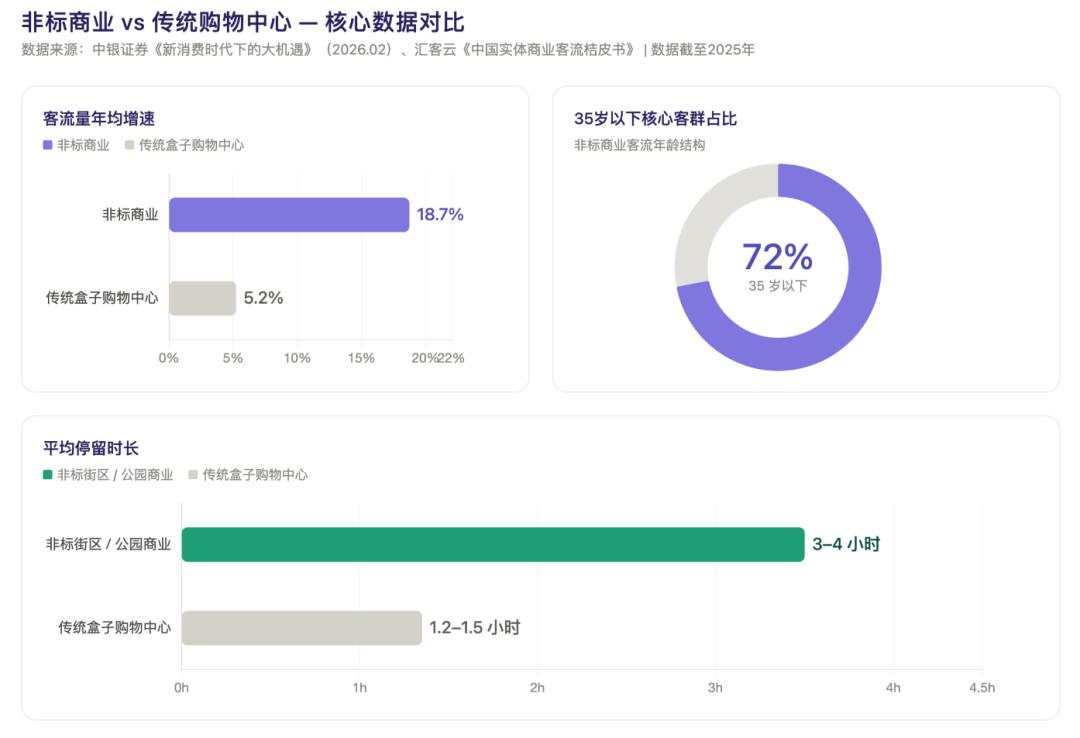
Data Comparison: Non-Standard Commercial Spaces vs. Traditional Shopping Malls
According to an industry report released by BOC International in February this year, in 2025, the foot traffic growth rate of traditional enclosed shopping malls was 5.2%, while that of non-standard commercial spaces reached 18.7% — 3.6 times the former. In terms of average dwell time, visitors to non-standard pedestrian streets or park commercial spaces stay for 3 to 4 hours, wandering around in a relaxed, unhurried state. In contrast, the average dwell time in traditional enclosed shopping malls is only 1.2 to 1.5 hours, with visitors usually having very clear, specific shopping goals.
Enclosed malls function more like standardized containers, while non-standard commercial spaces are building competitive barriers through differentiated content and scenarios. This difference directly determines the choices of many brands and business formats.
A 2025 Q3 Chengdu real estate market report from CBRE put it bluntly: "The evolution of consumer scenarios and consumption structures has led to continuous lease terminations by traditional anchor retail tenants, such as gyms, cinemas, and bookstores."
Non-standard commercial spaces are becoming the new gathering place for these "exodus brands".
Open layouts, high frequency of content updates, community-focused operations, and tenant recruitment strategies tailored to each individual location are the common traits of these projects. They do not pursue brand standardization, but instead pursue uniqueness and irreplicability — exactly what enclosed malls lack the most.
04
It Is Not the End of the "Box"
But the Rules of the Game Have Changed
That said, traditional enclosed commercial spaces are not facing their doomsday, and enclosed malls will never disappear completely.
It is just that the old commercial logic of stuffing every business format into a single enclosed box and managing everything with uniform standards is being dismantled layer by layer. In today's commercial market, there is no such thing as a "one-size-fits-all mall", nor any business format that can dominate all locations.
Facing this trend, traditional shopping malls do not need to deliberately chase physical innovation for the sake of being "non-standard" while neglecting operational quality. Cinema chains, large family entertainment centers, full-range supermarkets, fast fashion chains, fine jewelry stores, mass beauty multi-brand stores, chain full-service restaurants, consumer electronics retailers, and standard light luxury stores all rely heavily on the enclosed safety, high foot traffic concentration, and complete supporting facilities of enclosed malls, and cannot survive independently in non-standard street-side locations. These formats form the fundamental base of enclosed mall business.
Blindly recruiting experience-oriented formats will only lead to frequent store closures, damaging the mall's reputation and wasting valuable retail space resources.
By holding onto this fundamental base, maintaining strict quality control, and acting as a trusted guarantor between merchants and consumers, enclosed malls still have a viable path forward. After all, there is currently only one Pangdonglai department store in the entire country.
In the future, the core of commercial competition will ultimately come down to scenario matching, target audience matching, and business logic matching. The clear boundaries of business format migration are not only the result of market survival of the fittest, but also the new operating rules that all commercial practitioners must follow.
This article is from the WeChat Official Account "New Travel Media", written by Yuki, and republished with authorization from 36Kr.