AI "revolutionizes" the entertainment industry, can trendy toys support Yuehua's second growth curve?
In July 2026, the second season of iQiyi variety show Sisters in Charge featuring Du Hua premiered, where several of her blunt remarks quickly went viral across social media platforms.
Facing the camera and her own artists, she stated unreservedly: "AI will not replace top-tier artists, but it will replace you (mid-to-lower tier artists)." She compared AI to the "Industrial Revolution," asserting that the decline in talent remuneration has become an irreversible trend. This was not a variety show guest manufacturing talking points, but a veteran industry leader with 20 years of experience describing the industry transformation she has witnessed.
Data supports her pessimistic outlook.
Comprehensive media information from Tianyancha shows that the number of film crews in Hengdian has plummeted to one-fifth of the level two years ago, while 50-60% of music festivals have been canceled. Du Hua calculated the accounts for artists on the show: for a single work engagement, the photography costs 10,000 yuan, makeup and hair styling cost 5,000 yuan, plus labor costs for agents, finance staff, and legal personnel, leaving artists with only a few thousand yuan in final take-home revenue. Yuehua Entertainment's girl group business is also in the exploration phase: nearly 10 million yuan has been invested in two albums, while revenue settled from streaming platforms is still gradually increasing.
Du Hua frankly admitted on the show that the ceiling of the traditional idol economy has become visible.
But the impact of AI short dramas has hit even harder.
AI Short Dramas "Revolutionize" the Entertainment Industry, Urgent Transformation Is Needed
Du Hua revealed on the show that the production cost of AI short dramas is about 5,000 yuan per minute, and a three-person team can produce 200 works in one week.
What does this mean?
It means that the cost for a traditional short drama crew of dozens of people to film in Hengdian for a whole month can be covered by an AI team in just one week, with an output dozens of times higher. Those shrinking crews, transitioning lighting technicians, photographers, and makeup artists in Hengdian are facing a real "Industrial Revolution" — not a metaphor, but a tangible reality.
Yuehua Entertainment is not waiting passively for decline.
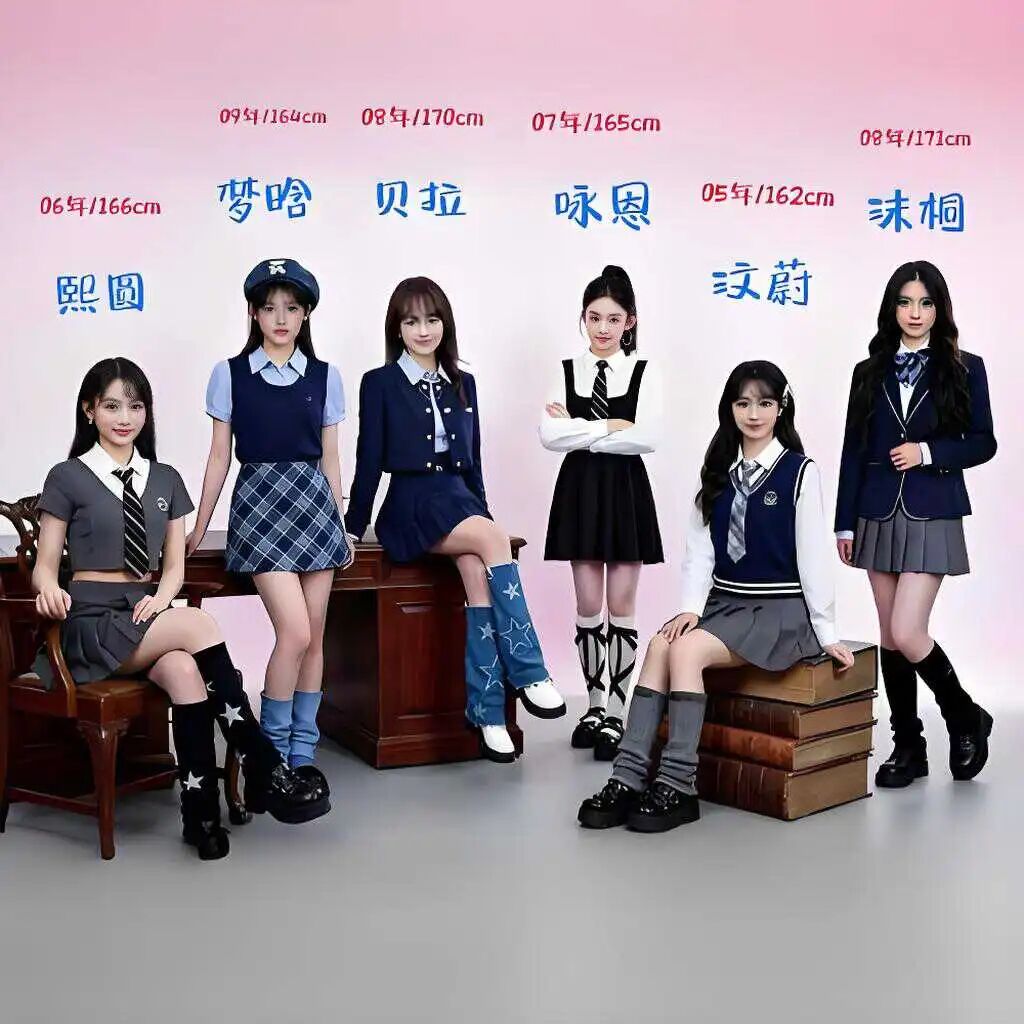
On March 2, 2026, HeyDream officially debuted, billed as "Asia's first AI-driven real-person girl group." The six real members — Wen Wei, Xi Yuan, Yong En, Mo Tong, Bella, and Meng Han — are backed by an AI creation system, with all promotional materials and visual content generated by AI. The dance moves, virtual scenes, and lighting effects in the debut announcement video were all designed by AI algorithms.
Yuehua is also working on another more interesting initiative: the YH TOYS ROBO SHOP robotic retail stores, with over 50 locations already opened across China, concentrated in core business districts such as Chaoyang Joy City in Beijing and Deji Plaza in Nanjing. Robots serve as salesclerks, selling trendy toy IP products. The ambition behind this layout is clear — AI is replacing not just content production labor, but also human labor costs in the retail sector. If a store only needs one robot plus one restocking staff, while a traditional trendy toy store requires three to four sales guides, the cost difference is self-evident.
Internal restructuring is also advancing simultaneously.
Yuehua's long-form video production team has been merged into the short video department, and four new AI business teams have been established, covering AI short videos, AI manhua dramas, and short dramas. The company is also collaborating with Aijin Studio to cultivate "artists with distinct cultural attributes." Du Hua is moving fast and launching frequent initiatives. These new businesses are still in the investment phase, but the 45% gross margin of trendy toys has already proven their profit potential.
In the 2025 financial report, revenue from trendy toy operations accounted for 4.1% of total annual revenue.
The direction is clear.
Can Trendy Toys Support the Second Growth Curve?
WAKUKU is one of the few bright spots in Yuehua's trendy toy business. This single IP can generate 129 million yuan in quarterly revenue, and among Yuehua's total 18 IPs, WAKUKU alone contributes nearly three-quarters of the total revenue.
Comprehensive information from Tianyancha and the 2025 annual report show that the trendy toy business recorded its first revenue of 37.13 million yuan, with a gross margin as high as 45.0% — a figure even higher than the 22.8% gross margin of the artist management business. In other words, excluding WAKUKU, the remaining 17 IPs combined contribute less than 10 million yuan in revenue. This is far from reaching the scale of Pop Mart's matrix of multiple hit IPs such as Molly, Dimoo, and Skullpanda.
But WAKUKU's market performance is indeed outstanding. Its "Pangdada" series sold out within 2 hours of its first launch at MINISO, driving a 90.3% month-on-month surge in store sales. The Wang Yibo co-branded blind box, priced at 199 yuan, sold out in 48 hours, with a premium exceeding 300% in the secondary market. The product identical to Yu Shuxin's favorite, originally priced at 99 yuan, was speculated to sell for 3,000 yuan, a 30-fold increase. These figures sound impressive, but we need to analyze them in depth.
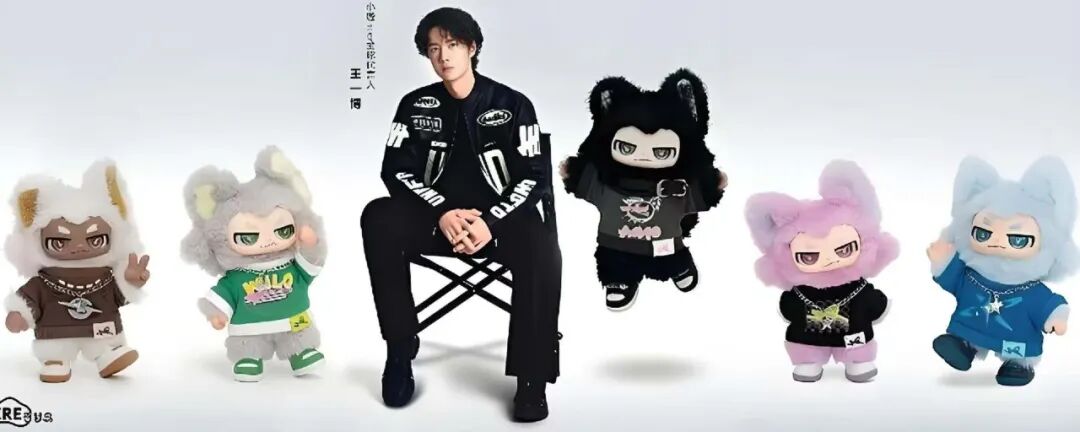
First of all, WAKUKU's hot sales largely rely on the star same-style effect. The Wang Yibo co-branded blind box selling out instantly cannot be separated from Wang Yibo's powerful fan base effect. The Yu Shuxin same-style product being speculated to a 30-fold premium — is it purely due to product scarcity? This forms a perfect closed loop with Yuehua's core problem: the trendy toy business is essentially a monetization channel for artist influence at present. WAKUKU is evolving from a star-associated product to an independent IP, a process that requires time and more product iterations.
Secondly, trendy toy revenue accounts for only 4.1% of total annual revenue. While WAKUKU's quarterly revenue of 129 million yuan sounds considerable, it should be noted that Yuehua's total annual revenue in 2025 was 907 million yuan, meaning the absolute revenue contributed by trendy toys is approximately 37 million yuan. Pop Mart's annual revenue exceeding 10 billion yuan in 2024 provides a target for Yuehua to chase. Yuehua currently lacks the scale to build a "second growth curve" relying on trendy toys, with a gap of an order of magnitude.
Yuehua has also taken new actions in the trendy toy sector. Its collaboration with Quantum Song led to a 285% surge in the partner's stock price in three months, indicating that the capital market is optimistic about the potential of this direction. The company is also partnering with Huaqiang Fantawild to develop cultural tourism projects, attempting to extend IP influence from retail to offline experiences. However, these collaborations are still in the early stages, and it will take at least the second half of 2026 or even later to see whether they can be transformed into sustainable revenue.
The more than 50 YH TOYS ROBO SHOP stores are another key asset. Rent in core business districts is not cheap, and the procurement and maintenance of robotic equipment also incur costs. A robot that sells trendy toys is not the same as an ordinary vending machine — it requires an interactive interface, inventory management, payment systems, and continuous content updates. Whether the single-store model can achieve positive cash flow will determine whether this business becomes an asset or a burden. Yuehua has not disclosed per-store revenue data, but based on the current 4.1% share of trendy toys in total revenue, the more than 50 stores are still in the market cultivation phase, and large-scale profitability will take time.
The competitive landscape of the trendy toy industry is even more brutal than that of artist management. Pop Mart has already captured user mindshare, with TOPTOY and 52TOYS closely chasing behind, while MINISO is also increasing investment in self-developed IPs.
What is Yuehua's advantage in the trendy toy business? It is its artist resources. But this advantage itself is a double-edged sword — artists can bring traffic, which is Yuehua's unique resource endowment. The transition from "leveraging star power" to "IP with inherent traffic" requires a process — Pop Mart also achieved widespread popularity through social media viral topics. WAKUKU has already proven its market recognition, and the next step is to enrich the product line and reduce dependence on individual artists.
Du Hua defined 2026 as the "Year of Transformation" — covering AI girl groups, robotic retail stores, and trendy toy production lines. This is a choice based on Du Hua's sensitive business acumen, making her more clear-headed than most industry peers.
Those remarks she made on the variety show — "AI will replace you," "The decline in talent remuneration is a foregone conclusion," "The tragic situation where only one-fifth of Hengdian's film crews remain" — are not a boss giving empty motivational speeches to employees, but a person at the center of the storm describing the future she sees. Clear-headedness is the first step. The initial business model of the AI girl group has been proven, the expansion speed of robotic stores meets expectations, and the 45% gross margin of trendy toys demonstrates profitability — these signals indicate that Du Hua is heading in the right direction, and the next step is to prove her large-scale operational capabilities.
In this industry, the only certainty is uncertainty. Artists will lose popularity, technology will iterate, and the capital market will change its attitude. When the proportion of new business revenue rises from 4.1% to 10%, and then to 20%, the stock price of HK$1.98 may no longer be the end of Yuehua's story, but a brand new starting point.
This article is from the WeChat public account "Zero State LT", written by Zhang Qian, and published with authorization from 36Kr.