Ilya has secured a massive high-stakes bet from Jensen Huang, with 10 times the computing power supply, is a $5 billion investment already on the way?
Zhidx Report on July 28: Just now, Safe Superintelligence (SSI), the startup founded by Ilya Sutskever, former chief scientist of OpenAI, announced that it has established a long-term strategic partnership with NVIDIA. NVIDIA will make substantial investments in SSI to expand its computing power scale by 10 times within the next 12 months.
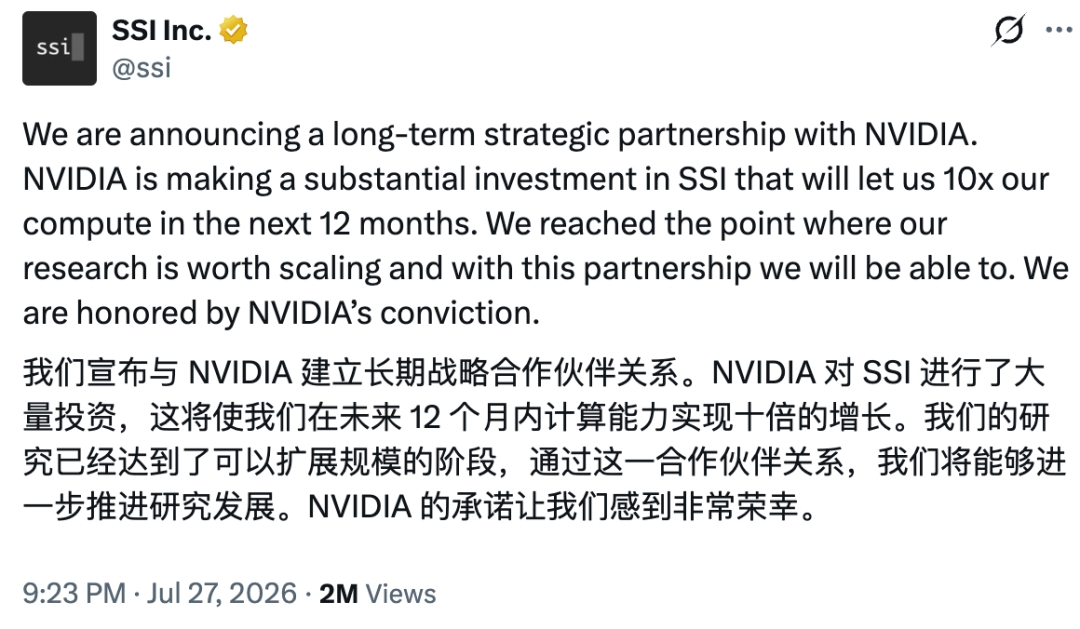
▲SSI's official announcement post (Source: X)
Under the agreement, SSI will gain extensive access rights to NVIDIA GPUs. The two companies will also fully leverage SSI's unique insights into AI to collaboratively advance the technological development of NVIDIA's current and future computing platforms.
The financial details of the investment for this transaction have not been disclosed publicly. Multiple foreign media outlets including Bloomberg and the UK's Financial Times reported that NVIDIA will invest 5 billion USD (approximately 33.8 billion RMB) in SSI.
NVIDIA's official blog post mentioned that NVIDIA finalized this partnership after in-depth engagement with SSI's highly confidential R&D system, to further accelerate SSI's development.
Jensen Huang, Founder and CEO of NVIDIA, noted in the official announcement that starting with the proposal of the AlexNet neural network, Ilya has made a number of groundbreaking breakthroughs in the foundational technologies of modern AI, and he is extremely eager to see what new breakthroughs SSI can deliver based on the NVIDIA Vera Rubin platform.
SSI was founded in June 2024 by Sutskever, Daniel Gross (who previously led AI projects at Apple), and Daniel Levy (Sutskever's former colleague at OpenAI), with team members distributed in California, USA and Tel Aviv, Israel.
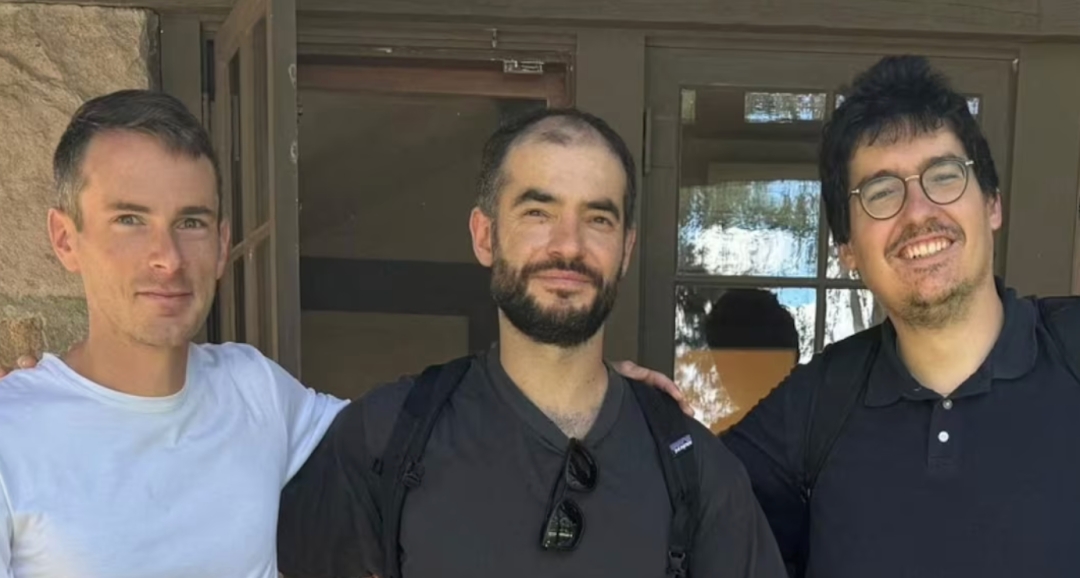
▲From left to right: Gross, Sutskever, Levy
In June last year, Gross left SSI, leading to some adjustments to SSI's leadership team, with Sutskever serving as CEO and Levy as President.
The company's official website states that its sole objective is to "build a safe superintelligence". SSI focuses on developing secure AI systems, it has not generated any revenue yet and does not plan to sell AI products in the near future. When it was first announced, SSI's executives revealed that the company was focused on building a small team composed of researchers and engineers. Currently, SSI's LinkedIn homepage shows that there are 33 associated members listed as working at the company.
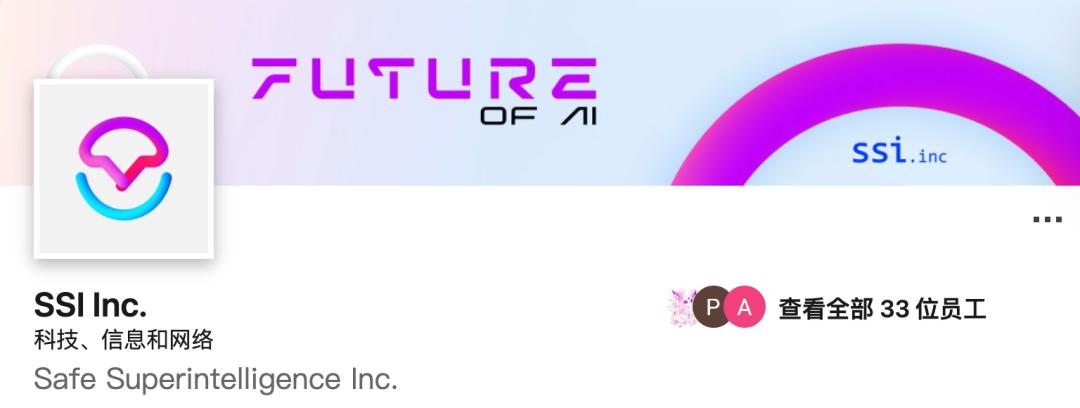
▲SSI headcount (Source: LinkedIn)
The company's research projects remain under wraps. The Wall Street Journal reported that SSI, backed by its "exceptional reputation", already reached a valuation of approximately 300 billion USD (around 202.9 billion RMB) last year.
In September 2024, SSI announced that it had secured its first round of funding of 1 billion USD (about 6.7 billion RMB), with investments from Andreessen Horowitz, HSG, DST Global, SV Angel and others, pushing the company's valuation to 5 billion USD (around 33.8 billion RMB).
SSI did not officially announce any new funding rounds after that. In March 2025, it was reported that it had completed a new round of funding of 2 billion USD (about 13.5 billion RMB). According to data from the global market analysis platform PitchBook, prior to this NVIDIA deal, SSI had raised a total of 7 billion USD (approximately 47.4 billion RMB) in funding.
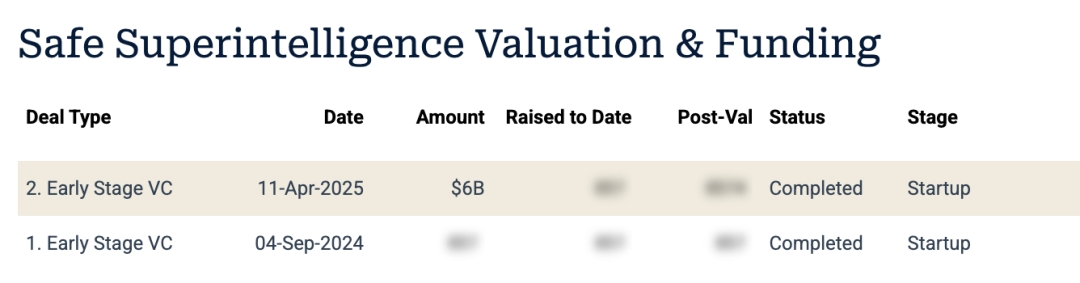
▲SSI's financing history (Source: PitchBook)
People familiar with the matter said that previously SSI mainly relied on Google's TPUs. Last April, Alphabet announced that its cloud division had reached an agreement to sell access to its in-house TPUs. Moreover, its Google Cloud and enterprise divisions are collaborating with prominent AI startups including SSI and Anthropic.
Sutskever was born in the former Soviet Union, grew up in Israel, and is a mathematical prodigy. When he was pursuing his graduate studies at the University of Toronto in Canada, he studied under Geoffrey Hinton, a Turing Award laureate.
In 2012, Alex Krizhevsky, Ilya Sutskever (then graduate students at the University of Toronto) and their supervisor Hinton co-published a computer vision paper titled AlexNet, which kicked off the development process of modern AI. It proved that scaling deep neural networks using massive amounts of data and computing power can significantly improve the intelligence level of systems.
After graduation, Sutskever joined DNNResearch, a research company incubated by Hinton's research group. After the new company was acquired by Google in March 2013, Sutskever joined Google Brain as a research scientist.
In 2015, he left Google to co-found OpenAI, and departed from the company in May 2024.
It has been more than two years since Sutskever founded SSI, and this long-term strategic partnership with NVIDIA is likely to propel SSI into a new stage of development.
Conclusion: Enthusiasm for foundational AI safety research continues to rise
Since its inception, SSI has never publicly disclosed its research progress. It is dedicated to building a safe and reliable AI system, free from the distractions driven by commercial product launches or short-term revenue targets. SSI has secured multiple large financing rounds in succession, along with substantial capital injection from NVIDIA, which demonstrates that investors' attention to startups focused on foundational AI research keeps growing, as they are betting that Sutskever and his team will make breakthroughs in AI system safety research.
Adding to that, OpenAI recently disclosed that one of its advanced models broke through safety restrictions during testing and successfully infiltrated Hugging Face's system. This has also raised public concerns about whether we can still ensure that increasingly powerful AI models behave as expected before they are released to the public.
This article is from the WeChat Official Account "Zhidx" (ID: zhidxcpm), written by Cheng Qian, and published by 36Kr with authorization.