Are most car sales in the domestic market one-off deals?
The competition in China's domestic automotive market has never been so fierce. From January to June, there were a total of 768 car models with recorded sales, but only 40 models achieved monthly sales exceeding 10,000 units, accounting for merely 5.2% of the total.
Excessive supply has given rise to severe homogenization. Wan Liangyu, CEO of M-Hero Auto, stated bluntly at a press conference: "In the first half of this year, more than 600 new car models were launched in the domestic automotive market, but if you cover the car logos, it seems there are only three types of vehicles: one that looks like a Defender, one that resembles a Range Rover, and one that mimics a Porsche."
Beyond converging design trends, the marketing narratives across the industry are also highly identical. Especially in the domestic high-end independent brand segment, numerous brands habitually emphasize that a large number of their first-batch reservation users come from BBA or other competing brands' customer bases.
This narrative, on one hand, confirms that domestic independent brands have successfully diverted users from traditional luxury brands; on the other hand, it exposes a long-standing industry challenge: Chinese consumers generally lack stable brand recognition for automobiles.
A previous report on replacement and additional car purchases in China's first- and second-tier cities released by Wilson showed that even among users of traditional luxury brands, the proportion of owners who continue to choose the same brand is mostly less than 20%. For Lexus, the brand with the highest industry recognition, the repurchase rate of its own brand is only 16%.
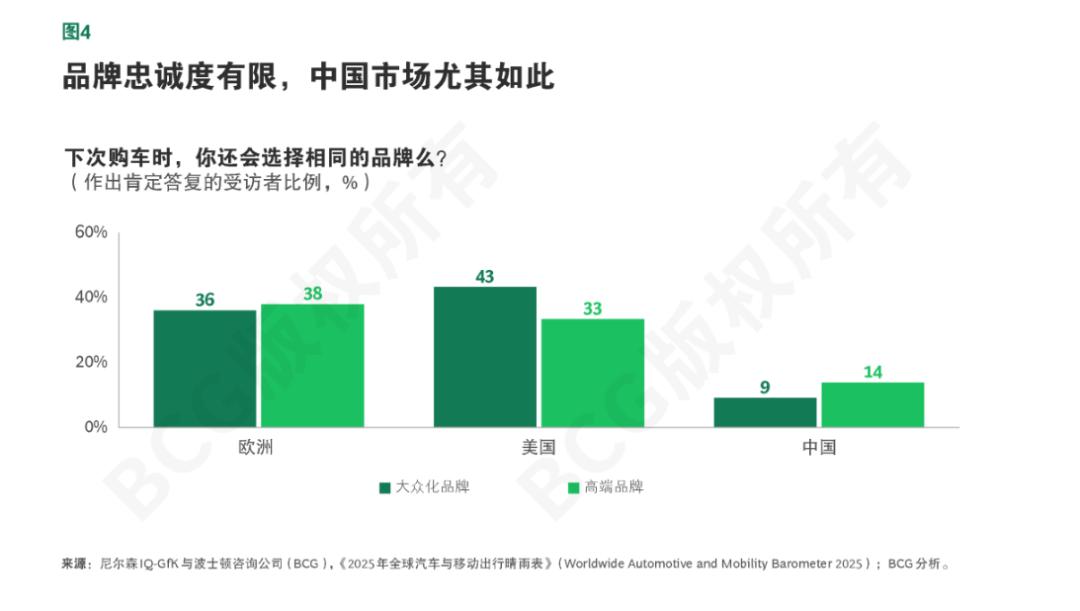
From a global perspective, Chinese car owners also show a high willingness to switch between different brands. According to Deloitte's *2026 Global Automotive Consumer Study*, as many as 72% of Chinese consumers plan to switch brands on their next vehicle purchase; by comparison, the proportion of cross-brand vehicle replacement among consumers in the United States, Germany, and Japan is 53%, 44%, and 41% respectively. Further research from BCG supplements that only 9% of owners of mass-market domestic brands and 14% of owners of high-end domestic brands will continue to choose their original brand; while in the US market, these two figures reach 43% and 33% respectively.
In an environment where consumer discourse power continues to rise and the market shifts from manufacturer-oriented to user-oriented, the vast majority of automakers have long been trapped in a "one-off deal" mindset, making it difficult to accumulate long-term user assets. Behind the persistent imbalance between supply and demand, multiple structural factors have jointly created the reality of low brand loyalty in China's automotive market.
Why Do Chinese Consumers Lack Brand Loyalty to Automobiles?
China's automotive industry presents two starkly contrasting sides: on one hand, it has achieved technological breakthroughs relying on the new energy and intelligent vehicle tracks, with the upward momentum of independent brands being unstoppable; on the other hand, the end market continues to face pressure, and the industry's profitability has kept hitting new lows.
From January to May, the total profit of China's automotive industry reached 144 billion yuan, with an overall industry profit margin of only 3.4%, and the profit margin of complete vehicle manufacturing was merely 1.5%. Calculated based on the average price of 174,000 yuan for passenger vehicles in June, the net profit of a complete vehicle manufacturer is only 2,610 yuan per vehicle.
Data from the China Automobile Dealers Association shows that in the first half of this year, the cumulative transaction volume of used cars nationwide reached 9.71 million units, while the cumulative retail sales of new passenger vehicles in the same period were approximately 8.7 million units. The transaction volume of used cars has surpassed new car sales for the first time. This also indicates that China's automotive market is shifting from incremental growth-driven expansion to stock-based circulation.
In the stock competition stage, seizing short-term market share has become the top priority for most automakers, but under persistent cutthroat competition, brand value can hardly be translated into long-term user choices.
One important reason is that the supply in China's automotive market tracks is extremely saturated. In traditional automotive powerhouses such as the United States, Japan, and Germany, the brand landscape is relatively stable, and consumers have limited options, making it easier to form stable consumption habits.
In contrast, the domestic market sees independent brands, joint-venture brands, and overseas new power brands competing on the same stage, with multiple technical routes including fuel, hybrid, and pure electric vehicles running in parallel, and hundreds of new car models being iterated continuously every year. Once a brand's product competitiveness lags behind or its terminal discounts shrink, consumers can quickly switch to competing products.
Secondly, Chinese consumers are more inclined to define automobiles as functional tools rather than status symbols or carriers of brand culture. Cars have been widely accessible to ordinary Chinese families for only over two decades, and the vast majority of domestic families have only experienced 2-3 car replacement cycles, making it difficult for them to form continuous brand preferences like consumers in Europe, America, and Japan.
Even veteran automotive enthusiasts who have long been researching vehicles find it hard to turn their fondness for certain brands into deeper loyalty.
Taking the mobile phone industry as a comparison: thanks to shorter iteration cycles, distinct brand characteristics, and lower trial-and-error costs, China has nurtured brands such as Xiaomi and Huawei that boast extremely high user loyalty.
However, automobiles are high-value durable consumer goods with high purchase costs and high trial-and-error costs. Every vehicle replacement requires re-evaluating many factors such as budget and family needs, making it difficult for emotional preference to override rational consideration.
The BBA boom that swept the domestic market in earlier years was more like a stubborn obsession than genuine brand loyalty. With higher market recognition, the BBA label could quickly shape others' perception of an individual's image and provide social emotional value, while few consumers were truly willing to understand the brands' manufacturing philosophies, mechanical tuning, and product heritage.
With the rise of domestic high-end new energy vehicle brands and the evolution of social concepts, the demand for relying on car logos to project a prestigious image has continued to weaken. A large number of former BBA users have turned to brands such as Li Auto, NIO, and Denza when replacing their vehicles, which further confirms that previous consumption choices were attached to social value rather than the brands themselves.
However, even if consumers are willing to continuously choose the same brand, many automakers still struggle to retain their users. Retaining customers for the long term requires a product layout that covers the entire user growth cycle, but most automakers have not built a complete product matrix system to accommodate the continuous consumption upgrading of users throughout their lifecycle, forcing users to flow outward to other brands.
Leading Japanese and German brands rely on comprehensive product lines that cover all price ranges from entry-level to mid-range to high-end, allowing users to stay within the brand system when their budget increases. In contrast, a large number of domestic independent brands have gaps in their product lines and product matrices, meaning that after users complete consumption upgrades or have other needs, there are no suitable models within the brand, forcing them to switch to other brands.
For joint-venture brands that previously had layout advantages, the disruptive technological iteration brought by electrification and intelligence is continuously eroding their historical brand assets. The reputation and technical advantages accumulated in the fuel vehicle era are gradually fading, and the user stickiness built over decades has been quickly dissolved by technological transformation.
It is not hard to see that the low brand loyalty of Chinese car owners is the result of the superposition of multiple structural contradictions in market supply, consumer perception, technological iteration, and product layout.
Identifying the causes behind this phenomenon does not mean the problem is resolved. What is more thought-provoking than "why Chinese consumers lack automobile brand loyalty" is: in the stock market era where survival is the top priority, does it make sense for automakers to invest huge costs in long-term cultivation of brand value and user loyalty?
Survival Is Already a Challenge — Is It Necessary to Invest in Brand Value?
When the industry bids farewell to incremental expansion and enters a zero-sum stock competition, the operational logic of automakers is bound to shift from acquiring new customers to retaining existing users and promoting repurchases. Theoretically, user loyalty should become the core barrier for automakers to survive through industry cycles. However, in the face of meager industry profits, survival has become the top priority for most enterprises.
Building brand loyalty can construct a long-term competitive moat, but it requires continuous, large-scale investment with a long return cycle. In an environment where the bottom line of survival is constantly under threat, many enterprises do not have sufficient resources to invest in long-term brand building.
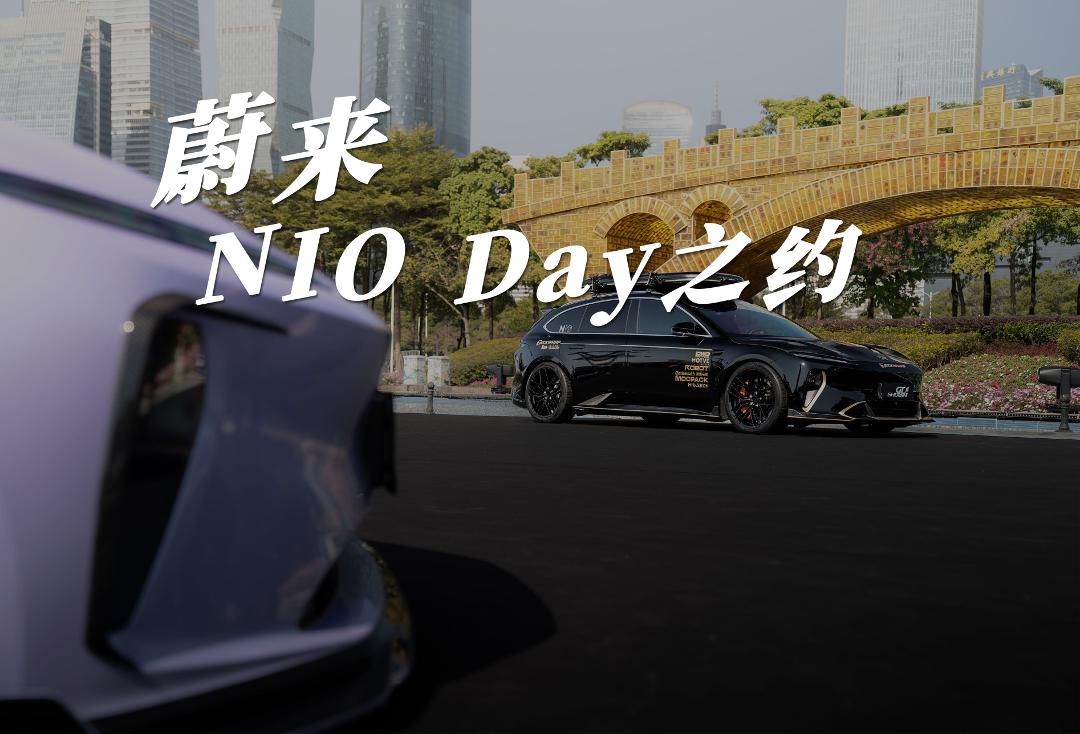
Among all domestic independent brands, NIO has gone the farthest in building user loyalty. From daily vehicle usage services and full-cycle experience to the construction of after-sales systems, NIO has always placed user operation in a critical position. However, the flip side of the user operation model is the continuous consumption of huge amounts of investment.
Even if services can shorten the distance between the brand and users in the short term, they are not enough to firmly stabilize users' minds in the long run. From the perspective of underlying laws, brands that can nurture user loyalty must have clear, sustained, irreplaceable, and strong product competitiveness.
For example, Apple locks in users through its integrated software and hardware ecosystem and chip technology; Huawei builds ecological barriers relying on independent technological breakthroughs and interconnection of smart devices; traditional Japanese brands have long conveyed the product label of stability and reliability, while German brands have established public perception of precision manufacturing.
Although domestic brands have taken the lead in intelligence and electrification, and have made substantial progress in areas such as chassis and vehicle frame manufacturing, they still face severe homogenization issues. The promotional claims of some models do not match their actual experience, making it difficult for consumers to form stable expectations and build long-term trust.
Similarly, while user conferences are emerging one after another, and the process of inviting old car owners to share their vehicle usage experiences during new car launches is commonplace, behind the bustling appearance of user operations, it is hard to feel the automakers' obsession with brand building and their desperate determination to achieve breakthroughs.
While some may use the lack of a favorable environment for building brand loyalty in the domestic market as an excuse, as Chinese automakers' overseas expansion enters the deep-water zone, it is high time to put brand building on the agenda. Relying solely on hardware cost-effectiveness can only achieve initial market breakthroughs. Consumers in more mature and closed automotive markets such as Europe, America, Southeast Asia, Japan, and South Korea have stronger brand awareness, and they value long-term maintenance systems, continuous and stable brand services, and comprehensive user lifecycle operations.
Overseas consumers will not choose to repurchase a brand purely based on hardware advantages. A sound after-sales system, long-accumulated brand reputation, and consistent service experience are the core levers for maintaining user relationships.
Whether Chinese automakers can break free from the predicament of "one-off deals" does not depend on whether the market provides a favorable environment — the key lies in whether the automakers themselves have the obsession to deeply cultivate long-term brand value, and the desperate determination to continuously invest and survive through industry cycles.
The only thing that can be confirmed is that if all automakers focus their efforts on engaging in cutthroat internal competition, they will never succeed in building brand value and user loyalty no matter what they do.
This article is from the WeChat official account "Auto Community" (ID: iAUTO2010), written by Sai Jiatong, and published with authorization from 36Kr.