We can vaguely see the incremental growth storyline in the stock market narrative of China's air conditioning industry.
The air conditioning industry has finally seen some notable movement recently. In past market research, discussions always centered on the industry landscape: when the price war would hit bottom, how far industrial chain integration could go, how much untapped potential remained for channel efficiency improvements, and whether the reforms following the management transition would deliver results.
These issues are undeniably critical — after all, China's domestic air conditioner ownership has exceeded 780 million units, with replacement demand accounting for over 60%. In 2025, the CR3 (market concentration ratio of top 3 players) in the shipment segment reached 60%, making this a typical stock game market where the stability of market structure inherently matters far more than incremental growth.
Yet beyond these widely accepted industry consensuses, two key strategic directions that enterprises have heavily invested in have rarely been thoroughly discussed in the market:
○ Domestic substitution in the central air conditioning sector. The global central air conditioning market exceeds 2.5 trillion yuan in scale, surpassing the total revenue of Gree Electric. However, this sector is still dominated by international brands, with the global CR5 exceeding 40%. Daikin, Carrier, Johnson Controls, Trane Technologies, and Midea rank as the top five players in this market.
○ Brand globalization. China's air conditioner output accounts for 80% of the global total, and domestic brands have already dominated the Chinese household air conditioner market. Yet the combined global market share of Midea, Haier, and Gree stands at only 22%.
Breakthroughs in the overseas central air conditioning market are already emerging for Binglun Environment (refer to "This Old Industrial City in Shandong is Nurturing Two High-Growth Stocks in the AI Era"); meanwhile, the brand globalization path that has been pursued for years with limited returns from mergers and acquisitions is being carved open by the 2026 European heatwave, creating new opportunities.
01 Heatwave Sweeps Europe: High Temperatures Reshape Air Conditioner Demand
The summer of 2026 brought unusually intense heat to Europe.
In May, Western Europe was hit by an early, high-intensity heatwave, with average daily temperatures in parts of western France, England, and Wales over 10°C higher than the seasonal average. By June, a new round of widespread extreme heat arrived, making it the hottest June on record in Western Europe, with average temperatures 3°C above the historical mean.
In recent years, global warming has intensified, and extreme weather events have become more frequent. Europe, long known for its "cool summers and low household air conditioner penetration," is being forced to adapt to a new climatic normal. This shift in climate patterns often brings about a fundamental restructuring of demand structures.
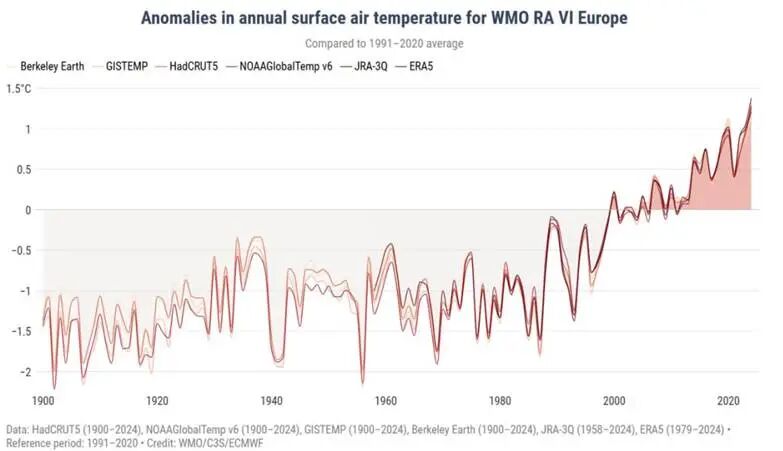
Figure: Systematic increase in Europe's temperature deviation from the 1991-2020 average. Source: Huayuan Securities
The concentrated release of cooling demand is already reflected in official data. According to data from Industry Online, from January to May 2026, China's exports of portable household air conditioners to Western Europe grew month by month, with May exports surging 116% year-on-year. In the first half of 2026, China's total air conditioner exports to the EU reached $3.76 billion, up 43.2% year-on-year and hitting an all-time high, with exports to France, the Netherlands, and Belgium doubling year-on-year.
Enterprises have felt this surge even more directly. Midea's PortaSplit portable split air conditioner, designed for the European market, requires no drilling or professional installation — consumers can simply place the outdoor unit on a windowsill or balcony for use, with cooling performance comparable to traditional split units. This year, its B2B shipments exceeded 200,000 units, doubling year-on-year. TCL's entire inventory of portable air conditioners has been sold out, and Gree's portable air conditioners are completely out of stock across regional channels, with overseas agents rushing to restock.
Europe historically had a mild climate, with household air conditioner penetration at only around 20%, far below the global average of 37%. As a high-value market with 200-250 million households, Europe is clearly a blue ocean for the air conditioning industry. With extreme weather becoming the new normal, the International Energy Agency predicts that EU air conditioner ownership will rise to 275 million units by 2050, more than double the figure in 2019.
Currently, Europe accounts for only about 10% of the global air conditioning market. If its long-term growth potential is realized, this proportion could reach 20% of the global market — a transformation that will unlock new growth possibilities for the entire air conditioning industry.
02 How Much Incremental Growth Potential Does the Overseas Market Hold?
It is not just Europe that has faced extreme heat this year; Southeast Asia has also experienced sweltering temperatures. The normalization of extreme weather is essentially raising the overall demand ceiling for the entire air conditioning industry.
To fully understand the growth potential of overseas markets, we must first examine the full picture of global air conditioner penetration rates:
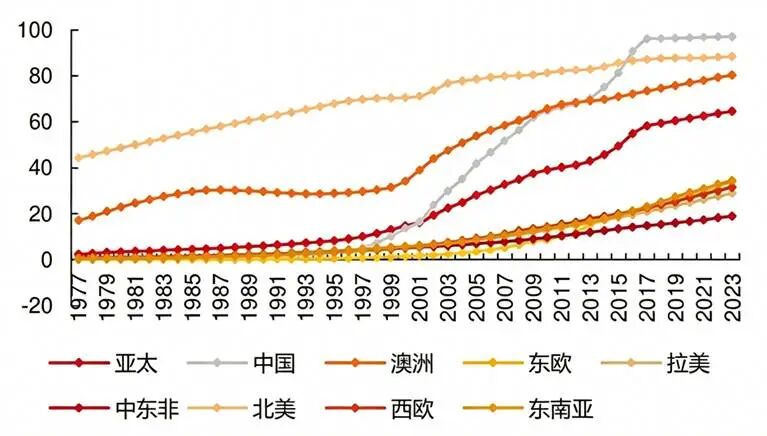
Figure: Household air conditioner ownership rates across different global regions (%). Source: Changjiang Securities
The Asia-Pacific region, particularly China and Japan, represents the upper limit of global air conditioner penetration — China serves as a popularization sample for emerging economies, while Japan acts as a mature benchmark for developed economies.
Japan is one of the countries with the highest household air conditioner penetration, with over 280 units per 100 households. This is not merely a result of economic development, but a combined effect of climate and technology: during summer, the Japanese archipelago is affected by the Pacific high-pressure system and monsoons, bringing long periods of high heat and humidity. In Tokyo, summer average temperatures range from 28°C to 30°C, with humidity levels above 80% — this sauna-like climate has transformed air conditioners from luxury goods into essential survival items.
Meanwhile, Japan is one of the birthplaces of air conditioning technology (Daikin was founded in 1924). Japanese enterprises have long led the industry in inverter technology, energy efficiency standards, and precise temperature control, driving product popularization and continuous iteration.
China's current household air conditioner penetration is close to the levels in developed economies. In 2025, there were 162 units per 100 households nationwide, still leaving room for improvement compared to Japan. From a global perspective, however, China, with its 1.4 billion population, has the world's largest total air conditioner ownership at around 570 million units, accounting for over one-third of the global total.
The key turning point occurred between 2010 and 2020. Research shows that when the annual household income exceeded $10,000, air conditioner penetration began to accelerate. At the same time, policies such as home appliance subsidies for rural areas and trade-in programs further boosted air conditioner popularization. This dynamic decade also cultivated the world's three strongest leading home appliance giants.
Yet the penetration rate in the vast majority of regions worldwide is far lower than the levels in China and Japan. The average household air conditioner ownership rate in Southeast Asia, Europe, and Latin America is only around 30%, while the Middle East and Africa stand at just 19%. India, with a population comparable to China's, currently has a household penetration rate of only about 4%. The gap becomes even more pronounced when looking at per capita ownership figures.
The reasons for low penetration vary across regions. In Europe, besides the historically cool climate, market access barriers are also high: there are strict restrictions on installing air conditioners in historic buildings, the approval process for traditional air conditioners is cumbersome, and the total cost of equipment plus installation exceeds 7,000 euros. Coupled with the EU's strict low-carbon policies, residents are generally cautious about high-energy-consuming cooling equipment.
Regions like Southeast Asia, the Middle East and Africa, and South America have year-round high temperatures and solid demand foundations, but low income levels and underdeveloped infrastructure have slowed down the popularization of air conditioners.
Using the penetration rates in China and Japan as a benchmark, the normalization of high temperatures will undoubtedly continue to push up the global air conditioning demand ceiling. Rough estimates show that the growth potential of the European market is equivalent to 20%-30% of China's total air conditioner sales, with a unit price about twice that of the domestic market, corresponding to an incremental market space of approximately 50%. The Southeast Asian, Latin American, and Middle East & Africa markets will contribute at least an additional 50% in incremental growth.
Overall, overseas markets hold the long-term potential to "recreate a full-sized Chinese air conditioning market."
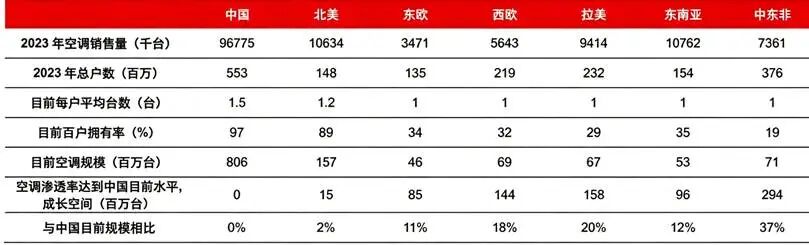
Figure: Estimated incremental growth potential for air conditioners across different global regions. Source: Changjiang Securities
This level of incremental growth is significant enough to make the market re-evaluate the growth attributes of the air conditioning industry, rather than focusing solely on the existing stock market structure. IndexBox predicts that global air conditioner consumption will reach 359 million units by 2035, representing a 60% increase over the next decade, with a total market size of $169 billion — figures that are largely consistent with the above estimates.
03 China's Production Capacity Can Supply the World, but Globalization Is Far More Than "Selling Products"
China's Production Capacity Is Massive
Given this enormous growth potential, who will supply the demand? The answer is almost certainly China, either through building independent global brands or providing OEM services for overseas clients.
In terms of volume, in the 2025 cooling year, total global household air conditioner shipments reached 221 million units, of which China produced 200 million units and exported over 90 million units (more than half of which were OEM products). This production capacity share is only comparable to that of the photovoltaic industry.
China is not only the world's largest air conditioner producer, but also its largest consumer. However, the current domestic capacity utilization rate is less than 70%, with output consistently outpacing domestic demand. This means China has abundant excess capacity that can theoretically fully meet the global incremental demand — exports currently account for 48% of domestic production.
Furthermore, the industrial chain is highly vertically integrated: Midea and Gree alone produce over 70% of the world's household air conditioner compressors.
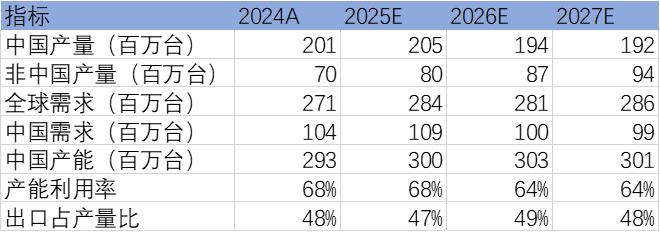
Figure: China's air conditioning production capacity profile. Source: Summarized by Brocade Research Institute
Yet "being able to manufacture and supply products" is completely different from "building a profitable global brand."
According to Euromonitor data, in 2025, Midea, Haier, and Gree held global air conditioning market shares of 12.2%, 6.3%, and 3.9% respectively, totaling only 22.4% — far below their combined domestic market share of over 70%. Many air conditioners sold overseas are actually manufactured by Midea, Aux, and TCL through OEM arrangements.
This pattern of "high domestic concentration, extreme overseas fragmentation" indicates that the globalization of China's air conditioning industry is still at the stage of "capacity export," rather than true "brand globalization" and "value chain globalization."
Three Unavoidable Practical Barriers
The growth story of overseas markets sounds appealing, but the realization cycle is long. More importantly, the core challenge lies in achieving profit growth alongside revenue growth. This is not unfounded pessimism, but an objective recognition of real-world operational barriers.
First, air conditioners are no longer standardized products — product standards and demand characteristics vary drastically across different markets.
The European heatwave has boosted sales of portable air conditioners, but this is only one aspect of the European market. Different European countries have varying requirements for historic building protection, installation approval processes, and energy efficiency standards, and traditional split air conditioners still face many compliance obstacles in most countries.
The success of Midea's PortaSplit precisely demonstrates that enterprises need to restructure their products for local markets — rather than directly exporting products designed for the domestic market, they must redesign product forms from scratch.
The Middle East and Africa hold great future growth potential, where split air conditioners are expected to gradually replace window units, representing another direction for product iteration. Southeast Asia has a hot and humid climate, but underdeveloped infrastructure and unstable power supply impose higher requirements on product durability and adaptability. The North American market has entered a brand-focused consumption stage, where consumers prioritize brand reputation and service over low prices alone.
There is no single standard product that can satisfy all global markets, and each market requires independent product definition. However, the proven mature strategy in the Chinese market — streamlining SKUs and reducing costs through economies of scale — clearly needs to be adjusted for fragmented overseas markets.
Second, localized production capacity and brand operation are unavoidable challenges.
Global trade barriers are continuously rising. The suppressive effect of U.S. tariffs on air conditioner exports has already become apparent: in 2025, China's air conditioner exports to North America fell 18.4% year-on-year in volume and 14% year-on-year in value, forcing a large number of orders to be fulfilled from overseas production bases. The U.S. and some emerging market countries are protecting their domestic manufacturing industries by raising energy efficiency standards and imposing additional tariffs.
The EU's Carbon Border Adjustment Mechanism (CBAM) entered a substantive transition phase in 2025, with extremely strict requirements for the full life cycle carbon footprint of air conditioning products. The export model that solely relies on cost advantages is no longer sustainable, as compliance costs are significantly eroding export profit margins.
This means that building overseas production facilities is no longer an "optional" strategy, but a "necessary" one. However, current globalized production capacity layouts are mostly concentrated among leading enterprises, and localized production capacity in Europe remains very scarce.
Every step from OEM (Original Equipment Manufacturer) to ODM (Original Design Manufacturer) and then to OBM (Original Brand Manufacturer) requires massive investment and extended time. Channel construction, after-sales service, brand recognition, and localized teams cannot be automatically resolved simply by relocating production capacity.
Third, green trade barriers are continuously escalating.
Apart from tariffs, the tightening of green trade barriers