From supplying Luckin Coffee to opening their own stores, frozen bread manufacturers have set their sights on young people who are keen on stockpiling goods.
In recent months, a wave of new brands operating under the banner of "frozen bakery factory stores" has emerged intensively across the market.
These brands first landed in the Jiangsu-Zhejiang-Shanghai region. For instance, Lubian Pipi, which opened its first store in Shanghai in April, reported that its sales exceeded 1.1 million yuan in less than a month of operation; Yibai Yicheng Bakery Factory Store has deployed 9 outlets in Shanghai, Changzhou, Kunshan, and Taicang; Dawei Bread Factory has opened 6 stores in Taicang; brands including Laikaer Bakery Factory, Meilijia Bread Factory Store, and Quanmai Master have also launched their physical stores one after another.
Some brands are expanding to more regions. Good Morning Dongdong, which originated in Ningbo, has already established presence in cities such as Hangzhou, Ningbo, Changzhou, and Foshan, and plans to further expand into the East China, South China, and Central China markets.
These frozen bakery factory stores have no back kitchens, no on-site baking areas, and no large dine-in spaces. They focus on frozen bread and desserts, with almost all single product prices falling below 10 yuan — bagels at 2.9 yuan, toast at 2.9 yuan, sliced cakes at 9.9 yuan...
What is more noteworthy than the low prices is that most of these stores are backed by a food factory. As more and more food factories begin to bypass traditional brands and sell bread directly to consumers, what kind of new business are they trying to build?
Starting from 1.9 Yuan, Bread Is Being Sold "By the Basket"
Recently, Red-Can News visited Good Morning Dongdong's first South China outlet in Foshan.
Stepping inside, you will find it barely resembles a traditional bakery as we know it. There is no on-site baking area, no bakers, and only one staff member at the front desk handling checkout.
In a space of around 100 square meters, the core furnishings are nothing but rows of freezers, neatly stocked with hundreds of products including bagels, toast, pretzel bread, artisanal loaves, and sliced cakes. All products are uniformly packaged in transparent sealed wrappers, with a frozen shelf life of up to 6 months. The packaging clearly labels ingredients, manufacturers, and consumption instructions, while reheating guidelines are posted on the wall — products can quickly regain their original texture using an air fryer, home oven, or microwave.
The shopping experience is fully self-service: grab a basket at the entrance, select and pack your items by yourself, then check out and leave.
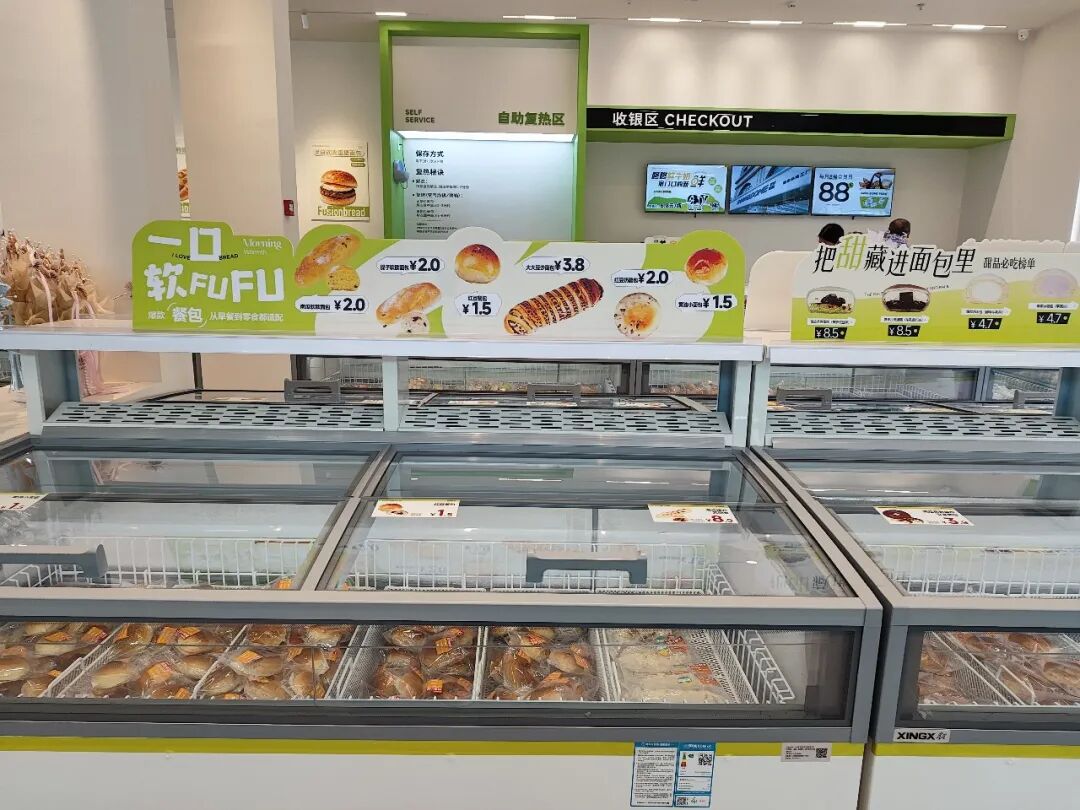
△ Image source: Photo by Red-Can News
This design is not unique to Good Morning Dongdong. Stores of brands including Lubian Pipi, Yibai Yicheng, and Laikaer Bakery Factory are highly similar: minimalist decoration, no proofing cabinets or ovens, only a small dedicated reheating zone and a few dine-in seats; Lubian Pipi even directly uses factory turnover baskets as display racks inside the store, with no dine-in seating at all.
Without looking at the store signs, these frozen bakery factory stores are more like frozen food wholesale supermarkets.
Low pricing is one of the most prominent labels of these outlets.
The main price points of Good Morning Dongdong are 2.9 yuan, 3.9 yuan, and 9.9 yuan, with even sesame cakes priced at 1.9 yuan; over 100 SKUs of Lubian Pipi are almost all under 10 yuan, including 2.9-yuan bagels and toast, and 9.9-yuan sliced cakes; the core single products of Yibai Yicheng are priced between 4 and 8 yuan, with most products costing less than 10 yuan.
Consumers can buy 2 to 5 pieces of bread or cake with the same amount of money spent on a cup of milk tea.
However, low unit price does not mean low customer transaction value.
Different from traditional bakeries where customers "buy two pieces for breakfast", frozen bakery factory stores emphasize bulk stockpiling in one visit. Each packaging bag of Lubian Pipi is printed with a prominent "stock up" character, and the brand has also launched the slogan "Stock up freshness, keep life warm".
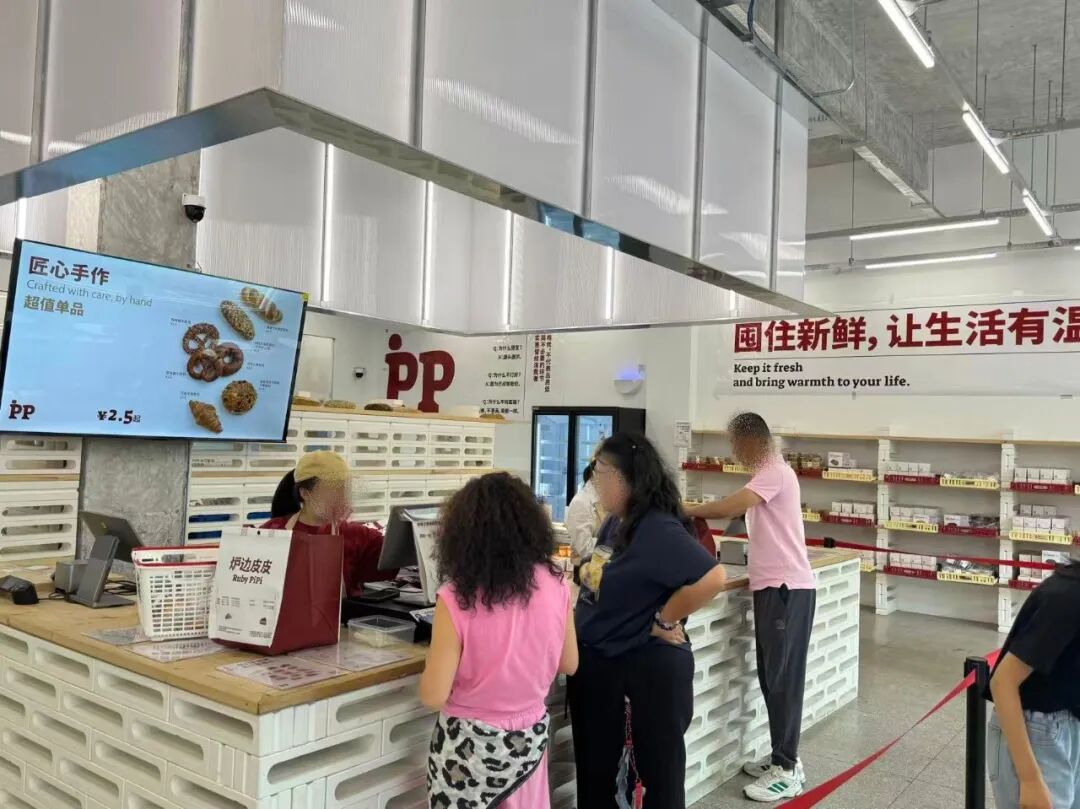
△ Image source: Photo by Red-Can News
Red-Can News observed that the per capita consumption of brands such as Lubian Pipi, Good Morning Dongdong, and Yibai Yicheng is generally between 40 and 50 yuan, and it is not uncommon for many consumers to purchase more than ten products at a time, filling an entire basket. A netizen shared, "I picked items casually and ended up with a full basket, buying 20 pieces of bread and small cakes in total for 128 yuan, the cost performance is pretty good."
Low unit prices reduce decision-making costs, while the long shelf life (frozen products can generally be stored for 6 months) combined with a rich SKU assortment encourages many people to stock up a whole basket of goods in one go.
Operating Stores Backed by Factories, Cutting Down the Cost of a Single Bread
With an average price of less than 10 yuan and the lowest starting price at 1.9 yuan, can this pricing system support a sustainable long-term business?
"Direct factory delivery ensures low prices, and products barely generate any wastage. From the perspective of cost structure, this model has inherent advantages," Zhang Quan (pseudonym), who has run a food factory in Suzhou for nearly a decade, stated frankly. The frozen bakery factory model does not simply seize the market by relying on low prices, but redesigns the cost structure of traditional bakeries from scratch.
In traditional bakeries, the cost of a single bread consists of raw materials, production and processing, packaging, and logistics on the supply side, as well as rent, labor, equipment amortization, and product wastage at the store end.
From dough proofing and on-site baking to display and sales, the bakery not only needs to hire bakers and equip ovens, proofing cabinets and other equipment, but also reserve a large operation space. Meanwhile, due to the short shelf life of freshly baked products, stores need to arrange production based on passenger flow every day, and unsold products easily become wastage.
Frozen bakery factory stores adopt a completely different logic.
Products are fully produced and baked inside the factory, then rapidly frozen to lock in freshness, and delivered uniformly to stores for sale. The stores no longer undertake production functions, and are only responsible for storage, display and sales, functioning more like a retail terminal.
After the production links are moved forward to the factory, the costs that stores need to bear have also changed accordingly.
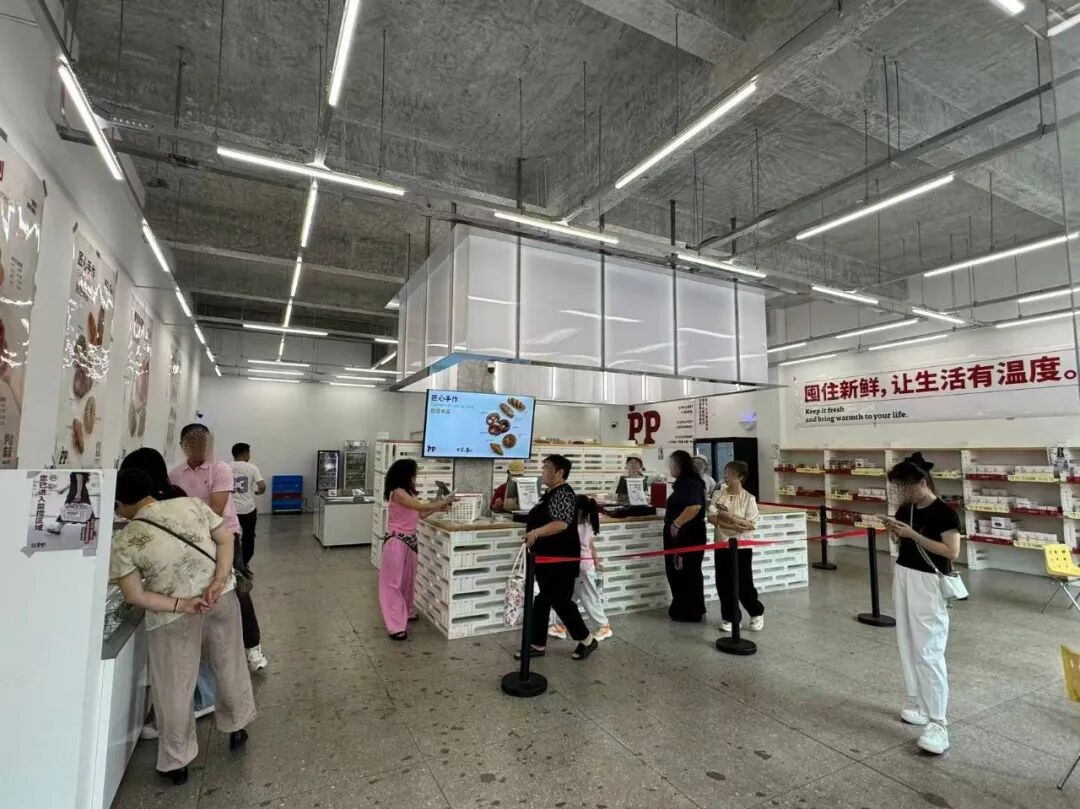
△ Image source: Photo by Red-Can News
The most intuitive change lies in labor input. For brands such as Youhe and Rukou Tianwu that focus on fresh on-site baking, a single store usually requires 30 to 50 employees, while frozen bakery factory stores generally only need 1 to 3 staff members to handle restocking and checkout.
Equipment investment has also been reduced accordingly. Without an on-site baking zone, there is no need for large equipment such as ovens and proofing cabinets, nor is it necessary to reserve a large back kitchen space, so the store area and decoration costs can be further compressed. The 6-month long shelf life also alleviates the operational pressure of the traditional on-site baking model where unsold products must be written off on the same day, making inventory management more flexible.
Without providing the experience of fresh on-site production or emphasizing dine-in consumption, frozen bakery factory stores have far lower site selection requirements than traditional bakeries.
A group of frozen bakery factory stores including Lubian Pipi, Good Morning Dongdong, and Dawei Bread Factory are mostly located in areas with relatively low rent, such as surrounding communities, street-facing shops in residential areas, and near industrial parks.
For example, Good Morning Dongdong's first South China store is located in a street-facing shop in Beijiao Community, Foshan, and its stores in Ningbo, Changzhou and other cities are mostly located on community streets or near railway stations; all 6 stores of Dawei Bread Factory are distributed around communities in Taicang.
Xia Qianfang, the person in charge of the Yibai Yicheng brand, also told Red-Can News that the core requirement for its site selection is not the popularity of the business district, but the convenience for residents. "We will give priority to shops that are easy to find, open, and have strong display effects, with convenient parking and clear resident movement lines in the surrounding area, making it easy for local residents to make daily repeat purchases, grab their items and go, which fits the daily rigid consumption needs of ordinary people."
This low-threshold site selection, low equipment and labor requirement, and low-wastage model has driven down store opening costs, and the total implementation cost of a single Yibai Yicheng store is currently controlled within 150,000 yuan.
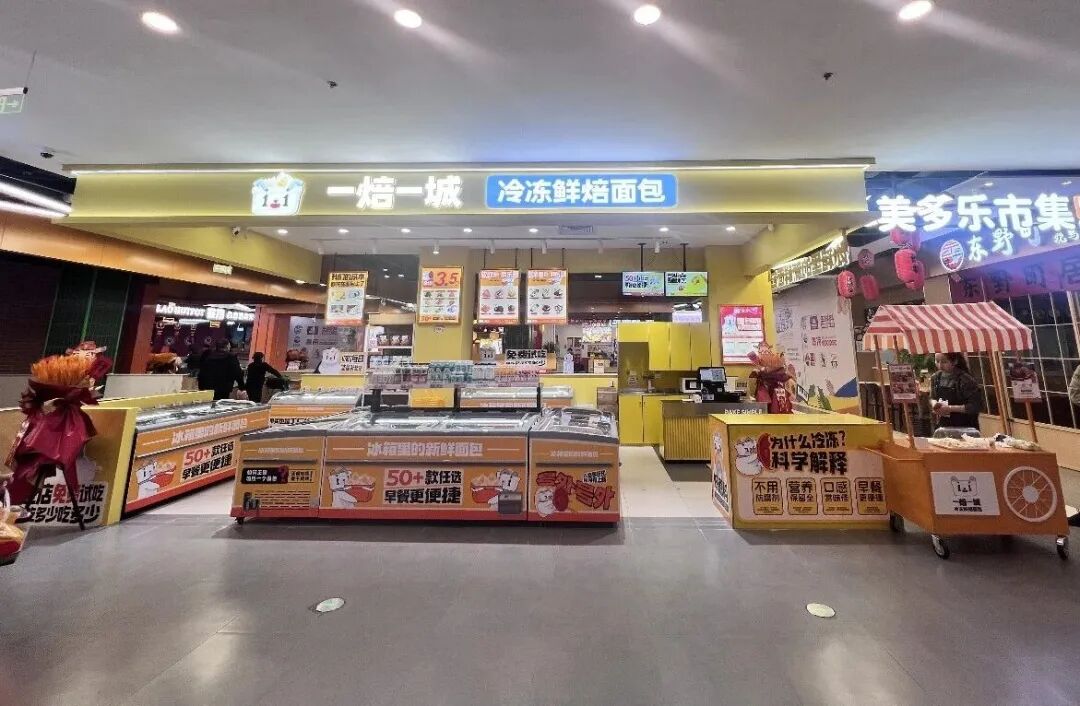
△ Image source: Provided by the interviewee
However, the premise for stores to achieve these "subtractions" is that the factory can take on more responsibilities.
Red-Can News's research found that most frozen bakery factory stores currently on the market are backed by mature food factories.
For example, Good Morning Dongdong is affiliated with Zhejiang Weixin Holding Group, sharing central factories, product R&D, and cold chain distribution systems with brands such as Yebuer, Nanyang Master, Pu Mama, and Haoxingfu; the products of Lubian Pipi are mainly supplied by Pingu Food, which has long provided frozen bakery products for brands including Starbucks, 85°C, and FamilyMart; Yibai Yicheng had built a bakery factory of around 2,000 square meters before opening its first stores.
There are also factories that directly enter the retail sector to open their own stores.
For instance, Jiaxing Meilijia Food Co., Ltd. directly opened the "Meilijia Bread Factory Store" right at the gate of its factory; Abenbroet, which has long supplied products to brands including Freshippo, Tims, and ALDI, launched its bread factory store in Shanghai; Laikaer Food has incubated brands such as "Quanmai Master" and "Laikaer Bakery Factory".
For food factories, this is also a new attempt to digest production capacity and expand incremental markets.
Zhang Quan said that the Jiangsu-Zhejiang-Shanghai region is home to a large number of food factories, many of which have long provided OEM services for coffee, tea beverage, supermarket, and chain catering brands. As industry competition intensifies and production capacity continues to expand, factories have begun to look for new growth spaces. Directly opening frozen bakery factory stores is a new path that many food factories are currently experimenting with.
Factories Can Make Bread, But May Not Be Good at Building Brands
Generally, traditional bakeries sell bread that is freshly baked on the same day or has a short normal-temperature shelf life, and consumers buy them for immediate meals; while frozen bakery factory stores emphasize "stockpiling", where consumers buy more than a dozen products at a time, store them in the refrigerator, and reheat them when needed.
Low prices and the "wanting to try new things" mentality can drive consumers to enter the stores, but for factory stores to build stable repeat purchases, customers need to gradually form the habit of "always having frozen bread in the refrigerator".
Xia Qianfang said that most of Yibai Yicheng's current customers are first-time visitors who come to try new products. "Most people still equate the term 'frozen' with 'not fresh', and lack understanding of the quick-freezing fresh-locking technology, so market education still takes a long time. The difficulty in building user trust directly affects transaction conversion."
Apart from cognitive barriers, the products themselves still need to undergo market testing.
"There is no big problem in making toast with a long shelf life, but for products such as pretzel bread and bagels, the market still needs time to gradually verify the acceptance of their texture after reheating," Xu Si (pseudonym), a sales specialist at Axing Food, told Red-Can News, the texture of different types of finished frozen bakery products varies after reheating, which is also an important factor affecting store repurchase rates.
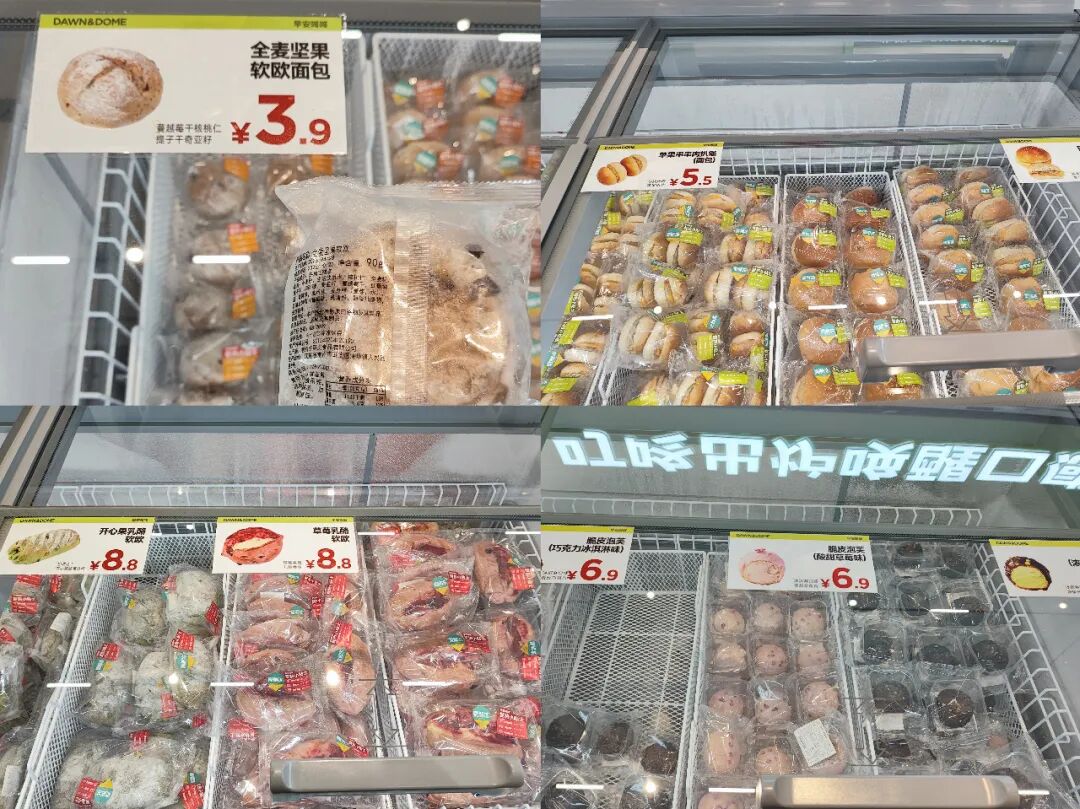
△ Image source: Photo by Red-Can News
Compared with consumer education, the greater challenge actually comes from store operation itself.
For most food factories, transitioning from a B2B supplier to C-end retail is inherently a capability transformation process.
In the past, food factories served supermarkets and catering brands, only needing to ensure good product quality and on-time delivery; now facing consumers directly means they also need to do a good job in store operation, membership system, online traffic operation, brand communication, and after-sales service.
Zhang Quan (pseudonym) told Red-Can News that many current frozen bakery factory stores are essentially an attempt by food factories to explore the C-end market. "Supply chain capabilities can be replicated, but truly turning a single store into a well-known brand is not something factories are inherently good at."
Red-Can News noticed that Yibai Yicheng previously closed two stores in Changshu and Taicang. Xia Qianfang reviewed that this was because the stores lacked dedicated personnel in charge of daily operation and refined management, so the operating results failed to meet expectations, and they finally chose to adjust their store layout. She stated that in the next stage, Yibai Yicheng will still focus on polishing a stable and replicable single-store profit model.
This article is from the WeChat official account "Red-Can News", written by the Red-Can Editorial Department, and published with authorization from 36Kr.