These "invisible" cities have squeezed into Changxin's "circle of friends"
On July 27, CX Technology, the largest IPO (Initial Public Offering) in the history of the Sci-Tech Innovation Board that has drawn widespread market attention, was officially listed. On its first trading day, CX Technology delivered a remarkable market performance, with its closing price surging nearly 466% above the issue price to close at 49 yuan per share, giving it an A-share market capitalization of approximately 3.28 trillion yuan and catapulting it to the top of the A-share market capitalization rankings.
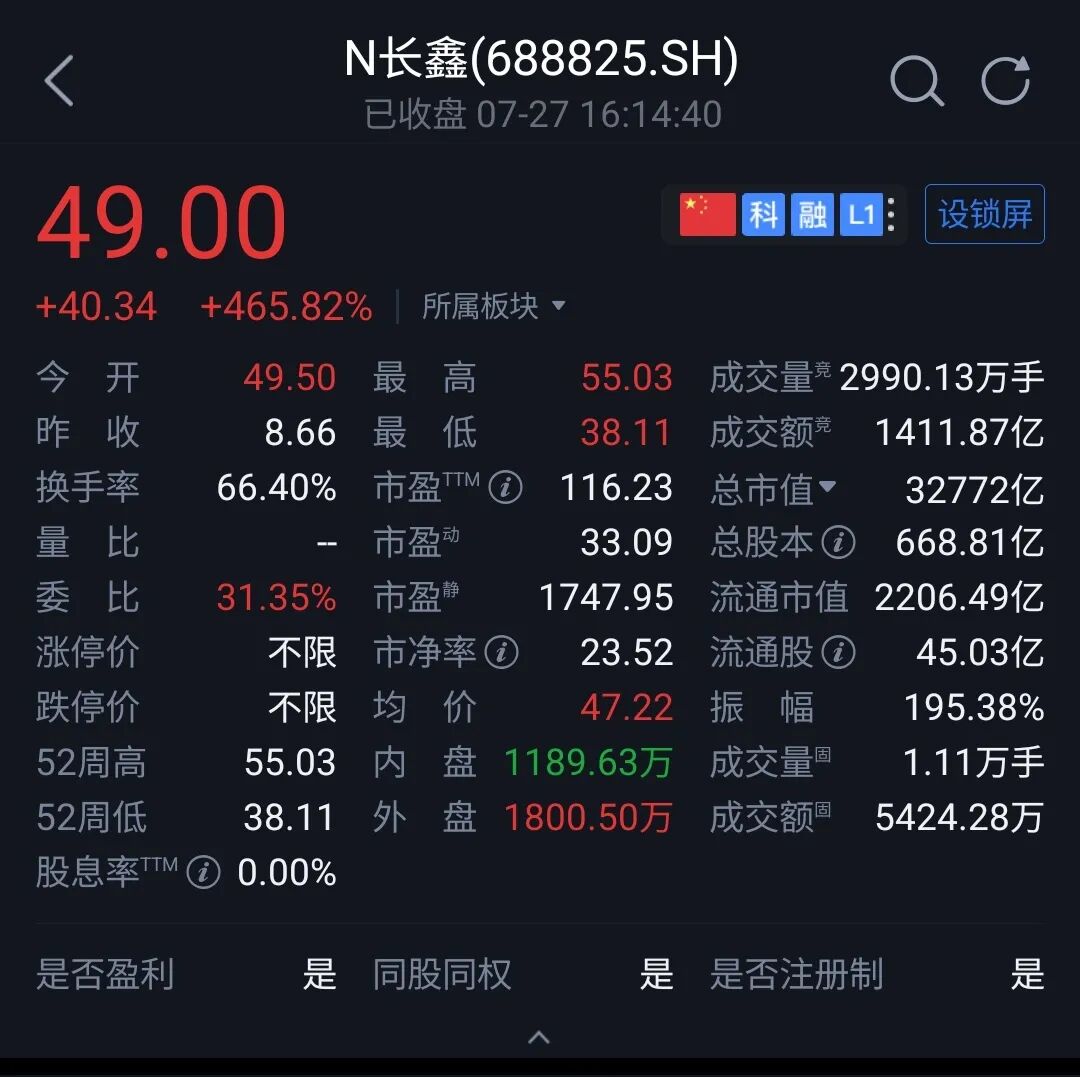
CX Technology's closing price on its first listing day
Hefei is undoubtedly the biggest winner. As CX Technology's largest shareholder, Hefei State-owned Capital, which has funded and supported CX Technology's growth all along, holds a total stake of approximately 36.79%. Calculated based on CX Technology's closing price, the market value of the shares held by Hefei State-owned Capital exceeds 1 trillion yuan. As a result, the total A-share market capitalization of Hefei's A-share listed companies has surpassed 4.5 trillion yuan, lifting Hefei to fourth place in the national ranking of cities by total A-share market capitalization.
There is a view in public discourse that the difficulty of China's semiconductor localization lies ostensibly in the technological gap, but essentially in the long-term monopoly over industry rules and industrial ecosystems. Given the semiconductor industry's lengthy industrial chain, CX Technology's breakthrough would not have been possible without the full support of a complete industrial system, and the enterprises involved in this system have in turn revealed a long list of cities that play key roles.
Against this backdrop, we attempt to identify the cities that are part of CX Technology's ecosystem. Notably, beyond the semiconductor industry clusters in regions such as the Beijing-Tianjin-Hebei region, the Yangtze River Delta, and the Pearl River Delta, a number of relatively "invisible" cities are gradually coming to prominence.
01
The listing of CX Technology is not just a celebration for Hefei's capital market, but has also deepened the industrial ties of cities including Beijing, Shanghai, and Shenzhen. In particular, CX Technology has finally completed a strategic placement of approximately 14.437 billion yuan, with 30 investors participating, implicitly outlining a brand-new map of the industrial ecosystem.
Among these investors, 18 have direct connections to the industrial chain, of which 12 companies including Transsion Holdings, Xi'an Yicai, Anji Technology, and Tongfu Microelectronics can be directly matched to A-share listed companies. These enterprises cover fields such as semiconductor equipment, semiconductor materials, packaging and testing, and storage interfaces, with the stock prices of more than 80% of these companies closing higher on the trading day.
Statistics show that Shanghai has 5 companies (Advanced Micro-Fabrication Equipment Inc. China, Anji Technology, Shanghai Simgroep Silicon Industries, Montage Technology, and Huaqin Technology), Shenzhen has 2 companies (Transsion Holdings and ZTE Corporation), while Beijing (Yitao Technology), Shenyang (Tuojing Technology), Xi'an (Xi'an Yicai), Nantong (Tongfu Microelectronics), and Huizhou (TCL Technology) each have 1 company on the list.
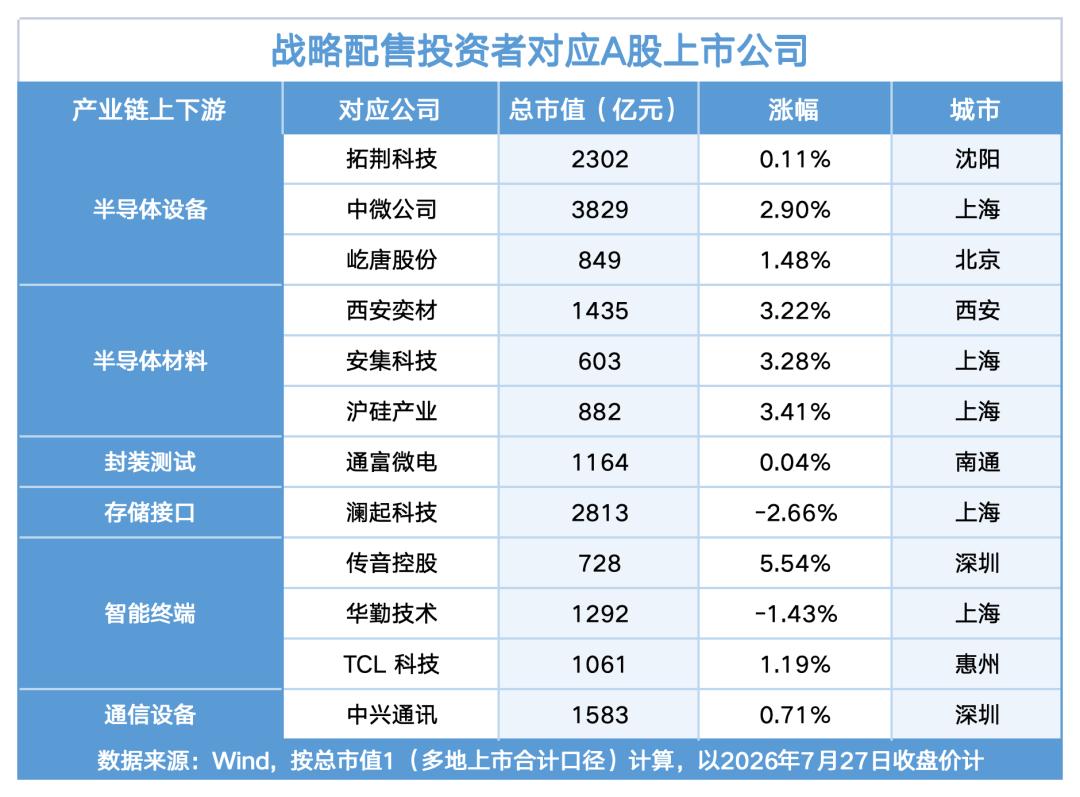
The inclusion of these cities in the industrial chain is not accidental, and reflects CX Technology's considerations in building its ecosystem. CX Technology stated in its announcement that the introduction of strategic placement investors can stimulate the synergy of its industrial chain and ensure the supply of key resources. At the same time, it can also bring opportunities for downstream application scenarios, customer resources, and order growth.
For example, Xiaomi, Tencent, Alibaba Cloud, Meituan, NIO, and Chery have also been included in the strategic placement list, which is largely based on the consideration of downstream scenario applications. A typical example is that CX Technology and Chery's potential cooperation areas include "giving priority to the use of the issuer's products in the R&D and mass production stages of new vehicle models".
From the perspective of the "density" of strategic placement investors, cities in the Yangtze River Delta, Pearl River Delta, and Beijing-Tianjin-Hebei region such as Shanghai, Beijing, and Shenzhen occupy a very important position and have become key links in CX Technology's industrial chain ecosystem layout.
At the same time, cities such as Xi'an and Shenyang have also joined the ecosystem by virtue of their advantages in niche industrial segments.
In April 2020, Beijing Eswin Material Technology Co., Ltd. (one of the four Eswin-affiliated enterprises) founded by Wang Dongsheng, the former head of BOE, was relocated to Xi'an and renamed Xi'an Yicai. It has become the largest 12-inch silicon wafer manufacturer in mainland China and the sixth largest in the world, and was successfully listed on the Sci-Tech Innovation Board last year.
Behind this, Shaanxi local capitals such as the Shaanxi Integrated Circuit Fund (managed by Xigao Investment under Xi'an High-tech Financial Holding) have acted as patient capital, holding a 9.06% stake to become the third largest shareholder before the IPO. Today, Xi'an Yicai has become a core silicon wafer supplier to CX Technology and a microcosm of the strength of Xi'an's semiconductor industry.
In recent years, Shenyang has also seen the rise of a distinctive group of enterprises, known as the "Six Little Tigers of Semiconductor Equipment" — Sinyang, Tuojing Technology, Fortech, CASI, Heyuan Technology, and SIASUN Robot. Among them, Sinyang is the only domestic enterprise that can provide mass-produced mid-to-high-end photoresist coating and developing equipment, while Tuojing Technology has broken the long-term monopoly of overseas manufacturers in the field of thin film deposition equipment.
This time, Tuojing Technology has become a core supplier of PECVD/ALD/SACVD equipment for CX Technology, which represents Shenyang's accumulated strength in the semiconductor industry. Of course, there are more cities joining the industrial chain, becoming participants in CX Technology's production expansion and even the wave of semiconductor localization substitution.
02
If we expand the scope further to cover enterprises in the upstream and downstream of CX Technology's industrial chain, more cities will be "selected".
According to incomplete statistics from *China Securities Journal*, CX Technology's industrial landscape involves at least 27 A-share listed companies, covering multiple links such as electronic chemicals, photoresist, silicon wafers, electronic specialty gases, semiconductor equipment, packaging and testing. Counting the registered locations of the main bodies of these listed enterprises will present a distinct panoramic map of cities in the "CX Technology Industrial Chain".
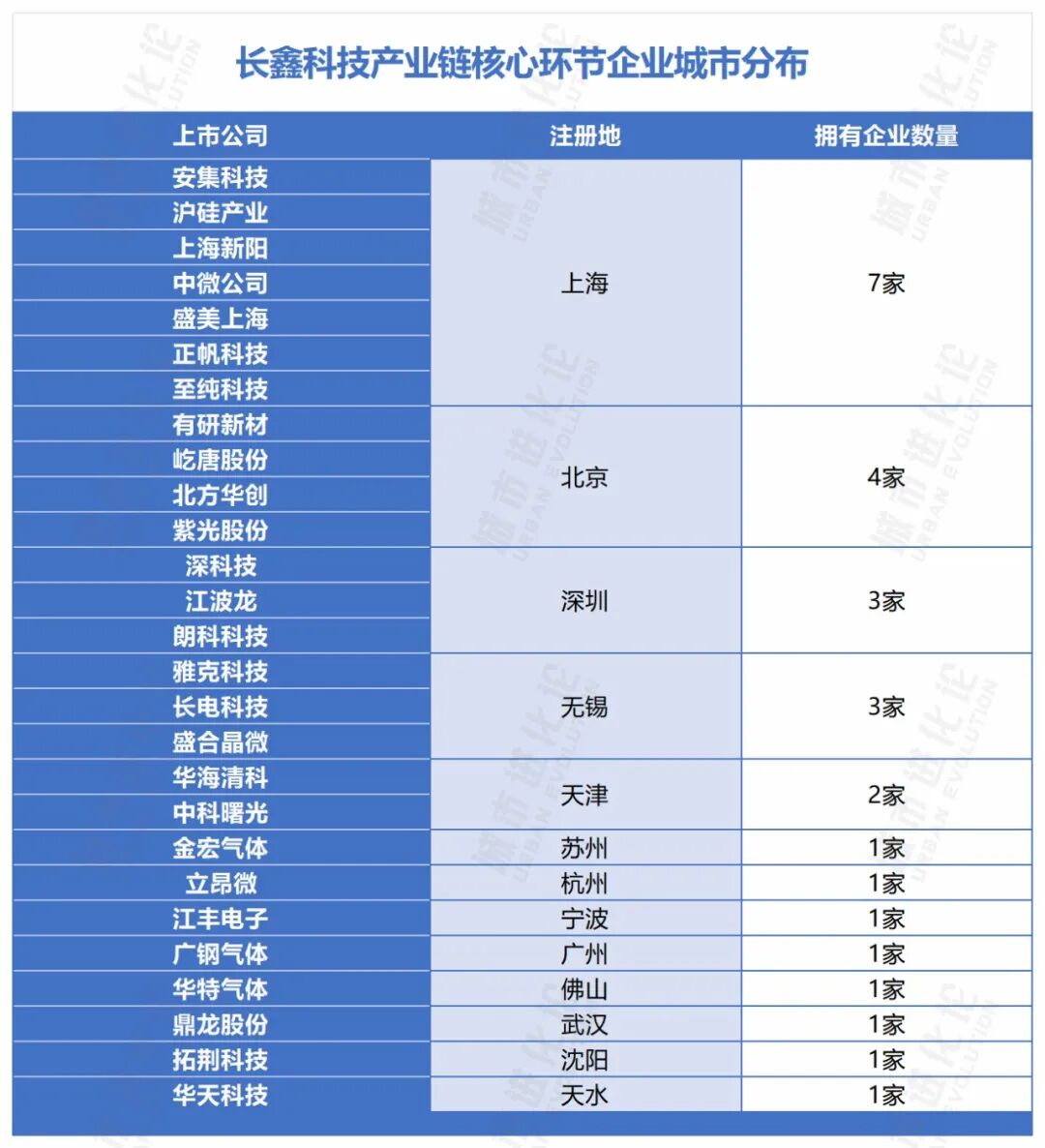
Shanghai still ranks first with 7 enterprises, followed by Beijing with 4 enterprises, then Shenzhen and Wuxi each have 3 enterprises, while Tianjin has 2 enterprises on the list.
Among them, Tianjin's Huahai Qingke is a leading domestic enterprise in CMP equipment, focusing on the R&D and manufacturing of semiconductor polishing equipment. Together with Yitao Technology, which mainly manufactures three types of equipment: dry degumming, rapid thermal processing, and dry etching, as well as Naura Technology, which is also registered in Beijing and is considered to have "developed almost every key piece of equipment for the front-end process of chip manufacturing except lithography machines", these enterprises jointly demonstrate the characteristics of the Beijing-Tianjin-Hebei region in promoting the verification of domestically produced semiconductor equipment.
Among the 3 enterprises in Wuxi, two of them — Jiangsu Changjiang Electronics Technology and Jiangsu Sai Microelectronics — are representatives of advanced packaging and testing, which is Wuxi's advantageous segment in the semiconductor manufacturing industry. The more distinctive one is Yake Technology, which has been a supplier to SK Hynix since SK Hynix settled in Wuxi 20 years ago. Currently, it supplies precursors to both SK Hynix and CX Technology — semiconductor precursors are core chemical materials for the thin film deposition process in the manufacturing of chips and HBM memory, and are essential consumables.
In addition to the "leading cities", the cities at the lower end of the list are also eye-catching.
Take Wuhan as an example. Dinglong Co., Ltd., which is on the list, was just a small factory producing printing and copying consumables when it was founded in Wuhan in 2000. Soon after, it broke Japan's 20-year global monopoly on charge regulators and gradually transformed into a new materials enterprise. After entering the semiconductor materials track in 2010, Dinglong Co., Ltd. has continuously developed into the largest domestic provider of CMP polishing pads in China. This consumable is known as the "precision sandpaper" for polishing wafers, and now its domestic market share is as high as 70% to 80%.
The most special case is Tianshui, a small city in Gansu Province.
As a city located deep inland, far away from the developed coastal semiconductor industrial chain, and not backed by a large economic province, Tianshui hardly has any advantages in the development of emerging industries. The origin of Huatian Technology can be traced back to the "Third Front Construction" period. As early as 1969, its predecessor, Yonghong Instrument Factory (Factory 749), moved to Tianshui to undertake the task of producing core circuit boards for the Jiuquan Satellite Launch Center.
As Tianshui's traditional industrial advantages as an old industrial base are weakening, finding a new industrial breakthrough has become an inevitable choice. In 2010, based on the restructured Huatian Technology, Tianshui made a judgment that instead of pursuing an unrealistic "full industrial chain", it is better to focus on the niche segment of packaging and testing. This segment has relatively low capital density and high labor intensity, which fits Tianshui's comparative advantages of abundant human resources and low factor costs.
Through the interaction between the city and the enterprise, Huatian Technology has now become the sixth largest integrated circuit packaging and testing enterprise in the world and the third largest in China. In 2024, Tianshui's integrated circuit output reached 73.84 billion pieces, surpassing the output of Shenzhen and Suzhou. At present, Gansu Province has also proposed to actively strive to include Tianshui in the national high-tech industry layout, and support the construction of an integrated circuit packaging and testing industrial base and Tianshui Electronic Information Industrial Park.
It can be said that Tianshui's remarkable rise against the odds is rooted in the city's decades-long industrial choices, and is also a microcosm of a group of cities that have seized opportunities and reshaped their ecosystems when leading enterprises represented by CX Technology expanded their supply chains. This industrial chain is still extending, and more cities are waiting for their own opportunities.
This article is from the WeChat official account "City Evolution", written by YANG Qifei and DAN Zhongkui, and published with authorization from 36Kr.