Will Changxin Technology continue to rise today?
Changxin Technology set multiple records on its first trading day, with its share price closing up 465.82% at 49 yuan per share. Boasting a market capitalization of 3.28 trillion yuan, it overtook the Industrial and Commercial Bank of China to become the new top-valued stock on the A-share market. Its total trading volume for the day exceeded 140 billion yuan, making it the first stock in A-share history to see single-day transaction value surpass 100 billion yuan.
At the same time, 7.7 million investors who won the Changxin Technology new share subscription lottery are now presented with an opportunity to realize their profits.
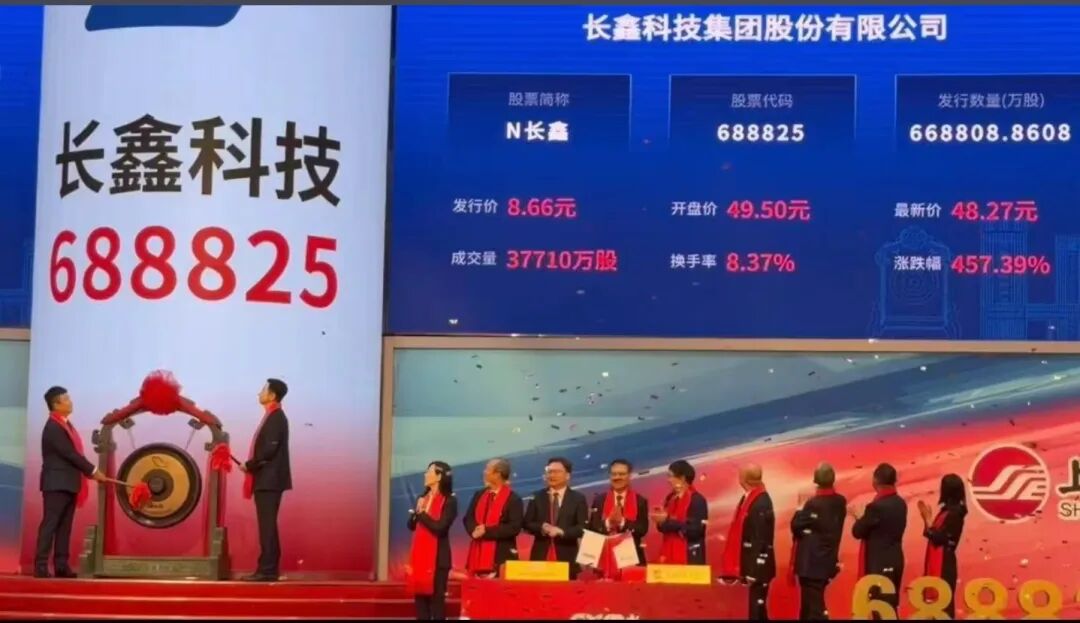
The photo shows the listing bell-ringing ceremony of Changxin Technology. Source: Internet
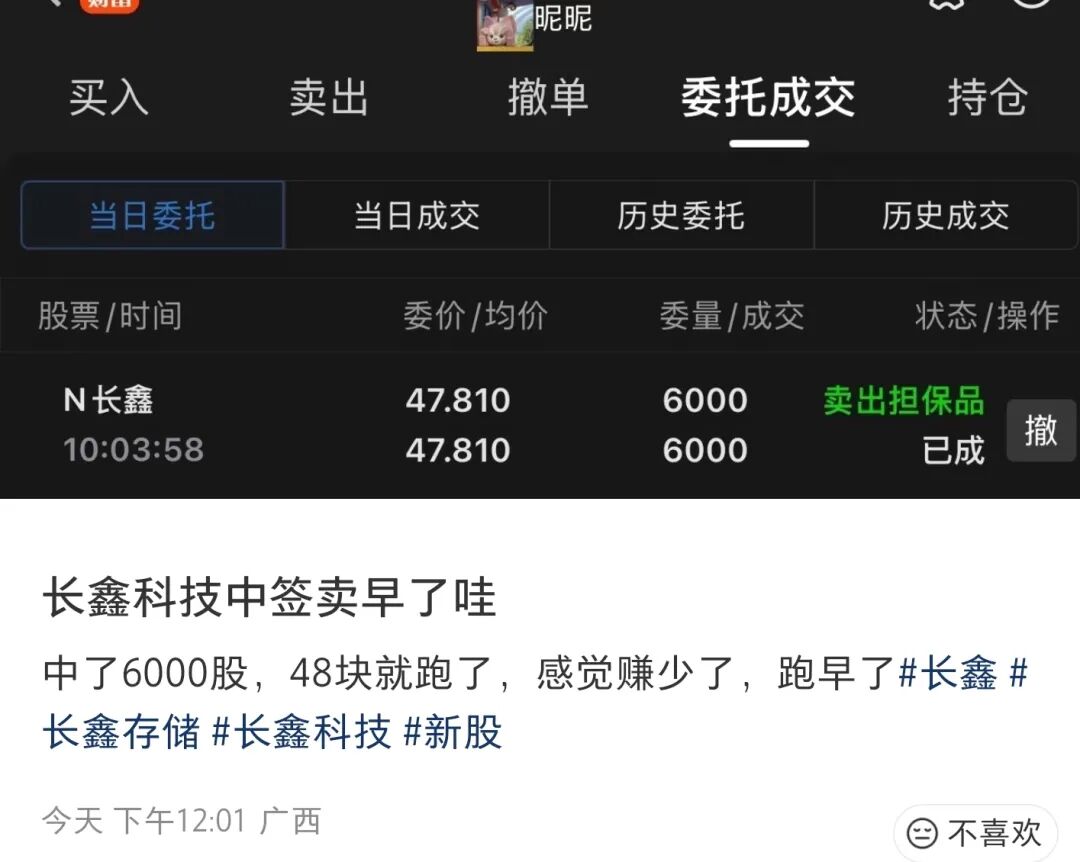
On the first trading day, investors who won the new shares had different mindsets: some sold their positions as soon as the market opened, only to watch the stock hit a new intraday high afterward and feel full of regret; others chose to lock in their gains and refused to gamble on post-market price fluctuations; while some held their shares instead of selling, and even added more positions in Changxin.
Meanwhile, the question "Will Changxin become the next PetroChina?" has emerged across various investment communities, and the future trend of Changxin Technology's stock price has become a hot topic of widespread discussion.
01 Not selling at the highest point, investors with winning new shares feel regretful
The popularity of Changxin Technology's debut on the market far exceeded expectations. Some investors reported that shortly after the market opened, trading systems experienced lags, making it impossible to execute transactions or cancel orders. The systems gradually returned to normal around 10 a.m.
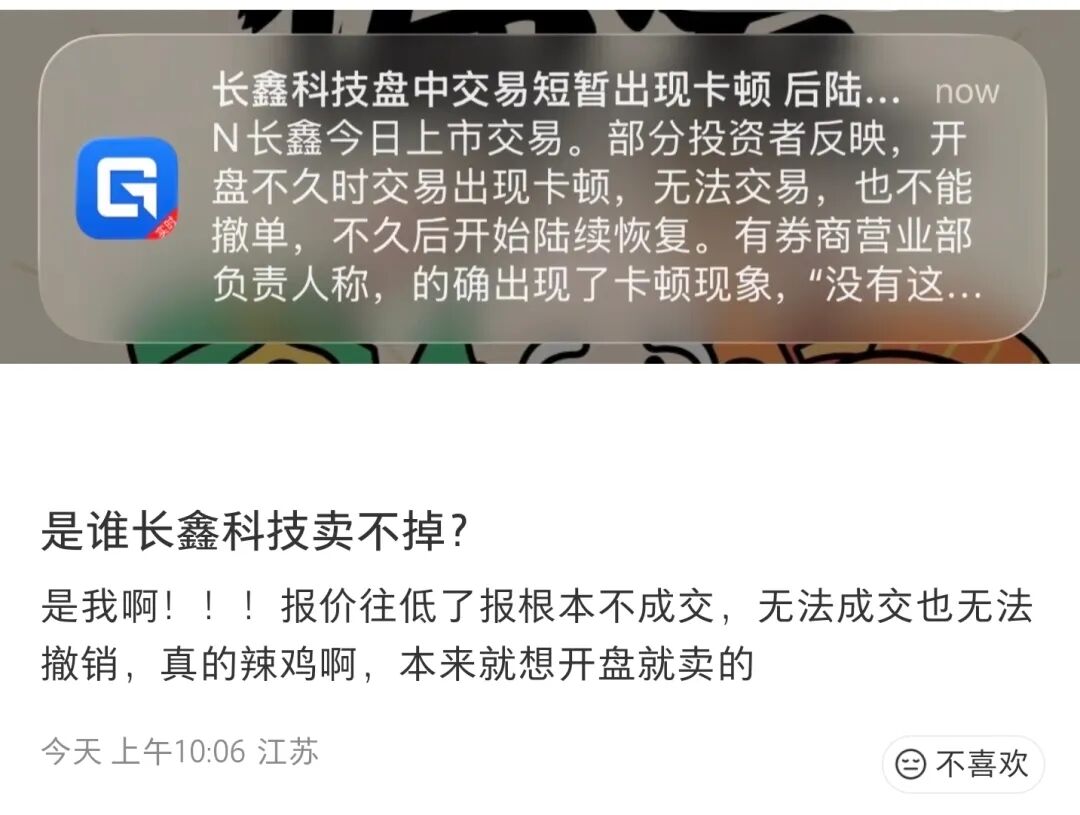
Source: Internet
The last time such widespread system lags and failed order cancellations occurred during a new share listing was on October 15, 2020, when A-share food giant Jinlongyu landed on the ChiNext board. As the new share with the largest fundraising scale in ChiNext history at that time, its price surged 90.51% at opening. The concentrated influx of capital into the Shenzhen Stock Exchange channels in the morning triggered a system-wide order jam across all brokerage platforms.
Source: Internet
Many investors who held the new shares sold their positions after the brokerage trading systems returned to normal, but soon felt regretful when Changxin Technology's share price hit a new intraday high just before the morning trading session closed.
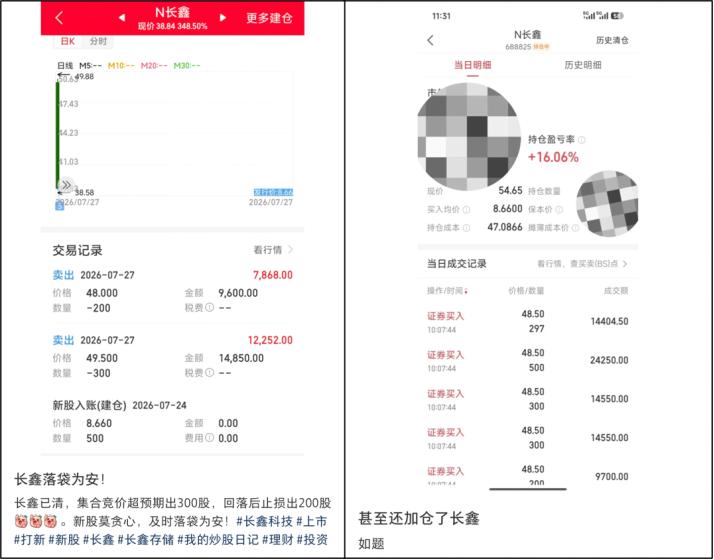
The chart shows investors' buying and selling activities. Source: Internet
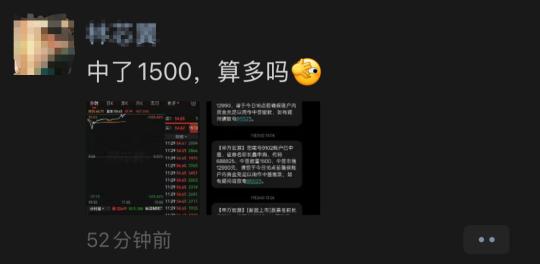
Many conservative investors who won the new shares chose to sell all their positions on the first day to lock in profits and avoid betting on future price volatility. On the contrary, some investors who are optimistic about the long-term value of the company not only did not sell a single share, but also added more positions when the stock price pulled back during the trading session, betting on the long-term growth potential of Changxin Technology as a leading domestic storage chip enterprise.
Source: Internet
Benefiting from Changxin Technology's high new share winning rate of 0.4714%, the coverage of this new share subscription lottery has been greatly expanded. It is common to see investors around us showing off their positions on social media moments, sharing the joy of making huge profits on the first trading day.
Regardless of whether they sold at the intraday highest point, for investors holding the shares, the first-day market performance of Changxin Technology is undoubtedly a real profit feast.
02 Will Changxin Technology's stock trend become the next PetroChina?
Amid the wealth-building carnival, many investors have begun to worry about short-term speculative bubbles and the risk of the industry cycle peaking.
The scenario of a 3-trillion-yuan market capitalization at opening, widespread public enthusiasm, and a super IPO reminds many veteran investors of PetroChina, which went public in 2007.
Because people have found that the data of the two companies are highly similar in several aspects.
First, their fundraising scales are almost the same: PetroChina raised 66.8 billion yuan through its A-share issuance in 2007; Changxin Technology raised 66.607 billion yuan after fully exercising its greenshoe option. Both are mega-IPOs on the A-share market, triggering market concerns about capital diversion.
Second, the frenzied sentiment in the secondary market on their respective first trading days also reminds people of PetroChina's debut.
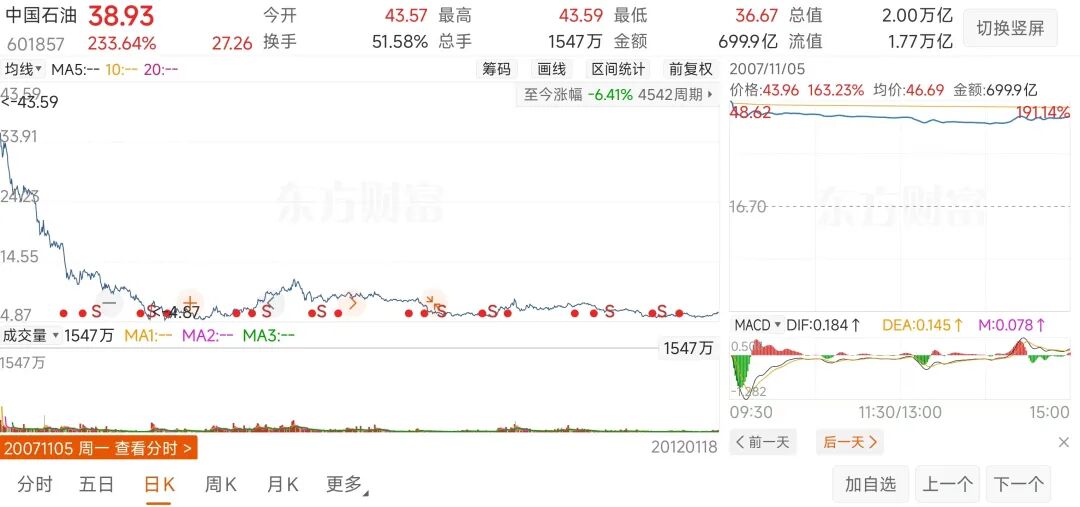
The chart shows the stock trend of PetroChina after its 2007 listing. Source: Internet
At that time, PetroChina's issue price was 16.7 yuan. Its share price quickly rose to 48.6 yuan after opening, representing a 191% increase. Its total market capitalization briefly exceeded 8 trillion yuan that day, making it the world's largest company by market value. As for Changxin Technology, its issue price is 8.66 yuan. Its share price opened at 49.5 yuan today, up 471.59%, and with a market capitalization of 3.2 trillion yuan, it instantly overtook the Industrial and Commercial Bank of China to become the top-valued stock on the A-share market.
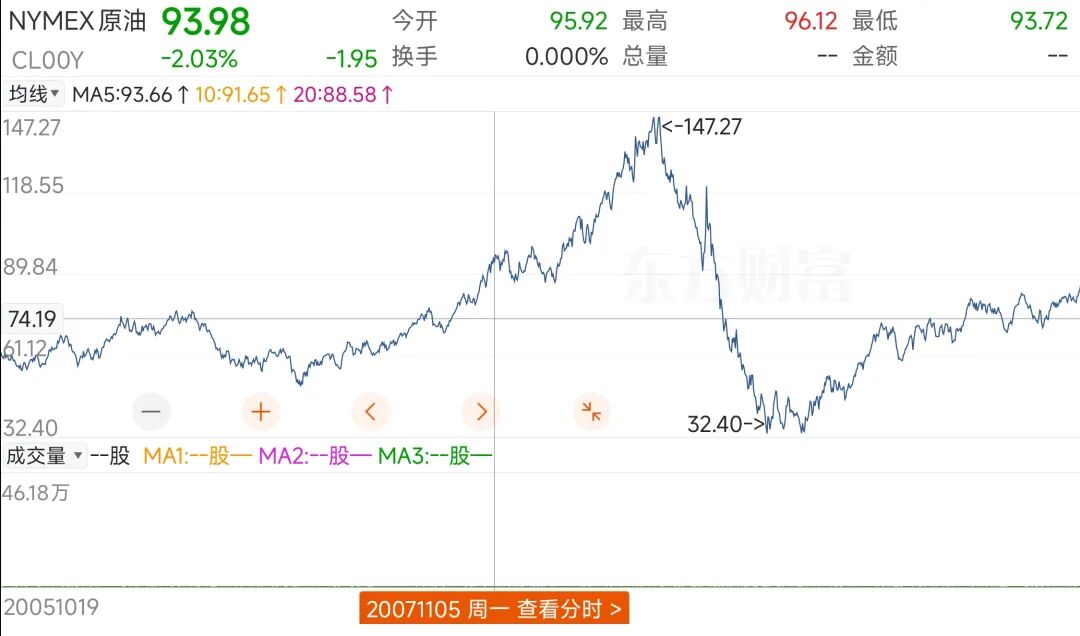
The chart shows international oil prices in 2007. Source: Internet
Finally, both companies went public during a prosperous industry cycle. When PetroChina was listed, international oil prices were at a historical high, with crude oil priced at around 90 US dollars per barrel, and the market was universally optimistic about the long-term dividends of the energy industry. Changxin Technology's listing also coincided with a cycle of skyrocketing storage chip prices. Its net profit for the first half of 2026 is expected to surge more than 22 times year-on-year. Therefore, the market is worried that we are currently at the peak of the storage cycle, and the share price will weaken once the cycle ends.
However, based on comprehensive brokerage research reports and analysts' views, simply equating Changxin Technology with PetroChina only sees the superficial commonalities such as "mega-IPO, listing at the cycle peak, and widespread public speculation", while ignoring the core differences in growth tracks, domestic substitution, and performance growth rates.
Analyst Wang Fang from Zhongtai Securities believes that this major storage price increase cycle started in the second quarter of 2025, and the price increase ranges in the fourth quarter of 2025 and the first quarter of 2026 have continuously exceeded expectations. It is expected that the supply and demand of DRAM will remain tight in 2026, and prices are likely to continue rising.
In terms of performance growth potential, Huaxi Securities believes that as high-generation products such as DDR5 continue to see increasing sales, product structures are continuously optimized, and scale effects are gradually released, the company's future performance growth space is expected to further expand. It has also given a profit forecast for Changxin Technology: the company's operating income is expected to reach 2,776.90 / 3,917.94 / 5,726.94 billion yuan respectively from 2026 to 2028, and its net profit attributable to shareholders is expected to reach 1,244.05 / 1,821.17 / 2,906.02 billion yuan respectively.
In terms of comparable reference targets, the stock trend of leading semiconductor stocks on the A-share Sci-Tech Innovation Board after their listing may be a more appropriate reference for Changxin Technology's share price.
The domestic chip independent controllable sector has long enjoyed valuation premiums. For example, Semiconductor Manufacturing International Corporation (SMIC), the leading wafer manufacturing enterprise, as the only domestic wafer foundry platform at that time, saw its share price rise rapidly and then pull back in the short term after listing, but it has maintained a high valuation for a long time driven by the domestic substitution logic. Its 2026 consensus expected PE ratio is around 150 times.
Some institutions that are extremely optimistic about the long-term dividends of the industry have given a highly imaginative valuation ceiling for Changxin Technology.
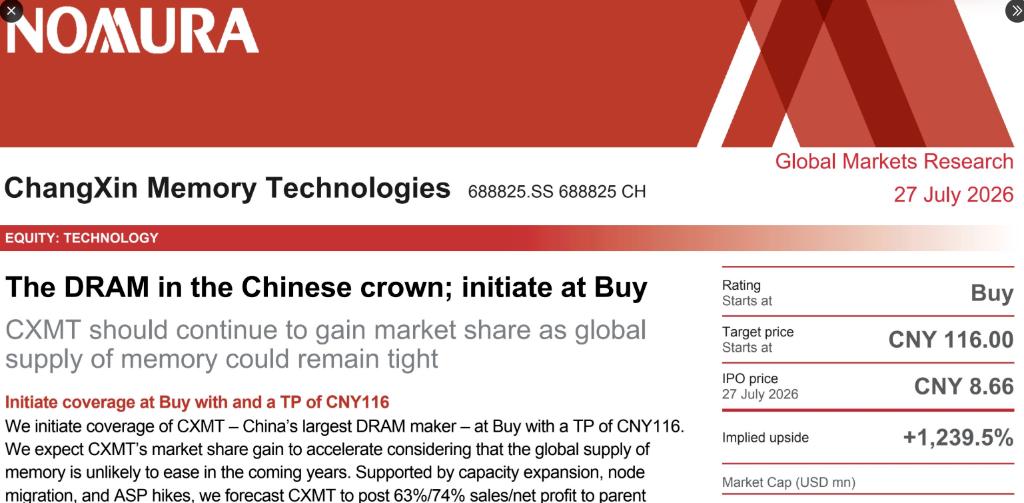
The chart is from Nomura Securities' research report. Source: Internet
Nomura Securities directly gave a "buy" rating and a target price of 116 yuan, corresponding to a market capitalization of 7.76 trillion yuan, representing an upside of more than 12 times compared with the issue price.
Nomura Securities judges that the explosion of AI computing power has led to exponential growth in DRAM demand. Major overseas storage manufacturers have shifted their production to HBM, which has compressed the supply of general-purpose memory, resulting in a persistently tight supply-demand pattern in the industry. Changxin Technology currently only holds an 8% global market share, leaving sufficient room for domestic substitution growth. In addition, the expansion of its mature process production capacity is not restricted by EUV lithography machines. Once its HBM technology is successfully launched, the company will open up a brand new growth curve. Therefore, the valuation is based on a 20 times expected PE ratio for 2028.
From the perspective of historical cycles, the storage industry has natural cyclical fluctuations of 3 to 4 years. However, Guojin Securities pointed out that the start of every major storage cycle (such as 2008 and 2016) is driven by emerging technologies that promote product upgrades and innovations, which in turn boost the total volume, penetration rate, and value of memory products, pushing the overall memory market size to a higher level. With the AI-driven increase in demand, we are now at the starting point of a new major storage cycle, and we are optimistic about the long-term and substantial boost to storage demand brought by the implementation of AI models and applications.
For ordinary investors, the key is to continuously pay attention to the development stage of the storage cycle and breakthroughs in high-end storage technologies such as HBM.
This article is from the WeChat public account "Phoenix Finance", authored by Corporate Research Institute, and published with authorization from 36Kr.