Changxin has earned its seat at the table, but it is not yet time for China's domestic memory industry to celebrate victory.
The offering price was 8.66 yuan, and the stock closed at 49 yuan on its first trading day, marking a surge of 465.82%.
On the day Changxin Technology debuted on the STAR Market, its total market capitalization reached approximately 3.3 trillion yuan, temporarily surpassing the Industrial and Commercial Bank of China to become the most valuable listed company on the A-share market. Its trading volume for the day hit roughly 1411 billion yuan, setting a new single-day transaction record for a single A-share stock.
The capital market had pushed sentiment to a peak. On social platforms, phrases like "the rise of domestic memory", "China's Samsung" and "DRAM has finally stood up" became buzzwords.
Yet questions soon followed: Is a memory company that has just achieved scaled catch-up really worth 3.3 trillion yuan? Does Changxin's listing mean that domestic memory has already broken through the global competition barrier?
To judge a memory company's position, stock price only offers a fleeting snapshot. Generation of products, manufacturing yield, unit cost, customer certification and cyclic profitability are the long-term metrics that define this competition.
Changxin has secured its ticket to the global DRAM table. There are still several tough battles to fight before any victory celebration.
This entry ticket did not come easily for Changxin
China is one of the world's largest electronics manufacturing bases, but it has long lacked its own large-scale DRAM manufacturers.
DRAM is what we commonly refer to as running memory. It determines how many apps a phone can run simultaneously, how smoothly a computer processes large files, and whether servers can quickly feed data to CPUs and GPUs. For years, this market has been dominated by Samsung, SK Hynix and Micron, which together hold over 90% of the global market share.
Changxin has ended China's long absence from this sector.
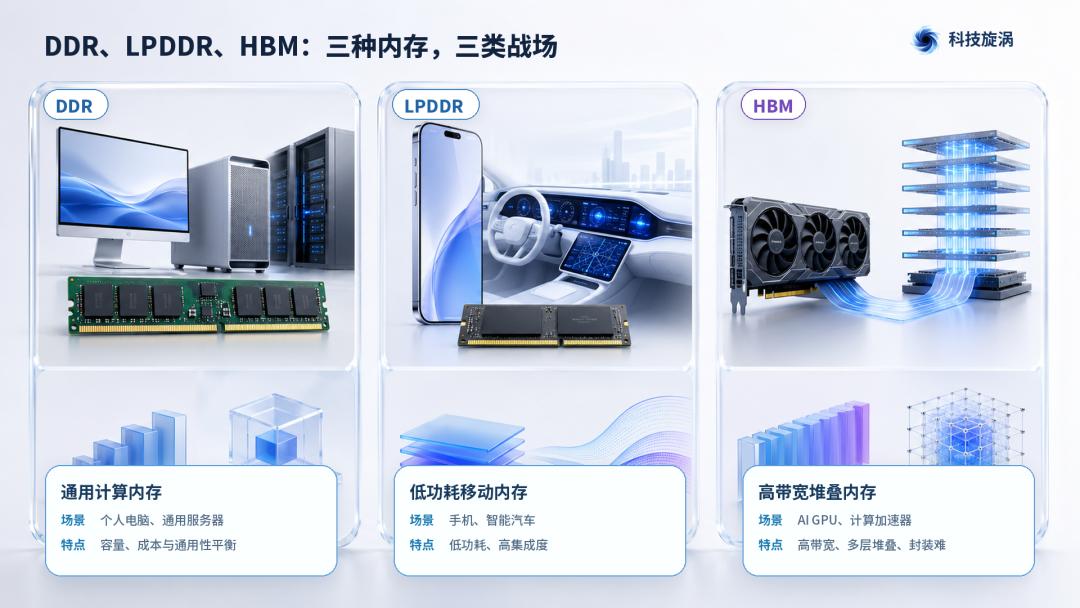
In 2019, Changxin launched its self-designed and manufactured 8Gb DDR4 product, marking a major breakthrough in large-scale DRAM mass production in mainland China. Since then, the company has continued to iterate its products and processes, with its product line now covering DDR4, DDR5, LPDDR4X and LPDDR5/5X.
Currently, the maximum speed of Changxin's DDR5 chips reaches 8000Mbps, with capacities covering 16Gb and 24Gb; its LPDDR5X maximum speed hits 10667Mbps. Its products have entered the server, personal computer, mobile phone, smart vehicle and other markets.
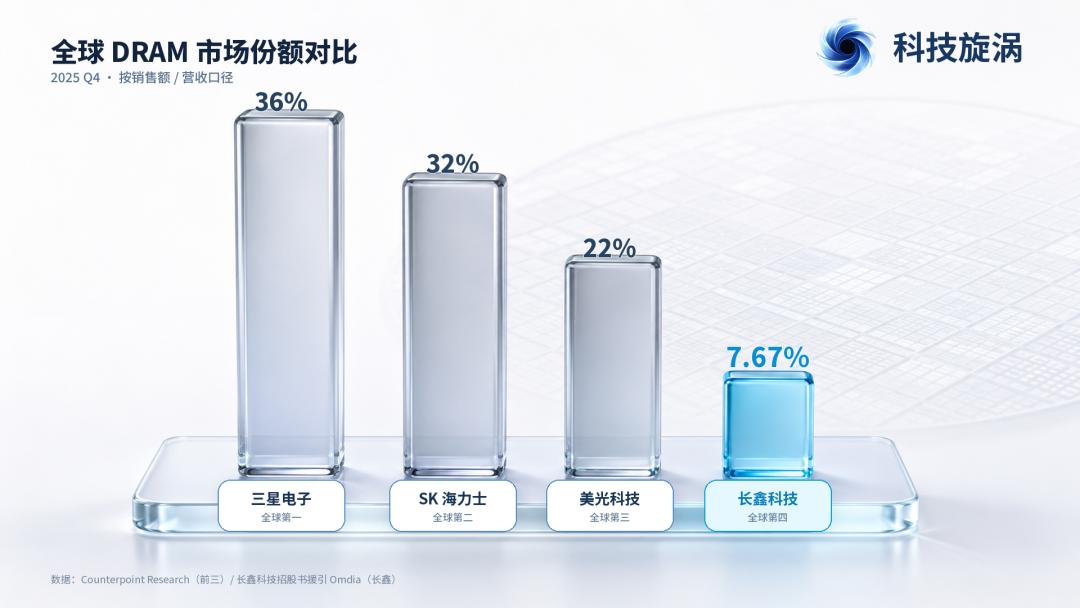
By the end of 2025, Changxin operated three 12-inch DRAM wafer fabs in Hefei and Beijing. Calculated based on its sales in the fourth quarter of 2025, its global DRAM market share reached 7.67%, ranking fourth worldwide.
The company's operational scale has also expanded rapidly. In 2025, its revenue hit 61.799 billion yuan, up 155.6% year-over-year; its annual R&D investment reached 9.593 billion yuan, with more than 6,200 R&D employees.
These figures show that Changxin has moved past the lab and small-scale validation stage. It boasts a complete product line, manufacturing capabilities, customer ecosystem and continuous R&D investment, and the global memory industry now recognizes it as a legitimate competitor.
The value of being the "world's fourth" lies in the fact that China finally has a DRAM enterprise whose production capacity and market share are seriously counted by global peers.
3.3 Trillion Yuan: Pricing for Today or the Future?
While Changxin's industrial status deserves recognition, its first-day market capitalization needs to be viewed from a different perspective.
According to its listing prospectus, Changxin's total share capital after issuance is approximately 66.881 billion shares, with roughly 4.503 billion unrestricted tradable shares at the early stage of listing, accounting for 6.73% of total share capital.
The first-day market price was formed by less than 7% of the tradable shares, multiplied by all outstanding shares to reach the 3.3 trillion yuan total market capitalization. Limited tradable shares, the scarcity of domestic advanced chips, and the AI-driven memory boom collectively amplified the first-day market rally.
Based on its 2025 net profit attributable to shareholders and post-issuance total share capital, Changxin's offering price of 8.66 yuan already corresponds to a price-to-earnings ratio of 308.92. After the stock closed at 49 yuan, its static valuation jumped by another order of magnitude.
The market is clearly not pricing Changxin based on the current profits of a traditional memory company. Investors are buying into years of future process improvements, capacity expansion, domestic substitution and HBM breakthroughs.
Such expectations are not entirely unfounded. China has a massive market for mobile phones, computers, servers, cloud computing and smart vehicles, and its domestic supply chain is maturing rapidly. As long as Changxin continues to increase its market share, it can deliver considerable growth.
The catch is that memory chips are a classic cyclical industry. When prices rise, production capacity almost directly translates to profits; when supply overflows, product prices can plummet quickly. Changxin was still operating at a loss in 2023 and 2024, and its profit improvement in 2025 came not only from its own growth, but also from the upswing in memory prices and expanding AI demand.
The first-day listing price has already priced in many unfulfilled technological and commercial milestones. Now, Changxin has to deliver on each of them one by one.
How Far Is the Fourth Place From the Top Three?
A 7.67% market share has landed Changxin in the fourth seat. Samsung, SK Hynix and Micron still control over 90% of the market, with decades of continuous investment behind their technology, production capacity, customer base and patent portfolios.
Today, the most profitable battlefield in the memory industry has shifted to HBM.
HBM, or high-bandwidth memory, uses multi-layer stacking to transfer massive volumes of data at higher speeds to GPUs and AI accelerators. A high-performance AI server requires far more memory value than a traditional personal computer or smartphone. AI chipmakers like NVIDIA and AMD have also set extremely high standards for HBM in terms of bandwidth, power consumption, packaging and yield.
SK Hynix, Samsung and Micron have already poured massive capital into HBM3E and HBM4. They are competing for certification from top clients like NVIDIA, and for the highest-value memory orders in AI servers.
Changxin's main products currently on the open market are still dominated by DDR and LPDDR. While DDR5 and LPDDR5X have reached mainstream generations, HBM is still in the stage of continuous R&D and industrialization. International research firm Morningstar believes that China's AI investment will bring strong demand to Changxin, but technological gaps, restrictions on advanced equipment and geopolitical factors may limit its ability to capture significant share in the global AI memory market in the short term.
This creates the most realistic challenge for Changxin: while it is rapidly scaling up in the general-purpose DRAM market, industry leaders have already diverted more resources to HBM and high-end server memory.
A follower has to run faster, because the finish line keeps moving.
Behind Changxin Stands a Group of Industrial Shareholders
The strategic placement list for Changxin's IPO might be more worth examining than the total funds raised.
NIO participated in the strategic placement through its subsidiary NIO Power Technology (Hefei) Co., Ltd., committing to subscribe 158 million yuan with a 18-month lock-up period. Under the strategic cooperation agreement signed by the three parties, NIO will prioritize Changxin as its strategic DRAM partner. The two sides will cooperate on automotive-grade LPDDR4X and LPDDR5X, and set increasing procurement share and building a stable supply relationship as their long-term goals.
The investment amount is not large, but its industrial significance is very tangible.
Smart vehicles are evolving into mobile terminals with multiple computing platforms. Smart cockpits, assisted driving and vehicle body control all require memory, and iterative vehicle models are constantly raising requirements for capacity, bandwidth and reliability.
The certification cycle for automotive-grade chips is lengthy. Once a memory chip passes verification and enters a vehicle model platform, the supply relationship usually remains very stable. NIO can provide Changxin with real vehicle application scenarios, and requirements for power consumption, reliability, durability and long-term supply will directly feed into product iterations. In return, NIO gains a local memory partner that is closer and more responsive, giving it more options during global supply crunches.
Their procurement cooperation still has clear prerequisites. Changxin's products must meet comprehensive requirements for quality, technology, compliance and price competitiveness. Capital ties can boost the willingness to cooperate, but product capabilities determine the final market share.
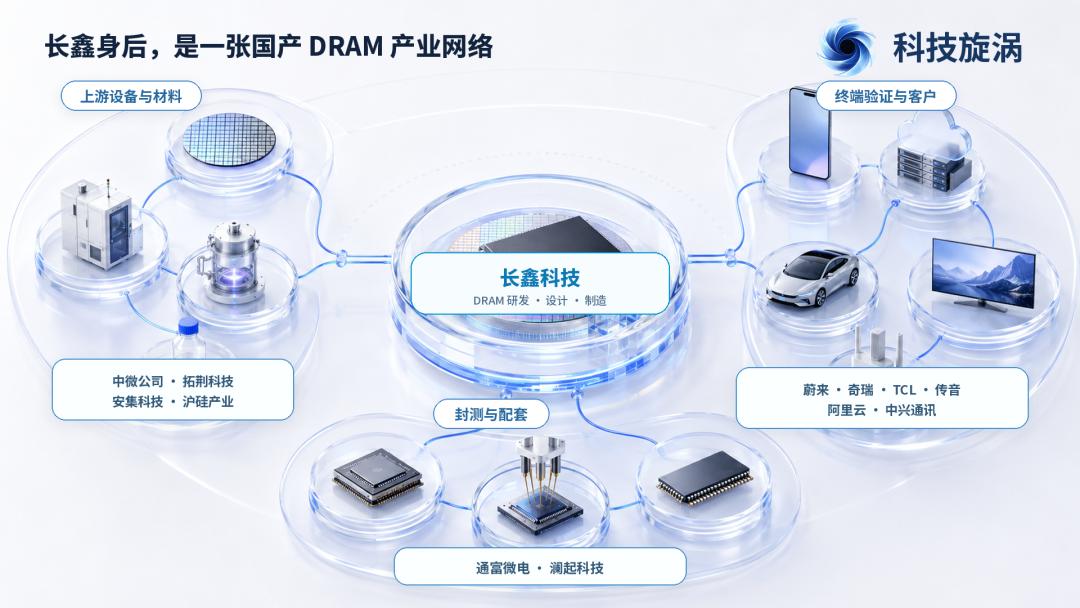
Strategic investors also include downstream companies such as Chery, TCL, Transsion, Alibaba Cloud and ZTE, as well as industry chain partners such as Advanced Micro-Fabrication Equipment Inc. China, Piotech, Anji Microelectronics, Tongfu Microelectronics, Shanghai Simgui Technology and Montage Technology.
This list covers semiconductor equipment, materials, packaging, servers, communications, consumer electronics and smart vehicles. Every critical link a DRAM needs to go through, from equipment validation and wafer manufacturing to entering mobile phones, servers and vehicles, can be found within this network.
For Changxin, this industrial network offers three types of support: upstream enterprises collaborate on process iteration, downstream clients participate in product validation, and the end market absorbs new production capacity. Products are continuously refined in real-world scenarios, and costs are diluted through scaling up — this is a clear path to growth.
China's massive end market is Changxin's most valuable resource as it chases global giants.
After Listing, the Real Exam Gets Harder
Changxin has already proven that China can produce DRAM at scale. Now, the market will judge it by far higher standards.
First comes HBM. Whether the product can complete R&D, sampling, customer certification and stable mass production will determine if Changxin can enter the core AI memory market.
Second is yield and cost. Memory chips are highly standardized. For products of the same generation, the ultimate competition lies in how many qualified chips can be cut from each wafer, and the manufacturing cost per bit. Catching up with peers on specifications is only the first step; large-scale production still has to make economic sense.
Third is cyclical resilience. Changxin needs to survive a full downward cycle in the memory industry, proving that it can still control inventory, cash flow and loss margins when prices drop sharply.
Overseas clients and supply chain security also deserve long-term observation. Geopolitics may restrict Changxin's access to some international markets, and the stable supply of advanced equipment and key materials will continue to affect its subsequent process upgrades.
None of these issues can be solved by a single IPO. Listing brings capital that can build production lines, buy equipment, hire engineers and advance R&D. But whether its products can secure sustained customer purchases will be proven only by time and manufacturing capabilities.
Ten years ago, China's biggest anxiety about DRAM was whether production lines could even run. Today, the questions have become: How much more can yields improve? How much lower can costs go? Can HBM pass customer certification? Can it maintain operational resilience during industry troughs?
The harder questions are a sign that Changxin has reached a higher level.
Changxin is now at the table. The victory toast can wait. First, we will see if it can win round after round in technology, clients and market share at the table hosted by Samsung, SK Hynix and Micron.
This article is from the WeChat public account"Tech Vortex", written by WANG Qinzhou, and published with authorization from 36Kr.