Ban a batch of marketing accounts, and another batch will pop up right away. Are the platforms actually "nurturing" these marketing accounts?
Can you still make money by entering the short video business now?
The overall market size has exceeded 200 billion yuan, with hundreds of billions of yuan in advertising budgets pouring in every year. The track is booming, and the industry is thriving across the board.
However, many original creators share a common confusion: after putting in tremendous effort to polish a piece of content, why does its traffic sometimes fail to match that of mass-produced assembly-line videos?
Driven by this obvious discrepancy, a conjecture has long circulated online.
Perhaps there are certain interest ties between platforms and marketing accounts, leading them to turn a blind eye to boost overall traffic. Is this claim actually true?
Today, we will break down the truth: who is really pulling the strings behind the scenes? And what role do platforms play in this dynamic?

Who Is The Hidden Culprit
The answer may surprise you!
In fact, the real hidden culprit is not an individual or a platform, but malicious marketing accounts.
But before you rush to criticize, there is a misunderstanding that needs to be clarified first.
"Marketing account" itself is a neutral term. An account that produces high-quality content, secures advertisements, and hosts live-stream sales to achieve commercial monetization through excellent content output is a normal and legitimate part of the content ecosystem.

But "malicious marketing accounts" are an entirely different matter.
Rao Lei, the business representative for malicious marketing account governance at Douyin, recently gave a very straightforward definition in a podcast program.
These accounts do not create content sincerely on the platform. Their operations are mass-produced and gang-based, using malicious and non-compliant content as a tool, with the core goal of running a traffic-driven profit business.

So how exactly do these people operate?
First, let's talk about their production methods. They either frequently repost and plagiarize other people's content, or use the same template to mass-produce homogeneous videos. Dozens or even hundreds of accounts form a matrix to distribute content simultaneously.
In the early days, their practices were relatively "simple": they mainly edited, reposted, and stitched together clips from films and TV shows, or took news materials out of context to create derivative content.
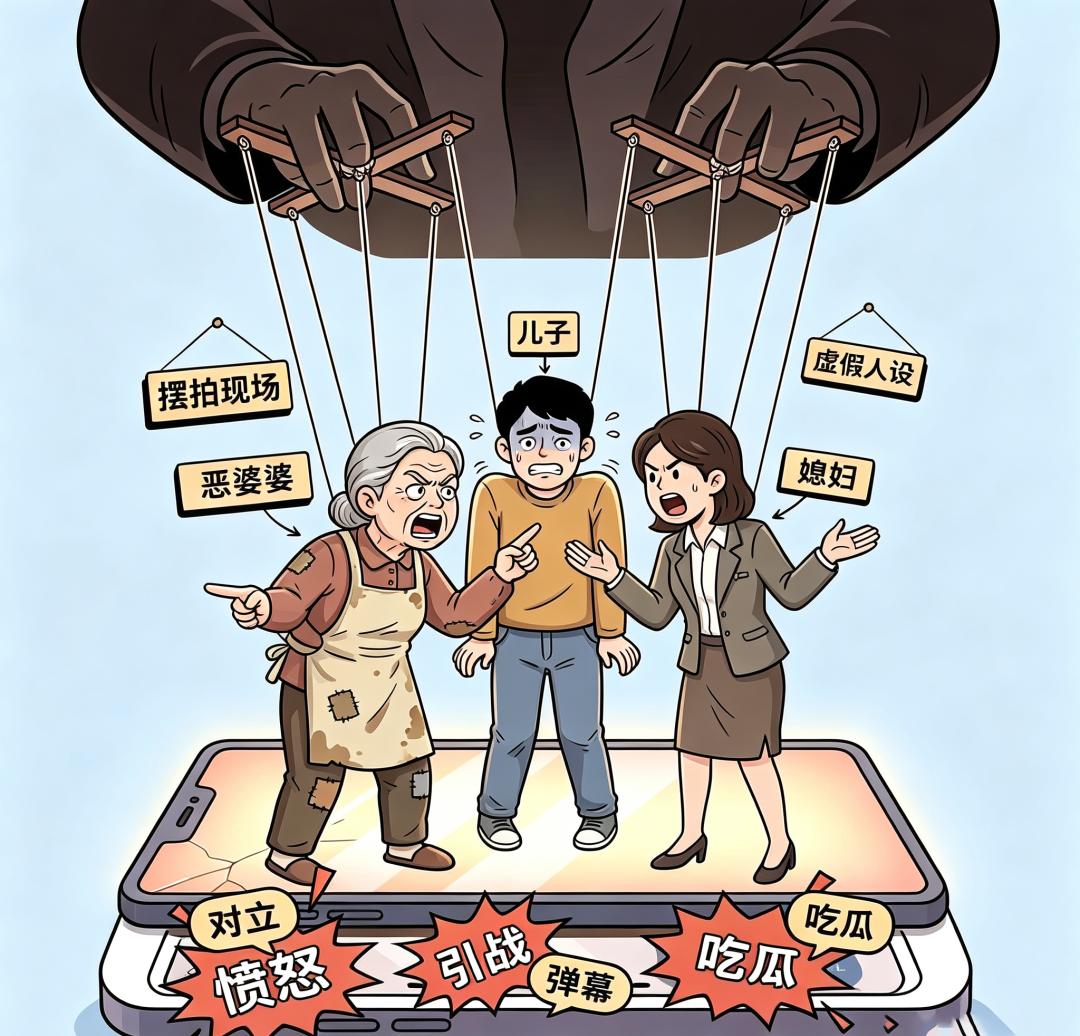
Gradually, they began to chase traffic by creating conflicts, inciting divisions, and exploiting public emotions.
In the past two years, their tactics have continued to evolve, and they have begun to deliberately ride on the coattails of various public social hot topics. For example, when the "Xie Qingshui family reunion" event went viral, they mass-produced fake accounts impersonating the parties involved to gain attention and followers.
Next, let's look at their monetization methods, several of which are particularly common.
The first method is to fabricate false personal personas and use AI to impersonate public figures.
Have you ever scrolled across videos where Olympic champion Quan Hongchan promotes free-range eggs or shampoo?
In fact, all of these videos are AI-generated. Many fans mistook the impersonations for Quan Hongchan herself and placed orders to support her.

Malicious marketing accounts also frequently use AI to clone the voice of Zeng Shiqiang, create templates of "disaster warnings" for each of the 12 zodiac signs, publish them in batches to drive traffic, and sell lucky charm products.
With current AI technology, marketing accounts only need to write a simple script instruction to automatically generate hundreds of video contents. The entire process, from copywriting, face-swapping to voiceover, is fully automated.
Public figures are unknowingly used by these accounts as "spokespersons" for low-quality products.

The second method is to act as paid trolls and black public relations operators.
In high-unit-price sectors such as technology, automobiles, and digital products, they specifically take orders to create negative publicity.
Spreading rumors about a new car, fabricating negative information about a brand, or stirring up public sentiment against a product — the price for a single such video ranges from hundreds to tens of thousands of yuan.

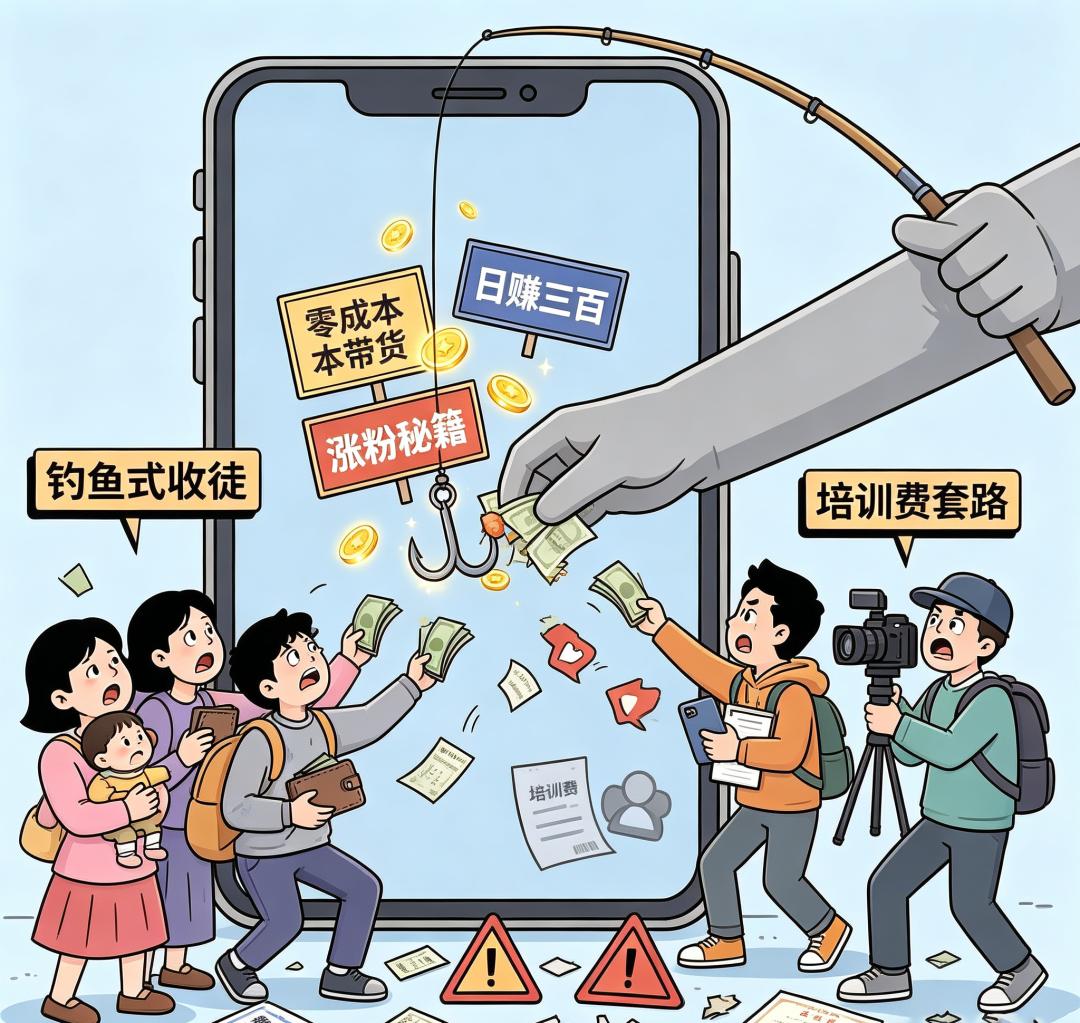
The third method is to profit by exploiting novice users with "get rich quick" scams.
They publish a large number of false "follower growth cheat codes" such as "stay-at-home moms earn five-figure monthly income through live-stream sales" and "ordinary college students make over ten thousand yuan from part-time jobs".
They target stay-at-home moms and college students, using their accounts to post videos on their behalf, or charge training fees to teach them the tricks of mass-producing non-compliant accounts.
On the surface, they claim to help you make money, but in reality, they are the ones making money from you.
In short, these malicious marketing accounts never care about content quality or user experience, and their only goal is to achieve rapid monetization.
Of course, these people do not operate alone: behind them there is often a team or an MCN agency.
They have already formed fixed traffic-harvesting routines, with highly standardized content production and monetization paths, making it no problem to publish hundreds of videos a day.
It is precisely because such accounts keep emerging and flooding the platform that many netizens have raised doubts:
Is it true that platforms allow these gray-area accounts to exist for a long time just to chase traffic?

Are Platforms "Nurturing" Accounts For Traffic?
In fact, the idea that platforms "nurture" marketing accounts for traffic is a huge misunderstanding.
Of course, to prove this point, we cannot just listen to the slogans put forward by platforms, but need to analyze it from multiple dimensions.
First, from the perspective of platform ecology, industrially mass-produced false content and videos that deliberately incite divisions will directly damage users' viewing experience.
In the long run, high-quality creators will face shrinking traffic space, and the original content ecosystem will be destroyed. From the perspective of long-term operation, platforms have no reason whatsoever to support gray-area accounts.

From a commercial logic perspective, the core business models of content platforms are advertising and e-commerce.
Just imagine: in an environment rife with rumors and online violence, which brand would be willing to place advertisements there, and which user would dare to make purchases?
Malicious marketing accounts undermine the platform's most critical assets: user trust and a healthy commercial ecosystem.
This is equally true for all major global platforms.
As Wei Wuhui mentioned in a podcast, a quantitative study on YouTube showed that long-term exposure to homogeneous, low-quality content would significantly reduce the long-term retention rate and activity level of platform users.
To put it bluntly, condoning gray-area accounts essentially drains the long-term commercial vitality of the platform.
This is not a unique challenge for Douyin. As the world's largest video platform, YouTube has long been plagued by malicious marketing accounts. Last year, the platform updated its policy to crack down on "inauthentic content", tightening regulatory rules specifically for mass-produced, repetitive, and low-quality content.

Governance Is Not Slogan, But Action
In fact, Douyin has been continuously taking strong measures against malicious marketing accounts.
In April 2025, Douyin released the "Governance Specification for 'Malicious Marketing Accounts'", clarifying ten types of non-compliant behaviors that are the focus of crackdown.
The platform also launched a dynamic evaluation mechanism called "Account Health Score". The initial score is 100 points, points will be deducted for violations, and scores can be recovered through compliant operations. Accounts with excessively low scores will face tiered penalties ranging from traffic restrictions, speech bans, to permanent account suspension.
In addition, the platform targets illegal activities such as black and gray industry gangs, mass fraud, false traffic diversion, illegal account trading, and large-scale rumor-mongering and smear campaigns, by collecting complete evidence chains and pursuing legal responsibilities.
Previously, a group of accounts used AI to generate false rumors that a certain celebrity was critically ill, and registered more than 300 accounts in batches to spread the rumors simultaneously.
The platform followed the clues and traced the operation back to a black and gray industry company based in Beijing.

Their operation model was divided into three parts: first, dedicated staff tracked hot topics and used AI to mass-produce false content; second, they recruited stay-at-home moms and college students as distributors under the lure of "earning over ten thousand yuan a month through live-stream sales"; third, they charged membership fees and training fees through so-called "tutorials".
In other words, these stay-at-home moms and college students were both tools and victims — they paid the fees but failed to get the promised returns, and the accounts they operated were soon dealt with by the platform.
In the end, the platform brought the gang to court and completely cut off their profit chain.

Over the past year, Douyin has dealt with a total of 3.874 million non-compliant accounts, removed 29.56 million non-compliant short videos, and the proportion of malicious marketing-related non-compliant content has dropped by 41.24%.
To cope with the ever-changing confrontation tactics, the platform has also upgraded its AI recognition capabilities. No longer limited to image and keyword comparison, the AI can capture the unified operation patterns of accounts, long-term inconsistencies in personal personas, and see through all kinds of disguised and hidden traffic-diverting rhetoric.
Therefore, platforms and the malicious marketing black and gray industries are by no means a community of shared interests, but a long-term confrontational game relationship.
Platforms always stand on the side of original creators and ordinary users, and their governance efforts have never ceased.
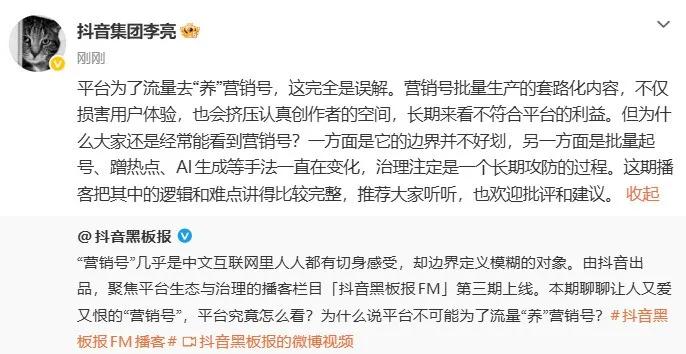
However, as Wei Wuhui said in the podcast, this is an endless cat-and-mouse game. As soon as the platform closes one loophole, marketing