The moment of truth for Baidu AI has come.
A few days ago, Robin Li was spotted in the stands of the North American World Cup final. In the photo, he was watching the match with his wife and entrepreneur friends, looking quite relaxed. The long-time head of this Chinese tech giant had temporarily stepped away from the company's daily affairs.
But Baidu, off the playing field, is far from being as relaxed as Robin Li was a few days ago.
In May of this year, Baidu released its Q1 financial report, which showed total revenue of 32.1 billion yuan, a slight year-on-year decrease of 1.16%. Although slightly better than the market expectation of 31.49 billion yuan, the data of 3.445 billion yuan in net profit attributable to shareholders, down 55.36% year-on-year, still caught the market's attention.
A more detailed breakdown reveals a stark duality in this financial report: on one hand, traditional businesses continue to slow down, with net profit far below previous levels; on the other hand, AI businesses are advancing rapidly, accounting for half of total revenue for the first time.
Counting from 2016, when Robin Li shouted the slogan "All in AI", nearly ten years have passed. AI has finally evolved from a strategic slogan into Baidu's most important tangible source of revenue, which is clearly a highly valuable business transition.
Undoubtedly, Baidu's brand-new AI engine has roared to life. However, whether it can fully offset the downward momentum of traditional businesses and lead Baidu to greater heights remains to be seen. After all, in this field, Baidu's competitors are genuinely strong.
The Baton Pass
Going back to 2024, Baidu's core new AI business generated 27 billion yuan in full-year revenue.
Just one year later, this figure reached 40 billion yuan, representing a year-on-year growth rate of 48%.
The changes extend beyond total volume, and the structural picture is even clearer: in Q4 2025, AI business revenue accounted for only 43% of Baidu's general business revenue, but by Q1 2026, that figure had jumped to 52%.
A 9-percentage-point increase in a single quarter is a rare growth pace among internet giants. Behind this is the collective strength of Baidu's full-stack AI layout, with every product line contributing to growth.
The fastest-growing segment is smart cloud. In Q1 2026, Baidu AI Cloud's revenue reached 8.8 billion yuan, up 79% year-on-year, with GPU cloud revenue surging by 184% year-on-year.
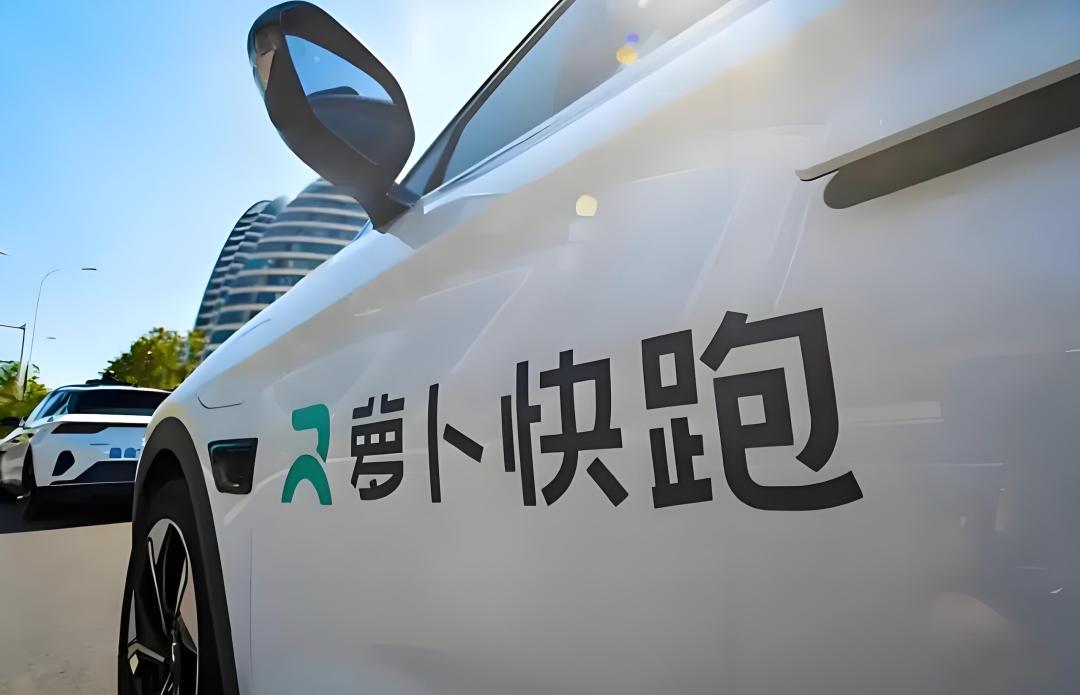
These figures intuitively reflect the explosion in enterprise-side computing power demand. Leveraging its full-stack capabilities combining Kunlunxin chips, PaddlePaddle framework, and ERNIE large models, Baidu Cloud has secured a significant share in this wave of demand.
AI-native marketing services are another bright spot, generating 2.3 billion yuan in revenue for the quarter, up 36% year-on-year.
In the autonomous driving sector, Apollo Go is also steadily advancing commercialization. It provided 3.2 million fully driverless mobility services in the quarter, with total orders up more than 120% year-on-year, and the peak weekly orders in March exceeded 350,000. As of April this year, cumulative service orders have surpassed 22 million, with operations covering 27 cities globally, including major domestic cities as well as Dubai, Seoul, and other locations.
Robin Li revealed that Apollo Go has achieved single-vehicle break-even in its largest operational city in China, which means the commercialization model for autonomous driving has started to prove viable.
Among all AI assets, what most captures the market's attention is the expected IPO of Kunlunxin.
On May 7 this year, Kunlunxin officially launched its listing counseling for the Sci-Tech Innovation Board. Prior to that, in January, Kunlunxin had submitted a confidential listing application to the Hong Kong Stock Exchange, forming a dual-track "A+H" listing structure.
The market has high valuation expectations for Kunlunxin. According to multiple media reports, Kunlunxin's Hong Kong IPO has a target valuation of about $50 billion, creating a phenomenon where the subsidiary is valued far higher than Baidu Group's own market capitalization.
However, it should be noted that all the impressive growth is built on massive investments. Baidu's cost of sales in Q1 reached 19.6 billion yuan, up 12% year-on-year, mainly due to increased costs related to smart cloud. When comparing gross margins, AI businesses are far less profitable than traditional search advertising.
This is determined by the industry's inherent rules in the AI sector, and it is also the core reason why Baidu's net profit has declined sharply even as AI revenue accounts for more than half of total revenue. The profitability of new businesses can only be achieved through large-scale capital expenditures and marketing expenses. This is not just a challenge facing Baidu, but a common issue for all enterprises in the AI field.
Tradition
In stark contrast to the rapid progress of AI businesses is the accelerating contraction of traditional businesses.
In Q1 2026, Baidu's online marketing services revenue was 12.6 billion yuan, down 22% year-on-year, and its share of general business revenue fell below 50% for the first time to 48%.
Looking only at the core traditional advertising from search and information feeds, the decline is even more pronounced: revenue was just 10.2 billion yuan, down 29% year-on-year.
This is no longer a short-term fluctuation. Starting from Q2 2024, Baidu's online marketing revenue has declined for six consecutive quarters. The cash cow that once sustained the entire company is continuously shrinking.
The reasons for the decline are twofold. First, shifts in traffic distribution have led to the diversion of advertising budgets.
User habits for accessing information have long changed. When looking for travel guides and life tips, users first turn to Xiaohongshu; for product reviews and learning skills, they scroll through Douyin; for instant information and official account articles, WeChat Search can meet their needs. These scenario-based information platforms are nibbling away at the territory of traditional search engines piece by piece.
StatCounter data shows that Baidu held over 70% of China's search market share from 2017 to 2022. Its share has declined significantly since 2023, dropping to 44.64% by April this year, representing a reduction of more than one-third in three years.
The outcome of users voting with their feet is directly reflected in monthly active user data. Baidu App's monthly active users have fallen from a peak of 708 million in Q3 2025 to 655 million in March 2026.
QuestMobile data shows that as of June 2025, Baidu's media status index in China's internet advertising market has dropped to 9th place, behind Douyin, Taobao, WeChat, Kuaishou, Xiaohongshu, Jinri Toutiao, Weibo, and JD.com.
If the diversion from short-video and content platforms is a gradual erosion, the impact of AI on native search is more direct, striking at the very core of Baidu's business.
The explosive rise of DeepSeek was a landmark event. For the first time, it made a large number of ordinary users realize that "finding answers" can completely bypass search engines—by asking a direct question, AI can provide the answer.
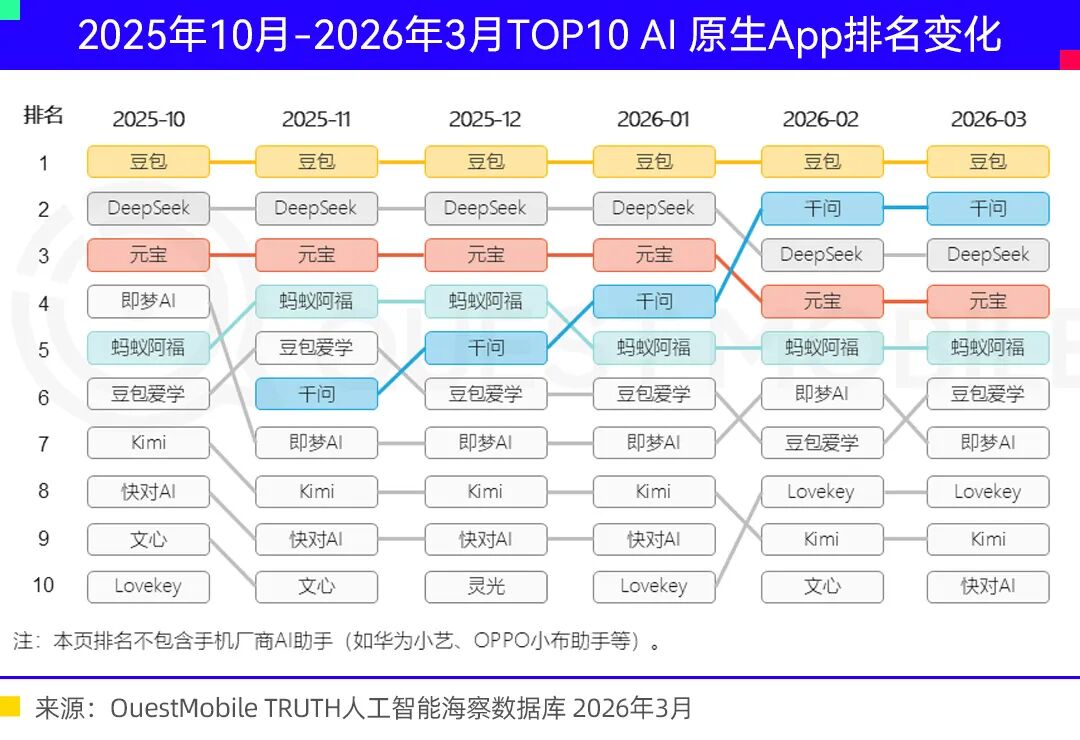
With the proliferation of large models like Doubao, Kimi, and Tongyi Qianwen, the frequency of traditional "search" behavior is decreasing, while question-based "new-style search" is becoming increasingly popular.
Baidu's commercial foundation—paid search ranking—is facing profound challenges. Robin Li chose to proactively embrace change by embedding AI into search, which amounts to self-innovation. But from an operational perspective, the more complete and direct the AI-generated answers are, the fewer opportunities users will have to scroll further and click on ad links.
This is a dilemma: without AI search, users will be snatched by competitors; with AI search, Baidu's own advertising revenue will be eroded.
Even with the correct macro strategic direction, Baidu still needs to resolve many detailed issues to smoothly navigate this painful period of transition between old and new growth drivers.
Growing Pains
So far, the incremental revenue from Baidu's AI business has not yet filled the gap left by the decline in traditional advertising.
What will happen in the future? Baidu has both advantages and disadvantages.
The advantage is that Baidu can be said to be one of the internet enterprises in China that got involved in AI the earliest and made the largest investments. Robin Li himself is also one of the first people in China to access AI knowledge.

In 1990, while studying in the Department of Information Management at Peking University, Robin Li took an artificial intelligence course. Later, he unearthed his old class notes, on the title page of which were the characters for "Artificial Intelligence" and the lecture records of "Expert Systems and Knowledge Engineering", testifying to this early learning experience.
During his subsequent pursuit of a master's degree in computer science in the United States, Robin Li took more AI-related courses, and during his internship at the Panasonic Information Technology Research Institute, he designed an OCR recognition algorithm, whose relevant research results were later published in the academic journal PAMI.
Back in 2016, Robin Li said that Baidu would completely transform into an AI company. Among all the internet giants, Baidu was the first to shout the slogan "All in AI".
Nearly ten years since then, Baidu has built a complete closed-loop AI technology system: at the bottom layer is the self-developed Kunlunxin AI chip, above that is the PaddlePaddle deep learning framework, then the ERNIE large model, and at the top layer are various applications such as smart cloud, autonomous driving, search, and Baidu Wenku.
It covers the entire chain from hardware to software, from basic technology to scenario implementation.
Continuous investment has yielded technological accumulation. Over the past ten years, Baidu's total R&D investment has exceeded 180 billion yuan, holding 27,000 global AI patents, ranking first in China for AI patents for seven consecutive years, and in the leading position in subfields such as deep learning and large models.
These are Baidu's confidence in developing AI, and also the returns from its long-term strategic persistence. However, technological accumulation does not equal commercial success, and the challenges ahead for Baidu remain real.
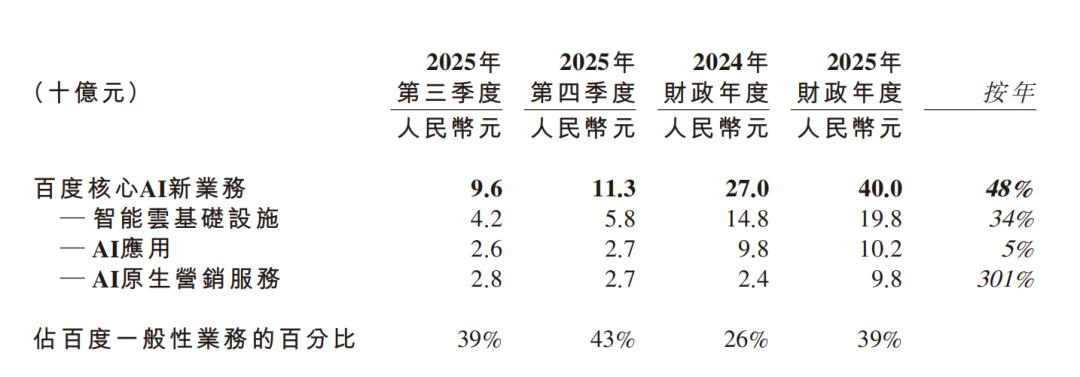
Looking at the revenue structure, out of the 40 billion yuan in AI revenue in 2025, smart cloud infrastructure contributed 19.8 billion yuan, accounting for almost half. This business has a large scale, low gross margin, and fierce competition. Alibaba Cloud, Tencent Cloud, and Huawei Cloud are all engaged in price wars, with computing power rental prices dropping repeatedly. Although Baidu Cloud is growing rapidly, its profit margin is limited, and there is a gap compared to the profitability of search advertising in the past.
AI-native marketing services contributed 9.8 billion yuan in 2025, up 301% year-on-year, but this is mostly a transition from the advertising business, and the growth is far from enough to offset the decline of traditional advertising. The growth rate slowed to 36% in Q1 2026, and whether it can maintain rapid growth remains to be verified.
Another focus is the performance of C-end AI applications. Baidu is one of the first manufacturers in China to launch large model products, with ERNIE Bot officially released in March 2023, more than half a year earlier than most competitors. It had a clear head start, but the actual performance falls short of expectations.
QuestMobile's Q1 2026 data shows that the ERNIE App ranks outside the top 10 among AI-native applications, far behind DeepSeek, Doubao, and Alibaba's Qwen in the same period.
In fact, since generative AI exploded in 2023, applications like DeepSeek, Doubao, and Kimi have all had phenomenal performances, while ERNIE has remained relatively lackluster, with limited driving effect on Baidu's overall brand image.
Nowadays, the Matthew Effect is emerging in C-end AI applications, with leading products occupying the vast majority of users. Whether ERNIE, which is lagging behind, has the potential to break through, requires Baidu to deliver practical results as soon as possible.
Final Thoughts
Not long ago, Robin Li published an article in *People's Daily* stating: "AI cannot just 'top the rankings' in laboratories; it must 'work' in factory workshops."
In a sense, this statement can also be regarded as a form of self-reminder for Baidu.
Back then, Robin Li's determination to shift Baidu's gears with AI was immense, and the current achievements are sufficient to confirm the success of this major transformation. However, the reality is far more complex than when Baidu was pushing forward on its own.
The next few quarters will be a critical window to test the quality of Baidu's gear shift. The market needs to confirm the real driving force of the AI business as the new engine, to witness the birth of a "new Baidu".
This article is from the WeChat Official Account "Giant Tide WAVE", author: Lao Yuer, editor: YANG Xuran, published with authorization from 36Kr.